-01%201.svg)
Key takeaways
- Manual GSTR-2B reconciliation drains 3 to 5 days each month for mid to large volumes, smart tools compress this to hours while protecting every rupee of eligible ITC.
- Automation that blends exact and fuzzy matching, real time GST portal sync, and configurable exception handling is the difference between chaos and control.
- Prioritize seamless integrations with accounting systems, clean data foundations, and vendor collaboration to unlock 85 to 95 percent auto match rates.
- Measure outcomes, not features: reduced reconciliation time, higher ITC realization, lower audit risk, and clear audit trails should be your scorecard.
- Choose a platform that scales across entities and periods, supports role based workflows, and provides analytics for ITC optimization and vendor performance.
- Plan change management early, train by role, document SOPs, and pilot before you roll out, this ensures sustained adoption and consistent compliance.
- Advanced capabilities like intelligent exception workflows, ITC forecasting, and predictive vendor follow ups are now practical, and they directly improve cash flow.
Understanding GSTR-2B Reconciliation Challenges
The Real Cost of Manual GSTR-2B Matching
For most companies processing more than 500 invoices in a month, manual reconciliation consumes 3 to 5 days of productive time. That time is not just clicking and comparing, it is cost in missed ITC, compliance exposure, and team burnout. When a vendor uploads an invoice with a slightly different GSTIN or invoice number, manual checks either miss it, or require hours of detective work. Multiply that by hundreds of line items, and you see why many finance teams rank GSTR-2B reconciliation as their number one GST challenge.
Manual matching is not just slow, it is fragile. One inconsistent invoice number, one date variance, one amount tolerance break, and the wheels come off.
Common Pain Points Finance Teams Face
- Volume overwhelm during peak periods, overtime rises, accuracy drops, and deadlines become stressful sprints.
- Data format chaos across Tally, JSON downloads, PDFs, and vendor spreadsheets, before matching starts, data wrangling soaks hours.
- Mismatch investigations that span GSTIN, invoice number, date, taxable value, and tax amounts, each exception needs documentation and a decision trail.
- Vendor coordination without workflows turns into an email spreadsheet maze, follow ups get lost, audit trails vanish.
Key Features of Modern GSTR-2B Reconciliation Software
Automated Matching Algorithms
Contemporary tools compare purchase registers with GSTR-2B using multi field logic, matching GSTIN, invoice number, date, and values together, not line by line. Fuzzy matching recognizes small variations, for example INV-1234 versus INV1234, date tolerance, and abbreviations, while respecting your thresholds. Advanced engines learn from your past actions, improving the probability of correct matches for recurring vendors, amended invoices, and consolidated vendor uploads.
Real time GSTR-2B Data Sync
API connections remove JSON downloads and uploads. Continuous sync means reconciliation can run throughout the month, not just at close. When vendors upload late or amend invoices, change tracking highlights the delta so nothing slips through. Fewer surprises, fewer last minute escalations.
Exception Management Workflows
Not every record will align, which is why well designed exception workflows are critical. Amount differences inside tolerance can auto approve, missing vendor invoices trigger follow ups, and GSTIN issues route for review. The best platforms let you configure rules by vendor type, value bands, and tax category, with clear status tags that move exceptions from raised to resolved.
Bulk Operations and Data Processing
At scale, batch operations are a must. Bulk import validates and standardizes diverse formats, surfacing row level errors for quick fixes. With a few actions, you can approve matched batches, exclude categories, or apply ITC decisions to similar transactions. Clicks go down, throughput goes up.
Top GSTR-2B Reconciliation Tools Compared
AI Accountant
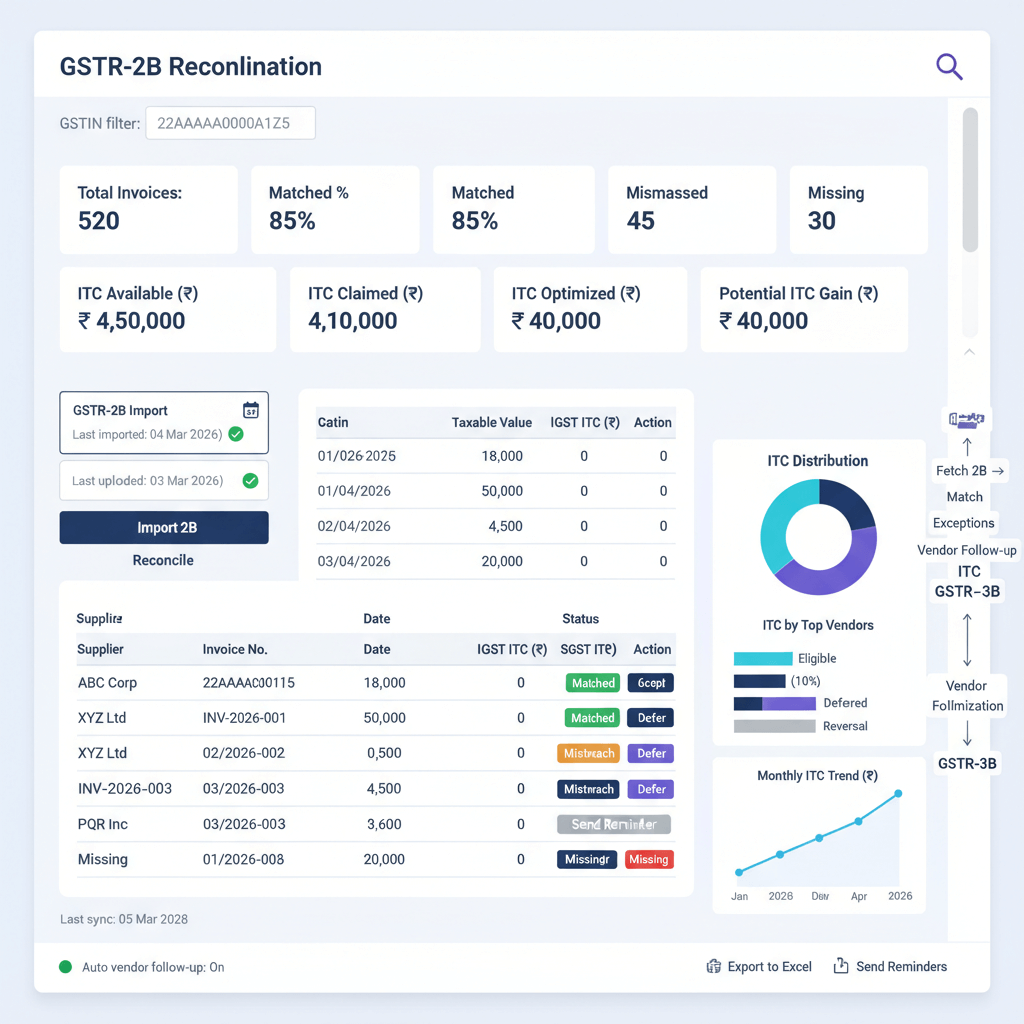
AI Accountant delivers a comprehensive GST reconciliation module, from ingestion to ITC optimization. It ingests purchase registers, journal vouchers, and credit notes, standardizes formats, and learns from prior reconciliation choices to sharpen accuracy. Integrations with Zoho Books and Tally lower effort, data flows in automatically, and multi organization support suits CA firms and multi entity finance teams. Detailed statuses make it simple to monitor matched, pending, and attention required items.
ClearTax GST Software
ClearTax offers strong reconciliation inside a wider GST suite. Its ITC focused features handle tricky cases such as consolidated e way bills, bill of entry for imports, and reverse charge transactions. Enterprises value its depth across return filing, e invoicing, and compliance reporting.
Zoho Books
Zoho Books includes built in reconciliation aligned with accounting flows. It automatically fetches GSTR-2B and compares against recorded purchases in the ledger. For small and medium businesses already on Zoho, this reduces tool sprawl while handling standard scenarios with ease.
TallyPrime
TallyPrime embeds reconciliation in ERP workflows, with high performance for large volumes, drill down reports, and strong audit trails. Organizations with many locations or inter branch transfers benefit from its operational depth.
QuickBooks Online
QuickBooks Online suits straightforward purchase patterns. It provides essential matching, flags evident mismatches, and offers clear reporting. User friendly screens shorten the learning curve for lean teams.
How to Choose the Right GSTR-2B Tool for Your Business
Assessing Your Business Requirements
Start with volume, complexity, and structure. Under 100 invoices a month, basic workflows can work, above 500, automation becomes mandatory, past 1,000 invoices, look for enterprise grade processing and exception queues. Consider vendor behavior, if small vendors upload late or with errors, robust follow up and exception handling become non negotiable. Factor in user skills, approvals, and mobile needs.
Integration with Existing Accounting Systems
Choose tools that play nicely with your books. If you rely on Tally, consult this focused Tally reconciliation guide to understand best practices and integration checkpoints. Beyond transactions, synchronize vendor masters and tax codes, ensure updates reflect both ways, and avoid duplicates. Assess API depth, sync frequency, and data integrity safeguards.
Scalability Considerations
Plan for tomorrow. Check performance under higher volumes, pricing tiers at scale, and support for multiple entities and GSTINs. As teams grow, role based access, audit trails, and collaborative queues become essential. If expansion across states is on the horizon, confirm multi GSTIN capability from day one.
Pricing Models and ROI Calculation
Model total cost beyond subscription, include setup, API charges, extra users, and support. Compare against current cost of time, delayed ITC, penalties, and audits. Many teams find that a monthly fee that saves double digit person days pays back immediately. Pilots and monthly billing help de risk adoption and build stakeholder trust.
Implementation Best Practices
Data Preparation and Cleanup
Clean inputs drive high match rates. Standardize vendor names, verify GSTIN formats, remove duplicates, and align invoice numbering rules. Review your purchase register for mandatory fields and correct tax calculations. Establish data standards for future entries, then run a baseline manual cycle to quantify current match rate and exception patterns. This becomes your benchmark.
Team Training Requirements
Train power users first, then tailor sessions by role, uploader, investigator, approver, auditor. Document SOPs with steps, screenshots, and escalation paths. Plan refreshers each quarter, and track tool updates so new features do not sit idle.
Setting Up Reconciliation Workflows
Design your flow on paper before configuration. Define tolerances by category and value, rules for auto exclusion, and the approach for recurring transactions. Build clear exception paths for missing invoices, GSTIN errors, and value variances, including who follows up with vendors and what evidence is required. Calibrate approval layers for risk, for example small differences auto approve, medium differences manager review, large differences finance head sign off.
Measuring Success Metrics
Track reconciliation time, auto match rate, and ITC optimization. Measure time saved across processing, investigation, vendor follow up, and reporting. Monitor auto match improvement over successive months. Quantify financial impact via higher ITC realized, fewer penalties, and reduced audit queries. Share a simple dashboard with leadership to sustain momentum.
Advanced Features to Look For
ITC Optimization Capabilities
Leading tools go beyond matching to guide ITC strategy. They understand blocked credits under Section 17(5), calculate proportionate ITC for mixed supplies, and monitor ITC reversal requirements. Recommendation engines can spotlight vendors who frequently cause ITC loss, suggest process fixes, and forecast ITC based on vendor upload patterns for better cash planning.
Vendor Communication Tools
Automation should extend to vendor engagement. Auto reminders for missing uploads, configurable templates, and a vendor portal for self service updates reduce email clutter and protect audit trails. Vendor scorecards make performance visible, timeliness, accuracy, and reconciliation success rates improve with transparency.
Audit Trail and Compliance Reporting
Every action must be traceable, data uploads, rules applied, approvals, and reversals. Exportable reconciliation reports with drill downs support audits, including mismatch listings, ITC summaries, and vendor wise status. Some platforms generate compliance attestations that save days during reviews.
Dashboard and Analytics Features
Real time views of match percentage, exception queues, and ITC at risk keep the team aligned. Drill downs by vendor and aging of exceptions spotlight bottlenecks. Predictive analytics estimate end of month outcomes and likely late vendor uploads, enabling proactive follow up.
Common Pitfalls to Avoid
Over relying on Automation
Automation accelerates outcomes, but human oversight protects accuracy. Periodic sample checks catch edge cases and pattern errors, then you can refine rules. Stay current on GST updates, tools evolve, but your governance remains the safety net.
Ignoring Data Quality Issues
No engine can fully overcome poor source data. Fix root causes in vendor onboarding and AP entry, enforce validation for GSTIN formats and mandatory fields, and run periodic master data cleanups. Prevent errors at entry, do not mop them up at reconciliation.
Inadequate Vendor Management
Your ITC depends on vendor discipline. Educate suppliers on timely uploads and accurate values, share scorecards, and include compliance in procurement decisions. Chronic non compliance is a cost, consider alternatives when it persists.
Underestimating Change Management
Reconciliation transformation is as much about people as platforms. Involve stakeholders early, communicate personal benefits, and pilot with one entity to build proof before scaling. Celebrate quick wins to encourage adoption.
Future of GSTR-2B Reconciliation Technology
AI and Machine Learning Integration
Machine learning learns from your reconciliation history, improving fuzzy matches without manual rule tweaks. Natural language techniques interpret unstructured invoices. Predictive models flag likely late vendors, estimate ITC positions, and highlight audit risk transactions. Routine exception investigation can be automated, with humans focusing on complex cases.
Blockchain and Distributed Ledger Applications
Shared, immutable records can reduce reconciliation to confirmation. Smart contracts could auto claim ITC once conditions are met, while preserving an ironclad audit trail. Hybrid approaches are emerging for high value flows where integrity is paramount.
Real time Reconciliation Possibilities
As e invoicing expands and APIs mature, reconciliation can happen continuously. Issues are resolved as they arise, and ITC optimization becomes a rolling process, improving cash flow. Tighter ties with payment systems could trigger instant checks at the point of settlement.
Conclusion
Pick a reconciliation platform that fits your volume, complexity, and stack, then implement with clean data, clear rules, and trained people. No solution is magic on day one, but the combination of disciplined processes and automation quickly turns month end from a scramble into a routine. The payoff is bigger than time saved, higher ITC realization, lower risk, better cash flow, and a happier finance team. Evaluate carefully, run pilots, and choose a partner that scales with you. With the right approach, GSTR-2B reconciliation becomes a dependable, low friction part of compliance.
FAQ
As a CA managing multiple clients, what is the fastest way to reconcile GSTR-2B across entities without exporting endless spreadsheets?
Adopt a multi entity reconciliation platform that supports centralized logins, role based access, and bulk operations. Tools like AI Accountant allow you to switch organizations, import purchase registers in a single pass, auto fetch GSTR-2B via API, and batch approve matched sets. This removes repeated exports, reduces touch time, and preserves clean audit trails for each client.
How do I push my auto match rate above 90 percent when vendors enter slightly inconsistent invoice numbers and dates?
Combine fuzzy matching with strict tolerance settings. Enable character normalization for invoice numbers, define date windows for expected receipt, and set value tolerances by category. Train the engine by resolving a representative sample, then lock refined rules. AI Accountant, for example, learns from your approvals and denials, which improves future matching without manual tweaks.
What is a practical exception handling framework for amount mismatches and GSTIN errors that auditors will accept?
Create typed queues, amount variance, date variance, GSTIN discrepancy, and missing invoice. For small variances inside threshold, auto approve with an audit note. For GSTIN issues, require vendor confirmation and documentary support. Use a tool that timestamps every action and captures attachments, AI Accountant maintains this trail and produces exportable reports acceptable to audit teams.
Can I reconcile continuously during the month, and does it really reduce month end pressure?
Yes, continuous reconciliation with API based GSTR-2B sync spreads workload, surfaces vendor delays earlier, and shortens the final close. You will resolve exceptions in smaller batches, vendor reminders go out sooner, and ITC forecasting is more accurate. Teams using AI Accountant typically shift to weekly micro cycles and report smoother month ends.
How should I calculate ROI for a GSTR-2B tool for a client with 1,200 monthly invoices and three GSTINs?
Add the current person hours for data prep, matching, investigation, vendor follow up, and reporting, then multiply by loaded hourly rates. Add opportunity cost from delayed ITC, any interest, and recent penalties or audit effort. Compare with subscription, setup, and integration costs. Many firms recover subscription costs within the first one or two cycles through time saved and higher ITC realization.
What data hygiene steps should I insist on before onboarding a reconciliation platform?
Standardize vendor masters, verified GSTIN formats, dedupe vendors, enforce invoice numbering rules, and align tax calculation fields in your purchase register. Configure accounting system validations to prevent bad entries going forward. Run a one month baseline reconciliation to identify systemic issues, then start the tool rollout. Clean data is the biggest driver of auto match success.
How do I manage vendors who consistently upload late, causing ITC timing gaps for my clients?
Implement vendor scorecards, share timeliness and accuracy metrics monthly, and automate reminders. Include compliance SLAs in POs, and consider early payment benefits tied to upload discipline. Platforms like AI Accountant can trigger scheduled nudges and track vendor response times, giving you leverage in procurement conversations.
Is it safe to auto approve small variances, or will that create audit exposure?
It is safe if thresholds are documented, consistently applied, and supported by evidence. Set category wise tolerances, maintain an approval matrix, and keep a clear audit log. Good tools stamp user, time, rule applied, and rationale. During audits, provide a policy note and system exports to demonstrate control and consistency.
How do I reconcile import transactions, bill of entry references, and reverse charge cases with GSTR-2B?
Use a platform that supports specialized match keys beyond standard invoice fields. Map bill of entry numbers, ports, and dates, then define match logic for reverse charge entries. AI Accountant and similar tools allow custom fields and conditional rules, ensuring these complex flows match correctly and remain audit ready.
We run Tally in multiple branches, how do we avoid duplicate entries and mismatches during sync?
Standardize masters across branches, use unique document numbering sequences, and ensure two way sync respects updates and cancels. Configure the reconciliation tool to dedupe on a composite key, for example GSTIN plus invoice number plus date plus value. Follow a branch wise import cadence and reconcile discrepancies weekly to keep the dataset clean.
What governance should I put in place for approvals so my CFO has comfort on ITC decisions?
Define a tiered approval matrix, for example matches inside one percent auto approve, one to five percent require manager review, above five percent require finance head sign off. Require notes and attachments for overrides. Provide the CFO a dashboard for period wise ITC taken, exceptions pending, and reversals, AI Accountant surfaces these metrics for oversight without micromanagement.
Can an AI driven tool really forecast ITC for cash planning, or is that just marketing?
Forecasts are practical when the system learns vendor behavior and upload timing, then applies it to open POs and recorded purchases. With pattern data, the tool estimates likely additions to GSTR-2B before close, highlights ITC at risk, and projects end of month ITC. AI Accountant provides such projections, which help treasury plan working capital more precisely.

Rohan Sinha is a fintech and growth leader building aiaccountant.com, focused on simplifying accounting and compliance for Indian businesses through automation. An IIT BHU alumnus, he brings hands-on experience across 0 to 1 product building, growth, and strategy in B2B SaaS and fintech.