-01%201.svg)

Key takeaways
- Missing advance tax installments triggers automatic interest at 12% annually, even if you pay your full tax by March 31, driven by Section 234B and Section 234C
- GST input credits expire permanently after November 30 for the previous financial year, per Section 16(4) of the CGST Act, no extensions, no appeals
- Delayed payments to MSME vendors now trigger disallowance of expense deductions under Section 43B(h), sharply increasing tax outgo
- TDS deposit delays attract monthly interest, filing delays add per-day late fees, and incorrect statements risk penalties under Sections 201(1A), 234E, and 271H
- Virtual Accounting by AI Accountant prevents these violations through automated tracking, proactive alerts, and CA-led oversight
Why well-run SMEs still get blindsided by tax rules
You're building a business, managing teams, winning customers, and then a notice lands on your desk, you have violated a tax rule you did not even know existed. It is not evasion, it is the dozens of timing rules, definitions, and thresholds that quietly turn oversights into interest at 12 to 18 percent annually. Research shows Indian SMEs spend over 240 hours annually on tax compliance, yet deadlines still slip, credits expire, and penalties pile up.
Below are the 13 rules Indian SMEs most often break without realizing, followed by practical fixes and automation ideas to stay clean, confident, and audit-ready.
13 rules Indian SMEs break without realizing
1) Advance tax installments, Section 234B interest
If your annual tax exceeds ₹10,000, you must pay advance tax in four tranches, 15 percent by June 15, 45 percent by September 15, 75 percent by December 15, and 100 percent by March 15. Miss them, and Section 234B charges 1 percent per month until settlement, effectively 12 percent per year, regardless of intent.
2) Quarterly deferment interest under Section 234C
Even if you clear the year’s tax by March, Section 234C adds 1 percent per month on quarterly shortfalls, stacking fast if June and September are missed.
3) GST input credit cutoff, Section 16(4)
Input tax credit for a financial year must be claimed by November 30 of the following year per Section 16(4), credits vanish permanently after this date, even if the vendor filed late.
4) MSME payments beyond 45 or 15 days, Section 43B(h)
Expenses payable to MSME-registered suppliers are disallowed if unpaid beyond 45 days, or 15 days where contracts specify, as mandated by Section 43B(h). Disallowance increases taxable income immediately.
5) TDS deposit delays, Section 201(1A)
Depositing TDS even one day late triggers monthly interest under Section 201(1A), calculated from date of deduction until payment.
6) TDS statement late fee, Section 234E
File TDS returns late and Section 234E adds ₹200 per day, capped at TDS amount, small delays still sting.
7) TDS on purchase of goods, Section 194Q
Cross ₹50 lakh annual purchases from one vendor, you must deduct 0.1 percent under Section 194Q on the excess, buyer’s responsibility.
8) TCS on sale of goods, Section 206C(1H)
Sellers with receipts exceeding ₹50 lakh per buyer must collect 0.1 percent TCS under Section 206C(1H), exceptions apply but tracking is vital.
9) TDS on benefits or perquisites, Section 194R
Gifts, incentives, free samples, sponsorships, and similar benefits above ₹20,000 attract 10 percent TDS under Section 194R, even if non-cash.
10) Higher TDS for non-filers, Section 206AB
Payments to specified persons, chronic non-filers, need TDS at twice the rate or 5 percent, whichever higher, as per Section 206AB, vendor status checks are mandatory.
11) Depreciation 180-day rule, Section 32
Assets used under 180 days in the year of purchase get only half the normal depreciation under Section 32, timing matters for tax efficiency.
12) Bad debt write-off timing, Section 36(1)(vii)
Deduction is allowed in the year you write off in books as per Section 36(1)(vii), you need not prove irrecoverability if conditions are met.
13) GST e-invoicing threshold, plus annual LUT renewal
Once you cross ₹5 crore aggregate turnover, you must generate IRN for B2B documents from the next year, and exporters must renew LUT by April 30 each year, both per evolving GST rules documented in recent circulars and notifications.
The hidden cost of advance tax ignorance
If your total tax is above ₹10,000, advance tax is unavoidable, 15 percent by June 15, 45 percent by September 15, 75 percent by December 15, 100 percent by March 15. Miss or underpay, and Section 234B charges 1 percent monthly until you settle, and Section 234C adds 1 percent on each deferred quarter. A consultancy with ₹5 lakh tax liability that skips all tranches can see roughly ₹50,000 in interest, about 10 percent of tax, purely for timing.
What triggers advance tax earlier than you expect
All income streams count, business profits, interest, rent, and capital gains. Sole proprietors and consultants often cross the threshold quicker than they think, especially when salary plus consulting overlap.
Warning: Advance tax interest applies even when TDS or refunds are due, the department computes interest first, then adjusts credits.
The GST input credit time bomb
Per Section 16(4), claim ITC by November 30 of the following year or lose it, permanently. Invoices discovered during audit, late vendor uploads, or revised documents after cutoff do not help, lakhs vanish for growing traders and manufacturers who reconcile late.
How to avoid ITC expiry with disciplined reconciliation
Adopt monthly GSTR-2B matching, flag missing invoices by the 10th of the next month, create a vendor scorecard for late uploaders, and run a three-stage sweep, July to September for prior year stragglers, October for the final sweep, November 1 to 20 as last-chance claims.
- April to June, reconcile current year purchases, low risk
- July to September, chase prior year invoices, medium risk
- October, final prior year sweep, high risk
- November 1 to 20, last window to claim, critical
- After November 30, ITC lost, no recourse
Section 43B(h), the MSME payment trap
From AY 2024-25, delayed payments to MSME-registered suppliers get disallowed under Section 43B(h). A ₹10 lakh invoice paid beyond 45 days can increase your tax by ₹3 lakh at the highest slab, a cash flow tactic becomes a tax penalty.
Who qualifies as MSME and what proof matters
Verify MSME classification during vendor onboarding, keep Udyam registration and payment proof within 45 days, or 15 days if agreed. Build an MSME vendor master, age payables, and prioritize high-risk invoices at 30 days.
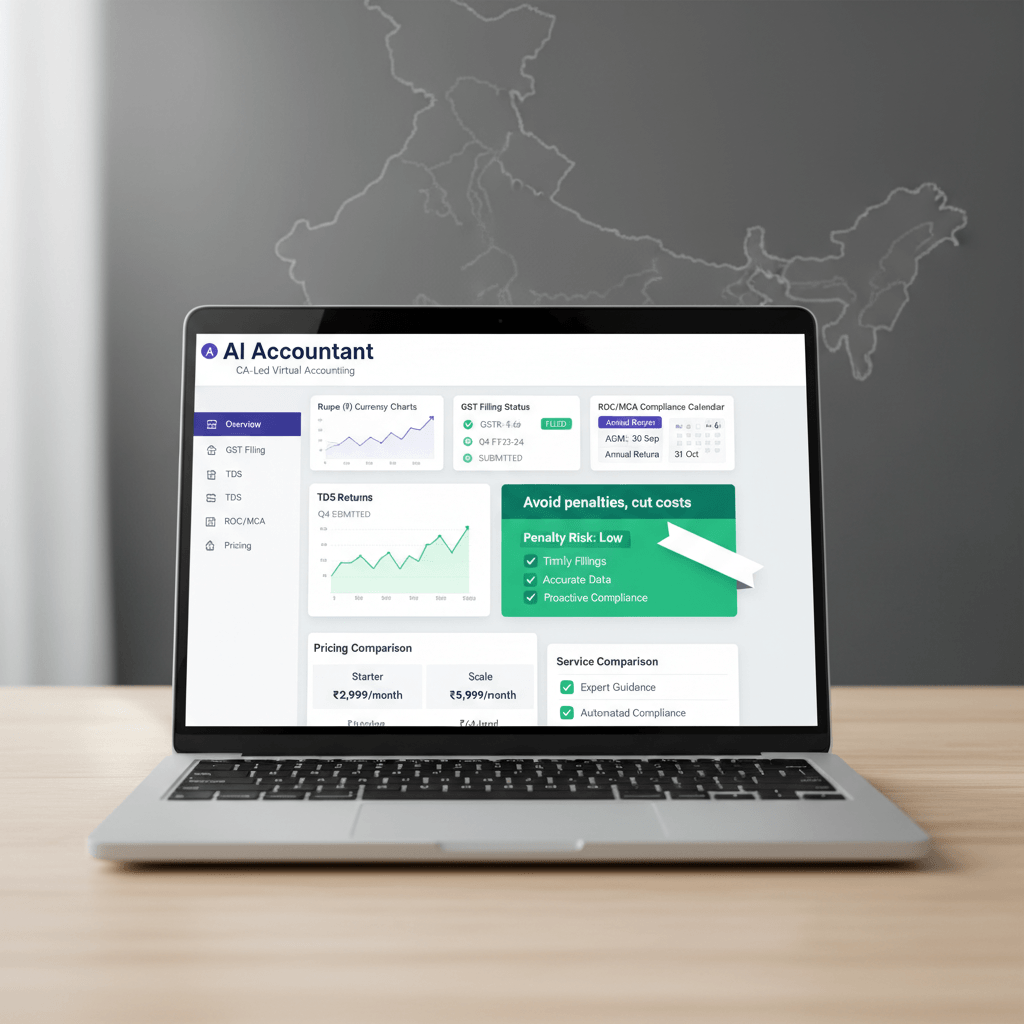
Automation tip: Virtual Accounting by AI Accountant auto-tags MSME vendors, issues 30-day alerts, and maintains audit-ready evidence for each transaction. Want a quick peek, watch this short video.
The TDS and TCS maze, interest, fees, and penalties
Deposit TDS late and Section 201(1A) levies 1 percent per month initially, then 1.5 percent monthly, file returns late and Section 234E adds ₹200 per day. Add newer rules, Section 194Q at 0.1 percent on purchases above ₹50 lakh, Section 194R at 10 percent on benefits above ₹20,000, and Section 206C(1H) at 0.1 percent on sales above ₹50 lakh. Each has separate thresholds and calendars.
Double rates for non-filers, the 206AB sting
For vendors flagged as specified persons under Section 206AB, deduct twice the rate or 5 percent, whichever higher. Always verify vendor status before high-value payouts, errors make you liable for shortfall plus interest.
Penalty alert: Incorrect statements can trigger fines under Section 271H. With TDS complexities rising, proactive checks beat post-facto firefighting.
Tax benefits you miss while paying penalties
While interest and fees stack up, many SMEs skip legitimate deductions, losing money twice. Section 36(1)(vii) allows bad debt write-offs when recorded in books, and Section 32 provides generous depreciation, but the 180-day rule halves your first-year claim if you buy too late.
Bad debts, claim on write-off, not on hope
Write off once you conclude recovery is unlikely, ensure income was earlier booked, keep follow-up evidence, deduction is allowed in the year of write-off. Waiting years burns cash, a ₹20 lakh stuck receivable can save ₹6 lakh in tax when written off correctly.
Depreciation, small assets and timing
- Computers and software, 40 percent, small items under ₹10,000 can be fully expensed
- Plant and machinery, 15 percent, additional 20 percent for new manufacturing equipment
- Furniture, 10 percent, segregate low-value items to accelerate deductions
- Vehicles, 15 percent, higher for EVs as notified
Plan big-ticket purchases before early October to pass the 180-day threshold and secure full-year rates.
The presumptive taxation sweet spot most SMEs miss
Sections 44AD and 44ADA can slash compliance and taxes, up to ₹3 crore turnover qualifies for 6 percent deemed profit if 95 percent of receipts are digital, professionals get ₹75 lakh with 50 percent deemed profit. One wrong move, accepting too much cash or opting out without modeling five-year consequences, can lock you into audit and higher costs.
Virtual Accounting by AI Accountant tracks your digital receipts, flags threshold breaches before they happen, and coaches you on structuring payments to preserve eligibility.
E-invoicing and LUT, two quiet killers of working capital
Once you cross ₹5 crore aggregate turnover, e-invoicing becomes mandatory from the next financial year, IRN and QR codes must appear on B2B invoices, real-time or near-real-time generation is essential to avoid buyer ITC problems. Exporters also need annual LUT renewal by April 30, miss it and you pay IGST upfront, with refunds blocking cash for months.
Operational guardrails that work
- Start e-invoice onboarding 90 days before applicability, test integrations, train teams
- Submit LUT by April 15 to buffer portal glitches and re-submissions
- Track common LUT rejection reasons, bank detail mismatches, signatory errors, missing prior export proofs
The real cost, 240+ hours that should grow your business
SMEs spend 240+ hours a year on compliance, time not spent on sales or product. Typical breakdown looks like this, GST returns and reconciliation, 8 to 10 hours per month, TDS compliance, 6 to 8 hours per quarter, advance tax, 4 to 5 hours per quarter, ITR and audit, 40 to 50 hours annually, plus ad-hoc notice responses. At ₹500 per hour implied founder value, those hours cost ₹1.2 lakh before penalties and lost credits.
Founder’s shortcut: Instead of juggling portals and spreadsheets, use Virtual Accounting by AI Accountant for automated calendars, real-time reconciliation, and CA-led reviews, it is peace of mind that usually costs less than one missed deadline.
Conclusion
India’s tax system penalizes oversight more than intent, advance tax installments slip, GST credits expire on November 30, MSME payments overshoot 45 days, and TDS obligations multiply. The fix is not working longer nights, it is a system of controls, reconciliations, and reminders that never sleeps. Virtual Accounting by AI Accountant gives you that system, a dedicated CA team plus automation that prevents losses before they happen, so compliance stops being a gamble and becomes a quiet, reliable process you barely notice.
FAQs
I missed the TDS deposit by one day, what exactly is my damage and can it be waived?
Interest at 1 percent per month under Section 201(1A) applies from deduction date to deposit date, waivers are not provided. If the return is also late, Section 234E adds ₹200 per day, capped at TDS. Virtual Accounting by AI Accountant prevents this with auto-reminders five days before due dates and same-day payment workflows.
Can I ever claim last year’s GST input credit after November 30?
No, the cutoff in Section 16(4) is final. Late vendor uploads or portal glitches do not restore eligibility. Run monthly GSTR-2B reconciliation and a final October to November sweep to avoid permanent loss.
How do I confirm a supplier’s MSME status for Section 43B(h) so I do not get disallowed?
Collect Udyam Registration and verify on the official portal, then set 40-day internal payment targets to stay within the 45 or 15 day rule in Section 43B(h). Build an MSME vendor master and track due dates. Virtual Accounting by AI Accountant automates tagging and alerting.
My turnover crossed ₹5 crore mid-year, when does e-invoicing start for me?
E-invoicing kicks in from the next financial year once the ₹5 crore aggregate threshold is crossed as captured in recent guidance. Begin integration and training at least 90 days earlier, and generate IRN within 30 days of invoice date, best practice is same day.
Which TDS rate applies if the vendor has not filed returns for two years?
Under Section 206AB, deduct at twice the applicable rate or 5 percent, whichever is higher. Always verify status before paying, otherwise you bear the shortfall plus interest.
Do 194Q and 206C(1H) apply together or does one override the other?
Where both seem to apply, only one operates, if the seller collects TCS under Section 206C(1H), the buyer need not deduct TDS under Section 194Q. Coordinate with counterparties and document who applies which provision.
What exactly counts as a “benefit or perquisite” for 194R and how do I deduct on non-cash gifts?
Per Section 194R, gifts, free samples, incentive trips, vouchers, sponsorship benefits, and hospitality over ₹20,000 in a year attract 10 percent TDS. For non-cash items, deposit TDS from your funds and issue a certificate, or gross-up the value.
How do I write off a partially paid invoice and claim bad debt correctly?
Write off only the unpaid portion in your books and claim under Section 36(1)(vii). Keep the original invoice, payment ledger, follow-up records, and management approval. Courts and CBDT clarifications recognize write-off based on business judgment.
Can I use GST credits or TDS refunds to pay advance tax installments?
No, advance tax must be paid in cash, credits adjust only at return time. This is why founders with large TDS credits still face Section 234B and Section 234C interest. Plan cash flows around installment dates.
Is presumptive taxation always better if I qualify under 44AD or 44ADA?
Not always. If real margins are below 6 percent, if you need big depreciation, have losses to carry forward, or plan funding and valuations, audited books may be better. Also, opting out later triggers a five-year audit lock-in. Model scenarios with your CA or use Virtual Accounting by AI Accountant to simulate five-year outcomes.
How fast must I generate an e-invoice after issuing it, and what if I miss the window?
Best practice is same-day IRN generation, technical guidance allows up to 30 days. Missing timelines risks buyer ITC issues and penalties. You cannot cancel e-invoices after 24 hours, only adjust with credit or debit notes.
Do I need an LUT if I export services via platforms like Upwork or marketplaces?
Yes, all exports of goods or services require an LUT to supply without IGST. File by April 30 each year as per current GST process, otherwise you pay IGST first and wait months for refunds. Virtual Accounting by AI Accountant files and tracks LUT renewals automatically.
What is the 180-day depreciation rule in practice, and how should I plan purchases?
Assets used for less than 180 days in the year of purchase get half the normal rate under Section 32. Plan installations by early October to claim full rates, track “put to use” dates, not just purchase dates.
If I deposit TDS late but file returns on time, do I still pay interest?
Yes, interest under Section 201(1A) runs from deduction to deposit date regardless of filing status, and it cannot be waived. You also remain an assessee in default until paid.
I run a lean startup, should I DIY compliance or outsource to a virtual accounting team?
If your implied hourly rate is high, DIY often costs more in time, missed credits, and penalties. A service like Virtual Accounting by AI Accountant combines automation with a dedicated CA team, monthly GSTR-2B checks, MSME payment alerts, TDS calendar automation, and advance tax planning, usually delivering savings well beyond the fee.

A results-driven finance and sales professional with hands-on experience through finance internships and a fast-paced sales role. With a strong interest in accounting and business finance, Harsh focuses on turning complex topics into clear, practical takeaways for founders and finance teams.