-01%201.svg)
Key takeaways
- Indian SMEs can automate vendor scorecards with existing Tally or Zoho Books data, no major IT build needed.
- Prioritize metrics that reflect Indian compliance, such as GST 2B match rate, e invoice validity, MSME payment cycle, TDS and TCS correctness.
- Start with spend concentration, invoice accuracy, GSTR 2B reconciliation, and payment cycle time, then expand to delivery and quality.
- Automating bank statement linking and GSTR 2B reconciliation delivers the fastest time savings and compliance wins.
- Map PO, GRN, and quality data via simple Excel templates if they are not inside Tally, then compute OTIF and fill rates.
- Use weighted scoring to grade vendors, then make negotiations data driven with transparent A, B, C grades.
- Track MSME exposure proactively with alerts to avoid penalties, learn more under MSME Act compliance.
- Tools like AI Accountant unify Tally or Zoho data, bank statements, and GSTR 2B files to produce live vendor analytics.
Why vendor performance tracking automation India matters now
Most finance teams spend long hours reconciling vendor bills and chasing corrections, which delays closings and creates compliance risk. Invoice inaccuracies, scattered GRN and PO data, and manual MSME exposure tracking turn month end into a slog. Automation connects data sources, validates master data, and calculates repeatable metrics so you can act, not reconcile.
When your metrics are automated and transparent, vendor conversations move from opinions to facts, and improvements follow quickly.
Compliance adds urgency. GSTR 2B matching, e invoice validity, and MSME Act compliance are not optional, and errors cost real money.
Key concepts in the Indian context
Vendor performance tracking automation in India means programmatically scoring delivery, quality, cost, compliance, and service using live data from accounting, banking, GST portals, and operations logs. A supplier scorecard India is a periodic, weighted score built from these signals. Vendor analytics India goes further with always on dashboards for spend, risk, reconciliation health, and payment behavior.
The Indian nuance is crucial. Beyond delivery and quality, measure GST compliance, MSME payment cycles, TDS and TCS correctness, and e invoice validity. Miss these, and the penalties are immediate, not theoretical.
Essential metrics for your supplier scorecard India
Delivery and reliability
- OTIF percentage per vendor, a simple, powerful reliability measure.
- Average delay days, to separate consistently late suppliers from outliers.
- Fill rate, to highlight short shipments that trigger manual follow ups.
Cost and price discipline
- Price variance versus PO or last purchase, to spot quiet rate creep.
- Rate change frequency, a signal of instability or opportunism.
- Discount capture rate, the gap between negotiated and invoiced discounts.
Quality
- Defect rate and returns, the hidden cost driver behind service calls and rework.
- Credit note frequency and value, an early warning for billing or quality issues.
- Replacement turnaround time, the operational impact metric.
Finance and compliance
- Invoice accuracy, with checks on GSTIN, legal name, and address.
- GSTR 2B match status at invoice level, for ITC eligibility assurance.
- E invoice validity, to avoid audit exposure.
- Payment cycle from bill to bank, with MSME alerts at 30 and 45 days.
- TDS and TCS correctness, to prevent notices and rework.
Service and relationship
- Average first response time to queries, fewer follow ups, faster closures.
- SLA adherence across documentation and promised reports.
- Documentation completeness score, fewer cycles of back and forth.
Governance
- KYC completeness across PAN, GSTIN, and registration status.
- Blacklisting flags from industry sources, to prevent fraud exposure.
Mapping your data sources
Tally or Zoho Books
- Purchase registers, credit and debit notes, vendor masters with GSTIN and PAN.
- Payables aging and bill wise details for due dates and payment patterns.
- Extraction via ODBC for Tally or APIs for Zoho Books, scheduled Excel exports if needed.
Bank and card statements
- Payment timestamps for realized cycle time, matched against vendor bills and due dates.
- Include corporate cards, which often sit outside payables tracking.
GSTR 2B files
- Monthly downloads, ideally Excel, to reconcile invoice level ITC.
- Match each vendor bill to 2B entries, then tag matched, mismatched, or missing.
POs, GRNs, and quality logs
- If they live in Excel, standardize templates, capture order date, expected date, ordered and received quantities, receipt dates.
- Maintain simple issue logs for defects and disputes with open and closure dates.
How to rate vendor performance in Tally India
Extract master and transaction data from Tally, then centralize calculations in Excel or a BI tool. Keep the flow simple, repeatable, and auditable.
Compute payment cycles
- Match bill due dates to actual payment dates from bank statements.
- Flag MSME vendors breaching 45 days for immediate resolution.
Invoice accuracy and GST checks
- Cross check GSTIN, legal name, and address between vendor master and bills.
- Reconcile monthly against GSTR 2B, and tag every invoice with status.
Spend and dependency patterns
- Spend per vendor and group level concentration, to surface risk exposure.
- Payables aging trends to identify structural delays.
Incorporate external signals
- Import PO and GRN data for OTIF and fill rates, plus quality and service logs.
Apply scoring weights
Start light, then refine with experience.
| Metric category | Weight | Key calculation |
|---|---|---|
| Delivery | 30% | OTIF percentage |
| Quality | 20% | Defect rate |
| Cost | 20% | Price variance |
| Compliance | 20% | GSTR 2B match rate |
| Service | 10% | Average response time |
Grade monthly, for example A for 90 percent and above, B for 70 to 89 percent, C for below 70 percent.
Automate refresh
- Schedule extractions from Tally, automate Power Query or BI refresh, and publish dashboards.
Where automation delivers outsized wins
High return automations
- Bulk bill ingestion, no manual typing for high volume vendors.
- Bank statement normalization, consistent mapping across banks.
- Master data validation, instant GSTIN and PAN checks.
- Automated GSTR 2B reconciliation, thousands of invoices matched in minutes.
- Payment linking, bills to bank entries without manual effort.
- Recurring metric runs, scorecards and alerts on a fixed cadence.
- Multi entity rollups, a group view of supplier risk and performance.
Common pitfalls
- Dirty vendor masters, duplicates and typos break matching logic.
- Inconsistent narrations and abbreviations, which confuse automated mapping.
- Missing due dates on bills, which blocks MSME tracking.
- Unmarked MSME vendors, which hides compliance exposure.
- Non standard dates and units, which produce unreliable metrics.
Tools to implement vendor performance tracking automation
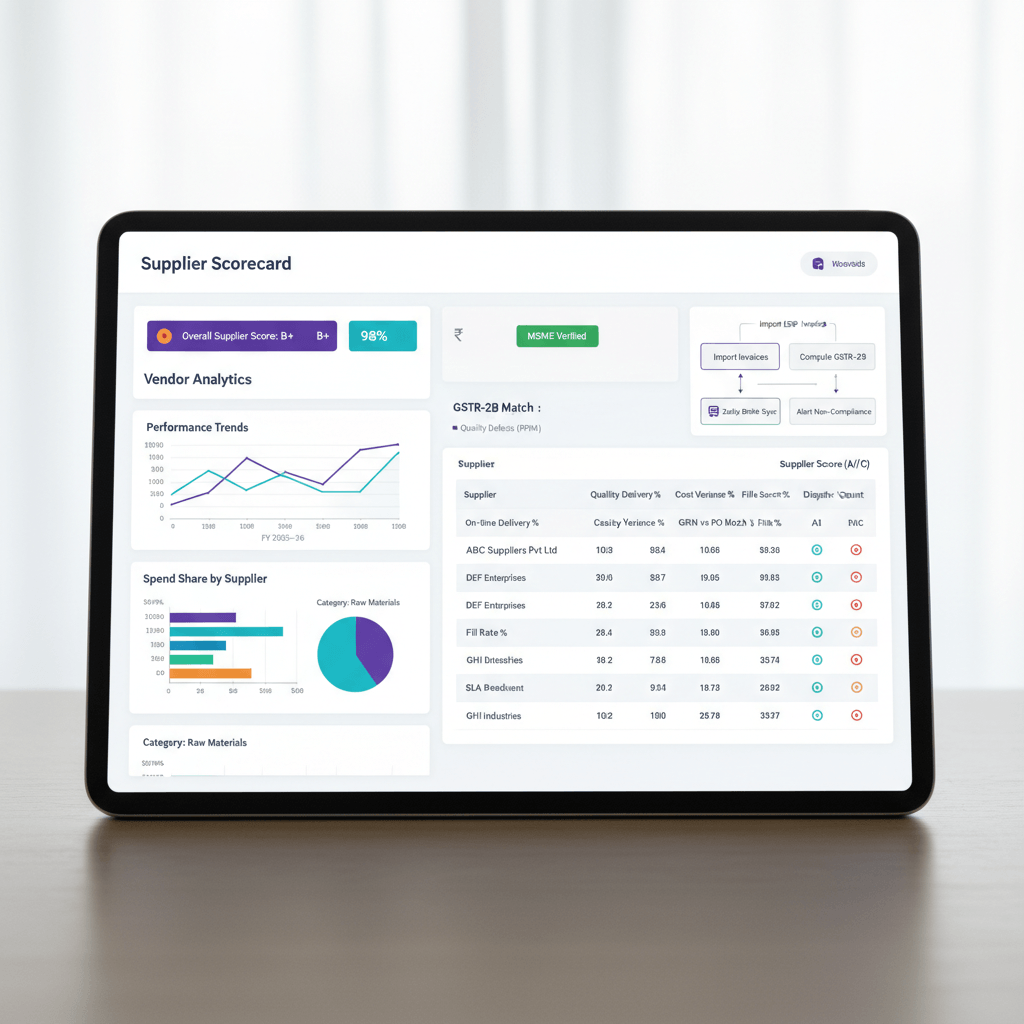
AI Accountant serves Indian SMEs on Tally or Zoho Books exceptionally well. It automates AP extraction, validates GSTIN and PAN, normalizes bank statements for cycle tracking, and reconciles purchases against GSTR 2B. With direct syncs and ready dashboards for vendor analytics, it is aligned to Indian compliance workflows.
QuickBooks and Xero offer supplier tracking, yet GST depth is limited, so 2B matching needs external workflows. FreshBooks suits service businesses with lighter compliance. Zoho Analytics adds strong custom BI inside the Zoho stack. Enterprises may consider SAP Ariba or Oracle Procurement Cloud, which require significant resources.
Building with AI Accountant, a practical walkthrough
Core capabilities
- AP automation that extracts bills in bulk from PDFs and spreadsheets, with master data mismatch flags.
- Bank statement ingestion and mapping, enabling automatic payment cycle computation.
- Auto linking of payments to open bills, and ledger predictions that learn over time.
- GSTR 2B reconciliation at invoice level, with clear status tags.
- Native Tally and Zoho sync for masters and transactions, plus safe write back of cleaned data.
- Dashboards for spend, payments, and vendor metrics, with export for custom scorecards.
- Excel imports for PO, GRN, and quality templates, validated on upload.
- Multi organization visibility from a single login.
Six week implementation rhythm
- Week 1, connect to Tally or Zoho, sync masters and history.
- Week 2, ingest bills in bulk, resolve GSTIN and naming issues.
- Week 3, load GSTR 2B, review reconciliation results.
- Week 4, ingest bank statements, compute cycles and MSME alerts.
- Week 5, import PO, GRN, and quality logs, validate OTIF.
- Week 6, publish the first scorecards and analytics, iterate with feedback.
Data flow
Tally or Zoho Books, bank statements, GSTR 2B, and Excel imports feed into the platform, which cleans, validates, reconciles, and scores, then pushes clean results back to books and dashboards.
Measuring ROI and impact
- Forty to sixty percent reduction in data prep time.
- Month end closing faster by three to five days.
- Payment disputes down by thirty percent or more.
- Improved cash planning from precise payment cycles.
- Near zero MSME penalties via automated alerts.
- Higher ITC capture with tighter 2B matching.
- Stronger negotiations using objective grades and trendlines.
Tool evaluation checklist
Must haves
- Reliable Tally or Zoho sync, verified with test runs.
- Bank statement ingestion across major Indian formats.
- GSTR 2B reconciliation aligned to Indian GST rules.
- Master data validation for GSTIN, PAN, and legal names.
- Excel import for PO, GRN, and quality data.
- Role based access for internal segregation.
- Data export for board packs and ad hoc analysis.
- SOC 2 or ISO 27001 certifications for data security.
Nice to haves
- Predictive mapping that learns your patterns.
- Bulk edit for quick corrections.
- Approval workflows for publishing scorecards.
- Multi org consolidation for group reporting.
Fit questions
- Active vendor count and invoice volume, to justify automation.
- Where POs and GRNs live today, system versus Excel.
- Desired update cadence, monthly or weekly.
- Compatibility with your BI stack for downstream reporting.
Your 30 day implementation roadmap
Week 1, foundation
- Clean vendor masters, fix duplicates and GSTIN typos, standardize names.
- Agree KPIs and weights, start with five to seven metrics.
- Map sources and access paths, tests for Tally or Zoho exports.
Week 2, connections
- Connect automation tool to Tally or Zoho, validate sync quality.
- Ingest twelve months of history for baselines.
- Upload GSTR 2B, sample check reconciliation accuracy.
- Connect bank accounts, include cards.
Week 3, enhancement
- Import PO and GRN templates, validate OTIF on known orders.
- Add quality and service logs for top vendors.
- Draft dashboards and scorecards, run parallel manual checks.
Week 4, go live
- Finalize weights and grading, document the method.
- Publish scorecards for the top twenty vendors, validate internally.
- Schedule automated refresh, set exception alerts.
- Plan quarterly reviews with data driven agendas.
Compliance and governance essentials
MSME tracking
- Maintain MSME flags in vendor masters, run specific aging, alert at 30 and 45 days.
- Non compliance attracts interest and impacts procurement quotas, automation prevents misses.
GST hygiene
- Monthly checks for cancelled or suspended GSTINs.
- Monitor filing behavior, as non filers affect ITC.
- Track e invoice applicability and validity.
Security and auditability
- Choose ISO 27001 or SOC 2 vendors, AI Accountant maintains both.
- Enable role based access and audit trails for score changes.
- Backups and retention policies aligned to statutory needs.
Taking the next step
Begin with your top twenty vendors, automate a concise scorecard, and iterate. The goal is momentum, not perfection. Book a walkthrough of AI Accountant to see supplier scorecards India and vendor analytics running on your Tally or Zoho Books data. Clear, objective metrics create better vendor performance, faster month ends, and stronger compliance.
FAQ
How do I rate vendor performance in Tally India when POs and GRNs are in Excel?
Standardize PO and GRN templates with order date, expected date, ordered and received quantities, and receipt dates. Export Tally purchase registers and map via vendor and reference numbers. Compute OTIF and fill rates in Excel or a BI layer, then blend with Tally spend and payment data. Tools like AI Accountant validate the templates on import and refresh metrics automatically.
What are the minimum metrics a CA should track to start a supplier scorecard India rollout?
Begin with invoice accuracy, GSTR 2B match rate, payment cycle time, and spend concentration. These rely on Tally or Zoho Books and GSTR 2B files, which you already have. Add OTIF and defect rate when PO, GRN, and quality logs stabilize.
How do I treat MSME 45 day limits for partial deliveries and staggered invoicing?
Anchor the clock to the date of acceptance of goods or services per invoice. For partial deliveries, each invoice has its own cycle. Maintain MSME flags in vendor masters, ensure every bill has a due date, and run alerts at day 30 and day 45. Platforms like AI Accountant compute cycle days from bill to bank and highlight MSME breaches.
How can I reconcile GSTR 2B when vendor names and GSTINs vary from my Tally master?
Use GSTIN as the primary key wherever possible. Apply fuzzy matching on legal names only when GSTIN is unavailable. Normalize casing and remove punctuation during matching. An AI assisted reconciler such as AI Accountant tags invoices matched, mismatched, or missing, and creates an exceptions list for vendor follow ups.
What is the simplest way to compute OTIF if I only have GRN dates and not expected dates?
Set expected date using PO terms or agreed SLA days from PO date. When SLAs vary, use a default threshold for the pilot phase, then refine with vendor specific SLAs. Calculate on time if GRN date is on or before expected, and in full if received equals ordered for that line or shipment.
How do I map bank narration lines to vendor bills reliably for payment cycle analytics?
Start with rule based parsing for UTR, invoice numbers, vendor names, and virtual account references. Maintain a dictionary of common abbreviations. Then layer ML mapping that learns from corrections. AI Accountant combines rules and learning, linking payments to open bills and producing accurate cycle days.
How should TDS and TCS mismatches be handled inside the scorecard?
Create a compliance error rate metric, count invoices with incorrect TDS or TCS as a percentage of total invoices from that vendor. Deduct points in the compliance pillar for repeated errors. Maintain a quarterly vendor compliance report to drive corrective action.
How frequently should I run vendor analytics India dashboards for actionable decisions?
Monthly is the standard for scorecards, with weekly exception dashboards for MSME exposure, 2B mismatches, and overdue documentation. Daily refresh is useful for high volume AP teams, yet start with monthly and weekly cadences to stabilize processes.
How do I consolidate vendor performance across multiple GSTIN entities within a group?
Maintain a group vendor mapping table that links entity level vendor codes to a single group vendor ID. Compute entity scores first, then aggregate to group level using spend weighted averages. AI Accountant supports multi org rollups so group controllers can view consolidated risk and performance.
What evidence should I retain for audits when using automated reconciliation and scorecards?
Preserve input files, transformation logs, reconciliation results, and published scorecards with timestamps. Ensure role based approvals on methodology changes. Export exception lists and vendor communications to PDF at month end. Many teams use AI Accountant exports as audit packs.
How do I price weightings across delivery, quality, cost, compliance, and service for a manufacturing SME?
A common starting point is delivery at thirty percent, quality at twenty percent, cost at twenty percent, compliance at twenty percent, service at ten percent. Adjust after two cycles based on actual pain areas, for example raise compliance if 2B mismatches are frequent.
Can an AI Accountant style tool improve discount capture without changing procurement systems?
Yes, by comparing invoice line rates to PO or last purchase rates and highlighting expected discounts that did not post. This produces a vendor wise exception list for AP review before payment. Teams report higher discount realization once these checks run automatically.