-01%201.svg)
Key takeaways
- Build a validation first AP workflow, catch e-invoice issues at ingestion, not at month end.
- Protect ITC by verifying IRN status, GSTIN, and QR data before posting any bill.
- Use automation to ingest PDFs at scale, extract IRN and GSTIN, and run API checks in real time.
- Integrate clean, pre validated invoices into Tally and Zoho Books, with audit trails for every step.
- Track KPIs such as validation coverage, exception rate, and first time right rate to drive continuous improvement.
- Start with a pilot for your top vendors, then scale across entities with maker checker controls and monthly GSTR 2B reconciliation.
Why e-Invoice validation matters in India’s AP process
Compliance thresholds keep shrinking, volumes keep rising, and manual checks keep failing. Without robust validation, AP teams face ITC disallowances, duplicate postings, and fraud risks that ripple into cash flow and close timelines.
Bottom line: if you are booking vendor invoices without verifying IRN status and GSTIN integrity first, you are leaving ITC and audit defense to chance.
Smart finance teams embed controls directly into AP, they validate before booking, they only pay validated and matched invoices, and they keep airtight logs for audits.
Understanding e-invoice basics in the Indian context
An e-invoice is a digitally signed JSON generated via IRPs under GSTN oversight. The IRN is a unique 64 character hash derived from supplier GSTIN, document number, date, and taxable value. The regime covers B2B supplies, exports, and credit or debit notes above turnover thresholds, so always check the latest CBIC circulars.
Suppliers upload unsigned invoices to an IRP, the IRP returns a signed JSON and a QR code embedding the IRN and key fields. Your AP responsibility is to validate the e-invoice before you recognize expense and credit ITC.
Risks and controls you must design for
- ITC protection: Prevent booking invoices with wrong GSTIN, mismatched values, or canceled IRNs.
- Fraud prevention: Detect fake or reused IRNs, duplicate invoice numbers, and GSTIN swaps.
- Audit readiness: Maintain evidence of each check, including IRN, signed JSON, timestamp, and approver.
The cost of weak validation shows up as ITC reversals, vendor conflicts, and rework during close, which only gets worse at scale.
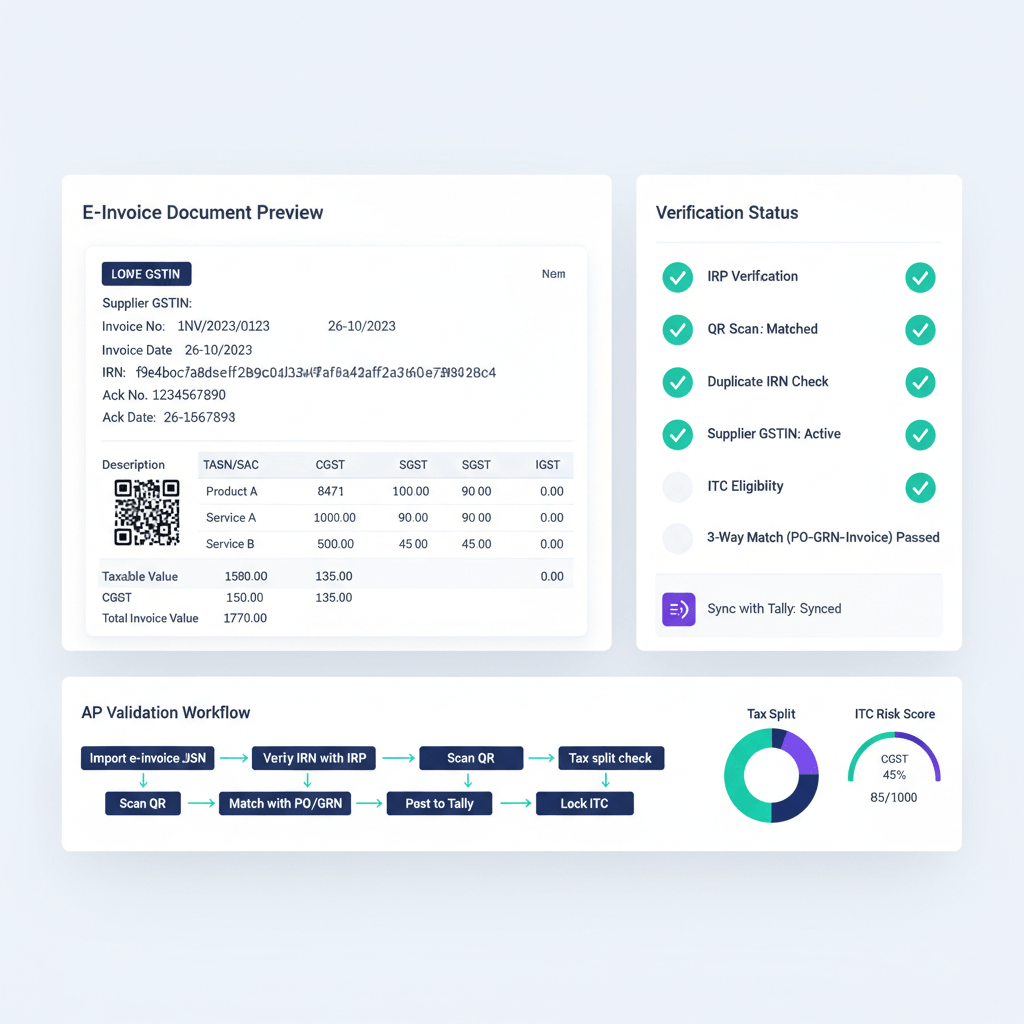
Complete AP workflow with embedded e-invoice validation
Step 1: Intelligent ingestion
Capture invoices from email, portals, scans, and PDFs. Use OCR tuned for Indian layouts to extract GSTIN, IRN, totals, and tax splits with high fidelity. Generic OCR often misses IRN or misreads HSN splits, which causes downstream mismatches.
Step 2: Vendor master validation
Before processing, validate the vendor’s GSTIN format and cross check legal name and address against PAN and GST systems. Clean vendor masters reduce exceptions later.
Step 3: IRN validation for vendor AP in India
Verify IRN via NIC or QR scan at the point of capture. Confirm the invoice is active, not canceled. Any canceled IRN must route to exception handling immediately.
Step 4: Three Way Matching
Match invoice to PO and GRN, including freight, discounts, rounding, and multi rate HSN lines. Ensure tax bases and rates align to PO terms and GRN quantities.
Step 5: e-invoice verification in accounts payable
Cross check IRN and QR details against the NIC portal, apply special handling for RCM, exports, or composition scheme suppliers, and tag such cases clearly for audits.
Step 6: Exception management
Request IRN regeneration when missing, process credit notes and amendments as per GST rules, and document legitimate non applicability cases with clear reasons.
Step 7: Clean posting
Only push validated bills into Tally or Zoho Books, store IRN in a persistent field, and retain the signed JSON for retrieval.
Step 8: Payment release
Release payment only after full match and validation. Maintain a step by step log to safeguard against unauthorized payouts.
Practical validation methods for Indian AP teams
Manual validation
Scan the QR on each invoice or use the NIC portal search to fetch the signed JSON, feasible for low volumes, but quickly becomes a bottleneck beyond a few dozen invoices weekly.
Semi automated approach
Use connectors or plugins for Tally and Zoho to run batch checks via GSP APIs, reduce manual effort, and handle exceptions with human review.
Fully automated validation
Automate ingestion, IRN checks, vendor validations, and postings, so exceptions are quarantined and only clean invoices reach your books, which scales to thousands of invoices with minimal touch.
Validate IRN in Tally: a step by step approach
Use Tally Prime’s E invoice fields in purchase vouchers to store IRN and QR data. Extract or paste IRN during voucher entry, run a status check against NIC before save, and block save if the IRN is invalid or canceled.
Enable duplicate checks by using the reference number field to prevent repeated IRNs. Immediately reverse entries when amended or canceled IRNs are detected, tag entries for ITC risk, and keep vendor communications on file.
Using AI Accountant for pre validation: AI Accountant validates IRNs before bills enter Tally, pushes clean vouchers with audit logs, and syncs validation status back to your dashboard, which cuts verification time significantly.
Zoho Books integration
Map IRN and QR to custom fields, set rules that block posting without valid IRN, and enable periodic master sync, mirroring the Tally approach using Zoho’s APIs.
Common e-invoice validation issues and fixes
| Issue | Fix |
|---|---|
| No IRN despite supplier being above threshold | Request immediate regeneration, hold booking until received |
| GSTIN or legal name mismatch | Correct vendor master, request amended e-invoice |
| IRN canceled after posting | Reverse entry, notify vendor, flag for ITC reversal |
| Duplicate IRN or invoice number | Block posting, escalate to AP manager |
| QR code unreadable | Search NIC with GSTIN, document number, and date |
| Credit or debit note missing IRN | Verify applicability, process only if compliant |
| Special cases like RCM or exports | Document reason for exception, tag for audit |
Tip: keep screenshots from the portal, the signed JSON, and email trails to vendors, which become invaluable during audits.
Documentation, audit trail, and governance
Maintain a consistent log for every invoice, including validation status, IRN, signed JSON, timestamps, and approver details. Enforce maker checker for exceptions, where the booker and approver are different users.
Reconcile purchases against GSTR 2B monthly, investigate mismatches immediately, and retain all records for 6 to 8 years as per statutory guidance.
Automation tools to evaluate
AI Accountant
AI Accountant automates bulk ingestion, IRN checks via APIs, GSTIN verification, and pushes validated bills into Tally and Zoho Books. It provides continuous GSTR 2B matching and real time dashboards for exceptions and coverage.
Tally Prime
Offers IRN fields, basic validations, and GST reports, suitable for smaller volumes with manual exception handling.
Zoho Books
Supports e-invoice generation, validation via custom fields and rules, and integrates well within the Zoho ecosystem.
ClearTax
Provides e-invoice generation and validation with reconciliation features, suitable for larger enterprises with dedicated compliance teams.
IRIS Sapphire
Specializes in GST compliance and validations with robust APIs, requires technical setup effort.
Masters India
Focuses on bulk processing for GST and e-invoice compliance, with varying depth of accounting integrations.
Benefits you can quantify with automated validation
- Bulk ingestion: process hundreds of complex PDFs in minutes with high accuracy on IRN and HSN splits.
- Vendor verification at scale: catch GSTIN and name mismatches instantly, reduce back and forth with suppliers.
- Real time IRN checks: block bad invoices at capture time, minimize rework at month end.
- Seamless Tally sync: maintain a single source of truth with bi directional status updates.
- Continuous GSTR 2B match: fix mismatches early, safeguard every rupee of ITC.
- Dashboards and security: live KPIs with ISO 27001 and SOC 2 aligned controls for multi entity operations.
Result: 70 to 90 percent touchless processing, AP cycle time down to a few days, and near zero ITC leakage.
KPIs that prove your validation is working
- Manual effort reduction: target 60 to 80 percent fewer human hours per invoice.
- Validation coverage: achieve at least 95 percent automated validation at ingestion.
- Exception rate: keep below 2 percent, investigate spikes quickly.
- Month end acceleration: move from 15 days to 5 days or less.
- ITC realization: eliminate preventable reversals and disallowances.
- First time right rate: hit 98 percent or higher on postings without rework.
Quick start implementation guide
Weeks 1 to 2, Foundation: connect Tally or Zoho Books, cleanse vendor masters, define validation rules and exception categories.
Weeks 3 to 4, Configuration: set approval thresholds, train users on the new paths, and agree SLAs for exceptions.
Weeks 5 to 8, Pilot: onboard 10 to 20 high volume vendors, run manual plus automated validation in parallel, refine rules.
Weeks 9 to 12, Scale: expand vendor coverage, monitor dashboards, and retire legacy manual steps.
Beyond 12 weeks, Optimize: cover credit and debit notes, special cases, and layer predictive alerts for duplicate or risky invoices.
Taking the next step
Your AP can be automated, validated, and audit ready. Start with your top vendors, embed validation at ingestion, and only pay what is matched and verified. Every unvalidated invoice is a potential ITC loss, an audit observation, or a fraud risk.
See this in action, book a free demo to watch live IRN checks flowing into Tally. You can also explore implementation checklists and best practices tailored to Indian AP teams.
Move fast, validate early, and close with confidence.
FAQ
What is the most efficient AP control to verify IRN status before booking in Tally Prime?
Implement a capture time API check that validates IRN against NIC as soon as the invoice is ingested, then block voucher save if the status is invalid or canceled. Tools like AI Accountant push only pre validated bills into Tally, which prevents downstream reversals.
How should a CA handle vendors below the e-invoice threshold while protecting ITC?
Confirm turnover based exemption, retain documentary proof, and validate GSTIN and supply type. Book invoices with a tag that indicates non applicability of e-invoice, and document your rationale for audit readiness.
What is the standard procedure if the supplier’s QR code is smudged or not scannable?
Use the NIC portal search with supplier GSTIN, document number, and date to retrieve IRN details. If no record exists for an eligible supplier, hold booking and seek regeneration. AI Accountant can auto attempt portal validations where scans fail.
Can IRN validations be automated for credit notes and debit notes in AP?
Yes, the same validation logic applies. Classify document type during ingestion, run IRN checks, and ensure reversal or adjustment postings follow GST rules. Systems like AI Accountant handle this uniformly across invoices and notes.
How do I set up a duplicate IRN check across entities and branches?
Maintain a central IRN index that checks for duplicates before posting, including cross entity collisions. Tally reference fields can help, while platforms like AI Accountant run global duplicate detection at ingestion time.
What immediate actions should be taken if a fake IRN is discovered post payment?
Reverse the accounting entry, initiate ITC reversal in the next GSTR 3B, notify the vendor, and escalate for legal action if required. Preserve all artifacts, and implement strengthened capture time validation to prevent a repeat.
How long should e-invoice validation evidence be retained for audits, and what exactly should be stored?
Retain for at least 6 years from the annual return due date, many teams keep 8 years. Store the signed JSON, IRN, QR payload, validation timestamp, user approvals, and screenshots of portal confirmations.
What KPIs should a CA track to show control effectiveness to management and auditors?
Track validation coverage at ingestion, exception rate, first time right rate, duplicate IRN blocks, and ITC realization. AI Accountant provides real time dashboards for these metrics.
How can we reconcile AP with GSTR 2B continuously rather than at month end?
Automate periodic pulls of 2B data and compare against your validated purchase register daily or weekly. Flag mismatches for supplier follow up early. Platforms like AI Accountant run rolling reconciliations to protect ITC.
What is the best practice for handling amended or canceled e-invoices already posted in books?
Run daily IRN status refresh, auto reverse or adjust affected vouchers, and notify stakeholders. Keep the original and amended records for the audit trail, with documented reasons from the supplier.
Which AP scenarios are commonly exempt from e-invoicing, and how should we document them?
B2C supplies, certain notified entities, and suppliers below threshold. Document exemption category, maintain supplier declarations if relevant, and tag transactions as exempt with clear rationale in your AP system.
Can an AI driven tool reduce manual effort in extraction and validation for Indian invoice formats?
Yes, specialized OCR and validation rules trained on Indian layouts extract IRN, GSTIN, HSN splits, and totals accurately, then run live checks. AI Accountant typically reduces manual touch by more than half while improving accuracy and speed.