-01%201.svg)
Key takeaways
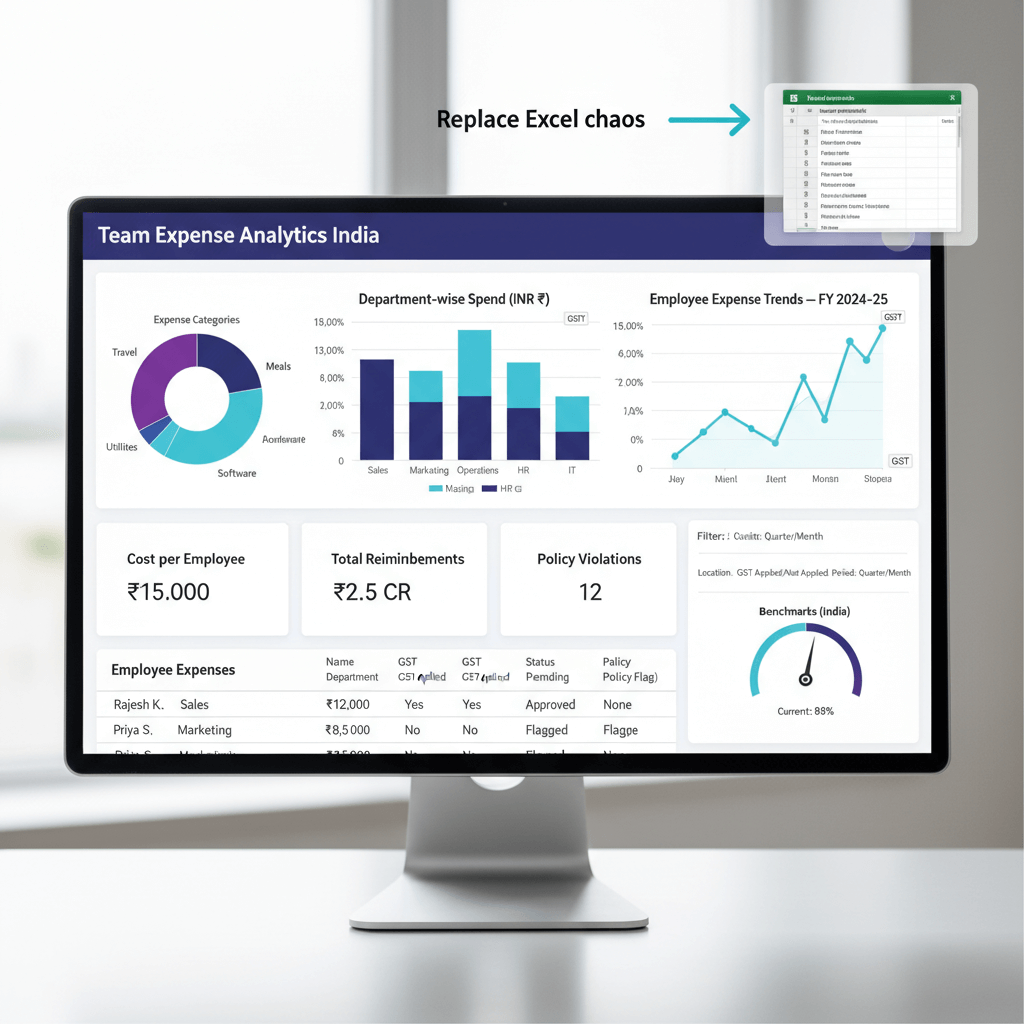
- Indian finance teams can replace Excel chaos with a unified expense intelligence stack that respects GST and TDS requirements, driving real time visibility, control, and compliance.
- Department wise spending analysis, employee trend detection, and cost per employee tracking enable proactive governance, budget discipline, and stronger unit economics.
- Expense benchmarking across teams and branches, supported by alerts and review cadence, builds accountability and spreads best practices.
- Clean, India ready data architecture, including HRIS and accounting integrations, is the foundation for accurate analytics and audit ready workflows.
- Evaluate platforms using an India focused checklist for GST ITC, TDS thresholds, bidirectional Tally and Zoho Books sync, policy engines, and multi entity structures.
- Expect fast ROI through leakage reduction, compliance lift, time savings, and policy enforcement, often within a single quarter.
- AI Accountant offers Indian context, predictive ledger mapping, and ready dashboards for department wise spend, employee trends, cost per employee, and benchmarking.
The Monthly Close Chaos in Indian SMBs
Every month end, finance teams across India face reimbursement claims in chat threads, crumpled receipts on desks, and proliferating spreadsheets. The reality is painful, scattered card spends and email threads, petty cash in notebooks, and compliance that slips through the cracks.
GST credit leakage bleeds working capital, missing GSTINs and wrong HSN codes block ITC, while policy slippages creep in with late hotel bills, upgraded stays, and duplicate subscriptions. Department attribution is hazy, the same restaurant bill appears twice, and per head spend varies wildly across branches without a clear reason.
When data is fragmented, you cannot see variance, you cannot enforce policy, and you cannot claim credits confidently.
Missed TDS thresholds trigger penalties, ITC opportunities vanish, and unit economics remain elusive because numbers live in dozens of spreadsheets that refuse to align.
Why Team Expense Analytics Matters Now
With tighter budgets and capital scarcity, every rupee counts. Distributed teams and card based spending demand new controls, boards expect real time visibility into spend efficiency, and finance needs analytics that reveal patterns, predict overruns, and guide corrective actions before damage compounds.
Shift from survival to scale requires financial intelligence, not just compliance. You must know what each team truly costs, how efficiency trends evolve, and where policy breaches concentrate.
What Team Expense Analytics Really Means for Indian SMBs
Team expense analytics in India goes beyond pretty charts. It consolidates card spends, reimbursements, vendor bills, petty cash, and subscriptions into a unified schema that mirrors your organization, cost centers, projects, departments, and branches.
Compliance is native, GST mapping covers HSN and SAC codes, place of supply, ITC eligibility and reverse charge, direct tax tracks TDS sections, thresholds, and PAN validation. Analytics aligns with policy, per diem and mileage rules become programmable guardrails, approvals follow maker checker logic, and audit trails provide end to end traceability.
The magic is alignment, analytical visibility that respects ITC rules, enforces policies, and keeps statutory auditors satisfied without heroics.
Department Wise Spending Analytics
Start by mirroring cost centers from Tally or Zoho into the analytics platform, tag every dimension, department, branch, project, ledger code, GST category, and TDS section. Define budgets versus actuals for each category, travel, SaaS, operations, utilities, and vendor payments.
- Compare sales travel versus marketing ads versus CX refunds for resource allocation clarity.
- Run branch wise breakdowns to explain utilities variance across cities.
- Detect subscription creep when multiple tools overlap across departments.
Month over month variance reports flag spikes early, budget breach alerts prevent overspending, vendor concentration analysis arms procurement for renewals. Visibility changes behavior, department heads become cost conscious, procurement consolidates, finance prevents overruns.
Employee Expense Trends and Pattern Detection
Employee analytics surfaces behavior patterns invisible to manual review, weekend claims spike, late night bookings exceed policy, foreign currency fees bite. The system catches split bills that bypass caps, duplicate receipts across claims, and backdated submissions.
- Configure category caps per day, per trip, or per role, set per diem and mileage rules by city grades and vehicle types.
- Enable conditional approvals by amount, role, or exception type, everything captured in audit logs.
- Risk controls tag GST eligible versus blocked, track TDS thresholds, and flag missing GSTIN or PAN.
Problems get caught at submission, not during audit, policies are enforced consistently, compliance becomes automatic.
Cost Per Employee Tracking That Drives Decisions
True cost per employee includes direct costs, travel, meals, tools, training, communication, devices, plus allocated costs, shared SaaS, rent, utilities, and benefits. Integrate HRIS to track by employee, team, location, role, and tenure.
Benchmarking reveals sales costs 40 percent more than tech, yet generates 3x revenue per head, metro locations cost more but may not deliver proportional output, costs often decline after year one as training pays off.
- Normalize KPIs, cost per rupee of revenue, cost per ticket resolved, cost per customer visit, cost per project delivered.
- Use role specific guardrails, maximum travel budgets for sales, tool allowances for developers, based on true fully loaded cost.
Expense Benchmarking Across Teams
Compare teams and branches on cost per head, cost per rupee of revenue, and cost per project. Track period over period, this quarter versus last quarter, and versus same quarter last year, add external sector benchmarks when available to calibrate spend.
Automated alerts fire when branches deviate, if Pune spends 30 percent more per head than Mumbai, you know immediately, if marketing spikes 50 percent month over month, you get notified quickly.
Healthy competition grows when efficiency metrics become shared goals, best practices spread, and resource allocation becomes data driven.
Data Architecture for Indian Expense Analytics
Robust analytics demand comprehensive inputs. Bank statements and corporate card feeds provide transaction detail, vendor bills and invoices add tax context, employee claims come via portals and mobile uploads.
HRIS integration supplies rosters, team structures, cost centers, and locations, Tally and Zoho Books add ledgers and tax structures, ensuring analytical alignment with statutory books.
- India specifics must be native, GSTIN validation, HSN and SAC codes, place of supply, tax rates, ITC categories.
- TDS sections, rates, cumulative thresholds, and PAN validation require equal rigor.
- Multi entity structures with separate GST registrations and companies need clean separation with optional rollups.
Data hygiene is non negotiable, high confidence OCR for Indian formats, duplicate detection for repeated invoices and card charges, consistent ledger mapping and dimension tagging, clean vendor masters and category standardization.
Essential Tool Evaluation Checklist
India readiness tops the list, native GST and TDS support, HSN and SAC, ITC rules, reverse charge, trained ingestion for Indian bank formats, and deep bidirectional sync with Tally and Zoho Books are crucial.
Analytics depth matters, ask for out-of-the-box department wise spending dashboards that do not need custom builds, employee trend analytics with anomaly detection, cost per employee with flexible allocation, and benchmarking views with normalized comparisons.
- Automation, ledger prediction, category suggestion, automatic GST code assignment with CGST, SGST, IGST splits, vendor detection, invoice to payment linking.
- Approval and policy engines, configurable multi level workflows, caps and exception rules, complete audit logs.
- Integrations, bidirectional accounting sync, HRIS mapping, flexible ingestion for PDF, JPEG, CSV, email, and API feeds.
- Security certifications, SOC 2 Type II and ISO 27001, role based access, maker checker separation, PII protection.
- Multi entity and CA firm workflows, cross company rollups with filters by entity and GSTIN, queue management, client wise dashboards and templates.
KPIs and Dashboard Views to Demand in Demos
Insist on live views that reflect Indian business realities. Department wise monthly spend with variance against budget and prior period, employee expense trends with anomaly flags and click through audit logs, cost per employee breakdowns by team, seniority, location, and branch.
Compliance tiles should include GST ITC utilization and non eligible ratios, TDS exposure tracking with threshold warnings, aging of claims and reimbursements, and cash flow impact views for days payable outstanding and runway.
Do not accept static screenshots, demand live demos with your structures and categories.
ROI Calculation Framework
Quantify time savings from data entry, classification, and reconciliation, conservatively model 50 to 75 percent reduction. Measure leakage reduction, duplicate claims blocked, policy violations prevented, ghost subscriptions cancelled, even 2 to 3 percent leakage reduction delivers lakhs.
Compliance lift adds value, additional ITC captured, fewer TDS interest charges, audit prep time reduced. Model scenarios by function, travel heavy sales optimize trip costs and visit economics, SaaS heavy tech rationalize subscriptions and tool overlap.
A mid sized company processing ₹5 crores in annual expenses often sees 15 to 20 percent cost reduction, platform payback in three to four months, 3x to 5x ROI in year one.
90 Day Implementation Blueprint
- Weeks 1 to 2, connect Tally or Zoho Books, set up bank and card feeds, ingest last 6 to 12 months of data, clean vendor masters, map transactions.
- Weeks 3 to 4, build dimensions for departments, projects, branches, configure policies and approvals, define dashboards and KPIs, set user access.
- Weeks 5 to 8, validate outputs with finance and department heads, tune ledger predictions and tax mapping, pilot dashboards, adjust rules based on patterns.
- Weeks 9 to 12, roll out alerts and benchmarking, establish review rhythm, train department heads, refine thresholds as usage grows.
This phased approach delivers quick wins while ensuring smooth adoption.
Common Implementation Pitfalls
- Inconsistent tagging, enforce standard naming early to avoid analytical chaos.
- Missing GST or TDS codes on claims and petty cash, make tax coding mandatory.
- Excel as a shadow system, commit to a single source of truth.
- Lack of audit trails in side spreadsheets, keep adjustments inside the platform.
- Ignoring multi entity consolidation, design for rollups from day one.
- Skipping per head normalization, always normalize for fair branch comparisons.
- Policies documented but not codified, turn every rule into a workflow control.
Governance Structure and Operating Cadence
Run monthly expense councils, the CFO and department heads review department wise spend and per employee metrics, document variances and actions, adjust budgets based on reality.
Enable threshold based alerts, investigate spend spikes immediately, route policy breaches to managers, block unauthorized vendors, surface unusual patterns before close.
Quarterly benchmarking compares normalized metrics, high performers share best practices, underperformers commit to corrective plans with clear timelines.
Close with a checklist, reconcile ITC against GSTR filings, confirm TDS thresholds and accruals, clear exception logs with documentation, make clean closes routine.
Where AI Accountant Fits in Your Expense Analytics Journey
AI Accountant brings specialized Indian context, ingestion for PDF, JPEG, and CSV trained on Indian bank formats, predictive ledger mapping for ledgers, GST codes, and vendors, reducing manual classification by up to 75 percent. Bidirectional sync with Tally and Zoho Books aligns analytics with compliance, auto built dashboards cover department wise spending, employee trends, cost per employee, and benchmarking, with Account Aggregator feeds and multi entity rollups on the roadmap.
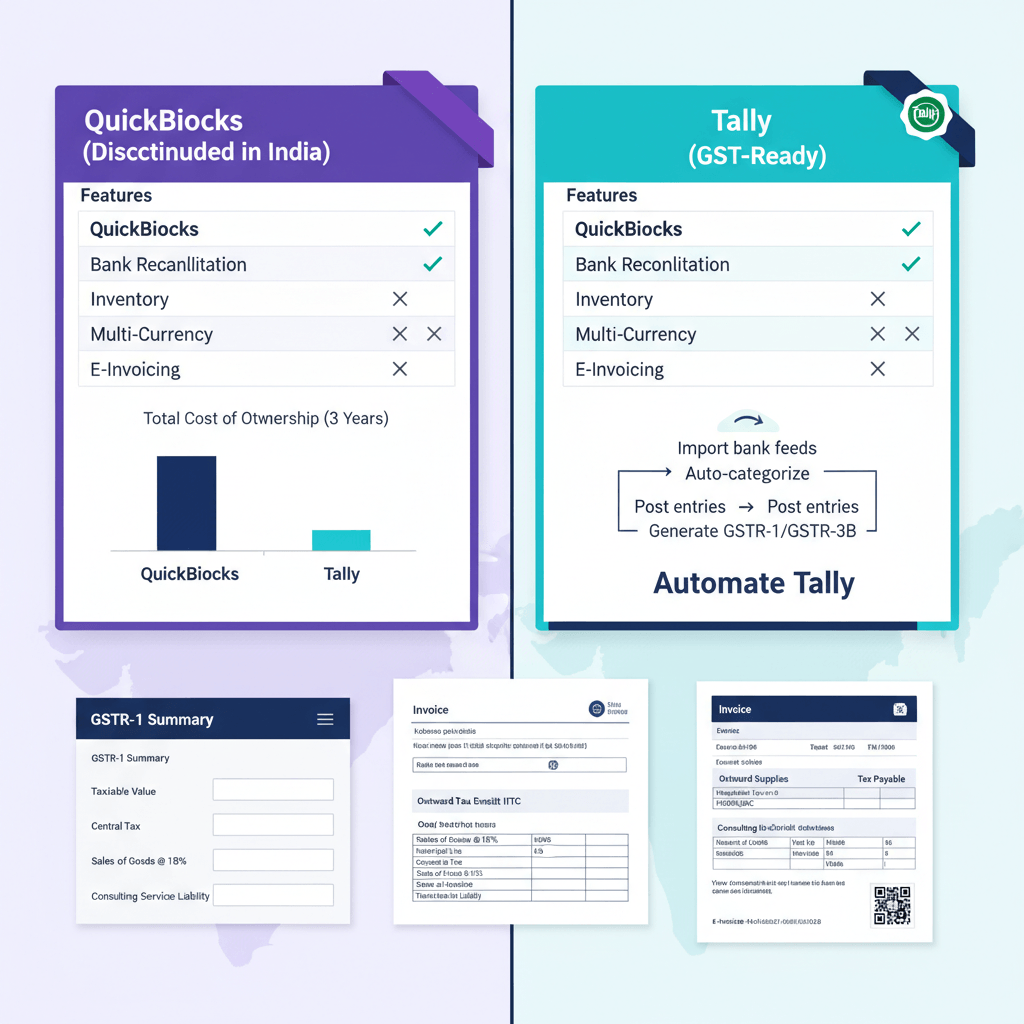
Other options include QuickBooks for basic tracking, Zoho Expense with strong workflows tied to Zoho Books, SAP Concur for enterprise scale, Expensify for simplicity, and Happay with local GST support, each with tradeoffs on Indian tax depth and analytical breadth.
Vendor Evaluation Demo Checklist
- Department wise spending, branch and project drill downs, variance to budget and prior periods, proof of complex structures.
- Employee trend analytics, policy violation detection, click through audit logs, duplicate and bill split recognition.
- Cost per employee, allocation rules for shared costs, per head normalization, multi dimensional tracking.
- Benchmarking, compare departments, show 12 months of trends, internal and external benchmarks.
- GST and TDS treatment, Process employee reimbursements with correct tax handling, vendor bills with and without GSTIN or PAN, ITC eligibility and TDS threshold monitoring.
- Technical capability, ingestion speeds with large samples, accuracy on your documents, reconciliation across sources.
- Integrations, bidirectional accounting sync, HRIS mapping, corporate card and bank feed connectivity.
Taking Action, Your Next Steps
Run a focused 4 week pilot with Sales and Technology, set success metrics, hours saved, leakage reduced, ITC lift, and days reduced in monthly close. Document baseline before implementation to prove ROI afterward.
Evaluate platforms with the India focused checklist, demand demos with your data, prefer guided implementation where tax codes, multi entity structures, and hierarchies benefit from expert configuration.
The path from chaos to clarity is short when you start with a strong pilot and scale iteratively.
Begin the evaluation, schedule your demo, and commit to the monthly review cadence that turns analytics into outcomes.
Conclusion
Expense intelligence is not just better dashboards, it is disciplined spending, policy enforcement, and compliant books. When every rupee is tracked, tagged, and analyzed, waste recedes and efficiency emerges, enabling scale with confidence.
Indian SMBs that embrace team expense analytics will run tighter operations, claim rightful credits, and make data driven decisions. Your finance team deserves to retire midnight reconciliations, your department heads need real time visibility, and your board expects clear unit economics. Deliver all three with a unified, India ready analytics platform.
FAQ
How should a CA structure department wise expense analytics for a multi entity client using an AI accounting tool like AI Accountant?
Mirror each client’s chart of accounts and cost centers from Tally or Zoho Books, create dimensions for departments, projects, branches, and GSTINs, then enforce standardized naming. Use AI Accountant to ingest card feeds, bills, and claims, apply predictive ledger and GST mapping, and build dashboards per entity with optional consolidated rollups. Normalize per head metrics to compare branches fairly, and set alerts for budget variance and unusual patterns.
What is the recommended workflow to capture GST ITC accurately on employee reimbursements for Indian SMBs?
Make GST data entry mandatory at claim submission, capture GSTIN, invoice number, HSN or SAC, place of supply, and ITC eligibility flag. Route exceptions to finance via maker checker approvals. Validate GSTIN programmatically and reconcile ITC with GSTR filings monthly. An AI Accountant workflow can tag eligible versus blocked credits automatically, reducing leakage and audit risk.
How can a CA quantify ROI when proposing a team expense analytics rollout to a client CFO?
Baseline current monthly hours for data entry, classification, and reconciliation, then apply a conservative 50 to 75 percent reduction. Measure duplicate claims blocked, policy breaches prevented, and ghost subscriptions cancelled. Add compliance lift, incremental ITC captured and reduced TDS interest. For example, with ₹5 crores annual expenses, a 2 to 3 percent leakage reduction plus time savings typically yields 3x to 5x ROI in year one using AI Accountant.
What allocation rules should a CA use to compute cost per employee when many expenses are shared across teams?
Allocate rent and utilities by seat count or floor area, shared SaaS by license usage or team active users, and corporate programs by department headcount. Tie allocations to HRIS data for roles, locations, and tenure. In AI Accountant, configure allocation rules per category, then report cost per employee by team, seniority, and branch, alongside normalized metrics like cost per rupee of revenue.
How does a CA detect policy evasion patterns such as split bills or duplicate receipts at scale?
Use anomaly detection to flag repetitive amounts near policy caps, for example two receipts of ₹2,450 when the cap is ₹2,500, and cross reference invoice numbers across claims to find duplicates. Configure rules for weekend spikes, late night hotel bookings, and foreign currency fees. AI Accountant highlights these exceptions with click through audit logs from summary to transaction detail.
What GST and TDS checks should be embedded in an expense analytics platform to satisfy statutory audits?
Embed GSTIN validation, HSN or SAC mapping, place of supply logic, CGST, SGST, IGST splits, and ITC eligibility rules including reverse charge. Track TDS sections by vendor category, cumulative thresholds, and PAN validation. Maintain immutable audit logs for approvals and exceptions. AI Accountant’s native India modules help CAs demonstrate compliant treatment across reimbursements and vendor bills.
How should a CA design benchmarking for branches with different sizes and revenue profiles?
Always normalize, compare cost per head, cost per rupee of revenue, and cost per project delivered. Use quartiles and guardrails to spot outliers, and track period over period trends, this quarter versus last quarter and versus same quarter last year. Configure automated alerts for deviations beyond thresholds. AI Accountant can produce branch wise benchmarking panels with drill downs to category and vendor.
What ingestion and data hygiene steps reduce errors when onboarding clients from spreadsheet driven processes?
Ingest 6 to 12 months of history, clean vendor masters, standardize categories, and enforce dimension tagging. Use OCR tuned for Indian formats with confidence thresholds, run duplicate detection for invoices and card charges, and map ledgers consistently. With AI Accountant, predictive mapping accelerates classification, while exception queues keep human review focused on edge cases.
How can a CA set up governance cadence to sustain savings after the initial analytics rollout?
Create monthly expense councils for variance review and corrective actions, maintain threshold based alerts for spikes and breaches, and run quarterly benchmarking to spread best practices. Tie actions to specific owners and timelines, and keep a close checklist for ITC reconciliation and TDS thresholds. AI Accountant supports scheduled reports, alerts, and audit logs that anchor this operating rhythm.
What demo evidence should a CA demand from vendors before recommending a platform to clients?
Require live demos using client like structures, not static screenshots. See department wise spend with drill downs, employee anomaly flags with audit trails, cost per employee with allocation rules, and benchmarking with normalized metrics. Confirm bidirectional Tally or Zoho sync, HRIS integration, and ingestion accuracy on Indian documents. AI Accountant can demonstrate these capabilities end to end, including policy engines and compliance tiles.

Rohan Sinha is a fintech and growth leader building aiaccountant.com, focused on simplifying accounting and compliance for Indian businesses through automation. An IIT BHU alumnus, he brings hands-on experience across 0 to 1 product building, growth, and strategy in B2B SaaS and fintech.