-01%201.svg)
Key takeaways
- Prioritize tools that excel at Indian bank statement ingestion, GST-aware matching, and seamless posting to Tally or Zoho Books, these are foundational for accuracy and compliance.
- Evaluate the four pillars thoroughly, card transaction matching, expense policy enforcement, card spend analytics, and fraud detection, each pillar must meet India-specific needs.
- Demand hard metrics, ingestion coverage for 50+ formats, auto-classification accuracy for merchants and MCCs, GST code mapping precision, and exception reduction rates.
- Insist on bi-directional sync with accounting systems, strong audit trails, and role-based access, the integration layer determines end-to-end reliability.
- Model ROI clearly, time saved per 1,000 transactions, prevented fraud, improved ITC recovery, and faster closes, then validate via a 30 to 60 day pilot.
Understanding corporate card reconciliation in the Indian context
Corporate card reconciliation in India is more than receipts matched to statements, it is the disciplined verification and categorization of expenses from company-issued cards into your ledgers while ensuring GST compliance, accounting standards, and internal policy adherence.
Complexity arises from diverse issuer formats across HDFC, ICICI, Axis, and SBI, additional GST invoice requirements, and RuPay credit-on-UPI formats. For a deeper dive into feed normalization, see wallet and UPI feed normalisation. Foreign exchange charges and posting cycles further complicate workflows, mismatched cycles make closes harder.
Manual reconciliation often consumes 30 to 45 minutes per account, every month. With bank frauds crossing ₹36,014 crore in FY 2024-25, and new RBI compliance rules expected in June 2025, robust automation is no longer optional.
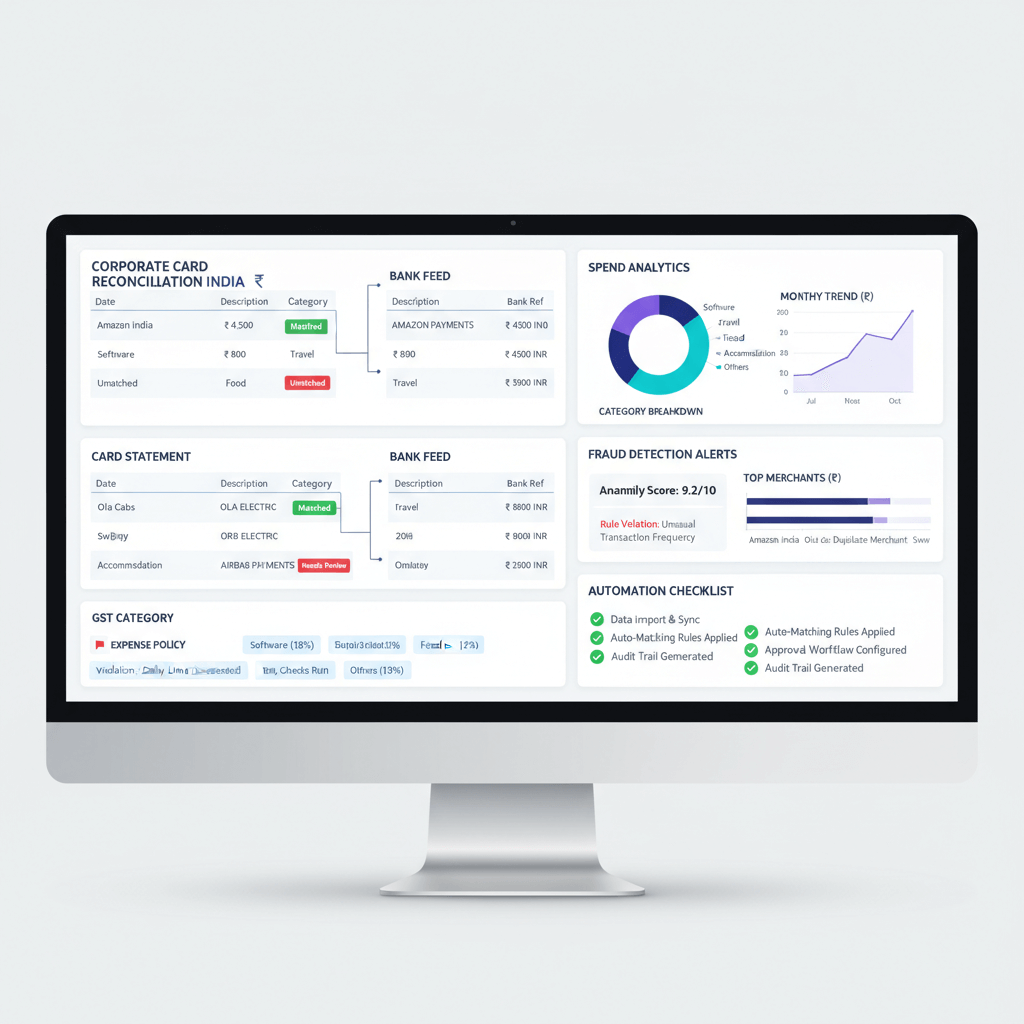
The right tools should excel across four core areas, accurate card transaction matching, policy-based expense enforcement, clear analytics, and proactive fraud detection, with smooth integration to Tally or Zoho Books to keep your books clean.
Explore industry perspectives in corporate card reconciliation, UPI wallets vs corporate cards, credit card reconciliation, and the India-focused overview in payment reconciliation platform India 2025.
India-specific challenges that shape your tool requirements
Statement timing and accounting mismatches
Statements often lag 24 to 48 hours behind spend, accrual versus cash basis becomes messy when transaction dates do not match posting dates, clearing accounts get noisy.
GST compliance complexities
Claiming ITC hinges on complete vendor GST invoices, with MCC nuances for hotels, fuel, and subscriptions, and GST on card fees and FX markups. For automated handling of fees and interest, review auto-tag bank charges and interest.
Multi-entity and card type variations
Indian businesses manage employee-level limits, layered approvals, shared cards, and issuer diversity across HDFC, ICICI, Axis, SBI, Amex, and RuPay, including chargebacks, refunds, EMIs, and partial reversals.
Data quality and format issues
Each bank delivers statements differently, PDFs vary, RuPay credit-on-UPI has its own quirks, and some statements arrive as JPEGs requiring OCR. Without automation, teams drown in entry work.
For broader context, consult payment reconciliation challenges and AI solutions, the Indian toolkit in payment reconciliation platform India 2025, and ecosystem insights in navigating the future of financial reconciliation in India.
Building the ideal corporate card reconciliation workflow
Step 1, intelligent data ingestion
Capture statements via PDF, CSV, or photos, normalize 50+ Indian bank formats with specialized OCR, then map fields consistently. Learn more in card statement ingestion and mapping.
Result, no more format juggling.
Step 2, automated card transaction matching
AI maps merchants, dates, amounts, and MCCs to employees and ledgers, links receipts and bills, and detects duplicates early.
Step 3, policy-based expense enforcement
Rules enforce spending caps, block prohibited MCCs, and mandate GST invoices, exceptions route to approvers with full audit trails.
Step 4, streamlined approval routing
High-risk or policy-violating items reach the right reviewer, with comments and attachments preserved.
Step 5, seamless accounting system posting
Approved transactions push to Tally or Zoho Books clearing accounts, the system auto-matches against bank ledgers.
Step 6, continuous review and analytics
Real-time dashboards surface trends, anomaly flags catch fraud, and exception patterns inform process improvement.
Compare approaches across corporate card reconciliation, AI solutions, and India-focused implementations in payment reconciliation platform India 2025.
Essential capabilities checklist for tool evaluation
Card transaction matching capabilities
- Coverage for 50+ Indian bank and card formats, robust OCR for PDFs and JPEGs.
- Automatic merchant normalization, accurate MCC classification, and duplicate detection across sources.
- Rule-based or AI matching to ledgers, vendors, and GST codes, minimal manual intervention.
Expense policy enforcement features
- Flexible configuration by MCC, category, employee, team, and entity.
- Mandatory GST invoice capture for claimable transactions, auto-flag or block non-compliant spend.
- Efficient exception queues, comments and attachments preserved, audit logs accessible.
Card spend analytics dashboards
- Trend analysis by merchant, MCC, team, and entity, with budget versus actuals.
- Fee and foreign exchange breakdowns, tax views, and cash flow impacts.
- Highlighted transactions for special reviews, actionable graphs for management.
Fraud detection systems
- Anomaly flags for out-of-hours spend, unusual values, and suspicious MCCs.
- Split transaction detection, geolocation and FX outlier monitoring.
- Personal versus business classification, chargeback tracking, alert workflows.
System integration fundamentals
- Bi-directional sync with Tally and Zoho Books, multi-entity support, role-based access.
- Security certifications such as ISO 27001 or SOC 2, plus full audit trails.
Benchmark against this reconciliation overview, AI reconciliation patterns, and India-first frameworks in payment reconciliation platform India 2025.
Understanding the vendor landscape
Card issuer platforms
HDFC, ICICI, Axis, SBI, and Amex offer strong card programs with feeds, however, PDF quality varies, and advanced automation or policy enforcement is limited. RuPay’s share in UPI continues to shape the ecosystem, see analysis on industry dynamics in India fintech wrap-up.
Expense management suites
Zoho Expense, Fyle, Happay, and EnKash excel at policy enforcement and receipt capture, reconciliation depth differs across products, and many require additional accounting integration.
Accounting automation platforms
Specialized tools focus on ingestion, matching, analytics, and Tally or Zoho Books sync, pairing these with card programs or expense tools yields an end-to-end stack.
Survey market views in UPI wallets vs corporate cards, reconciliation features, and industry whitepapers.
Top corporate card reconciliation tools for Indian businesses
- AI Accountant (https://aiaccountant.com) specializes in Indian bank statement processing with OCR for 50+ formats, automated GST code mapping, bi-directional Tally or Zoho Books sync, and ISO 27001 or SOC 2 certifications, built for Indian accounting complexities.
- Zoho Expense offers receipt scanning, mileage tracking, and approval workflows, it integrates with Zoho Books, complex card programs may require additional reconciliation tooling.
- Fyle provides real-time visibility, automated reporting, and credit card reconciliation, strong policy enforcement and integrations.
- Happay focuses on corporate cards with GST-aware expense management, widely used for travel and expense in enterprises.
- EnKash combines cards with spend management, bill payments, vendor payments, and expense tracking in one platform.
- QuickBooks offers accounting, basic expense tracking, and reconciliation, suitable for smaller operations.
Critical RFP questions for vendor evaluation
Data ingestion capabilities
Can you process our issuer PDFs, JPEGs, and CSVs reliably at our transaction scale, with error rates documented, and latency targets published.
Matching accuracy metrics
What is your auto-classification success rate for merchant names, MCCs, ledgers, and GST codes, share benchmarks from similar Indian clients.
Policy enforcement granularity
How granular can rules be, and can you enforce GST invoice capture before posting to ledgers.
Analytics and reporting
Show dashboards for spending by entity, employee, and MCC, including fee and FX breakdowns, and export capabilities.
Fraud detection capabilities
Which anomalies are flagged, how explainable are alerts, and what is the end-to-end resolution workflow for exceptions.
Compliance and integration
Do you support bi-directional Tally or Zoho Books sync, with multi-entity setups, and provide audit logs, and security certifications.
Cost and ROI metrics
What time savings occur per 1,000 transactions, how much do exceptions reduce, and what is the impact on ITC recovery.
For benchmarks and frameworks, see reconciliation capabilities, AI reconciliation insights, and India-first guidance in payment reconciliation platform India 2025.
Calculating ROI for card spend analytics implementation
Baseline manual process
For 1,000 monthly transactions, teams spend 30 to 45 hours on matching, receipt collection, and approvals, with elevated risk of fraud, duplicates, or GST policy breaches.
Automation impact
Strong automation reduces manual effort by roughly 75 percent, month-end closes shrink from weeks to days, and ITC misses or fraud attempts are caught early.
Quantified benefits table
| Metric | Manual process | Automated process | Savings or improvement |
|---|---|---|---|
| Time per 1,000 transactions | 30 to 45 hours | 7.5 to 11 hours | 75 percent reduction |
| Exception rate | High | Low with AI flags | 40 to 70 percent drop |
| Month-end close time | Weeks | Days | Accelerated close cycles |
| ITC recovery | Sporadic | Systematic | 3 to 5 percent improvement |
| Compliance risk | High | Low | Avoided penalties |
See supporting viewpoints in AI reconciliation challenges and India reconciliation whitepaper.
Implementation blueprint for fraud detection systems
Week 1 to 2, foundation setup
Connect entities, import historical statements, configure Tally or Zoho Books clearing ledgers, and establish data quality baselines.
Week 3 to 4, configuration and rules
Set matching rules for your patterns, map MCCs to GST codes, configure spending caps, prohibited categories, and invoice requirements.
Week 5 to 6, workflow design
Define approval hierarchies, build pilot dashboards, set initial fraud alerts and thresholds.
Week 7 to 8, training and go-live
Train teams, run parallel cycles, tune rules from exception patterns, then go live confidently.
For an India-first playbook, see payment reconciliation platform India 2025 and reconciliation guide.
Standard operating procedures and best practices
Daily tasks
Ingest statements promptly, allow auto-matching, review and resolve exceptions daily to prevent backlog.
Weekly activities
Approve compliant transactions, chase missing GST invoices, review trend anomalies, and update policies as regulations evolve.
Month-end procedures
Reconcile clearing accounts to statements and bank ledgers, close open exceptions, export analytics for management review, and document process improvements.
Common pitfalls to avoid
- Do not post claimable ITC transactions without GST invoices.
- Do not ignore FX fees in cost allocation.
- Close chargebacks properly to avoid duplicate credits.
- Maintain consistent vendor and category mapping across periods.
Supplement with viewpoints in UPI wallets vs corporate cards and AI reconciliation approaches.
Real-world success story from an Indian CA firm
A CA firm managing five entities and 40+ corporate cards struggled with subscription charges, hotel bookings, and travel expenses that complicated matching. After implementing automated matching and policy enforcement, plus analytics dashboards, month-end closes accelerated by 70 percent, policy breaches fell by 40 percent, and two fraud attempts were stopped early via anomaly detection.
Outcome, faster closes, fewer breaches, measurable fraud prevention, and cleaner books aligned to RBI expectations.
Explore similar results in corporate card reconciliation case views and UPI vs card analysis.
How AI Accountant enhances corporate card reconciliation
Advanced ingestion technology
Handles PDFs, JPEGs, CSVs, and photos, processes 50+ Indian bank formats with specialized OCR trained on local variations, reducing manual capture and error.
Intelligent transaction matching
AI predicts ledgers, vendors, and GST codes, automatically links bills and receipts, learns from corrections, and lifts accuracy over time.
Flexible policy framework
Rules by entity, team, and individual, approval queues with audit trails, GST invoice enforcement before posting, ensuring ITC integrity.
Comprehensive analytics
Dashboards for spend trends, fee and FX impacts, highlighted exceptions, multi-entity consolidation, and export for management reviews.
Fraud prevention features
Anomaly detection for suspicious patterns, explainable alerts, and guided resolution workflows, with a roadmap for enhanced controls.
Enterprise-grade security
ISO 27001 and SOC 2 Type 2 certified, bi-directional Tally or Zoho Books integration, and multi-entity scalability for growing businesses. Learn more in payment reconciliation platform India 2025.
Taking the next steps
Corporate card reconciliation in India demands tools built for local realities. Focus on card transaction matching, policy enforcement, analytics, and fraud detection, evaluate vendors with the RFP questions above, then run a pilot to validate accuracy and cycle-time gains.
Document your current process and pain points, prioritize capabilities, then measure results against a clear ROI model.
For comparative reading, visit this reconciliation guide and AI solutions for reconciliation, and consider AI Accountant for India-specific automation.
FAQ
As a CA, how do I evaluate matching accuracy across HDFC, ICICI, Axis, SBI, and Amex statements without manual cleanup.
Request issuer-specific benchmarks from vendors, ask for auto-classification accuracy for merchants, MCCs, and GST codes, and run a pilot on your last three cycles. AI Accountant demonstrates ingestion for 50+ Indian formats, with learning from your corrections to improve accuracy in subsequent runs.
Can an AI tool enforce GST invoice capture before posting, so ITC is never claimed without documentation.
Yes, policy engines can block or flag claimable transactions that lack GST invoices, route exceptions for approval, and prevent posting to clearing ledgers. AI Accountant enforces invoice requirements at the point of reconciliation, maintaining ITC integrity.
What is the recommended clearing account workflow in Tally or Zoho Books for card statements that post two days late.
Use a card clearing ledger to record matched transactions daily, then reconcile to the bank ledger when the statement posts, ensuring accrual accuracy. AI Accountant automates clearing entries, aligns posting dates, and reconciles variances when issuers post late.
How do I quantify ROI, specifically time saved per 1,000 transactions, exception reduction, and impact on month-end close.
Measure current hours spent on matching, receipt collection, and approvals, then compare against automated runs, plus track exception counts and close duration. AI Accountant pilots typically show around 75 percent time savings, lower exception rates, and faster closes by multiple days.
Can the system differentiate personal versus business expenses on corporate cards, with examples like split transactions and suspect MCCs.
Yes, anomaly detection flags personal patterns, off-hours spend, and split transactions used to bypass limits, while MCC rules block or escalate suspect categories. AI Accountant provides explainable alerts and guided workflows to resolve such exceptions.
How should a CA configure multi-entity policies, per-card limits, and consolidated analytics for group reporting.
Set entity-level policies, then layer team or card-level limits, and use consolidated views for group dashboards. AI Accountant supports multi-entity setups, per-card rules, and roll-up analytics for boards and group CFO reviews.
Does the platform support JPEG or photo-based statements when banks send low-quality PDFs, including RuPay credit-on-UPI feeds.
Look for OCR tuned to Indian formats, with photo ingestion and normalization for RuPay and UPI variations. AI Accountant ingests PDFs, JPEGs, CSVs, and photos, then normalizes fields consistently across issuers.
What fraud controls are essential for Indian corporate cards, and how does the alert workflow work in practice.
Controls include out-of-hours flags, high-value anomalies, suspect MCCs, split detection, geolocation and FX outliers, and chargeback tracking. AI Accountant routes alerts to the right approver, records actions and comments, and closes exceptions with audit trails.
How do I ensure compliance with RBI expectations on audits and KYC while automating reconciliation.
Maintain complete audit logs, role-based access, segregation of duties, and certified security frameworks. AI Accountant is ISO 27001 and SOC 2 certified, with detailed audit trails and approval routing to align with RBI’s tightening controls.
What integration pattern works best for Tally or Zoho Books, push-only or bi-directional, and how are updates handled.
Bi-directional sync is ideal, fetch bills and vendor data, then push clean entries with status updates, while reconciling clearing accounts automatically. AI Accountant’s integrations support two-way sync and multi-entity mappings.
Can AI help recover missed ITC by catching GST classification errors and incomplete invoices retroactively.
Yes, analytics can surface classification mismatches and missing invoices, then route recovery tasks. AI Accountant highlights recoverable ITC gaps and helps teams correct and claim within allowed timelines.
What is a practical 60 day rollout plan for a CA firm handling five entities and 40 plus cards, without disrupting the month-end close.
Run a phased rollout, two weeks for ingestion and ledger setup, two weeks for rules and MCC to GST mapping, two weeks for workflows and alerts, and parallel run for two cycles before go-live. AI Accountant provides implementation templates and pilot dashboards to stabilize the transition.

A results-driven finance and sales professional with hands-on experience through finance internships and a fast-paced sales role. With a strong interest in accounting and business finance, Harsh focuses on turning complex topics into clear, practical takeaways for founders and finance teams.