-01%201.svg)

Key takeaways
- Small businesses in India get end to end compliance when a CA led team manages ITR, GST, TDS, ROC, payroll, and books, you stay compliant and audit ready.
- Virtual accounting combines expert execution with a live dashboard, you see cash flow, due dates, ITC, and filing status in real time, issues are flagged early.
- Clean onboarding, steady reconciliations, and a predictable compliance calendar reduce penalties, notices, and last minute stress.
- AI powered checks and CA reviews recover missed ITC, optimize advance tax, and prevent TDS or GST leakages, this creates measurable savings.
- AI Accountant is a CA led virtual accounting service, the dashboard centralizes documents, shows live metrics, and lets you chat with your CA team.
Introduction to tax preparation services for small businesses in India
If you run a small business in India, tax prep can feel messy. A strong tax preparation service brings a CA led team to handle filings, books, and notices, so you stay compliant and audit ready. You get clarity on what is covered, what to share, timelines, how to avoid penalties, and how a virtual accounting model gives you live control without extra hires. With AI Accountant, you move from stress to simple through a CA team and a clear dashboard.
Compliance works best when books are updated monthly, reconciliations are routine, and your CA team closes the loop quickly.
For additional context on Indian compliance scope, see providers who outline end to end coverage for GST, TDS, ITR, and ROC, for example AG FinTax and curated lists like Gbooks.
Common pain points in tax preparation services for small businesses
- Missed GST or TDS dates, interest and late fees follow.
- Bank and gateway entries not matched, revenue and fees drift from reality.
- Vendor GST input not claimed on time, ITC is lost.
- Confusing ITC and RCM rules, errors accumulate.
- Forms and challans scattered across email and chat, no single truth.
- No line of sight to tax cash outflow, planning breaks down.
These issues compound during tax season when books are not closed, ledgers are messy, and documents are missing. Several outsourced tax guides share similar patterns and fixes, see CapActix and Sanjay Tax Pro.
Scope and inclusions you should expect
Income tax inclusions
Cover ITR filing for proprietors, partnerships, LLPs, and companies. Include advance tax planning and payments, TDS advisory, monthly challans and returns across sections like 24Q, 26Q, 27Q, and property or rent forms like 26QB, 26QC, 26QD. For an overview of TDS return coverage, see AI Accountant on TDS return filing services. Add non attest tax audit preparation and schedules when you cross audit limits.
GST inclusions
Include GST registration if needed and e invoicing setup when you cross the rule threshold. File GSTR 1 and 3B monthly or quarterly based on your scheme, then prepare GSTR 9 and 9C at year end. Run ITC reconciliations, guide on RCM, map HSN or SAC rates, and check place of supply for interstate and export flows. For reconciliation depth, see AI Accountant on GST reconciliation for SMEs.
Accounting and books closure
Do monthly bookkeeping for sales, purchases, expenses, and bank entries. Reconcile banks and payment gateways, keep a fixed asset register with depreciation, track inventory movement, and complete year end closing with schedules and a tidy trial balance. Share non certified MIS like P and L and cash flow.
Payroll and TDS on salaries
Compute TDS monthly, design a tax friendly salary structure, collect proofs, and complete Form 16 and related records on time.
ROC and MCA for companies
Handle AOC 4 and MGT 7, DIR 3 KYC, board meetings and minutes, AGM records, and event based filings for director or share changes, with secretarial registers kept clean.
Handling notices and routine support
Provide ongoing responses to routine queries and notices, maintain a log of reconciliations and replies, and keep your audit trail tidy.
For detailed inclusions across Indian compliance, cross check against TaxBuddy, AG FinTax, and Gbooks.
Why outsource instead of DIY
- Less risk, fewer penalties, and clean audits through disciplined filings and reconciliations.
- Cash flow clarity from planned tax outgo, no surprises near deadlines.
- Better capture of ITC and export benefits that DIY often misses.
- Scale your finance without hiring a full team, cost matches volume and complexity.
- Founder focus returns to sales, product, and hiring, while compliance runs quietly.
See perspectives on outsourcing and ROI in Meru Accounting, Clutch, and CapActix.
The virtual accounting model
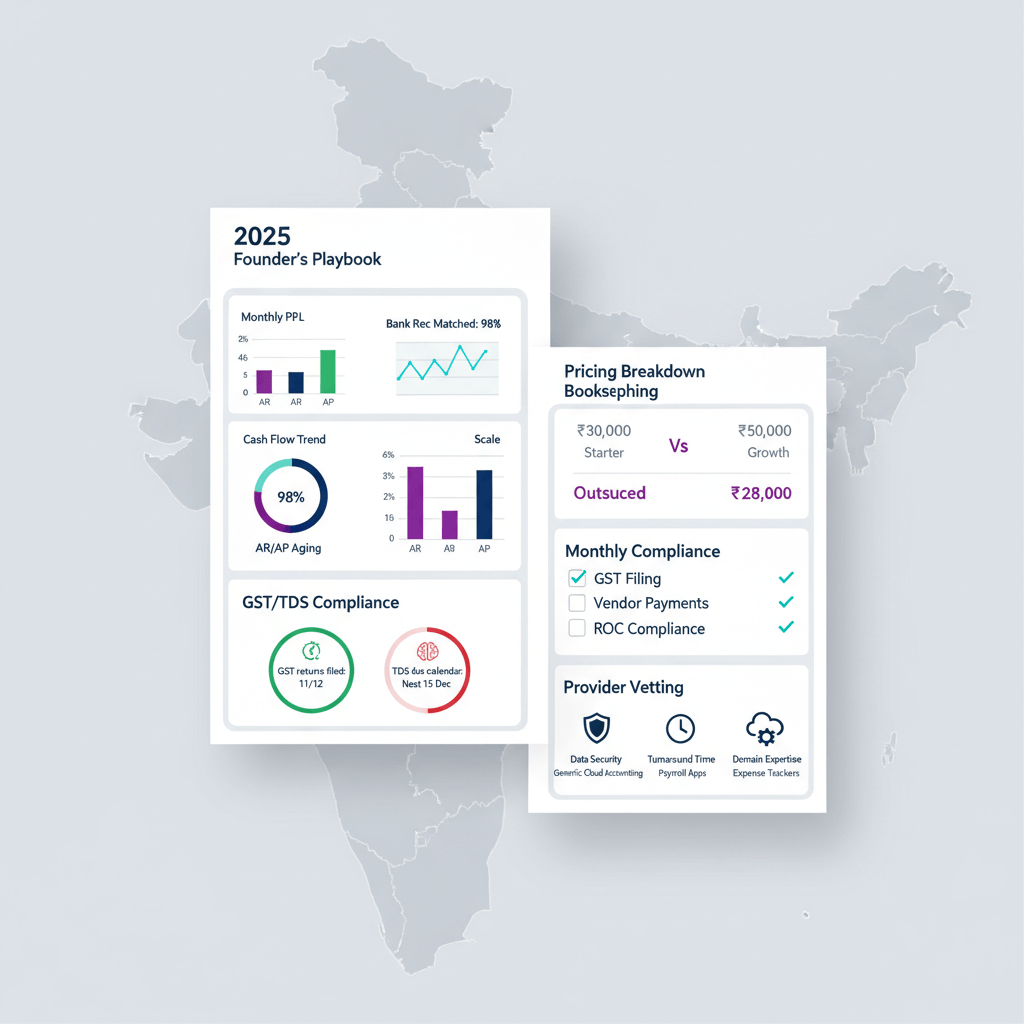
A virtual accounting model brings you a managed service with a CA team plus a dashboard, think of it as your always on finance desk. Your P and L, cash flow, burn, and runway are live. Your compliance calendar shows GST, TDS, ITR, and ROC due dates. AI alerts flag ITC mismatches, large cash outflows, or vendor issues. Bank statement analysis spots gaps. All your documents sit in one place, and you can chat with your CA team in the same system. Read a primer in AI Accountant’s virtual accounting overview.
A typical workflow you can trust
Onboarding
Data is gathered and cleaned, past returns and ledgers are reviewed, masters are set up, and gaps are fixed so you start from a clean base.
Monthly
Bookkeeping is completed, banks and gateways are reconciled, GST and TDS work is prepared and filed, MIS updates and alerts are shared.
Quarterly and year end
Books are closed, year end adjustments are passed, ITR prep starts after ledgers finalize, annual GST and ROC work is completed, schedules and audit support are prepared.
Ongoing
Advisory runs through the year, health checks catch issues early, and the team guides you on e invoicing, ITC rules, thresholds, and sector nuances.
How AI Accountant fits this model
AI Accountant delivers this model end to end. A CA led team executes accounting, GST, TDS, ITR, payroll, and ROC. The dashboard shows revenue, expenses, profit or loss, balances, cash flow trends, burn, runway, and recent transactions. You see bank statement insights, store and search documents, view due dates and filing status, and message the CA team inside the system. AI insights and alerts help you act early.
Outcome: predictable filings, recovered ITC, and audit ready books, with founders seeing cash clarity every day.
Documents and data you need to share
- KYC and registrations, PAN, TAN, GST, IEC if any, and bank KYC details.
- Past records, prior year financials, ITR copies, audit reports if any.
- GST and TDS history, past returns, challans, e invoice logs.
- Current books, trial balance, ledgers, vouchers, bank and UPI statements.
- Assets and inventory, fixed asset register, purchase bills, depreciation method, inventory movement.
- Payroll, salary master, Form 16, 12BA if relevant, proof collection process.
- Tax information, Form 26AS and AIS, customer and vendor contracts for tax treatment.
Provide these in soft form, keep folders tidy, and use a simple naming rule by year and month. For outsourcing readiness ideas, see Outsource Tax Return.
Compliance calendar and timelines
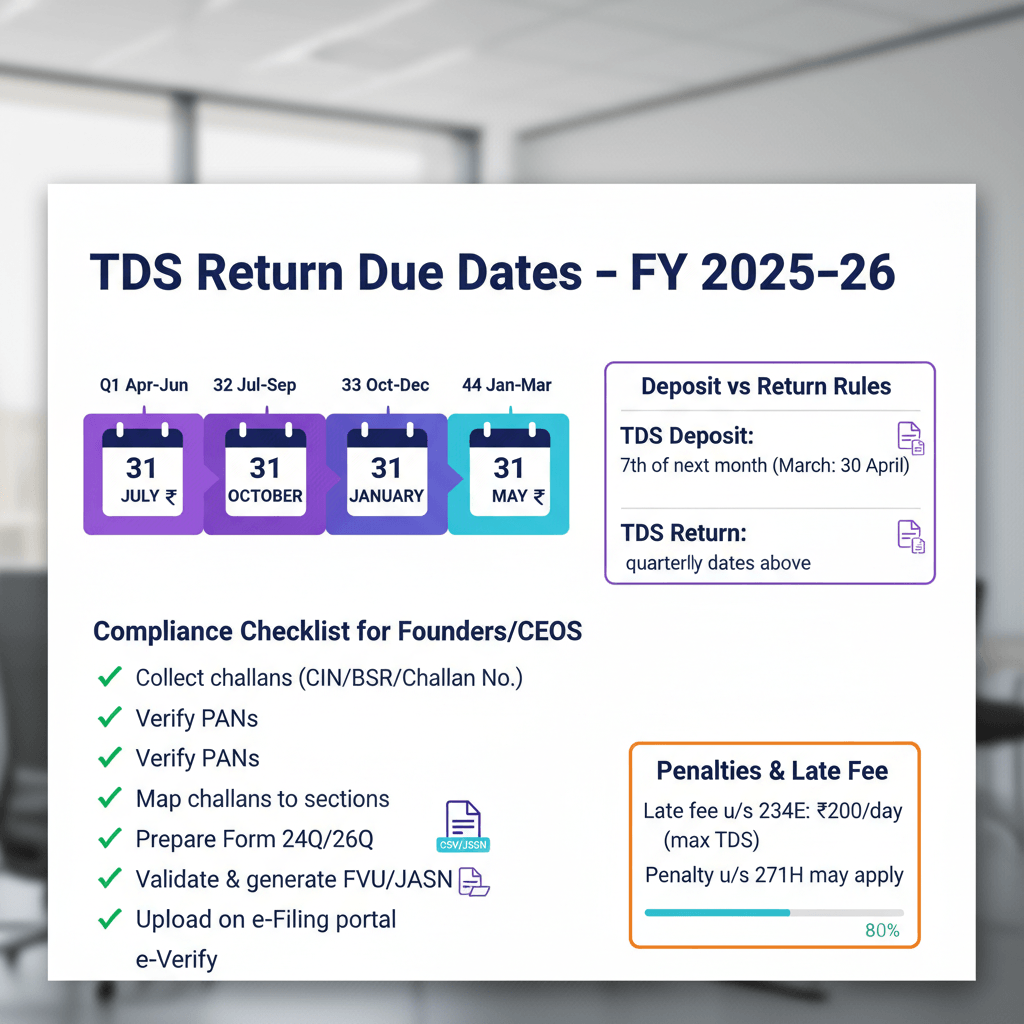
- Monthly or quarterly, GSTR 1 and 3B as per scheme, TDS deposits and returns like 24Q and 26Q on schedule.
- Advance tax, installments in June, September, December, and March, plan cash ahead.
- Income tax returns, July 31 for non audit, October 31 for audit, prep starts after books close.
- ROC filings for companies, AOC 4 and MGT 7 by end of October in the usual cycle, keep board and AGM minutes ready.
Dashboards can automate reminders and show filing status, reducing misses. For a quick compliance scope check, review AG FinTax.
Optimization and pitfalls
Income tax optimization
Choose presumptive or regular based on margins and record quality, document expenses and depreciation, and pay advance tax on time to avoid interest.
GST optimization
Use correct HSN or SAC, reconcile GSTR 2A and 2B to capture all ITC, track RCM and pay when due, and prepare early for e invoicing thresholds.
TDS optimization
Watch sections and thresholds across vendors and heads, apply lower TDS certificates where valid, and map masters to correct sections.
Payroll optimization
Structure salaries in a tax efficient way, collect Form 12BB proofs on time, and publish a clear claim policy.
Common pitfalls
Unreconciled payment gateways leak revenue, cash expenses without proof reduce deductions, and ignored notices get costly. Keep a monthly review rhythm. See a practical checklist in Gbooks.
Industry notes
- E commerce sellers: Marketplaces collect TCS or TDS, refunds and chargebacks flow through gateways, match orders, fees, and settlements to sales and GST returns.
- SaaS and exporters: Use LUT for zero rated services where eligible, maintain proof of foreign inward remittance, confirm place of supply on cross border rules.
- Freelancers and service firms: TDS under 194J or 194R may apply, keep expense records tight, split personal and business costs cleanly.
For outsourcing context across sectors, see Meru Accounting.
Evaluating providers, a practical scorecard
- CA led team with sector depth, insist on reviewers and industry experience.
- Clear scope and SLAs, cover accounting, GST, TDS, ITR, and ROC with timelines and response windows.
- Technology and data security, central dashboard, alerts, document control, backups.
- Responsiveness and references, test during a trial, speak to current clients.
- Transparent pricing, understand retainer versus per filing, link price to volumes, registrations, and payroll size.
- Real ROI, measure avoided penalties, ITC recovery, time saved, and audit readiness in quarter one.
Compare market options on Clutch, and review outsourcing guides like Outsource Tax Return and CapActix.
Mini case vignette, virtual accounting in action
Before: A D2C startup split work across a local bookkeeper, a GST filer, and an auditor. Gateways were not reconciled, GST notices arrived every quarter, ITC was missed due to 2B mismatches, penalties piled up.
After virtual accounting: A CA team cleaned ledgers and set rules for bank and gateway mapping. All filings moved to one calendar. ITC was recovered through steady 2A and 2B checks. In twelve months, there were zero penalties. The dashboard gave cash insights and runway, the founder used that to plan growth and hiring. See similar outcomes in CapActix.
Pre tax season readiness checklist
- Reconcile books and ledgers, include payment gateways and wallets.
- Update vendor and customer masters with GST and TDS mappings.
- Collect proofs for expenses, assets, and inventory counts.
- Review 26AS and AIS, along with GSTR 2A and 2B, fix mismatches.
- Plan advance tax, agree on a filing plan with your CA team.
For a compact view of small business accounting tasks, explore Gbooks.
How AI Accountant delivers virtual accounting and tax preparation
AI Accountant is a CA led managed service. You get a dedicated CA team that runs accounting, GST, TDS, ITR, payroll, and ROC. Execution sits on a central dashboard with live revenue, expenses, profit or loss, balances, cash flow, burn, runway, category breakdowns, recent transactions, and bank statement insights. AI insights and alerts flag ITC gaps or high tax outgo, documents stay in one place, compliance dates and filing status are always visible, and you can chat with your CA team in the same system.
What we do each month
We post sales, purchases, expenses, and bank entries, reconcile banks and gateways, maintain a fixed asset register and inventory records, prepare non certified MIS for P and L and cash flow, prepare GST and TDS filings and handle challans, plan advance tax, prepare for ITR and annual GST, and for small companies we handle AOC 4, MGT 7, board records, AGM, and event filings, and we support your statutory auditor with schedules and clarity.
Who we serve
We support freelancers, startups, and growth stage companies. Founders and finance teams use the dashboard daily while our CA team runs the work in the background. This replaces scattered email, Excel, and chat threads with one steady flow, you get real time visibility and dependable compliance. Explore more at AI Accountant.
Closing thoughts and next steps
Tax preparation services work best when books are live, calendars are clear, and the CA team and founder collaborate in one place. A virtual accounting model gives you that, you get steady execution, real time visibility, and audit ready records without building an in house team.
If you want a simple way to get compliant and stay compliant, AI Accountant blends a CA led team and a powerful dashboard. Book a free demo and see how virtual accounting removes tax stress and gives you control year round at AI Accountant.
FAQ
What scope should a CA managed tax preparation engagement cover for an Indian SMB, and how does AI Accountant structure it
A complete scope includes monthly bookkeeping, bank and gateway reconciliations, GST returns like GSTR 1 and 3B, annual GSTR 9 and 9C, TDS challans and returns like 24Q and 26Q, ITR filing with advance tax planning, ROC filings for companies like AOC 4 and MGT 7, payroll and Form 16, and routine notice handling. AI Accountant delivers this as a managed service with a dashboard that tracks due dates, filings, and documents end to end.
How do founders reduce penalties and notices without hiring a large finance team
Adopt a virtual accounting model with a CA led team, insist on a monthly close, automate reconciliation of banks and gateways, and use a compliance calendar with alerts. AI Accountant’s dashboard flags ITC gaps, due dates, and cash outliers, so issues are fixed before they become notices.
What is the fastest way to migrate mid year, and what data must we provide
Start with a scoped migration checklist, share PAN, TAN, GST, prior year financials and ITRs, challans and returns for GST and TDS, current trial balance and ledgers, bank and UPI statements, fixed asset register, inventory movement, salary master, Form 16, and 26AS or AIS. AI Accountant typically completes a clean onboarding in one to two weeks, depending on ledger quality.
How do CAs decide presumptive versus regular taxation for a small business
Evaluate margins, record robustness, and growth plans. If margins are thin or records are weak, presumptive can simplify compliance, but where ITC benefits and accurate expense capture matter, regular taxation is better. AI Accountant’s CA team models both scenarios and shows tax and cash impacts before you choose.
What controls ensure we capture full GST ITC without risking disputes
Run monthly 2A and 2B reconciliations, map vendor masters to correct GSTINs and HSN or SAC, process RCM correctly, and track e invoicing thresholds. AI Accountant automates reconciliation checks and the CA team follows up on vendor compliance so eligible ITC is claimed on time.
How should a finance head think about TDS leakages across sections and vendors
Centralize vendor and customer masters with section wise mappings, monitor thresholds for sections like 194C, 194J, and 194R, apply lower deduction certificates where available, and tie TDS timelines to cash disbursals. AI Accountant’s workflow and alerts keep TDS right sized while avoiding interest or late fees.
What ROC and secretarial hygiene is necessary for small companies to stay diligence ready
Maintain digital minute books, board and AGM records, director KYC, and event filings for director or share changes, then file AOC 4 and MGT 7 on time. AI Accountant maintains registers and schedules, making diligence and funding processes smoother.
How do we reconcile marketplace sales and payment gateways without revenue slippage
Use order level matching of marketplace reports to bank or gateway settlements, map fees and chargebacks, and align recognized revenue with GSTR 1. AI Accountant sets reconciliation rules and validates variances, preventing under reporting and missed TCS or TDS adjustments.
What timelines should a founder lock in for quarter end and year end to avoid last minute ITR rush
Close books within seven to ten days of month end, finish quarter end adjustments within two weeks, and start ITR prep immediately after year end close. AI Accountant’s calendar enforces this cadence and shows progress for each filing so nothing slips.
How does an AI enabled virtual service like AI Accountant prove ROI in quarter one
Track penalties avoided, ITC recovered, reconciled revenue versus gateway variances, time saved for the founder, and audit readiness scores. AI Accountant reports these metrics in the dashboard, including cash forecast improvements linked to advance tax planning.
What security and access controls are reasonable when outsourcing accounting and tax work
Use role based access to ledgers and documents, bank feeds with read only tokens, encrypted document storage, and exportable backups. AI Accountant provides controlled access, with an audit log of changes and uploads.
Can AI Accountant coordinate with our statutory auditor and existing tools like Tally or Zoho
Yes, the CA team prepares schedules and tie outs for statutory audit, and the workflow ingests exports from common systems like Tally or Zoho. The dashboard centralizes documents and reconciliations, reducing auditor queries and back and forth.