-01%201.svg)
Key Takeaways
- Tally is the system of record for statutory accounting, Excel is the analysis layer that reads from Tally, not the other way around.
- ITC eligibility follows GSTR-2B, not your internal register, manual Excel matching delays detection and drives interest costs.
ControlWhat it preventsSingle source of truth to TallyParallel ledgers and unexplained variancesProtected ranges for formulasAccidental overwritesData validation on inputsInvalid dates, vendor codes, and formatsNamed ranges and documented logicModel rot when owners changeVersion naming conventionConfusion over which file was presentedCloud storage with version historyLoss from accidental deletion or overwriteMonthly tie out to Tally trial balanceDrift that becomes an audit issue
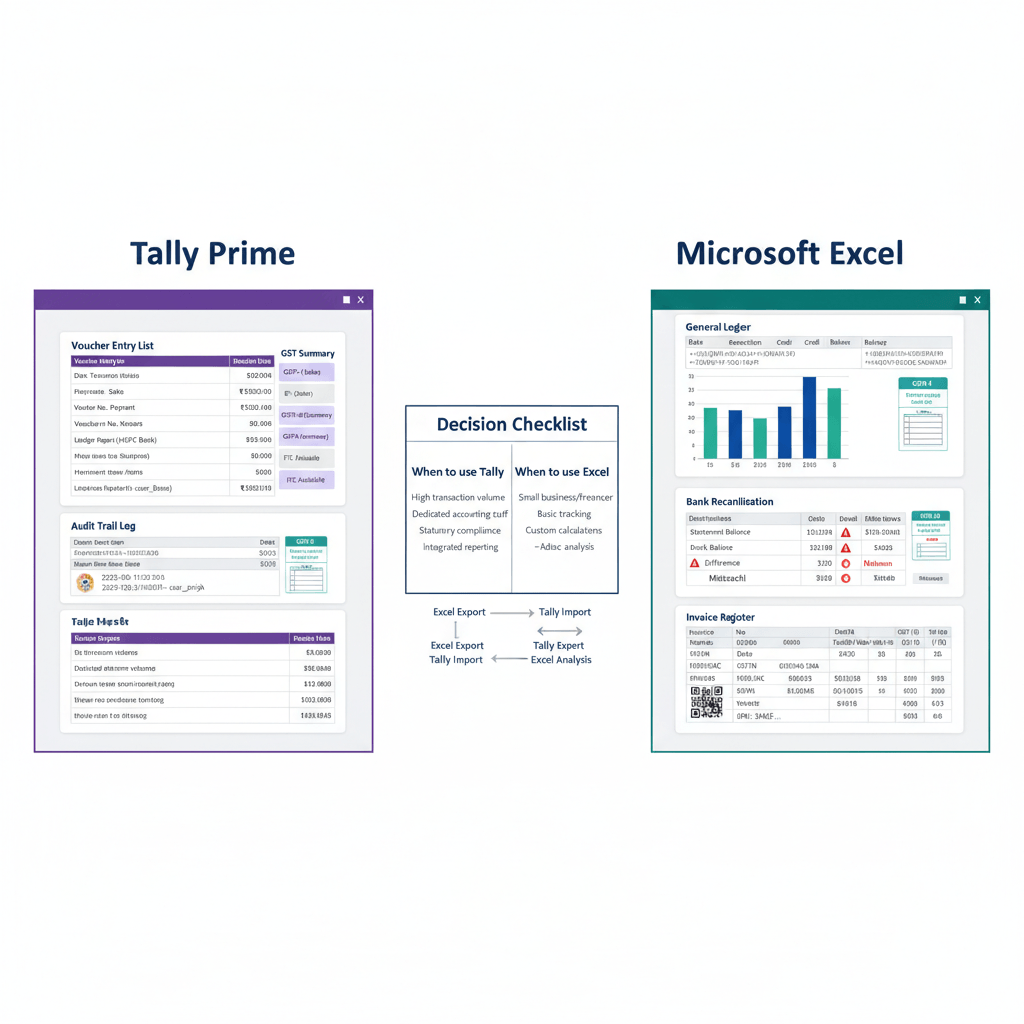
Tally vs Excel: The Short Answer
Tally is the statutory ledger, Excel is the analysis tool. Running books primarily in Excel fails the audit trail requirement for companies, and introduces operational risk once transaction volumes climb beyond minimal levels.
DimensionTally PrimeExcelStatutory books of accountYes, designed for itNo, no audit trailAudit trail (edit log)Yes, MCA compliantNo, not continuous or indelibleGST filing (GSTR-1, GSTR-3B)NativeManual export requiredGSTR-2B reconciliationNative or automatedManual comparisonBank reconciliationNative importManual entryFinancial modelling and MISLimitedStrongBudgeting and scenario analysisLimitedStrongData validation and formula integrityNot applicableUser controlledMulti-user access controlsYesLimitedRetention and retrievabilityStructuredFile management dependent
The rule most teams get wrong: never treat Excel as a parallel ledger. One direction of data flow is correct, Tally posts the entry, Excel reads the export. If a number exists only in Excel, it does not exist for statutory purposes.
Tally vs Excel: Which Should Run Your Books in India?
The Companies (Accounts) Rules, 2014, as amended by MCA Notification G.S.R. 206(E) dated 21 March 2021, require every company that uses accounting software to keep a continuously enabled audit trail that records each change with date and user identity from 1 April 2023. Excel does not offer a non-disableable, indelible edit log, therefore it fails this requirement.
The Audit Trail Rule and What It Means for Your Stack
Section 128 of the Companies Act, 2013 requires companies to maintain books of account that are readable, accessible in India, and retained for at least eight financial years. Non-compliance can expose officers in default to fines, imprisonment, or both. Tally Prime includes an edit log feature that aligns with the MCA requirement, which makes the choice straightforward for companies, Tally is mandatory, Excel is supplementary. If you are still on an older edition, review our Tally ERP 9 vs Tally Prime upgrade guide to stay compliant.
What This Means for Proprietorships and Partnerships
Proprietorships and partnerships are outside the Companies Act audit trail rule, however GST record accuracy and retrievability under Sections 35 and 36 of the CGST Act still apply. If your purchase register in Excel does not match GSTR-2B, your ITC is at risk. Tally produces purchase registers and GST reports natively, which removes one manual reconciliation step.
The System of Record Principle
One system owns every posted transaction, all other systems read from it. For Indian statutory accounting, Tally is the owner, Excel receives exports for analytics and MIS. The moment Excel contains entries that are not posted in Tally, you create reconciliation risk and a compliance gap.
Day to Day Finance: Where Excel Cracks on AP, Bank, and GST
In daily workflows, Excel introduces risk in three places, accounts payable ingestion, bank reconciliation, and GSTR-2B matching. Each failure comes with a predictable cost in hours, blocked ITC, or interest. If you want this work to run in the background, consider bookkeeping automation.
The Comparison: Excel Method vs Tally Native Method
TaskExcel MethodTally Native or Automated MethodRisk or CostAP ingestionManual entry into spreadsheets, separate vendor trackingBulk PDF and scan ingestion with OCR, automated posting to Tally, vendor mismatch flagsHigh error rate, missed discounts, poor liability visibilityBank reconciliationManual copy paste of statements into Excel, offline matchingAutomated statement import, AI matching, entries created directly in TallyReconciliation gaps, delayed close, fraud windowGSTR-2B matchingDownload from portal, manual comparison to purchase registerAutomated comparison, mismatch tagging, JV and credit note proposalsITC loss, interest on wrongful availment, filing revisions
AP Ingestion: The Manual Entry Tax
Every invoice keyed into Excel is usually keyed again into Tally, or worse, never posted. A team processing 800 invoices per month at four minutes each spends more than 50 hours on data entry before reconciliation. Errors in vendor codes, GSTINs, or invoice amounts cascade into GSTR-2B mismatches that block ITC. AiA ingests bills in bulk, extracts key fields, flags vendor mismatches, and posts to Tally with ledger prediction, so AP, bank ingestion, and Tally sync run in one flow. See vendor bill matching.
Bank Reconciliation: Time Drain with a Fraud Window
Manual bank reconciliation involves formatting statements, line by line matching, then chasing exceptions. At 500 bank lines per month, this takes 10 to 15 hours for a skilled accountant. Unreconciled entries beyond 30 days expand the window for duplicate payments and missed inflows. For a step by step playbook, read our bank reconciliation and statement automation guide.
GSTR-2B Matching: Where ITC Goes Missing
ITC eligibility follows your GSTR-2B, as clarified in CBIC Circular 237/31/2024 dated 15 October 2024. If a supplier files GSTR-1 late or incorrectly, the invoice will not appear in your GSTR-2B, and you cannot avail ITC until it does. Interest at 18 percent per annum applies on delayed tax payment, and 24 percent per annum applies on wrongful ITC availment or utilisation under CBIC Circular 238/32/2024 dated 15 October 2024. For the practical rule of thumb, see 2A vs 2B GST rules to avoid wrong claims and reversals.
Cost Reality: Licences vs Hidden Hours, Interest, and ITC Leakage
Licence fees are visible, the real cost of Excel based operations shows up as staff hours, blocked ITC, interest on wrongful availment, and late filing risk.
The ₹2 Crore Monthly Purchase Scenario
Assume ₹2 crore of monthly purchases at 18 percent GST, ₹36 lakh of potential ITC.
Cost itemCalculationMonthly costBlocked ITC5 percent of ₹36 lakh₹1.8 lakh tied upInterest if wrongfully availed₹1.8 lakh × 24 percent ÷ 12₹3,600If blocked for 6 months₹1.8 lakh × 18 percent × 6 ÷ 12₹16,200 total interestStaff time for manual AP, bank, GSTR-2B80 hours × ₹375 per hour₹30,000Total visible and hidden cost₹33,600+ per month, plus working capital strain
Total visible and hidden cost
₹33,600+ per month, plus working capital strain
Late Filing Adds Another Layer
Under Section 47(2) of the CGST Act, late fee applies for delayed filing of GSTR-9. Computation details are set out in CBIC Circular 246/03/2025 dated 30 January 2025. Manual reconciliation that slows annual return preparation compounds this risk.
E-Invoicing Adds Compliance Pressure at ₹5 Crore Turnover
Above the Rule 48(4) threshold, every B2B invoice must have an IRN from the IRP, an invoice without an IRN is invalid and your buyer cannot claim ITC. The penalty for not issuing a proper invoice is ₹10,000 per instance under Section 122 of the CGST Act. If AP is processed in Excel without IRN validation, you risk booking ITC on invalid invoices.
The Three-Point Check
If ₹50,000 or more in ITC sits blocked monthly, GST reconciliation in AiA tags each line by status, proposes JVs or credit notes, and posts cleaned entries back to Tally without creating a parallel spreadsheet.
Where Excel Still Wins and How to Keep It Clean
Where Excel Has No Substitute
Tally Prime supports export to Excel and CSV, and ODBC connectivity lets Excel query Tally data directly, which enables real time MIS without manual copy paste.
The Control Checklist for Clean Excel Use
ControlWhat it preventsSingle source of truth to TallyParallel ledgers and unexplained variancesProtected ranges for formulasAccidental overwritesData validation on inputsInvalid dates, vendor codes, and formatsNamed ranges and documented logicModel rot when owners changeVersion naming conventionConfusion over which file was presentedCloud storage with version historyLoss from accidental deletion or overwriteMonthly tie out to Tally trial balanceDrift that becomes an audit issue
The Institute of Chartered Accountants of India has consistently treated manual spreadsheets as high risk in internal financial controls guidance. While no specific quantified error rate is prescribed, compensating controls such as restricted access, versioning, and periodic reconciliation to the primary accounting system are expected.
Your Decision Framework: Pick the Right Stack for the Next 24 Months
The practical model is simple, Tally is the statutory ledger, Excel is the analysis layer, and automation handles ingestion, reconciliation, and GST matching. Use the thresholds below to decide when each layer becomes essential.
The Decision Framework by Business Type and Volume
If you are a Company: Tally, or equivalent audit trail compliant software, is mandatory from 1 April 2023. Excel only books do not satisfy the Companies (Accounts) Rules, 2014, and the auditor reports on this under Rule 11(g) of the Companies (Audit and Auditors) Rules, 2014.
If you are a Proprietorship or Partnership:
VolumeInvoices per monthBank lines per monthVendor countRecommendationLowUnder 200Under 100Under 20Tally for core books, Excel for analysis and MIS, manual GST matching is manageable with discipline.Medium200 to 1,000100 to 50020 to 100Tally for all accounting operations, add automation for AP and bank, Excel matching will leak ITC.HighOver 1,000Over 500Over 100Tally with full automation for AP, bank, and GSTR-2B, Excel operations at this scale are unsustainable.Complex GST structureAnyAnyAnyWith multi state GSTINs, RCM, or e commerce TCS, automate immediately, Excel reconciliation is not viable.
GST Record Retention Applies to Both Systems
Under Section 36 of the CGST Act, retain records for 72 months from the due date of the annual return. Companies must also meet Section 128 of the Companies Act, eight financial years. Your system must produce complete, readable records for the longer of the two periods.
The Two-Year Stack Decision
This is the tally and excel difference in practice, Tally keeps you compliant with clean, real time books, Excel turns those books into insight, automation moves data from invoices and bank statements into Tally without manual touch.
Anything outside this model is risk.
References
FAQ
What is the main difference between Tally and Excel for accounting?
Tally is purpose built accounting software with a double entry engine, GST filing integration, an audit trail, and statutory reports. Excel is a general spreadsheet that relies on user built formulas, it has no indelible audit trail or native GST connectivity. For Indian companies, Tally satisfies the Companies (Accounts) Rules, 2014 audit trail requirement, Excel does not.
Can my CA audit Excel based books for a company?
Your auditor can review any records, however under Rule 11(g) of the Companies (Audit and Auditors) Rules, 2014, the auditor must report whether the accounting software had a continuous audit trail throughout the year. If books sit primarily in Excel, the report will be qualified, which creates downstream issues with lenders and investors.
What happens if I avail ITC in GSTR-3B but it is not showing in GSTR-2B?
It is excess ITC availment. Interest at 24 percent per annum under Section 50(3) of the CGST Act applies on wrongful ITC availment or utilisation from the date of availment until reversal. Clarifications are provided in CBIC Circular 238/32/2024. Always check GSTR-2B before filing GSTR-3B.
Is there a penalty for not enabling audit trail in Tally for a company?
Penalties arise through failure to maintain proper books under Section 128 of the Companies Act, 2013, which can mean fines, imprisonment, or both for officers in default. Separately, a qualification under Rule 11(g) is recorded in the statutory audit report, which can trigger MCA attention.
How do I reconcile GSTR-2B mismatches if I find them after filing GSTR-3B?
Reverse the excess ITC in the next GSTR-3B and pay interest at 18 percent per annum under Section 50(1). If the availment is deemed wrongful, the interest rate is 24 percent per annum under Section 50(3). Coordinate with suppliers to correct their GSTR-1 so the invoice appears in a subsequent GSTR-2B, then re-avail ITC in that period.
Can I do manual GSTR-2B matching in Excel if I have under 100 vendors?
It is possible, however the risk is process reliability. A single missed ₹5 lakh invoice blocks ₹90,000 of ITC and, if wrongly availed, attracts interest at 24 percent per annum. Automated or Tally native reconciliation reduces month end scramble and avoids human error.
Does e-invoicing change how I manage AP, and is Excel sufficient?
Above the ₹5 crore threshold in Rule 48(4), every B2B invoice must carry an IRN from the IRP, an invoice without one is invalid and ITC will be denied to your buyer. Managing inbound IRN validation in Excel is error prone. Use Tally for outbound e-invoices and an automated AP layer to check IRNs on inbound invoices.
How long must I retain records under GST, and does Tally help?
Records must be retained for 72 months from the annual return due date under Section 36 of the CGST Act. Companies must also meet eight financial years under Section 128 of the Companies Act. Tally’s structured database is easier to retrieve reliably over time than scattered Excel files.
Can I compute payroll in Excel and post summaries to Tally?
Yes. Compute payroll in Excel, then post one journal voucher per period in Tally for salary expense, statutory deductions, and net payables. Keep the Excel file as supporting documentation, and let Tally hold the audited numbers with an edit log.
What is the fastest path to compliance if I currently run books in Excel?
For a company, open a Tally company immediately, enable the audit trail, import or enter opening balances, and post all new transactions in Tally going forward. Retain historic Excel files as support and have your CA validate the opening balances. Do not prolong the audit trail gap, move new activity into Tally now.
Where does AI Accountant fit if I already use Tally?
Tally covers statutory accounting and filings. If your team spends over 20 hours a month on AP data entry, GSTR-2B matching, or bank reconciliation, add an automation layer. AiA ingests invoices, reconciles GSTR-2B with proposed entries, imports bank statements, and posts cleanly to Tally, removing parallel spreadsheets and saving staff hours.

Rohan Sinha is a fintech and growth leader building aiaccountant.com, focused on simplifying accounting and compliance for Indian businesses through automation. An IIT BHU alumnus, he brings hands-on experience across 0 to 1 product building, growth, and strategy in B2B SaaS and fintech.