-01%201.svg)
Key takeaways
- CA-led Virtual Accounting gives founders peace of mind, the AI dashboard is for visibility, tracking, and comfort, while qualified CAs actually do the bookkeeping, GST, TDS, income tax, and compliance.
- Compliance switches on with scaling triggers, watch turnover, employee count, new states, fundraising, and cross border activity so filings stay clean.
- A simple AI-enabled compliance map, paired with clean books and proofs, prevents penalties and keeps investor diligence smooth.
- Use the dashboard as your early-warning system, but rely on your CA team to execute filings, reconcile accounts, and handle notices end to end.
- Link each trigger to the exact filing and date, for example GSTR 1, GSTR 3B, TDS by the 7th, PF by the 15th, PAS 3 within 30 days after allotment.
What is CA-led Virtual Accounting with AI dashboards?
CA-led Virtual Accounting means a Chartered Accountant team runs your books and compliance end to end, while you get an AI dashboard for transparency. The dashboard shows status, exceptions, and upcoming filings, but founders do not do accounting themselves. The CA team prepares ledgers, reconciles banks, files GST and TDS, closes months, and handles notices.
Why this model works for Indian startups: growth flips on new obligations, and experts keep pace while the dashboard keeps you informed. Guides like building a scalable compliance framework for startups and SMBs and legal compliance for startups outline these triggers, our CA team operationalizes them.
Use the dashboard to see what’s due, what’s filed, and what’s at risk, then let your CA team do the heavy lifting.
Scaling triggers and why the dashboard matters
As revenue, headcount, and reach grow, new filings and controls switch on. Triggers include turnover limits, employee count, new states, fundraising, and cross border activity. If you miss a trigger, you face cash blocks, GST credit losses, notices, or investor delays. The dashboard flags a trigger early, the CA team completes registrations and filings.
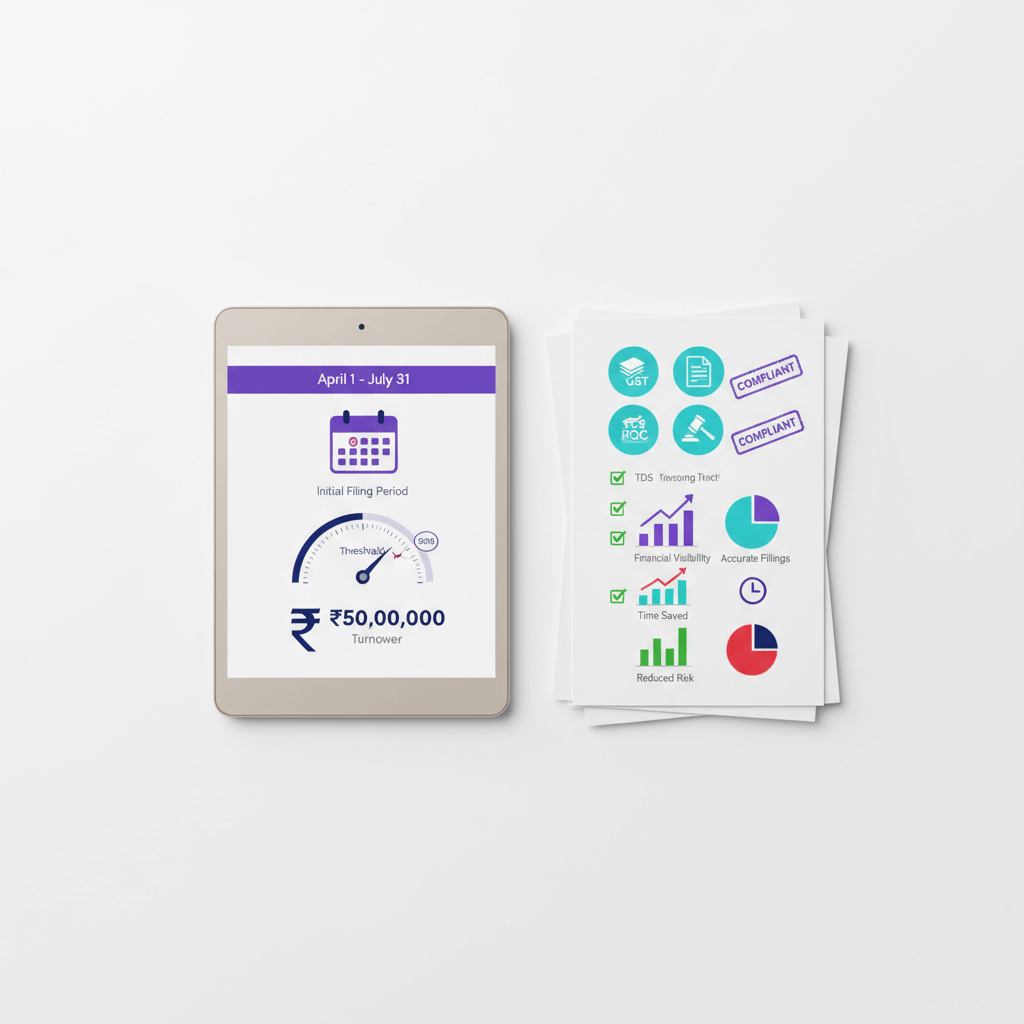
- Revenue thresholds: GST registration for services at ₹20 lakh, goods at ₹40 lakh in most states, with interstate sales creating new state nexus. See GST compliance services in India.
- Employee headcount: ESIC at 10 employees, PF at 20, with wage limits and due dates; see payroll compliance support under Section 192.
- New states or branches: separate GSTIN and local labour registrations.
- Fundraising and cap table changes: ROC filings such as PAS 3 within 30 days, more in ROC and secretarial support in India.
- International activity: FEMA and transfer pricing documentation, see legal compliance for startups.
Common miss: interstate sales start, but no new GSTIN is taken, or payroll doubles without PF and ESIC setup. The dashboard spots it, the CA team fixes it.
Tax compliance that accelerates with revenue and reach
Tax rules link obligations to scale so tax is collected and reported on time. Turnover and geography drive GST, profit and payments drive income tax and TDS. For specifics, refer to GST compliance services in India and broader context in legal compliance for startups.
- GST registration triggers: services at ₹20 lakh, goods at ₹40 lakh in most states, interstate sales create a registration need in the new state.
- GST return cadence: GSTR 1 commonly due around the 11th, GSTR 3B around the 20th of the next month, filed per GSTIN for multi state operations.
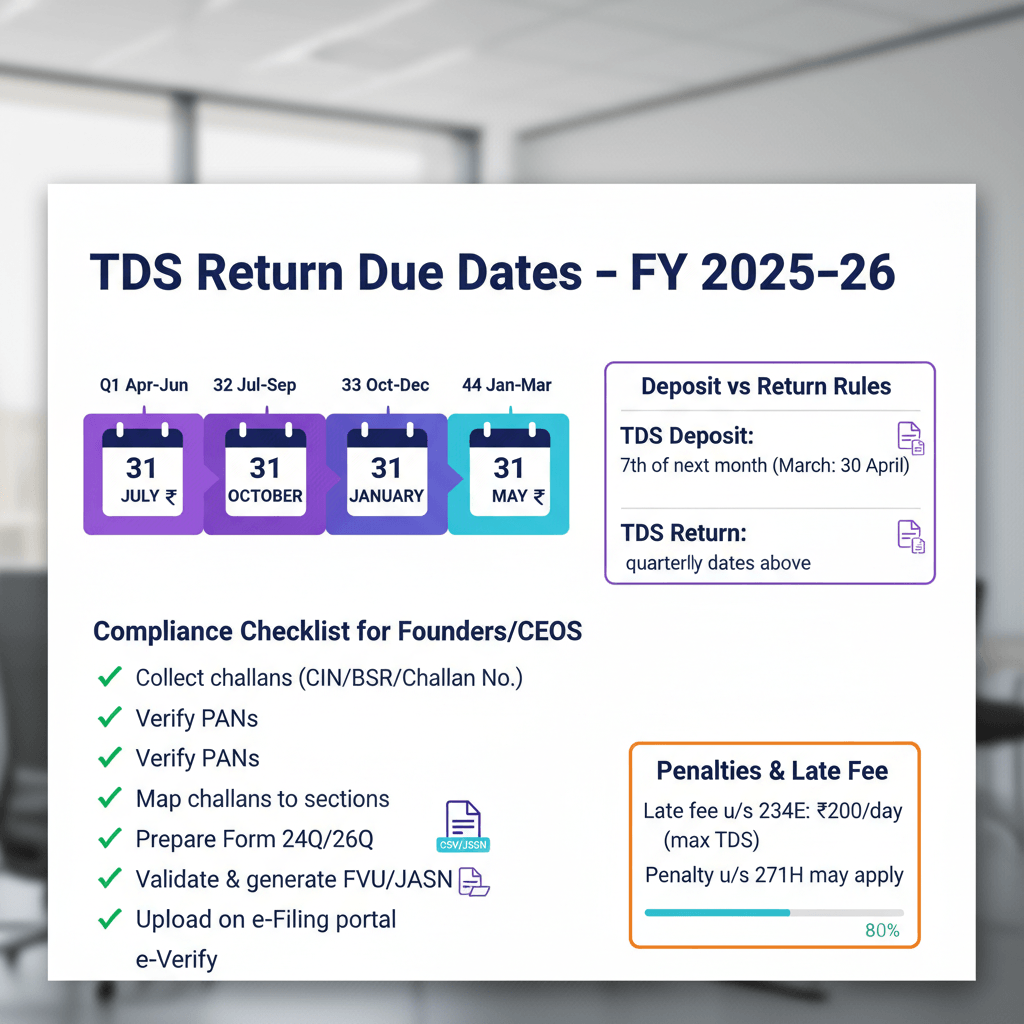
- Direct tax: if estimated total tax exceeds ₹10,000, pay advance tax quarterly, deduct and deposit TDS by the 7th of the following month.
- New jurisdictions: each state needs a GSTIN and may need Professional Tax and Shops registrations.
The AI dashboard surfaces upcoming GST and TDS deadlines, exceptions in input credits, and mismatch alerts, your CA team validates and files.
Payroll and employment obligations triggered by headcount
Labour laws protect employees and ensure social security, PF and ESIC kick in at clear counts. Ignoring these leads to notices, disputes, and tax errors. For monthly steps and Section 192 handling, see payroll compliance support under Section 192.
- PF and ESIC: EPF at 20 employees, ESIC at 10, subject to wage limits.
- Professional Tax: state dependent triggers, confirm local schedules.
- Monthly payments: deposit PF by the typical 15th, ESIC by the typical 15th, TDS on salaries by the 7th.
- POSH: 10 or more employees requires a POSH policy and Internal Committee.
- Classification and local registrations: correctly classify workers, obtain Shops and Establishments licenses per state.
Corporate governance obligations that scale with the startup
Company law expects board oversight and transparent records. As capital and locations grow, cadence and filings tighten. Guidance appears in building a scalable compliance framework for startups and SMBs.
- Boards and meetings: hold at least 4 board meetings yearly and 1 AGM, keep minutes and attendance.
- ROC filings on events: file PAS 3 within 30 days of share allotment and ADT 1 on auditor changes, read more in ROC and secretarial support in India.
- Subsidiaries and branches: obtain DIN as relevant, register with ROC, and remember state registrations for branches, not just a postal address.
Missed governance filings stall diligence, the dashboard shows pending forms, the CA secretarial team executes.
Financial reporting and audit triggers as you scale
Audits and stronger controls protect stakeholders as money flows increase. Confirm thresholds under current law, but prepare for accrual books, Ind AS alignment where applicable, documented controls, and clear invoice trails.
- Audit triggers: certain turnover or capital thresholds depending on entity type, confirm exact limits under current law.
- What auditors expect: timely bank reconciliations, schedules for revenue, GST, TDS, payroll, fixed assets.
- Infrastructure matters: clean startup accounting infrastructure makes audits faster and reduces adjustments and penalties, see systematic approaches in building a scalable compliance framework for startups and SMBs.
Fundraising and equity or ESOP compliance events
When you raise capital or issue options, law requires transparent records so ownership and money flows are clear. Your CA and company secretarial team keep filings and registers aligned.
- ROC filings: file PAS 3 for return of allotment within 30 days after share issue, supported by board and shareholder approvals, see ROC and secretarial support in India.
- Private placement and ESOP: maintain approvals, grant documentation, exercise and allotment proofs, and valuation approaches like DCF as referenced by sources such as legal compliance for startups.
- Cap table and reporting: reconcile registers with every issue, transfer, or exercise, share simple quarterly P and L and balance sheet with investors.
Cross border expansion, FEMA and transfer pricing triggers
Foreign exchange controls and transfer pricing rules ensure proper reporting of overseas receipts and related party pricing. Bank channels, RBI linked reports, and documentation are essential, more detail in legal compliance for startups.
- FEMA reporting: route export proceeds and outbound remittances via banking channels, file reports within timelines tied to transaction type.
- Transfer pricing: maintain documentation, justify pricing with foreign related parties, assess Permanent Establishment risk as presence grows.
- Practical cue: standardize invoice, contract, and bank proof bundles for each foreign receipt and payment.
Data protection obligations as user volume grows
More users mean more personal data. The DPDP Act expects consent, purpose limits, and fast response to requests and breaches. Implementation playbooks are captured in building a scalable compliance framework for startups and SMBs.
- DPDP basics: obtain clear consent, give notices, honor access or deletion requests as per law.
- Scale triggers: appoint a Data Protection Officer when processing is significant, and treat 72-hour breach notifications as a guardrail.
- Contracts: add data processing addendums with customers and vendors defining roles, security, and breach duties.
Multi state operations and industry licensing triggers
New states and regulated sectors bring local and sector regulators. Licenses gate entry, missing them blocks invoices and payments. Learn the checklist in legal compliance for startups and building a scalable compliance framework for startups and SMBs.
- New states: obtain a new GSTIN, Professional Tax registration, and Shops and Establishments license per state, update invoices and returns per GSTIN.
- Regulated sectors: fintech may need RBI Payment Aggregator approvals, food needs FSSAI, life sciences often need CDSCO.
- Operational cue: run a short licensing check before launching a new line or region, file applications early.
Compliance cadence, monthly, quarterly, annual
A fixed rhythm keeps cash and filings on time. Once a trigger turns on, the calendar keeps you compliant. See cadence context in legal compliance for startups and building a scalable compliance framework for startups and SMBs.
- Monthly: deposit TDS by the 7th, file or pay GST around the 11th and 20th depending on scheme, deposit PF and ESIC by typical due dates around the 12th to 15th.
- Quarterly: pay advance tax in June, September, December, and March, under QRMP file GSTR 3B quarterly with monthly payment.
- Annual: file ITR by July 31 for non audit cases, ROC annual returns such as AOC 4 and MGT 7 within cited timelines, complete audit within the statutory window.
The dashboard shows a rolling calendar and status, while your CA team crosschecks challans, reconciles ledgers, and files returns.
Evidence and recordkeeping as obligations scale
Proofs close audits and finish diligence fast. Without records, compliant work can still fail checks. See recordkeeping fundamentals in building a scalable compliance framework for startups and SMBs.
- Keep proofs: GSTR filings, ITR acknowledgements, TDS returns and challans, PF and ESIC challans, board and AGM minutes, payroll registers, key contracts.
- Retention: 8 years for GST, 10 years for income tax, keep core corporate records long term.
- Storage: use a digital repository linked to your accounting infrastructure so documents are retrievable in minutes.
Frequent scaling pitfalls and how to avoid them
Most penalties come from recurring misses that are easy to prevent with a checklist. Practical pitfalls are captured in legal compliance for startups and building a scalable compliance framework for startups and SMBs.
- Missing state registrations: interstate sales or branches without new GSTIN or Shops registration, fix with a pre launch registration check.
- Contractor misclassification: treating employees as contractors leads to wrong TDS and missing PF or ESIC, classify roles correctly and issue Form 16A where applicable.
- Late filings: per day penalties and interest across GST, TDS, and ROC, maintain a compliance calendar reviewed weekly.
- Cap table errors: after a raise or ESOP exercise, registers and PAS 3 do not match, reconcile quarterly.
- Outdated policies: POSH or data policies not refreshed, review yearly and update training.
Build a simple compliance map linked to your scaling triggers
A one page map ties obligations to triggers, owners, and dates. It prevents misses without any tools. Templates align with advice in legal compliance for startups and building a scalable compliance framework for startups and SMBs.
- Create a spreadsheet with domains like GST, Income Tax, ROC, labour, data, FEMA.
- List the trigger for each domain, turnover above ₹40 lakh, headcount above 10 or 20, a new state, a fundraise, or overseas sales.
- Add deadlines, GSTR 1 around the 11th, TDS by the 7th, PF by the 15th.
- Assign owners, CFO for tax and payroll, CEO or Company Secretary for governance.
- Track status monthly in green, yellow, or red, review quarterly.
- Link the map to your accounting infrastructure and dashboard so numbers and documents flow smoothly.
In short
Scaling turns on new obligations at clear points, watch turnover, headcount, new states, fundraising, and cross border activity. Link each trigger to the exact filing and date, keep clean books, proofs, and a simple calendar. With a CA team in the driver’s seat and an AI dashboard for visibility, compliance stays predictable and penalty free.
FAQ
What exactly does CA-led Virtual Accounting cover versus what the AI dashboard shows?
Your CA team handles bookkeeping, monthly close, GST and TDS filings, income tax, payroll compliance, ROC and secretarial filings, notices, and reconciliations. The AI dashboard surfaces visibility, upcoming due dates, exceptions, and filing status, it is not a do-it-yourself tool for founders.
When do we need GST registration for services or goods, and how will the dashboard alert us?
In most states, services trigger GST at ₹20 lakh turnover, goods at ₹40 lakh. Interstate sales add state nexus that often requires a new GSTIN. The dashboard flags approaching thresholds and interstate invoices, while the CA team completes registrations and starts GSTR 1 and GSTR 3B filing, see GST compliance services in India.
We crossed 20 employees, what flips on for PF and payroll compliance?
EPF registration becomes mandatory at 20 employees, ESIC at 10 subject to wage limits. Your CA payroll desk sets up registrations, computes deductions, deposits PF and ESIC, and files returns. Founders view status and challans on the dashboard, see payroll compliance support under Section 192.
How do multi state operations change our GST and labour footprint?
Each state generally needs its own GSTIN, Professional Tax registration, and Shops and Establishments license. The CA team obtains registrations, updates invoice series, and files returns per GSTIN, while the dashboard shows state wise compliance health.
What ROC filings appear after fundraising, and who manages PAS 3?
After share allotment, PAS 3 must be filed within 30 days, along with proper board and shareholder approvals. Your CA secretarial team drafts forms, tracks timelines, and maintains statutory registers. The dashboard shows form readiness and filing confirmations, read more in ROC and secretarial support in India.
How do we handle FEMA and transfer pricing when exporting or working with a foreign affiliate?
Route payments through banking channels, file RBI linked reports per transaction, and maintain transfer pricing documentation for related party transactions. The CA team prepares documentation and filings, the dashboard lists deadlines and required proofs, context in legal compliance for startups.
What’s the monthly and quarterly compliance rhythm we should expect?
Commonly, TDS by the 7th, GSTR 1 around the 11th, GSTR 3B around the 20th, PF and ESIC around the 12th to 15th, advance tax quarterly, and annual ITR, AOC 4, MGT 7 as per law. The dashboard keeps a rolling calendar, the CA team executes filings and reconciliations end to end.
How does the CA team prevent common scaling misses like interstate GSTIN or PF setup?
We monitor triggers inside the books, sales patterns, payroll growth, and state presence. When a threshold nears, the dashboard flags it and our CA team moves to register, update invoice templates, and initiate new return cycles, so no credit is blocked and no notice arrives.
What documentation should we retain to breeze through audits and diligence?
GSTR filings and acknowledgements, ITR and TDS challans, PF and ESIC challans and returns, board and AGM minutes, payroll registers, contracts, and cap table proofs. The CA team curates a digital repository linked to the dashboard for quick retrieval.
Does the AI dashboard replace a finance head or CA, or is it an assistant?
It is an assistant, not a replacement. Think of “AI Accountant” as an AI-enabled Virtual Accounting service where the dashboard augments a CA team by spotting exceptions and upcoming triggers, while experts do the accounting and compliance work.
How are ESOP grants and exercises tracked so PAS 3, registers, and the cap table stay in sync?
We maintain a single source of truth for grants, vesting, exercises, and allotments. The dashboard shows movements and supporting documents, while the CA secretarial desk files PAS 3, updates registers, and reconciles the cap table after each event.
What happens if a filing is late or a threshold was missed before we onboard?
We triage the backlog, compute interest and penalties, and file corrective returns or forms. The dashboard will show remediation status by domain, and your CA team will liaise with departments to close notices and restore compliance quickly.