-01%201.svg)
Key takeaways
- A management comments repository is a centralized, searchable system where your finance team stores variance explanations, strategic context, and audit narratives, replacing scattered emails, chat threads, and Excel notes with instant clarity.
- Teams that implement a structured repository save 20 to 30 hours monthly by eliminating repeated questions, reducing audit response time by roughly 50 percent, and preserving institutional knowledge when people leave.
- Success depends on simplicity: start with five to ten high impact categories, one variance template, and one platform your team already uses, then iterate based on real feedback and usage patterns.
- Connect commentary directly to financial dashboards so explanations live beside the numbers, cutting back and forth during month end reviews and board presentations.
- AI powered tools like AI Accountant's bookkeeping automation handle the heavy lifting, flagging anomalies, drafting initial explanations from transaction patterns, and prompting human verification so your team focuses on judgment rather than data entry.
- Measure ROI through time to answer, question recurrence rate, documentation completeness, and audit efficiency, then refine quarterly to keep the repository trusted and current.
Management Comments Repositories: What's New in 2026
In 2025, most Indian SME finance teams still relied on informal documentation, email threads, shared drives, or scattered spreadsheets for variance commentary. By early 2026, two regulatory shifts have forced a more structured approach.
First, the GST portal now requires more granular reconciliation narratives for ITC claims above ₹10 lakh per quarter. The GSTR-2B matching logic tightened in January 2026, meaning mismatches that previously went unnoticed now trigger automated notices. Finance teams without documented explanations for vendor discrepancies face blocked credits and interest at 18 percent per annum until resolution.
Second, ICAI's updated Standard on Auditing (SA 230) guidance on audit documentation now explicitly references digital commentary trails as acceptable evidence. Auditors increasingly request searchable, timestamped explanation logs rather than reconstructed narratives. Firms that maintain a living repository satisfy sampling requests in minutes instead of days.
The operational shift is clear: teams now need comment entries tagged to specific GSTR periods, locked after filing deadlines, and exportable for notice responses. Businesses on Tally with turnover above ₹5 crore feel this most acutely, as their transaction volumes generate more reconciliation exceptions per month.
What to do now:
- Audit your current commentary against GSTR-2B mismatches for October 2025 onward and fill gaps before your next filing cycle.
- Add a "notice response" tag to your repository so explanations can be filtered and exported when demands arrive.
- Ensure version locking activates within 48 hours of period close to satisfy the updated audit evidence expectations.
Teams using AI Accountant's GST reconciliation module already get automatic mismatch flagging with suggested narratives, making compliance with these 2026 expectations a natural byproduct of existing workflows.
The Hidden Cost of Scattered Financial Commentary
When context goes missing
Your CFO asks why receivables jumped 30% in March. The analyst who knew the story has left. The explanation hides in an old chat thread. Your controller spends hours piecing together evidence from ledger entries and vendor invoices.
This happens every month across Indian SMBs. Teams lose 15 to 20 hours chasing context that should be searchable and documented.
Information archaeology drains capacity, erodes confidence, and delays decisions. A repository replaces detective work with instant clarity.
The real impact on your finance team
- Explanation fatigue, the same questions repeat because answers are not captured once, then referenced later.
- Institutional knowledge loss, insights walk out the door when people leave, undocumented narratives disappear.
- Audit nightmares, fragmented sources force reconstruction during reviews, your team scrambles under timelines.
- Compliance risk, without documented rationale for tax positions, assessment responses take weeks instead of hours.
Why traditional methods fail
Email threads feel convenient, until you search eight months back. Excel comments break when files get overwritten. Shared drives drift into digital junkyards.
Familiar methods are comfortable, not effective. Your finance team needs a structured, searchable, and governed system that scales with transaction volumes and team changes.
What Makes a Great Management Comments Repository
Core components every repository needs
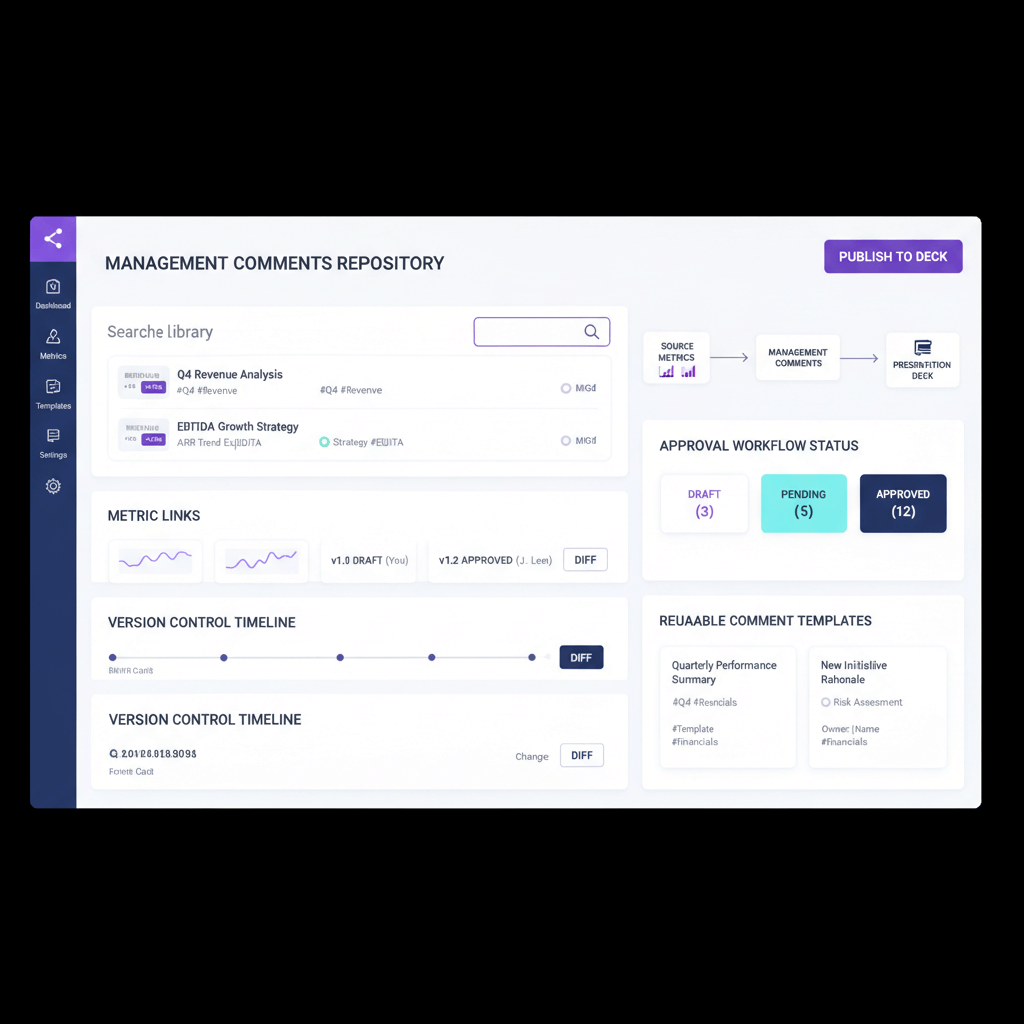
- Centralized storage, all explanations, variance analyses, and supporting notes in one place, searchable by anyone with access.
- Version control, see how narratives changed as policies evolved, maintain an audit trail for compliance.
- Search functionality, find answers fast using keywords, dates, accounts, or tags. Think Google for financial narratives.
- Access controls, protect sensitive discussions, use role based permissions for appropriate visibility.
- Integration capabilities, let comments flow between the repository and dashboards, reporting tools, and close procedures.
The architecture that works
Mirror your reporting structure. Organize by Revenue, Expenses, Balance Sheet, and Cash Flow, with subcategories aligned to your chart of accounts.
Standardize metadata: period, account code, variance amount, explanation, attachments reference, and approver. Build templates for common explanation types, including variance notes, trend narratives, and policy changes. Consistency accelerates searching and review.
Building for scale and sustainability
- Adopt clear naming conventions, for example, MAR24_REV_VAR_01, interpret at a glance.
- Implement tags for cross functional insights: GST impact, seasonal trend, one time event.
- Plan for new entities and increasing volumes. Ensure filters and views remain responsive and intuitive.
- Design for multi entity consolidation from day one if you manage more than one set of books.
Implementation Strategies for Different Platforms
Notion, the modern approach
Use a main database for comments with properties for period, category, account, variance, and explanation. Create filtered views per report or time period.
A template gallery supports monthly variances, quarterly reviews, and annual summaries. Link comments to meeting notes and initiatives for richer context. Leverage AI features to summarize long explanations for quick consumption.
Confluence, the enterprise standard
Structure spaces by fiscal year, then months or quarters. Use macros for excerpts and hierarchical views.
Apply labels consistently: board_reporting, audit_required, policy_change. Set approval flows so material variances are reviewed before publication. This maintains accuracy and accountability across large teams.
Google Workspace, the accessible option
Use a master Google Sheet with consolidated and category tabs. Drive submission through Forms to enforce data standards.
Automate alerts and summaries with Apps Script. Present a simple front end using Sites. Teams browse, search, and submit without touching complex spreadsheets.
Ensuring Adoption and Engagement
Make it stupidly simple to use
Offer one click submission, smart defaults, and immediate value. Start with high impact areas like monthly variance explanations.
The easier it is to add a comment, the faster completeness rises, and the more your team trusts the system.
Training that sticks
- Micro modules: five minute workflows covering how to add a variance comment, search historical narratives, and generate summaries.
- Short video walkthroughs: under three minutes, showing navigation and templates in action.
- Super users: champions across functions drive adoption through peer support and quick fixes.
Create a documentation culture
Leadership must use and reference repository content visibly. Celebrate wins where comments saved time or avoided errors.
Add documentation steps to checklists. Share metrics: hours saved, questions resolved, audit findings avoided. Recognition builds habit faster than mandates.
Integration with Financial Dashboards
Creating seamless connections
Connect metrics directly to relevant commentary. Place explanations one click away from the numbers they explain.
Sync comments bidirectionally. Trigger prompts when variances breach thresholds. Embed context into analysis flows. Questions reduce because answers sit beside numbers, not buried in separate systems.
Automated commentary workflows
- Set variance detection rules to request explanations from owners immediately.
- Schedule monthly comment collection campaigns. Document significant events before close.
- Use robotic process automation to draft initial explanations from transaction patterns. Teams verify and enrich.
- Publish exception reports that highlight missing comments on material variances.
Dashboard best practices
- Show comment indicators, previews on hover, and full history in drill downs.
- Enable in line editing for authorized users. Keep analysis and documentation in one flow.
- Use unique account identifiers to link dashboard tiles to repository entries without manual mapping.
Governance and Compliance
Approval hierarchies that work
- Define approval levels by materiality and sensitivity: routine variances versus policy changes.
- Use parallel approvals to avoid bottlenecks. Allow delegates to maintain continuity.
- Escalate overdue items to ensure timely resolution during busy periods.
Audit trails and version control
Track every change. Capture who changed what, when, and why. Maintain version history and lock comments after period close.
Protect integrity for compliance. Keep point in time backups for recovery. As noted in ICAI's guidance on audit documentation, digital trails with timestamps satisfy evidence requirements when properly maintained.
Compliance considerations in India
- Align commentary with GST filing narratives. Justify input tax credits with clear explanations tied to GSTR-2B reconciliation.
- Document TDS, TCS reconciliation notes, certificates, and corrections. Support assessments with structured entries.
- Prepare for statutory audits: explain unusual transactions, related party dealings, and estimates with dated narratives.
- Record transfer pricing rationale for international transactions. Support margin and royalty discussions with version controlled documentation.
Real World Success Patterns
The growing SaaS company
A Bangalore SaaS firm built a structured Notion repository for MRR movements, churn analysis, and CAC payback commentary. Board members accessed explanations directly.
Reporting time fell by 40 percent. Audits became smoother. The team flagged bank anomalies, drafted explanations from transaction patterns, and prompted human verification for accuracy.
The multi unit retail chain
A 50 store chain shifted to Google Workspace. Store managers submitted commentary through Forms using standardized templates.
The structure revealed seasonal trends and regional patterns. Dashboards surfaced local explanations beside performance tiles. Managers focused on improvements instead of repeated clarifications.
The manufacturing SME
A Pune auto components maker used Confluence with bilingual templates. Automated translation supported a Japanese partner.
Month end reporting dropped to one day. Recurring issues surfaced through structured narratives: vendor quality patterns and maintenance cycles that previously went undocumented.
Building Your Repository Today
Week 1, foundation setting
- Select a platform based on comfort and existing tools. Do not overthink. Migrations are possible later.
- Create five to ten categories covering high impact areas: revenue and major expenses.
- Publish your first monthly variance template with fields for amount, percent change, root cause, and action required.
- Seed recent quarter commentary to show immediate value and refine structure.
Week 2, process integration
- Add documentation steps to close checklists. Cover material variances and unusual transactions.
- Provide quick reference guides: add, search, report. Keep visuals concise.
- Automate reminders for submission and review. Calendar events or scripts work well.
- Integrate with one key dashboard for visibility and momentum.
Week 3, team enablement
- Run short role based training: contributors, approvers, administrators.
- Empower champions to drive adoption and channel feedback.
- Define governance: roles, approvals, escalation, and delegation.
- Track usage (comments added, searches, time saved) and establish baselines.
Week 4, optimization and scale
- Gather user feedback. Refine templates, remove unused fields, add needed ones.
- Expand categories organically as demand grows.
- Plan new integrations with project tools and communication platforms to multiply value.
The AI Advantage in Repository Management
How AI enhances your repository
Modern AI tools analyze bank statements and finance systems to surface unusual patterns automatically. Vendor spikes, unexpected refunds, or new transaction types generate alerts with suggested explanations.
Integrations with Tally correlate transactions with invoices and journal entries. Context becomes complete. Narratives become consistent through natural language processing that summarizes and standardizes terminology across your team.
Predictive commentary
- Pattern recognition anticipates recurring variances. Festival season marketing spikes are documented in advance.
- Anomaly detection prompts immediate explanations. Amounts, vendors, or timings that deviate from normal are flagged.
- Intelligent categorization recommends the right comment type and details to include.
- Automated draft generation accelerates work. Humans review and refine. Quality remains high.
Measuring Success and ROI
Key performance indicators
- Time to answer, reduce responses from hours to minutes.
- Question recurrence rate, cut repeated inquiries by 70 percent or more.
- Documentation completeness, reach at least 95 percent coverage of material variances.
- User engagement, track unique users, searches, and voluntary contributions.
- Audit efficiency, reduce audit response time by about 50 percent.
Calculating financial impact
- Quantify time saved monthly and translate to cost savings. A CA's billable hour at ₹2,000 to ₹5,000 makes even five hours per week significant.
- Measure error reduction where context prevented bad decisions.
- Account for audit fee reductions and internal time savings.
- Consider decision speed and confidence gains. Benefits often exceed direct costs by 3x to 5x within six months.
Continuous improvement framework
- Quarterly reviews of categories and templates. Prune and add based on usage.
- Analyze search patterns. Fill documentation gaps where searches fail.
- Audit comment quality periodically for completeness and usefulness.
- Solicit feedback through short surveys. Act on pain points and wins within one sprint cycle.
Common Pitfalls and How to Avoid Them
Over engineering from the start
Begin with the basics. Add complexity only when usage demands it. Minimize mandatory fields to three or four.
Migrate historical content selectively for immediate relevance. Nobody needs commentary from five years ago on day one.
Under investing in change management
Communicate the why before the how. Show personal benefit to contributors: fewer follow up messages, faster audit responses, less rework.
Address resistance with empathy. Maintain momentum through reinforcement and recognition. Public shoutouts for good documentation entries work surprisingly well.
Neglecting maintenance
Schedule monthly cleanup. Refresh approvals and access quarterly. Update training materials to match evolving workflows.
Keep the repository trusted and current. A stale repository is worse than no repository because teams stop checking it entirely.
Conclusion, Your Path to Financial Clarity
A management comments repository ends frantic searches, stops repetitive explanations, and preserves institutional knowledge. Choose a platform, set a simple structure, launch core templates, and demonstrate value within weeks.
With commitment to documentation culture, focused training, and iterative improvement, teams save 20 to 30 hours monthly while improving decision quality and audit readiness. As MCA compliance requirements grow more granular and CBIC reconciliation expectations tighten, the cost of undocumented financial narratives only increases.
Human judgment plus AI efficiency creates an intelligent financial memory. Start with one category, one template, and one team. Let visible wins compound. Perfection is not required, usefulness is. The best time to build this capability was yesterday, the second best is today.
FAQ
How should a CA design the metadata fields for a management comments repository to support audits and month end close?
Use five core fields: period, account code, variance amount, explanation summary, and approver status. This structure supports quick filtering during close and gives auditors traceable narratives tied to accounts and periods. Add optional fields for tags, attachments, and detailed narrative only when your team consistently uses the core set.
What materiality thresholds should I set for mandatory commentary, and how do I enforce them without slowing close?
Set dual thresholds by percentage and absolute value, for example, 10 percent or ₹2 lakh for revenue lines, 15 percent or ₹1 lakh for expenses. Automate prompts when thresholds are breached, and route routine items to team leads while policy changes go to the CFO. Parallel approvals prevent bottlenecks, and automated flagging ensures commentary lands before the close checklist completes.
Can AI auto draft variance explanations from Tally data, and how is accuracy controlled?
Yes, AI tools correlate bank and ledger activity, detect anomalies, and draft explanations based on historical patterns. Accuracy is controlled through mandatory human review, approval flows, and version locking after period close. Templates ensure reviewers validate root causes and action items consistently, preventing AI hallucinations from reaching final documentation.
What is the best folder or category structure for a CA handling multi entity books with consolidation?
Organize at three levels: entity, statement category (Revenue, Expenses, Balance Sheet, Cash Flow), and account subcategory. Include consolidation views that aggregate commentary with entity tags for drill down. Add specific tags for intercompany eliminations and consolidation adjustments so auditors can filter quickly.
How do I incorporate GST, TDS, and TCS narratives into the repository so assessments are smoother?
Create dedicated categories for indirect tax and withholding topics, capturing classification rationale, GSTR-2B reconciliation notes, certificates, and corrections. Tag entries by return type and period. During assessments, produce filtered exports by tag and period, reducing notice response time from weeks to days. (2026 update) The tightened GSTR-2B matching rules now make documented ITC explanations essential for claims above ₹10 lakh per quarter.
What KPIs should a CA track to prove ROI to management for this repository investment?
Track five metrics: time to answer (target under 5 minutes), question recurrence rate (target 70% reduction), documentation completeness on material variances (target 95%+), active user engagement, and audit response time (target 50% reduction). Convert time savings to ₹ value using your team's effective hourly rate to build the business case.
Can I start with Google Sheets and Forms, then migrate to Notion or Confluence later without losing audit trails?
Yes, design your Sheets schema to mirror the fields you will use later: period, account, variance, explanation, tags, approver, and status with timestamps. When migrating, carry over version timestamps and approver names, then shift approval workflows and locking to the new platform. Export structured data as CSV with all metadata intact for clean migration.

Rohan Sinha is a fintech and growth leader building aiaccountant.com, focused on simplifying accounting and compliance for Indian businesses through automation. An IIT BHU alumnus, he brings hands-on experience across 0 to 1 product building, growth, and strategy in B2B SaaS and fintech.