Table of Contents

Key takeaways

  • Clear monthly price bands for India delivery, Micro ₹8,000 to ₹15,000, Startup ₹15,000 to ₹35,000, Growth ₹35,000 to ₹75,000, Scale ₹75,000+, with add-ons like GST, TDS, and payroll billed separately.
  • Scope clarity matters, base packages cover books in Tally or Zoho Books, reconciliations, ageing reports, MIS, GST and TDS tagging, while filings, payroll, fixed assets, consolidation, and audit support typically sit outside base scope.
  • Documented SLAs are non-negotiable, daily ingestion, weekly reconciliations, T+5 to T+7 month-end close, and fast query response drive reliability and audit readiness.
  • Automation compresses cost and timelines, vendors using tools like AI Accountant can reduce manual classifications, speed up reconciliations, and deliver tighter closes.
  • Onboarding can complete in one week with discovery, secure access, bulk ingestion, a dry run, and go-live, if roles, documents, and SLAs are locked early.
  • Use a buying checklist, India compliance depth, written SLAs, tech stack, data security, transparent pricing, and client references should all be evaluated.
  • Track quality with explicit metrics, uncategorized items below 1 percent at close, reconciliation variance below 0.5 percent, complete audit trails, and logged review workflows.

Table of contents

Who Needs This, Check If Outsourced Bookkeeping Fits Your Business

Most Indian SMBs find bookkeeping tedious and error-prone, yet compliance critical. If you are a founder, a D2C operator, a services firm, or a CA managing dozens of clients, an outsourced package can simplify close, compliance, and MIS delivery.

Best-fit business profiles

  • Early-stage startups, under 500 monthly transactions, one entity, clean books for GST and simple MIS for investor updates.
  • Growing D2C and e-commerce brands, multiple gateways and COD partners, SKU and channel analytics, tight marketplace and COD reconciliation.
  • Services firms, GST and TDS complexity, milestone billing, disciplined receivables follow-up with ageing and project-wise MIS.
  • CA firms, 50 to 100 plus clients, standardized delivery, technology enabled, dependable SLAs across engagements.

Key trigger events signaling you are ready

  • Month-end close slipping beyond T+15, unreconciled bank items, unresolved suspense.
  • Frequent GST input credit mismatches, 2B versus books variance, poor MIS reliability.
  • Staff turnover, knowledge loss, single-point dependency, partner time consumed by cleanup.

When your team spends more time stitching data than interpreting it, you are past due for an outsourced bookkeeping partner.

Monthly Price Bands, Real Pricing for Indian Bookkeeping Services

Budgeting accurately requires understanding volume, complexity, and SLAs. These ranges reflect current India market rates for Tally or Zoho Books delivery with standard SLAs on 12-month contracts.

Core pricing drivers

  • Volume, total transactions across banks, wallets, gateways, cash, journals.
  • Structure, entities and GSTINs, number of bank accounts and gateways.
  • Complexity, foreign currency, intercompany, e-commerce marketplace and COD reconciliation, petty cash.
  • Add-ons, GST and TDS filings, payroll, fixed assets, year-end schedules.
  • Urgency, tighter T+ and close timelines, deep maker-checker reviews.

Realistic monthly price ranges

  • Micro Plan, up to 300 transactions, one entity, simple GST, ₹8,000 to ₹15,000 monthly.
  • Startup Plan, 301 to 1,000 transactions, one to two entities, basic GST and TDS, ₹15,000 to ₹35,000 monthly.
  • Growth Plan, 1,001 to 3,000 transactions, multi-gateway and e-commerce complexity, ₹35,000 to ₹75,000 monthly.
  • Scale or Multi-Entity Plan, 3,001 plus transactions, multiple entities and GSTINs, foreign exchange and consolidation, ₹75,000 plus, can exceed ₹1,50,000.

How AI-powered tools impact pricing

Vendors leveraging automation, for example AI Accountant, reduce manual hours through ingestion and intelligent mapping. For the same scope and SLAs, prices often compress by 20 percent to 40 percent, or the SLA tightens at the same price. Always ask how automation shapes labor mix, timelines, and cost.

Deliverables and SLA, What You Should Expect

Define deliverables and timelines upfront, prevent scope drift, and maintain audit readiness.

Core deliverables in base packages

  • Books in Tally or Zoho Books, clean chart of accounts, monthly close cadence.
  • Reconciliations, bank, wallet, gateway, and loan accounts reconciled routinely.
  • Vendor and customer ledgers, ageing, DSO and DPO tracking, disciplined follow-ups.
  • Monthly MIS packs, P and L, balance sheet, cash flow, cash in bank, ratios, exceptions, delivered as PDF, Excel, or dashboards.
  • GST and TDS tagging, input versus output mapping, 2B versus books variance, correct TDS application on expense and party ledgers.

SLA benchmarks you can adopt

Study Standard SLA Benchmarks for practical T+ targets. Daily ingestion aims for T+2 to T+3 postings for standard transactions. Weekly AP and AR reconciliations keep balances current with disputes flagged within T+1 of detection. Month-end close timelines typically land at T+5 to T+7, with MIS by T+7 to T+10. Critical support queries should receive a response within four business hours, routine queries within one business day. Quarterly ledger hygiene and half-yearly process reviews drive continuous improvement.

Quality metrics to track

Bake metrics into your agreement, see Quality Metrics to Track. Target less than 1 percent uncategorized items at close, and under 0.5 percent reconciliation variance across bank, gateway, and loan accounts. Maintain complete audit trails with attached documents and clear maker-checker logs.

AI Accountant’s role in meeting SLAs

AI Accountant automates PDF, CSV, and image extraction, predicts ledgers and tax codes, and flags exceptions like duplicates and GST or TDS anomalies. Live dashboards show ingestion status and SLA adherence, enabling proactive management.

Result, faster closes, fewer manual interventions, predictable quality.

Inclusions and Exclusions, Avoiding Scope Creep

Standard base package inclusions

  • Books in Tally or Zoho Books, chart of accounts setup and refinement.
  • Bank, wallet, gateway, and UPI reconciliations.
  • Vendor and customer ledger cleanup with monthly ageing packs.
  • GST input tagging, 2B versus books variance reports.
  • MIS dashboards with management commentary and exception highlights.

Common add-ons requiring extra payment

  • GSTR-1 and GSTR-3B preparation and filing, GSTR-2B reconciliation, vendor follow-ups.
  • TDS returns including 24Q and 26Q.
  • Payroll processing and PF, ESI, PT filings.
  • Fixed asset register and depreciation schedules.
  • Year-end audit support, lead schedules, confirmations, cut-offs.
  • Inventory valuation for trading, e-commerce, and manufacturing.
  • Multi-entity consolidation and foreign exchange treatment.
  • CFO advisory, budgets, forecasts, board packs, cash planning.

Typical exclusions unless explicitly included

  • Statutory audits and audit opinions.
  • ROC and secretarial compliance, MCA filings and minutes.
  • Valuations and detailed transaction advisory.
  • Scrutiny replies for GST or income tax.
  • Legacy backlogs beyond agreed windows.

Contract transparency requirements

Demand clarity on count caps, supported bank and gateway formats, and escalation paths. Specify penalties or credits for missed SLAs to keep delivery honest.

Onboarding Steps, Getting Started in One Week

Week 0 to 1, discovery and scope lock

Document entities, GSTINs, banks, wallets, gateways, monthly volumes, pain points, and SLAs. Finalize a Statement of Work with pricing, caps, and timelines.

Access and data setup

Create a secure workspace, share 6 to 12 months of bank statements, gateway reports, Tally backups, Zoho exports, and opening balances. Configure user roles and view-only or token access for banks and gateways.

Technology-enabled setup

Bulk upload historic statements, auto-extract, and auto-map ledgers and GST codes using AI Accountant. Standardize masters for vendors and customers, align GST tax categories.

Dry run and sign-off

Run a one-week pilot, test postings, reconciliations, and MIS formats, validate T+ targets and response times. Sign off before full implementation.

Go-live and cadence

Freeze weekly and monthly routines, maker-checker approvals, and query channels. Start full-cycle operations from the chosen month.

Security and compliance standards

Expect ISO 27001 and SOC 2 Type 2 grade controls, role-based access, audit logs, data retention policies, and encrypted storage with backups.

What to Compare Across Vendors, Your Buying Checklist

  • India-specific expertise, GST and TDS mastery, Tally and Zoho workflows, familiarity with Indian bank and gateway formats.
  • Documentation quality, written targets for T+ timelines, close dates, and quality metrics, enforceable deliverables.
  • Technology stack, native Tally or Zoho integration, AI ingestion for banks and bills, real-time dashboards.
  • Team structure, maker-checker, reviewer oversight, named account manager, capacity for spikes.
  • Data security posture, ISO or SOC certifications, access policies, backups, disaster recovery.
  • Pricing transparency, clear bands and caps, defined overage rates, written add-on pricing.
  • Client references, similar Indian businesses, especially D2C, SaaS, retail, and services.

Pro tip, ask each vendor to map your last month’s statements live, automation performance is the fastest reality check.

Sample Package Templates, Ready-to-Use Blueprints

Micro Plan Template

Target profile, early-stage startups and small agencies with 300 or fewer transactions and one entity. Inclusions, books in Tally or Zoho, bank and wallet reconciliations, ageing reports, GST input tagging with 2B versus books variance, basic MIS cover P and L, balance sheet, cash position. Service levels, T+3 posting, month-end close by T+7, one business day query response. Exclusions, GST and TDS filings, payroll, fixed assets, backlog cleanup. Setup timeline, three to five days for setup, one-week dry run, go-live thereafter.

Growth Plan Template

Target profile, D2C and e-commerce, IT services, and agencies at 1,000 to 3,000 transactions, multiple gateways. Base inclusions, Micro inclusions plus marketplace and gateway reconciliations, monthly GST and TDS tagging, enhanced MIS with channel-wise views. Add-ons, GSTR-1, GSTR-3B, TDS returns, payroll processing. Service levels, T+2 posting, month-end close by T+5, weekly exception and ageing reports.

Multi-Entity Plan Template

Target profile, groups with multiple entities and GSTINs, foreign exchange and subsidiaries. Comprehensive inclusions, cross-entity bookkeeping, intercompany and forex treatment, monthly consolidation, advanced dashboards by entity, product, region, and channel. Premium service levels, T+1 to T+2 postings on primary accounts, books closed by T+5, consolidated MIS by T+7, stricter maker-checker reviews.

How Modern Technology Powers Outsourced Bookkeeping

  1. AI Accountant, specialized AI platform for Indian SMBs that automates bookkeeping, reconciliation, and dashboard generation with deep Tally or Zoho integration.
  2. QuickBooks, widely used cloud accounting for automation and reporting.
  3. Xero, cloud accounting with extensive app ecosystem.
  4. FreshBooks, simple invoicing and accounting for service businesses.
  5. Zoho Books, Indian GST ready with a strong suite for SMBs.

Bills module capabilities

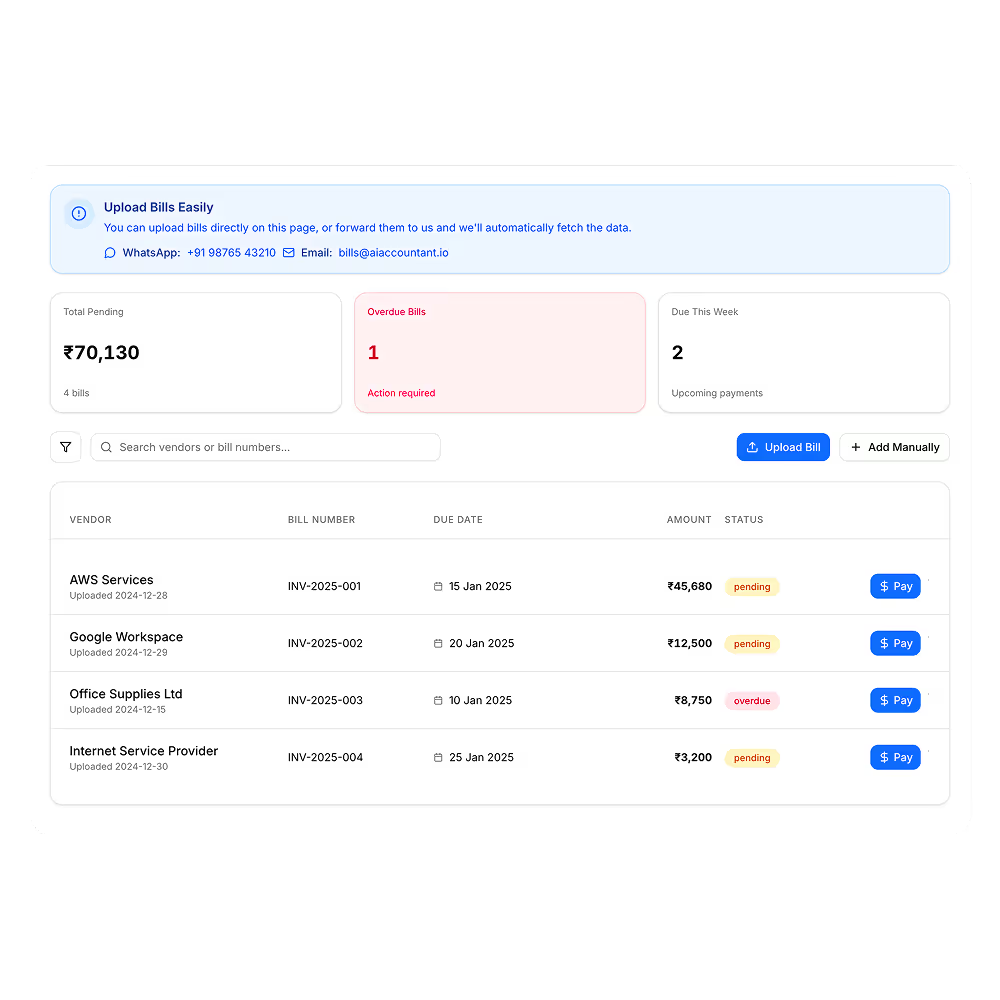
Bulk uploads handle PDFs and images efficiently, auto-extraction captures vendor, date, GST split, and line items, duplicate detection and GST validation reduce errors.

Transaction processing excellence

Training on Indian bank formats and gateways converts raw statements into structured data automatically for reliable posting.

Intelligent ledger mapping

Prediction suggests ledgers, GST codes, and vendors from history, targeting roughly 75 percent fewer manual classifications.

Seamless integration

One-click sync with Tally and Zoho Books eliminates double entry, bi-directional updates keep systems aligned.

Automated dashboard generation

Real-time profitability, cash flow trends, AP and AR ageing, and anomaly detection drive faster decisions.

Measurable outcomes

Closes improve to T+3 or T+5 from T+10 or later, error rates drop with fewer manual touches, costs fall while finance teams focus on analysis.

Real-World Case Study, D2C Brand Transformation

Profile, D2C brand with about 1,800 transactions per month across four gateways in one entity. Package, ₹45,000 monthly, T+3 postings, close by T+7, GSTR-1 and 3B as add-ons. Initial challenges, closes slipping to T+18, frequent GST mismatches, poor AP discipline, stressful audits. Results, close stabilized at T+6 to T+7, roughly 90 percent reduction in GST mismatches, better AP ageing with on-time payments, smoother statutory audit with fewer queries.

Next Steps, Taking Action

  • Document entities, volumes, banks, gateways, and pain points, draft a scoped SOW with caps and SLAs.
  • Use price bands to model scenarios, request quotes from two to three vendors, and ask for a one-week pilot.
  • Connect Tally or Zoho Books for a diagnostic, identify reconciliation gaps, uncategorized items, and GST or TDS tagging issues fast.

Start small, prove the model, then scale with tighter SLAs once confidence is high.

Making the Right Choice for Your Business

Align pricing with value, not just the lowest quote. Seek India compliance depth, precise SLAs, and modern automation. With the right partner, clean books, timely MIS, and compliance readiness shift finance from a bottleneck to a strategic advantage. Take the first step today, shortlist vendors, run a pilot, and lock the SLA that your business deserves.

FAQ

How should I price a 1,200 transaction per month client on Zoho Books, and what SLA is realistic in India conditions

For 1,200 monthly transactions, most engagements fall in the Growth Plan band at ₹35,000 to ₹55,000 depending on gateways and reconciliations. A practical SLA is T+2 posting on high-volume channels, close by T+5 to T+7, and weekly AR or AP ageing. With AI Accountant ingestion, vendors can compress timelines further without increasing cost.

What T+ timeline should I commit for a CA firm client portfolio if I standardize on maker-checker workflows

Commit T+2 for routine bank and gateway transactions, T+3 for complex items like EMI or loan schedules, weekly AR or AP reconciliations, and month-end close by T+5 to T+7. Document exceptions and holidays, and instrument dashboards through AI Accountant to monitor lag and exceptions in real time.

How do vendors typically structure caps and overages for fast-growing D2C accounts

Vendors specify monthly caps by transactions, bills, bank accounts, gateways, and entities. When averages exceed caps for two to three months, the plan upgrades, while occasional spikes attract per-transaction overages. Ensure caps and overage rates are spelled out in the SOW, and review quarterly.

Can I start mid-year and still ensure audit readiness, what happens to opening balances and unreconciled items

Yes, mid-year onboarding is standard. Opening balances are imported as of the cut-off date, while unreconciled items are tagged and resolved in the first month. Expect one-time onboarding fees where ledger cleanup is significant. Use AI Accountant to auto-ingest the last six to twelve months for fast backfill and variance checks.

What deliverables should I lock for a services firm with milestone billing and TDS complexity

Lock monthly books in Zoho or Tally, bank and gateway reconciliations, milestone and retainer invoicing support, TDS tagging with 26Q mapping, AR ageing with DSO tracking, and a monthly MIS pack with project-wise profitability. Add-ons for TDS returns and payroll should be priced separately.

How do I evaluate automation claims from vendors during procurement

Ask for a live ingestion test using your last month’s bank statements and ten to twenty invoices. Measure auto-classification hit rate, exception flags, and posting cycle time. Tools like AI Accountant should demonstrate near real-time parsing of PDFs and CSVs with credible ledger and GST code predictions.

What quality metrics should I include in my SLA to reduce audit queries

Set less than 1 percent uncategorized items at close, under 0.5 percent reconciliation variance for bank, wallet, and gateway accounts, 100 percent supporting documents for expenses and vendor bills, and logged maker-checker reviews. Monthly MIS should include exceptions and unusual transaction flags.

For multi-entity groups, how do I structure intercompany and consolidation in a monthly package

Include intercompany mapping, elimination entries, forex revaluations, and a monthly consolidation pack with entity and segment views. Postings should be T+2 for primary entities, consolidation by T+7. Price at Scale band with a premium for consolidation and foreign currency expertise.

Can outsourced teams handle marketplace and COD reconciliation reliably for e-commerce

Yes, if they have proven parsers for Amazon, Flipkart, and common COD partners, plus settlement reconciliation workflows. Insist on weekly gateway or marketplace reconciliations, dispute registers, and SKU or channel MIS. Automation through AI Accountant can ingest settlement files and reduce manual matching significantly.

How do I protect data and enforce access controls when working with an India delivery team

Require ISO 27001 and SOC 2 Type 2, role-based access, audit logs, encrypted storage, and documented data retention or deletion policies. Use view-only or tokenized bank access. Ensure a secure document vault, with named account managers accountable for access hygiene.

What is a fair onboarding timeline for a clean single-entity setup, and what are red flags

Three to five days for setup, one-week dry run, go-live in week one is reasonable for a clean, single-entity account. Red flags include no written SLA, no cap disclosures, and lack of live demos for ingestion and reconciliation.

How does AI Accountant practically reduce my monthly cost or tighten SLAs

AI Accountant automates bill and statement ingestion, predicts ledgers and tax codes, and flags exceptions instantly. This reduces manual classification effort and reconciliation time, allowing a vendor to either offer lower prices or commit to tighter T+ and close timelines without increasing headcount.

Explore More Topics

Discover insights across different areas of accounting and financial management

Discover more from AI Accountant

Subscribe now to keep reading and get access to the full archive.

Continue reading

Get in Touch

Heading Text

Lorem Ipsum is simply dummy text of the printing and typesetting industry. Lorem Ipsum has been the industry’s standard dummy text ever since the 1500s, when an unknown printer took a galley of type and scrambled it to make a type specimen book. It has survived not only five centuries.