-01%201.svg)
Key takeaways
- QA in bookkeeping is a structured review process that catches errors in transactions, ledgers, and compliance tasks before they snowball into GST mismatches, cash flow surprises, or audit penalties.
- Indian SMBs that implement materiality thresholds, risk based sampling, standardized checklists, and exception logs with SLAs cut post close adjustments by up to 60% and shorten month end close by two or more days.
- A blended sampling approach (40% risk based, 40% monetary unit, 20% random) gives targeted coverage on high risk items like new vendors and GST coded transactions without overwhelming a small review team.
- Exception logging with ownership, root cause codes, and severity tiers turns audit findings into trackable action items, not buried spreadsheet notes.
- Feedback loops using standard comment codes and weekly huddles lift preparer accuracy 30 to 40% within three months, reducing rework across the board.
- Repetitive grunt work like bank ingestion, ledger mapping, and reconciliation prep is exactly what AI Accountant's bookkeeping automation handles, so reviewers spend time on judgment, not data entry.
- If your team still relies on manual checks across multiple clients, the compounding cost of errors makes a structured QA program worth starting this month, not next quarter.
Quality assurance in bookkeeping: what's new in 2026
Until early 2025, most Indian SMBs ran QA as an informal month end exercise, a senior scanning entries before filing. By mid 2026, two regulatory shifts and one infrastructure change have made that approach risky.
First, the GST e invoicing threshold dropped from ₹5 crore to ₹1 crore (effective August 2025 per CBIC notifications), pulling lakhs of smaller businesses into mandatory e invoicing. Every invoice now feeds directly into the GST portal, meaning classification errors are visible to the department in near real time. A wrong HSN code or rate that previously hid until annual audit now triggers automated mismatches in GSTR 2B within days.
Second, the Reserve Bank of India's Account Aggregator framework has matured. Direct bank feeds from HDFC, SBI, ICICI, and others are replacing manual statement uploads for early adopters. This eliminates data entry errors on the ingestion side but shifts reviewer effort toward classification accuracy and compliance checks, a workflow change many teams have not adapted to.
The operational impact is concrete. QA checklists now need an e invoicing verification step for every sales entry. Sampling plans must flag transactions where the HSN code or GST rate changed between invoice generation and portal acknowledgment. Exception SLAs for GST related findings should tighten to same day, because delayed corrections can block the next filing cycle. Firms ignoring these steps face auto populated mismatches, ITC reversals, and interest at 18% on shortfalls under Section 50 of the CGST Act.
Teams managing QA across multiple clients can reduce the manual burden of these new checks by using automated GST reconciliation to match book entries against GSTR 2B and flag discrepancies before the filing window closes. The QA framework stays human driven; the data preparation does not have to be.
Introduction: understanding QA in bookkeeping
Quality Assurance in bookkeeping is the second pair of eyes every finance team needs. It is the discipline that ensures every transaction, every ledger, and every compliance task is accurate, complete, and review ready.
For Indian SMBs juggling GST, TDS, multiple bank formats, and high transaction volumes, QA is not optional. It is essential.
QA catches what your first pass misses, before it becomes a compliance headache or a cash flow surprise.
Why QA in bookkeeping matters for Indian SMBs
Indian businesses deal with GST reconciliations, TDS deductions, and heterogeneous bank statements. Without structured quality assurance, small errors compound. A wrong GST code today becomes a mismatch in tomorrow's GSTR filing. An unreconciled bank entry becomes next month's cash flow mystery.
Strong QA delivers accuracy at scale. It supports India specific compliance, reduces post close adjustments, and shortens your close cycle. For CA firms managing multiple clients, it also means fewer firefighting hours and more capacity for advisory work.
The India specific context
Teams work in Tally or Zoho Books. They manage bank statement formats from HDFC, SBI, and ICICI. They track multiple GST rates and HSN codes across hundreds of line items each month.
Generic QA frameworks fall short here. You need India aware controls: GSTR 2B matching, TDS verification, and document driven workflows that reflect local realities. The Institute of Chartered Accountants of India (ICAI) has also emphasized the importance of standardized quality review processes for accounting practices, reinforcing the need for structured bookkeeping quality control.
AI as your quiet assistant
Modern tools can shoulder the grunt work. Solutions that automate data ingestion, ledger mapping, and anomaly flagging prepare clean review queues for your team. Reviewers then focus on judgment and compliance, not manual data checks.
Automation prepares, humans decide.
What a QA program covers
A clear scope avoids gaps. Include bank reconciliations, vendor and customer ledgers, GST coding accuracy, accruals, AP and AR ageing, invoice to bill matching (sometimes called vendor invoice matching), cash and loan entries, and cross module ties such as inventory to COGS.
Defining roles and responsibilities
Clarity prevents confusion. Preparers enter and classify. Reviewers verify accuracy and compliance. Approvers sign off.
Keep a simple RACI so everyone stays in lane. This is especially important in CA firms where junior accountants handle first pass data entry and seniors own the review checklist.
Setting the right cadence
Weekly transaction checks catch errors early. Monthly reconciliations ensure a clean close. Quarterly deep dives surface systemic fixes.
Cadence balances speed and quality. For high volume clients, daily light reviews on unmatched items add another safety layer.
Materiality thresholds
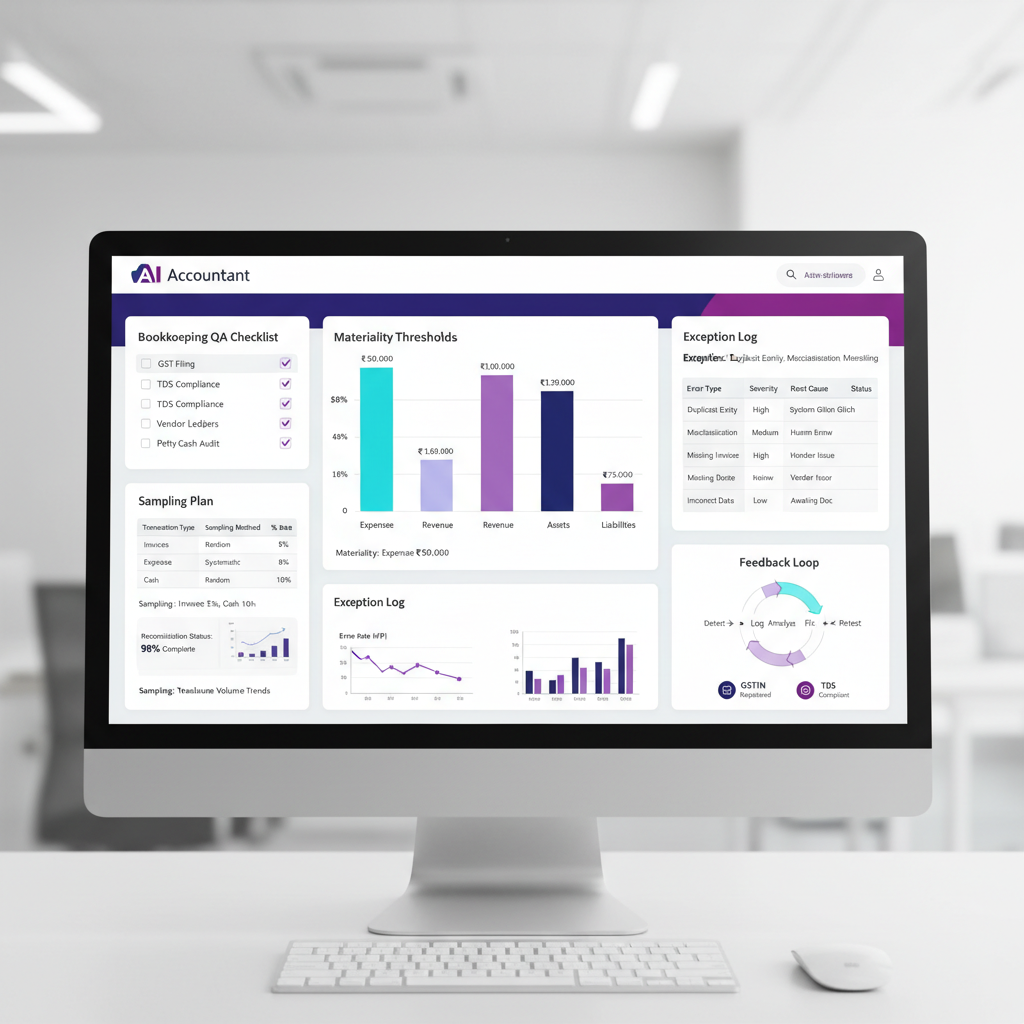
Materiality keeps effort focused on what matters. Overall materiality often sits at 5 percent of monthly profit, or 0.5 to 1 percent of monthly revenue. Performance materiality at roughly 75 percent of overall provides a buffer.
Set tolerances by category. Petty cash can allow 2 percent variance. High value vendor payments may allow just 0.5 percent. GST classification errors deserve zero tolerance.
Quantitative rules of thumb
For ₹50 lakh monthly revenue, overall materiality could be ₹50,000. Performance materiality would be ₹37,500.
Add absolute bands: under ₹1,000 gets a light review, over ₹1 lakh gets full scrutiny. Adjust by risk and scale.
Qualitative considerations
Some small errors still matter. GST misclassification, repeated vendor miscoding (a common ledger entry issue), and payroll anomalies all warrant attention regardless of amount. Factor these into your thresholds.
How thresholds guide your process
Thresholds size your samples, set checklist depth, and drive exception severity. They ensure material issues move first and low risk items do not consume scarce reviewer time.
Sampling plan design
You cannot review everything. Sampling gives confidence without overload.
Choosing your sampling approach
- Risk based: oversample new vendors, unusual amounts, manual journals, refunds, and foreign exchange entries.
- Statistical: random for unbiased coverage, stratified by buckets, monetary unit sampling (MUS) to weight large values.
A blended approach works best for most Indian SMBs. Combine risk based selection with statistical methods for complete yet manageable coverage.
Timing your samples
Pre close sampling three days before month end catches errors while fixes are easy. Post close sampling validates quality and informs next month's approach. Rolling weekly samples cover high risk items continuously.
Practical example: 10,000 monthly transactions
Sample 100 random items, all 50 over ₹5 lakh, 200 from new vendors, and 150 GST coded transactions. That is 500 total: comprehensive yet manageable.
Tune by error rate and team capacity. If defect density drops below 3 per thousand, you can reduce sample sizes gradually.
Working with Tally and Zoho
In Tally, pull by ledger group and export daybooks for random selection. In Zoho Books, use tags to mark samples. Use filters for high value or manual entries to build sampling frames.
How modern tools help
Standardized data from dozens of bank formats provides clean sampling frames and fewer false positives. When ingestion is automated, your sampling frame is already consistent before a reviewer touches it.
Reviewer checklist
Consistency requires standards. A short, sharp checklist turns subjective reviews into repeatable controls.
Core checklist items
- Bank statement line matched
- Correct ledger selected
- GST code appropriate
- Vendor or customer name consistent
- Invoice or bill (vendor invoice) attached
- Amount matches supporting document
- Payment mode identified correctly
- TDS deducted if applicable
- Advance adjusted if relevant
- Foreign exchange rate applied correctly
- Expense category logical
- Cost center allocated
- Approval obtained for high value
- No duplicate entry
- Period allocation correct
Phrase checks as yes or no questions. Add space for notes and a severity rating. This makes the bookkeeping review process repeatable across team members.
Integration with workflow tools
Upload, review, approve, and sync flows map neatly to these checks. Each stage in your accounting workflow should mirror a checklist step, ensuring nothing slips between preparer and approver.
Exception logging
Findings matter only when tracked to closure. Use structured exception logging with SLAs.
What to log
Capture description, ledger, amount, materiality band, root cause, owner, due date, status, resolution notes, and evidence links. This supports pattern analysis and accountability.
Good exception logs also serve as audit evidence. External auditors reviewing your QA pack can reduce their own testing when they see structured, closed exception records.
Severity and SLA tiers
- Critical: over performance materiality, same day resolution
- High: 50 to 100 percent of performance materiality, 48 hours
- Medium: 10 to 50 percent, one week
- Low: by month end
Root cause taxonomy
Standardize codes: data entry error, missing document, wrong GST code, duplicate entry, timing difference, unrecorded bank charge, integration issue. Consistency reveals where to train or automate.
When the same root cause appears more than five times in a month, it signals a process gap, not just a people gap. That is your cue to investigate the workflow itself.
Exception log template
Simple spreadsheet columns: ID, dates, description, amount, ledger, materiality, root cause, owner, due date, status, resolution notes, evidence, closed date.
Sort by due date, filter by owner, review daily. This template doubles as your audit trail for both internal reviews and statutory audits.
Feedback to preparers
QA becomes culture when feedback is timely and actionable.
Principles of effective feedback
Be prompt, be specific, be constructive, show evidence. Avoid vague comments. State the fix and the reason.
For example: "Use 18 percent GST for this professional service as per the GST rate schedule on the GSTN portal."
Standard comment codes
Define shorthand such as CHK-01 for bank not matched, CHK-07 for wrong GST code. Codes speed communication and training.
Keep your codebook to one page. Update it quarterly based on the patterns you see in your exception logs.
Cadence and channels
Daily micro feedback through the exception log. Weekly QA huddles for patterns. Monthly retros for metrics and improvements.
Sample feedback messages
Missing document: "₹25,000 to ABC Vendors on 15th needs invoice attachment as per policy. Upload and resubmit."
GST error: "Service coded at 12 percent, should be 18 percent for professional services. Revise and recalculate."
Duplicate: "Duplicate payment for INV-2345. Original on 10th, duplicate on 12th. Reverse duplicate and confirm single bank match."
Training interventions
Track feedback by preparer. Assign quick videos, one to one coaching, or formal courses where errors repeat. Prevention beats rework.
Teams that implement consistent feedback loops see preparer rework rates drop 30 to 40 percent within three months. The investment in structured feedback pays for itself quickly.
End to end workflow
Intake and structuring
Documents arrive via email, WhatsApp, portals, and paper. Automated ingestion tools can structure data from all these sources and prepare it for review, reducing manual entry risk at the very first step.
Applying thresholds and sampling
Flag high value items. Generate risk based and statistical samples. Publish a review roadmap so reviewers know what to check, and how deep to go.
Executing reviews and logging exceptions
Work the checklist. Log exceptions in real time. Escalate unusual patterns even if a checklist box is ticked. Trust the framework, but also trust your instincts when something looks off.
Approval and synchronization
Approve corrected items, then sync to Tally or Zoho Books to keep a single source of truth. Clean books feed dashboards and decisions.
Monthly close package
Include a QA summary, exceptions found and closed, and a residual risk note. Stakeholders get confidence with evidence, not just assurance.
Metrics and KPIs
Defect density
Errors per 1,000 transactions. For example, 15 errors in 3,000 reviewed equals 5 per thousand. Trend it monthly.
Well managed teams typically benchmark at 5 errors per 1,000 transactions. If you are consistently above 10, your training or process has a gap.
Exception resolution rates
Track SLA compliance by severity. Target 100 percent on critical, 90 percent on high, 80 percent on medium, 70 percent on low.
Preparer performance metrics
Rework rate and recurring exception types by preparer reveal training needs versus system fixes. A preparer with high GST error rates needs targeted coaching, not a generic refresher.
Sampling coverage
Compare planned versus actual samples. Investigate gaps and adjust future plans. If actual coverage consistently falls short, your team may be understaffed or your sample sizes need recalibration.
Compliance impact metrics
Measure GST and TDS mismatch rates, DSO and DPO changes, and forecast accuracy. These show QA value to leadership in terms they care about: cash flow, compliance, and audit readiness.
Case study
The baseline challenge
A CA firm serving 25 SMBs faced late reconciliations, GST code errors, and duplicate vendor bills. Teams were firefighting. Closes were late. Morale suffered.
Implementing QA
They set client specific materiality thresholds. They built risk based samples, standardized checklists, and mandated exception logs with ownership. Daily feedback tightened the loop, and automated tools reduced manual classification work.
Measuring the results
In three months, post close adjustments fell 60 percent. Manual classification dropped 75 percent. Close time improved by two days. Client satisfaction rose, and the firm onboarded new clients without adding headcount.
GST and TDS mismatch rates declined by over 50 percent, reducing the risk of penalty notices and ITC reversals.
Tools and templates
Materiality threshold calculator
Spreadsheet with revenue, expense, and profit inputs. Calculate overall and performance materiality, plus category tolerances. Include risk presets for common Indian SMB profiles.
Sampling plan template
Support risk based and statistical approaches. Include population size, confidence level, expected error rate, calculated sample size, selection, status, and findings columns.
Reviewer checklist variants
Monthly close, weekly transactions, and vendor payment checklists. Keep versions under control to track improvements over time.
Exception logging spreadsheet
Use data validation for status and root cause fields. Add pivots for quick analysis. Consider a task tool as volume scales beyond 50 open exceptions.
Feedback comment codebook
Document codes, meanings, and examples. Update quarterly based on patterns from your exception logs.
Common pitfalls and recommended tools
Common pitfalls to avoid
- Materiality set too low: noise drowns signal.
- Ignoring high risk categories like cash, foreign exchange, refunds, and new vendors.
- Checklists misaligned with Tally or Zoho workflows.
- Exceptions without ownership or SLAs.
- Delayed or vague feedback that does not teach.
- Manual processes where automation exists.
Recommended accounting tools
- AI Accountant, automates bank processing, ledger mapping, and Tally or Zoho sync, reducing manual work while lifting accuracy.
- QuickBooks Online, cloud based accounting with strong reporting.
- Zoho Books, accounting with GST compliance for Indian SMBs.
- Tally Prime, deep GST and compliance capabilities.
- Xero, excellent bank reconciliation and integrations.
- FreshBooks, simple invoicing and expense tracking.
India specific considerations and future roadmap
GSTN integration opportunities
Auto fetch GSTR 2B and push GSTR 1 to reduce manual errors. Build QA checks to verify book entries match 2B, and sales match 1. The GST Council continues to push for tighter portal integration, making these checks increasingly non negotiable.
Account Aggregator framework
Direct bank feeds reduce data entry risk and speed reconciliation. Shift reviewer time from accuracy checks to classification and compliance.
AI powered reconciliation
AI driven anomaly detection and approval queues accelerate exception resolution. Your QA framework provides the guardrails. The technology handles volume; humans handle judgment.
Data security and compliance
Work with ISO 27001 and SOC 2 Type 2 certified partners. Verify encryption and access controls. Document security checks within your QA program, especially when handling client financial data across multiple organizations.
Getting started: a four week implementation
Week 1: define thresholds and roles
Calculate materiality from recent financials. Publish a RACI. Align the team and gather input on pain points.
Week 2: design sampling and checklist
Draft risk based and statistical sampling. Build a crisp checklist. Test on historical data and refine based on what you find.
Week 3: pilot
Run a limited scope pilot with real data. Log exceptions. Deliver daily feedback. Capture lessons learned.
Week 4: launch and iterate
Roll out fully. Monitor metrics daily in week one. Tune thresholds and sample sizes based on actual error rates. Celebrate wins.
Conclusion
QA in bookkeeping is not about perfection. It is about consistent, measurable improvement.
For Indian SMBs, a disciplined QA framework reduces rework, speeds close, and builds confidence in the numbers. Start with thresholds, sampling, checklists, and exception logs. Add tight feedback loops. Then layer in automation where repetitive work slows your team down.
Regulations and tools will evolve. Your QA should too, while keeping its purpose intact: ensuring accurate, complete, and reliable financial records that hold up under scrutiny.
FAQ
How should a CA set materiality thresholds for micro clients with low revenue volatility?
Use absolute amounts to avoid impractically small percentages. For revenue under ₹10 lakhs a month, set overall materiality at ₹5,000 to ₹10,000, with performance materiality at roughly 75 percent of that. Apply zero tolerance for GST classification and statutory payments regardless of amount.
For a portfolio of 12 SMBs, what sampling mix is efficient for a two person review team?
A 40/40/20 split works well: 40 percent risk based, 40 percent monetary unit sampling, 20 percent pure random. Run pre close reviews three days before month end and a smaller post close validation. Automated bank data cleaning and anomaly tagging reduce the manual effort needed per sample.
How do I tune tolerable error rates by category without overcomplicating controls?
Group into four bands: statutory items at zero tolerance, high value at 0.5 percent, operational at 1 percent, and petty cash at 2 percent. Review quarterly against observed error rates and adjust. Keep the policy to a single page for easy adoption across your team.
What KPIs should a CA partner track to know QA is working across clients?
Track defect density (errors per 1,000 transactions), SLA hit rate by severity, rework rate by preparer, planned versus actual sampling coverage, GST and TDS mismatch rate, and close time in days. Trend these monthly and review outliers in a partner meeting.
When should I move from spreadsheets to a workflow tool for exception tracking?
Move when open exceptions exceed 50 across clients, or SLA breaches cross 10 percent in any given month. At that scale, a dedicated task or workflow tool prevents items from falling through the cracks and provides better audit trail visibility.
How does the 2026 e invoicing threshold change affect QA in bookkeeping?
Businesses with turnover above ₹1 crore now fall under mandatory e invoicing, down from the earlier ₹5 crore threshold (2026 update). This means QA checklists must include an e invoicing verification step for every sales entry, and GST classification errors are flagged by the portal almost immediately. Delayed corrections can block subsequent filings and trigger interest under Section 50 of the CGST Act.
What is the ideal reviewer to preparer ratio for Indian SMB bookkeeping?
One reviewer to three preparers is the standard for steady state operations. During new client onboarding, tighten to one reviewer to two preparers for the first two cycles. Expand the ratio once error rates and exception volumes stabilize at acceptable levels.