-01%201.svg)
Key takeaways
- A liquidity management dashboard for India should surface real-time cash positions, quick ratio, current ratio, and working capital trends, with transaction level drill-down so nothing stays hidden behind a summary number.
- Forecasting that ignores GST, TDS, and advance tax schedules will blindside you. Include statutory calendars and run best, base, and worst case scenarios weekly.
- India first integrations matter: native Tally sync, multi-GSTIN visibility, and automated Indian bank statement ingestion eliminate hours of manual reconciliation every month.
- Data reliability is the foundation. Clean vendor masters, normalized bank narrations, and automated invoice matching compound into trustworthy ratios and confident decisions over time.
- Teams using automated dashboards consistently report 50+ hours saved monthly, 30% lower overdraft interest, and 5 to 10 day DSO improvements within a quarter.
- Purpose built platforms like AI Accountant deliver native GST-aware workflows, automated ratio cards, and 13 week cash projections, solving the exact gaps global tools leave open for Indian businesses.
AI Finance Dashboard India: What's New in 2026
The biggest shift since 2025 is the expansion of mandatory e-invoicing. Until March 2025, e-invoicing applied to businesses with aggregate turnover above ₹5 crore. From April 2025, the CBIC lowered the threshold to ₹1 crore, pulling a significantly larger pool of SMEs into the compliance net. If you run a liquidity dashboard without factoring e-invoice data and the tighter reconciliation cycles it demands, your payables timing and input credit assumptions will drift.
Operationally, this means more invoices flowing through the IRP (Invoice Registration Portal), more frequent GST 2B matching, and shorter windows to catch mismatches before they block credits. CA firms managing multiple clients now need dashboards that ingest e-invoice data alongside bank statements and Tally ledgers, not as a bolt-on, but as a core data source.
The cost of inaction is concrete: unreconciled e-invoices delay ITC claims, and under Section 16(2)(aa) of the CGST Act, credits for invoices not reflected in GSTR-2B are disallowed. For SMEs operating near tight liquidity thresholds, even one quarter of blocked credits can trigger overdraft reliance or missed vendor payments.
What to do now:
- Confirm your dashboard ingests e-invoice JSON or IRN data, not just PDFs.
- Set up weekly reconciliation alerts for GST 2B mismatches, especially for vendors newly under the e-invoicing mandate.
- Review your GST reconciliation workflows to ensure they account for the higher volume of structured invoice data.
Firms already using automated MIS reporting are finding the transition smoother because their data pipelines were already normalized. If yours are not, this quarter is the time to fix that.
Table of contents
What Is a Liquidity Management Dashboard, India Context
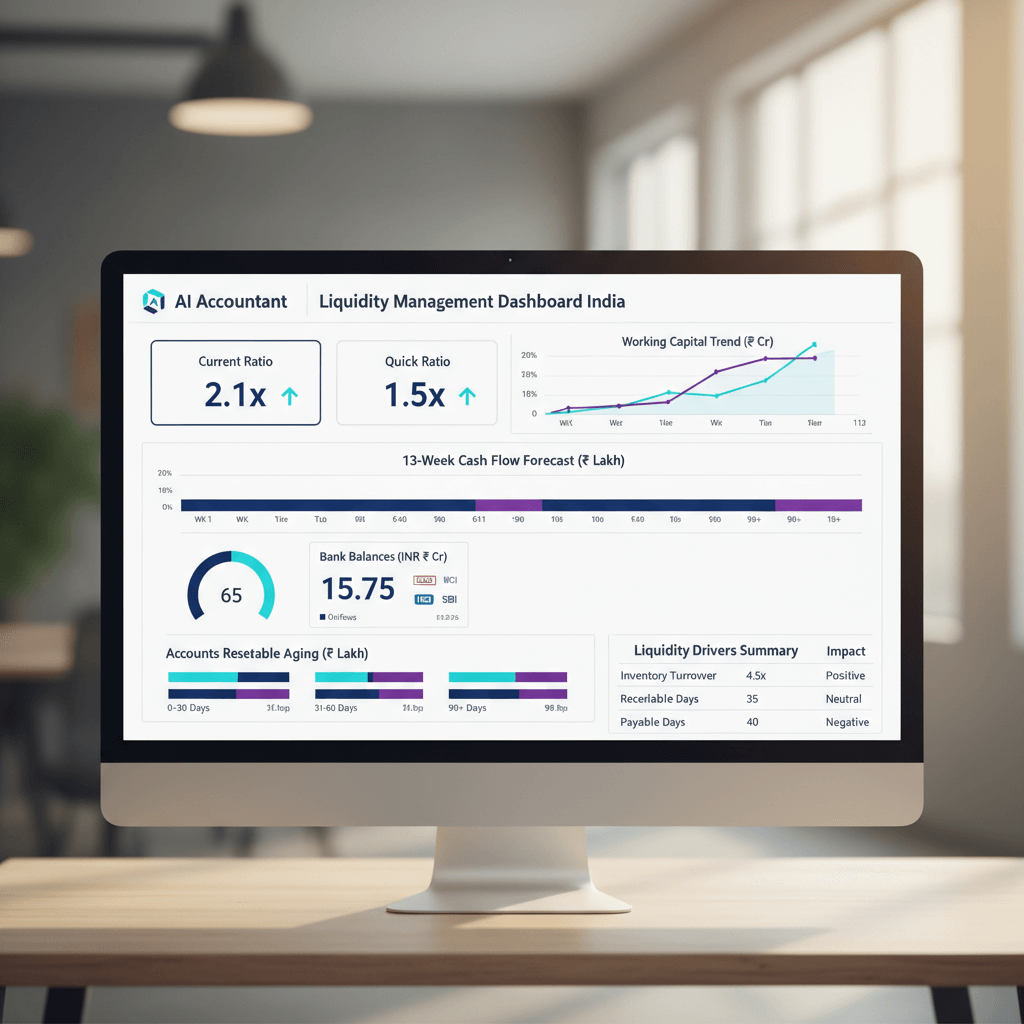
A liquidity management dashboard gives Indian businesses real-time visibility into cash positions, short term projections, and working capital KPIs like runway, DSO, DPO, and aging buckets. Think of it as a financial control room: one screen for consolidated cash, one for receivable collections, one for upcoming payables.
India's statutory nuances, GST reconciliation, UPI volumes, TDS and TCS, and multi-GSTIN operations, demand dashboards that are natively aware of local compliance and accounting systems. Most global tools miss these details. India first solutions integrate with Tally, tag transactions correctly, and keep daily workflows simple.
An effective AI finance dashboard for India goes beyond charts. It combines real-time analytics with statutory awareness and drill-down traceability. Those three pillars separate useful dashboards from decorative ones.
Real-time clarity, statutory awareness, and drill-down traceability: these three pillars define an effective liquidity dashboard for Indian businesses.
Must-Have Capabilities for Indian Businesses
Quick Ratio Tracking
Quick ratio tracking shows whether immediate obligations can be met without selling inventory. The formula is simple: liquid assets (cash plus receivables) divided by current liabilities. Dashboards should surface this ratio prominently, allow alert thresholds near 1.0 or an industry benchmark, and support entity wise views across GSTINs or a consolidated group.
Great dashboards enable drill-down from the ratio card to source transactions. You should be able to identify liquid receivables versus stuck items and pinpoint payables due now.
Tip: Configure alerts that notify via email or chat the moment the quick ratio dips below your safety level.
Current Ratio Monitoring
Current ratio monitoring takes a broader lens: current assets (including inventory) divided by current liabilities. Manufacturing businesses often target 1.5 to 2.0, while service companies may operate comfortably at 1.2 to 1.5.
Smart dashboards compare against targets and apply aging adjustments. A receivable overdue by 90 days is not as "current" as one due tomorrow. Without this adjustment, your ratio looks healthier than reality.
Working Capital Trends
Working capital trends reveal operational health. Track DSO for collections, monitor DPO for vendor payment timing, and watch DIO if you carry stock.
- Use aging buckets (0 to 30, 31 to 60, 61 to 90, and 90 plus days) to spot concentration risk.
- Study seasonal patterns. If DSO spikes every March, plan collections and payment cycles accordingly.
- Measure vendor performance and adjust DPO expectations when counterparties delay consistently.
For mid sized businesses seeking strong liquidity control, working capital trend analysis is often the single most actionable dashboard component. It tells you where cash is stuck before it becomes a crisis.
Liquidity Forecast Tools
Liquidity forecast tools project cash forward. The gold standard is a 13 week rolling forecast with weekly inflows and outflows.
Scenario planning should be instant: best, base, and worst cases. Model a large customer delay, a sales drop by 20 percent, vendor terms shifting, or tax outflows bunching together. In India, always include GST schedules, TDS, and advance tax dates. Statutory payments cannot be deferred like vendor bills.
AI powered cash flow forecasting learns from your actual collection cycles and payment patterns. After two to three months of clean data, 4 week forecasts often reach 85 to 90 percent accuracy.
Additional Technical Requirements
Data fidelity separates good dashboards from great ones. Every ratio card must link to source ledger entries. Audit trails should show who did what and when. Maker checker workflows prevent unauthorized changes.
Integration depth matters: real-time sync with Tally, ingestion for HDFC, ICICI, Axis bank statements, and multi org support to manage multiple entities or clients.
Security should be bank grade. Look for ISO 27001 certification and SOC 2 compliance, along with role based access controls. These are not optional for platforms handling financial data across multiple organizations.
Data Requirements and Architecture
Reliable dashboards start with clean data: consistent vendor and customer masters, accurate ledger mappings, and traceable transaction lineage from source to report.
Bank and credit card statement ingestion requires normalization. Dates, narrations, and amounts differ across banks, so the system should standardize automatically. GST 2B reconciliation affects payable timing directly. Match purchase registers to government data on the GST portal and flag mismatches that delay input credits.
Robotic process automation reduces manual touch. Auto categorize transactions by patterns, match payments to invoices, and keep humans focused on exceptions, not data entry.
Outcome: Less manual work, fewer errors, more reliable ratios, better decisions.
Solution Landscape Comparison
Indian businesses typically choose among four approaches when implementing a liquidity management software stack.
- Spreadsheets with manual statements: Cheap but error prone. Forecasts become guesswork and real-time visibility is impossible.
- BI tools over Tally: Flexible and customizable, yet require engineering overhead to maintain pipelines. Limited alerting and few native messaging options.
- ERP add ons: Integrated modules in SAP Business One or NetSuite. Heavy implementations, costly GST customizations, better for enterprises than SMBs.
- Dedicated India first solutions: Purpose built platforms deliver native ratio calculations, forecasting models, and GST aware flows. Many global tools do not understand GST reconciliation or MSME payment rules under the MSMED Act.
Popular Liquidity Management Tools
- AI Accountant: Built for Indian businesses. Native Tally integration, GST reconciliation, automated ratios, multi GSTIN setups, real-time dashboards, and drill-down to every transaction.
- QuickBooks Cash Flow Planner: Basic forecasting and Indian bank connectivity. GST handling requires manual configuration.
- Zoho Analytics: Strong fit for Zoho Books users, customizable dashboards, and basic ratio tracking.
- Float: Robust scenario planning, limited Indian bank integrations.
- Pulse: Simple forecasting for small teams, limited ratio monitoring.
- CashAnalytics: Enterprise grade modeling, significant setup time and costs.
How AI Accountant Addresses Liquidity Management
AI Accountant maps directly to the needs outlined above. For quick ratio tracking, you get out of box cards, configurable thresholds, and trendlines. Click any ratio to review underlying transactions.
Current ratio monitoring works by entity and consolidated views, with role based access for sensitive metrics. Working capital trends include dedicated receivable and payable dashboards, aging buckets, spend analysis by category, and direct links to source data.
Liquidity forecast tools learn actual collection cycles and vendor schedules, factor GST dues automatically, and produce a 13 week rolling cash view with scenarios. The data backbone includes AP automation, bank statement normalization, and intelligent matching from payments to invoices, all syncing with Tally.
CA firms benefit from multi org management, while ISO 27001 and SOC 2 certifications support security needs.
Implementation Roadmap
Week 0, foundation: Connect Tally, pull chart of accounts, masters, and open bills. Upload recent bank or card statements. Let ingestion normalize formats. Establish baselines for ratios and trends.
Week 1, configuration: Review mapping rules. Clean duplicate vendors, standardize customer names, fix ledger mappings. Then compute baseline quick ratio, current ratio, and working capital metrics. These guide threshold settings.
Week 2, activation: Configure forecasting assumptions from history. Input known future items like rent, salaries, and leases. Establish alerts (quick ratio below 0.8, DSO above 45 days). Enable email or chat notifications. Finalize dashboard layouts by role.
Ongoing success tips:
- Use specific thresholds aligned to your industry context. Avoid generic targets.
- Assign owners for collections and payables. Dashboards reveal issues, humans resolve them.
- Schedule weekly reviews. Liquidity discipline prevents crises and surprises.
ROI and Business Outcomes
Time savings: Teams save 50 plus hours monthly. Fewer downloads, fewer Excel fixes, fewer data chases. More time for analysis and advisory work.
Interest cost reduction: Clear visibility lowers overdraft usage. Clients report OD interest reductions of about 30 percent by timing payments better.
Working capital improvement: Faster collections boost available cash. Aging views flag issues before they become bad debts. Typical DSO gains are 5 to 10 days within three months.
Data quality benefits: Automation reduces errors. Clean data yields reliable ratios. Confidence enables decisive actions. These compounding benefits accrue over time.
India-Specific Best Practices
Embed GST in Payables Logic
GST 2B reconciliation determines input credit timing. Flag invoices pending reconciliation, include GST payment dates in forecasts, and avoid surprise cash drains. With the GST Council periodically updating filing requirements, your dashboard logic should stay current with the latest return schedules.
Factor MSME Payment Rules
The MSME Act mandates payment within 45 days. Include MSME vendor flags in your dashboard, track compliance, and prevent interest penalties. Non compliance also triggers disallowance of the expense under Section 43B(h) of the Income Tax Act, making this a double risk for businesses that ignore it.
Handle Inter-Account Transfers
Normalize transfers across OD, current, and deposit accounts. Do not double count movements. Treat them as reallocations, not income or expense.
Manage Multi-GSTIN Complexity
Maintain entity wise visibility first, then consolidate. Review ratios per GSTIN to identify where cash constraints originate. Act locally before rolling up to a group view.
Real-World Implementation Story
A mid sized manufacturing SME managed liquidity in Excel. Multiple bank accounts, two GSTINs, and seasonal demand created constant uncertainty. After adopting AI Accountant, they set quick ratio thresholds at 1.0, with alerts at 0.9. This became an early warning system that prevented crunches.
Current ratio monitoring exposed slow moving inventory. It inflated the ratio but did not yield cash. Safety stock was reduced. The 13 week forecast showed a crunch around GST dates, so vendor terms were renegotiated to smooth payments.
Within two months, month end close dropped from 10 days to 3 days. Working capital trends became real time. The finance team shifted from fire fighting to planned execution.
Evaluation Checklist for Buyers
Use this checklist when shortlisting solutions. Make it a structured evaluation rather than a feature chase.
Core functionality
- Out of box quick ratio tracking with thresholds and alerts
- Current ratio monitoring with drill-down and aging adjustments
- Working capital trends for DSO, DPO, DIO, and aging buckets
- Liquidity forecast tools with scenarios and statutory calendars
Integration capabilities
- Native Tally sync
- Indian bank statement ingestion and normalization
- Automated categorization and vendor invoice matching
- GST reconciliation logic baked into payables
Technical requirements
- Transaction level drill-down from any card
- Multi org, multi GSTIN support
- Role based access controls
- ISO 27001 and SOC 2 certifications
Implementation support
- Clear timeline and onboarding methodology
- Training quality and documentation
- Responsive support, ideally India based
- Proactive help with data cleanup and master standardization
Next Steps
Start with an assessment of your current state. Identify gaps using the checklist above. Then pilot a dashboard with your live data to validate ratios and forecasts.
Book a short assessment to review data readiness and generate a sample view of your inflows, outflows, and 13 week runway.
The transition from reactive scrambling to proactive planning can happen within weeks, not months. With the right liquidity management dashboard, your next cash crunch will be anticipated, planned, and neutralized.
Every day without liquidity visibility is avoidable risk. Begin your evaluation today.
FAQ
How should a CA validate forecast accuracy, and what input data does the model require
Compare projected inflows and outflows to actuals weekly, then investigate variance drivers and refine assumptions. The model ingests historical collections, payables, GST calendars, and bank statements. With two to three months of normalized data, 4 week forecasts typically reach 85 to 90 percent accuracy.
Quick ratio versus current ratio: which metric should a services firm prioritize
Prioritize the quick ratio, since inventory does not drive liquidity for service businesses. Use current ratio as a secondary solvency check. Aging adjustments keep both ratios grounded in reality rather than inflated by overdue receivables.
What is the recommended cadence for a 13 week cash forecast review
Review weekly, roll forward one week, and refresh assumptions each cycle. Use base, best, and worst scenarios to stress test resilience against customer delays, sales dips, or tax payment bunching.
How should GST 2B reconciliation be embedded into payables timing
Flag invoices not yet matched to GSTR-2B and hold input credit assumptions until reconciliation completes. Adjust cash forecasts accordingly. Under Section 16(2)(aa) of the CGST Act, credits for invoices not reflected in 2B are disallowed, so reconciliation gaps directly impact liquidity (2026 update).
What is a realistic implementation timeline for a CA firm rolling this out to multiple SME clients
Two to three weeks per client is typical, faster when masters are already clean. Week 0 covers system connection and statement ingestion. Week 1 refines mappings and computes baselines. Week 2 activates forecasts and alerts. Repeatable onboarding playbooks help CA teams scale across clients.
What does an AI finance dashboard for India need that global tools lack
It needs native GST 2B reconciliation, Tally integration, multi-GSTIN entity management, MSME 45 day payment tracking, and Indian bank statement normalization. Global tools typically require expensive custom configuration for these workflows, or skip them entirely. For Indian SMBs and CA firms, these are not optional features but core requirements (2026 update).
For a mid sized business, what is the smartest plan for strong liquidity control
Start with a 13 week rolling cash forecast, set entity wise ratio thresholds, and embed statutory calendars (GST, TDS, advance tax) into your projections. Pair this with automated bank ingestion and vendor bill matching to reduce manual reconciliation. Weekly reviews with scenario planning ensure you catch problems before they become crises.

Rohan Sinha is a fintech and growth leader building aiaccountant.com, focused on simplifying accounting and compliance for Indian businesses through automation. An IIT BHU alumnus, he brings hands-on experience across 0 to 1 product building, growth, and strategy in B2B SaaS and fintech.