-01%201.svg)
Key takeaways
- Shorten the cash conversion cycle by tightening receivables, optimizing payables, and accelerating inventory turns, each lever compounds cash flow impact.
- Build disciplined AR practices, credit policies and e-invoicing, then drive a consistent collections cadence with clear escalation.
- Set AP schedules that meet MSME compliance while extending DPO through vendor segmentation, early payment discount analysis, and workflow checks.
- Adopt inventory and procurement governance, ABC analysis, demand driven replenishment, and three way match assurance for GST compliance.
- Run a 13 week cash forecast with weekly variance reviews, use scenario planning to trigger targeted AR and AP actions.
- Track DRO, DPO, inventory days, CCC, and forecast accuracy with clear quarterly improvement plans, governance turns metrics into decisions.
- Leverage modern tools like AI Accountant, integrate with Tally or Zoho for real time AR and AP visibility, and automate alerts and dashboards.
Understanding Working Capital Fundamentals in India
Working capital is simple math with complex consequences, current assets minus current liabilities powers your daily operations. In India, GST cycles, bank cut offs, and vendor terms complicate the equation.
The cash conversion cycle shows speed of cash movement, CCC equals DRO plus Inventory Days minus DPO. A shorter cycle is healthier, a longer cycle signals pressure.
Think in levers, collect faster, pay smarter, stock leaner, every small improvement compounds into cash in bank.
Indian SMBs face delays from GST refunds, input tax credit blocks due to GSTR-2B mismatches, and RTGS or NEFT disruptions around holidays. Cash gets trapped in late receivables, excess inventory, rigid supplier terms, and weak forecasting.
For quick primers, explore working capital, dive into understanding working capital management, and review working capital loan concepts for MSMEs.
Mastering AR and AP Levers for Better Cash Flow
Accounts Receivable optimization
Your AR levers determine inflow speed. Start with credit policies that segment customers by reliability, set clear limits, and enforce an approval matrix for exceptions.
- Invoicing discipline, complete GST details, e-invoicing when applicable, timely dispatch, fewer disputes, faster payments.
- Collections cadence, reminders pre due date, structured escalation at 30, 45, and 90 days, mix courtesy calls and early payment incentives.
- Visibility, DRO dashboards flag accounts beyond 60 days, track disputes, and identify high risk segments before default.
To systematize collections, use collections workflow automation in India for templated reminders, dispute queues, and promise to pay tracking.
Accounts Payable management
Your AP levers control outflow timing. Set payment schedules that meet MSME compliance while preserving cash.
- Target 45 to 60 day cycles, maintain vendor trust, avoid GST credit loss from late filings, and minimize penalties.
- Evaluate early payment discounts against cost of capital, a 2,10 net 30 may be attractive if borrowing costs are high.
- Segment vendors, MSMEs within 45 days, strategic partners may accept 60 plus days, spot vendors optimized for retention.
- Workflow checks prevent duplicate payments and reconciliation errors.
For AP planning fundamentals, revisit working capital management, compare working capital strategies for SMEs, and study the impact of working capital management on profitability. For calendarized disbursements, see vendor payment scheduling in India.
Building Inventory and Procurement Discipline
Inventory traps cash quietly. Start with ABC analysis, A items are high value and need tight controls, B items get moderate reviews, C items run lighter. Clear slow moving and obsolete stock quarterly.
- Demand driven replenishment, calculate EOQ, set safety stock for monsoon and festival swings, define reorder points that trigger procurement.
- Procurement governance, approvals on purchase orders, GRN match before payment, price variance alerts for vendor overcharging.
- Track finished goods, WIP, and raw materials separately, each requires different tactics.
Automate compliance with three-way match automation GST, reduce mismatches and payment disputes. For broader context, review working capital management and SME working capital strategies.
Strategic Supplier Terms Negotiation
Preparation drives outcomes. Document payment history, benchmark typical DPO ranges, and stage negotiations.
- Extend terms gradually, move from 30 to 45 days over two quarters, propose tiered discounts tied to volume commitments.
- Consider consignment or VMI for high value items, balance inventory risk across the chain.
- Maintain contract hygiene, specify payment terms, returns, and FX terms for imports.
Respect MSME Act rules, MSME suppliers must be paid within 45 days. For financing context, see working capital loan guidance, and negotiation angles in working capital strategies for SMEs.
Creating Actionable Cash Forecasts
A 13 week cash forecast offers the clarity monthly reports miss. Build it from AR aging, AP schedules, payroll, GST, TDS, capex, and loan repayments.
- Scenario plan, base, best, and stress cases, define triggers for slippage or upside, act quickly when variances appear.
- Governance, weekly reviews, stretch AP or accelerate AR when collections slip, update assumptions to reflect reality.
For frameworks and examples, consult working capital, study working capital management, and analyze profitability impacts of working capital management.
Setting and Tracking KPI Targets
KPI targets turn intent into progress. Focus on what moves cash, then iterate quarterly.
- DRO by segment, 45 to 60 days overall, under 30 for top customers, tighten invoicing and automate reminders, target 10 day reduction in the first quarter.
- DPO by category, 45 days for MSMEs, 60 to 75 for others, negotiate tiers, extend by 5 to 10 days in quarter two.
- Inventory days by SKU, 60 days for A items, under 90 for others, less than 5 percent obsolete, run ABC cleanup, reduce by 15 days in quarter one.
- Cash conversion cycle, under 60 days, plan 20 day annual reduction.
- Forecast accuracy, under 10 percent variance, hold an 8 plus week runway, refine weekly.
- Collections effectiveness, 90 percent promise to pay conversion, disputes resolved within 30 days, enforce escalation cadence.
For benchmarks and techniques, reference working capital management, SME working capital strategies, and empirical research on profitability.
Leveraging Technology for Working Capital Management
Modern tools turn data chaos into clarity. Evaluate platforms by their ability to automate AR and AP, synchronize with ledgers, and forecast cash.
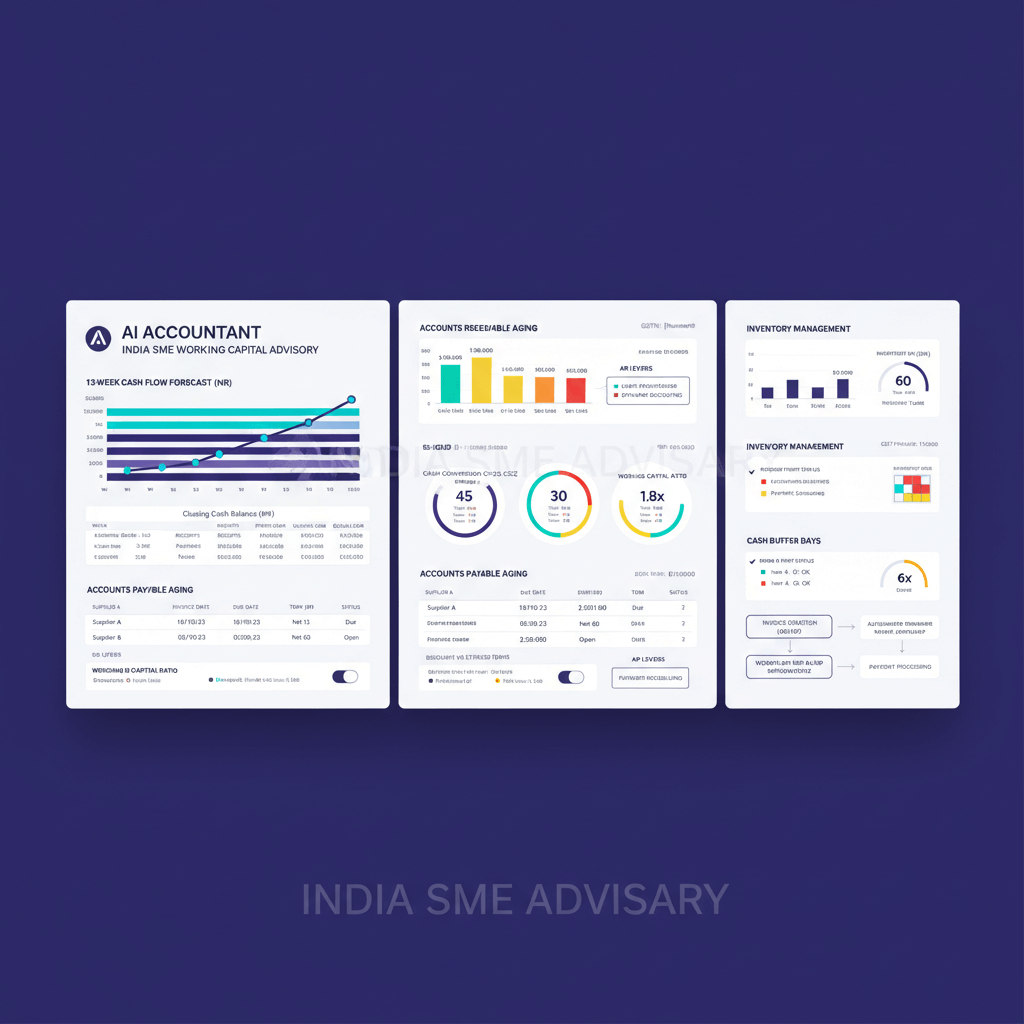
- AI Accountant, real time aging, DPO and DRO tracking, vendor insights, predictive cash trends, connectors for Tally and Zoho.
- QuickBooks, invoicing and basic forecasting, suitable for smaller setups.
- Xero, multi currency and automated bank reconciliation.
- Zoho Books, GST compliant workflows with inventory support.
- Tally Prime, Indian compliance and robust reporting.
Technology acts as your quiet assistant in working capital advisory India, it flags delays, categorizes transactions, and presents dashboards that make decisions faster.
For impact evidence, review profitability studies that connect process discipline with outcomes.
Navigating India-Specific Working Capital Pitfalls
India adds timing and compliance friction. Anticipate it and plan buffers.
- GST filings, reconcile GSTR-2B monthly, file early to accelerate refunds, missing deadlines blocks cash you already paid.
- TDS clustering, month end deductions require buffers, automate to cut errors and penalties.
- Banking cut offs, RTGS and NEFT vary by bank, holidays disrupt schedules, automate statement parsing to catch discrepancies quickly.
- Supplier concentration risk, diversify while preserving volume benefits, build backups early.
- Seasonality, festivals and monsoons shift demand, adjust inventory and payment plans, communicate changes in advance.
For context, revisit working capital and MSME financing via working capital loan options.
Implementation Roadmap for CAs and SMBs
This 90 day plan shifts you from reactive to proactive management.
Days 0 to 30, foundation
Baseline DRO, DPO, and inventory days, identify cash drains, start immediate AR follow ups, schedule AP, and clear obvious dead stock, set up basic tracking.
Days 30 to 60, optimization
Initiate supplier negotiations with data, enforce collections cadence and escalation, start weekly cash forecasts, test early payment discounts, segment customers and vendors, create sensible approvals.
Days 60 to 90, integration
Reset KPI targets, review forecast variances, enforce credit policies, launch dashboards for ongoing monitoring, hold monthly governance reviews and document lessons.
Ongoing governance
Monthly owner reviews, weekly operations check ins, daily cash positions, quarterly strategy sessions, persistence beats perfection.
Real-World Success Stories
Textile distributor transformation
A Mumbai distributor cut DRO from 72 to 60 days by enforcing 24 hour invoicing, automated reminders, and senior approval for exceptions, freeing 10 percent working capital for growth.
Manufacturing efficiency gain
A Pune manufacturer discovered 40 percent of inventory value in slow movers, ABC analysis and focused procurement released 15 percent of tied up cash within one quarter.
Services firm compliance balance
A Bangalore IT services company staggered payments by vendor type, met MSME requirements, and improved DPO from 35 to 48 days without penalties.
For additional playbooks and research, see working capital management, SME strategies, and working capital loan guidance.
Taking Action on Working Capital Advisory
Working capital advisory India is about momentum, not perfection. Drop DRO by a few days, extend DPO responsibly, tighten inventory turns, and your runway expands.
Start with one lever, master it, then move to the next. Use checklists for AR and AP, templates for 13 week forecasts, and trackers for KPIs. Integrate Tally or Zoho with smart dashboards, automate repetitive work, and reserve human judgment for negotiations and exceptions.
Small improvements, executed consistently, beat sporadic brilliance. Your peers face the same GST delays and banking quirks, the winners run a system. Make working capital your advantage.
FAQ
How should a CA compute and interpret CCC for an Indian SMB client, including DRO, DPO, and inventory days?
Compute CCC as DRO plus Inventory Days minus DPO, use AR aging to estimate DRO, vendor payment schedules for DPO, and SKU level stock reports for inventory days. Interpret trends, falling CCC signals faster cash recycling, rising CCC calls for AR escalation, AP rescheduling, or inventory cleanup. A tool like AI Accountant can auto compute CCC weekly from Tally or Zoho sync.
What DRO target is realistic for B2B customers in India, and how do I segment terms?
Common targets are 45 to 60 days overall, under 30 for top tier customers, and 60 plus for new or disputed accounts. Segment terms using credit scores, payment history, and industry norms. Enforce onboarding checks and an approval matrix to prevent ad hoc exceptions, use AI Accountant to monitor segment wise slippage and trigger reminders.
How do I structure a collections cadence that reduces 90 day plus overdues without damaging relationships?
Run staged touches, courtesy reminder pre due date, email plus SMS at 7 and 14 days past due, phone call at 30, escalation at 45, legal intent at 90. Offer early payment incentives selectively. For templates and automation, apply collections workflow automation in India, and track promise to pay conversion rates.
What is acceptable DPO for MSME vendors under the MSME Act, and how do I extend terms responsibly for non MSME suppliers?
MSME vendors must be paid within 45 days. For non MSME suppliers, 60 to 75 days is common when backed by volume commitments or staged extensions. Present reliability data, introduce tiered discounts, and consider consignment for high value items. Document terms clearly to avoid disputes.
How should I evaluate early payment discounts versus cost of capital for an SMB client?
Annualize the discount, compare with borrowing cost and cash opportunity returns. A 2,10 net 30 is roughly a high annualized yield, it often beats borrowing rates, so take it when liquidity allows. Use AI Accountant to model discount acceptance versus forecasted cash constraints.
What controls should I implement in AP to prevent duplicate or erroneous payments?
Enforce three way match, PO, GRN, invoice, mandate maker checker approvals, and monthly vendor statement reconciliation. Automate detection of duplicate invoice numbers and amounts. For GST compliance, deploy three-way match automation GST workflows.
How can I clean up slow moving and obsolete inventory without hurting sales?
Run ABC analysis monthly, freeze purchases on C items that stagnate, discount and bundle slow movers, and prioritize replenishment for fast movers. Set EOQ and safety stocks aligned to seasonality. Track inventory days by SKU, a 15 day reduction often releases meaningful cash.
What is the recommended structure for a 13 week cash forecast, and how do I manage variances?
Build daily or weekly buckets for AR inflows, AP outflows, payroll, taxes like GST and TDS, capex, and loans. Create base, best, and stress cases, define variance thresholds, for example act when collections slip by 15 percent. Use AI Accountant to ingest AR and AP schedules, then alert on variance triggers.
How do GST refund delays and GSTR-2B mismatches affect working capital, and what mitigation steps work?
Refund delays lock cash for months, mismatches block input credits. File early, reconcile 2B monthly, and automate invoice data validation to cut errors. Align AP schedules with GST filing calendars, and hold buffers during heavy compliance weeks.
How should I handle bank cut offs and public holidays that disrupt RTGS and NEFT, especially at month end?
Maintain a payment calendar per bank, pull cut off times, and shift large disbursements a day earlier. Keep emergency liquidity buffers and prioritize statutory payments first. Automate bank statement parsing to spot posting delays and duplicates quickly.
What KPI pack should a CA deliver to SMB owners monthly, and how does it tie to actions?
Include DRO by segment, DPO by vendor category, inventory days by SKU class, CCC, forecast accuracy, and collections effectiveness. Tie each KPI to an action plan, for example DRO slippage triggers invoice audits and reminder cadence, DPO gaps trigger vendor negotiations, inventory drift triggers ABC cleanup.
How do I integrate Tally or Zoho Books with an AI layer for AR and AP intelligence without heavy IT work?
Use plug and play connectors in AI Accountant to sync ledgers in minutes, map customers and vendors, and auto generate aging, CCC, and forecast dashboards. Start with read only data sync, then enable write back for reminders or payment scheduling once controls are agreed.

A results-driven finance and sales professional with hands-on experience through finance internships and a fast-paced sales role. With a strong interest in accounting and business finance, Harsh focuses on turning complex topics into clear, practical takeaways for founders and finance teams.