-01%201.svg)
Key takeaways
- Integration for tax filing automation connects books, bank feeds, payment gateways, and government portals, it validates, drafts, and files GST, TDS, and Income Tax returns with fewer errors and on time.
- A strong setup reconciles GSTR 2B to purchases and 26AS or AIS to your ledgers, it prevents interest and penalties and protects working capital through accurate ITC.
- Combine APIs, webhooks, SFTP, and selective RPA with robust error handling, audit logs, and maker checker to achieve scale and reliability.
- Normalize GSTIN, PAN, TAN, HSN, SAC, and place of supply across sales, purchases, payroll, bank, and gateways, then drive one click filings once checks pass.
- Managed services like AI Accountant’s Virtual Accounting give CA led execution plus a live dashboard, they accelerate time to value for startups and growth companies.
- Track cycle time, errors caught pre filing, ITC match rate, and hours saved to prove ROI and guide continuous improvement.
Body
Introduction to integration for tax filing automation
Integration for tax filing automation pulls data from your accounting and commerce stack, checks it with tax rules, prepares drafts, and files to government portals. It supports GST returns like GSTR 1 and GSTR 3B, TDS forms like 24Q and 26Q, and Income Tax returns. This reduces manual entry, reduces mistakes, and keeps filings punctual. Most Indian businesses run on split systems, sales in Tally or Zoho Books, payouts in Razorpay or PayU, purchases in Excel, and GST data in GSTN. Integration fixes this split with steady sync, smart checks, and clear status, including reconciliations like GSTR 2B match to purchases and 26AS or AIS match to your books. Result, lower risk and smoother closings.
Sources: mochaaccounting.com, tallyatcloud.com, aiaccountant.com
Why now: Penalties, interest, and cash flow strain from poor ITC claims and late filings cost more than the integration investment.
What integration covers across GST, TDS, Income Tax, and ROC
A complete India scope spans GST, TDS, Income Tax, and for small companies, ROC. For GST, cover GSTR 1, 3B, 9, 9C, plus e invoice and IRN through GSTN via a GSP or ASP, with support for place of supply, HSN or SAC, reverse charge, and ITC rules. For TDS, cover 24Q, 26Q, and 27Q, create challans, map sections and rates, post to TRACES, and generate Form 16 and 16A once locked. For Income Tax, prepare ITR drafts from books, sync advance tax, and match 26AS or AIS to ledgers. For small companies, include ROC forms like MGT 7 and AOC 4 with the MCA portal. Normalize GSTIN, PAN, TAN, HSN, SAC, and place of supply across sales, purchases, expenses, payroll, fixed assets, bank and gateways, and inventory, then schedule the right return on the right date without re entry.
Sources: mochaaccounting.com, learn.microsoft.com, taxpro.co.in, aiaccountant.com
Systems to integrate for GST, TDS, and Income Tax filing automation
- Accounting and ERP: Tally, Zoho Books, QuickBooks, SAP, NetSuite
- E commerce and POS: Shopify, Amazon, Flipkart
- Payment gateways: Razorpay, Stripe, PayU
- Banks and cash: Direct bank APIs, host to host, UPI collections and payouts
- Payroll and HRMS: Payroll engines for TDS on salaries, employee investments and proofs
- Document tools: Invoice and receipt storage, vendor KYC and contracts
- Government portals: GSTN including e invoice IRP, TRACES for TDS, Income Tax portal, MCA for ROC
Once the map is set, route data cleanly, for example, sales invoices flow from Tally or Shopify to GSTR 1, bank feeds flow to cash and TDS challans, purchase bills flow to GSTR 3B ITC, TDS ledgers flow to TRACES. One entry at the source, zero re entry later.
Sources: aiaccountant.com, mochaaccounting.com, learn.microsoft.com, taxpro.co.in
Viable integration patterns for India specific compliance automation
- REST APIs and webhooks for near real time sync.
- SFTP or batch files like CSV or JSON for bulk or offline uploads.
- Robotic process automation where APIs are weak, with audit trails and change control.
- Email parsers to auto capture vendor invoices into the purchase register.
- Bank and gateway APIs for auto reconciliations of cash and TDS.
- Smart error handling with retries, idempotency keys, dead letter queues, and audit logs.
When these patterns work together, ledgers, sales registers, TDS ledgers, and returns stay in sync without late night fire drills.
Sources: mochaaccounting.com, learn.microsoft.com, webtel.in, tallyatcloud.com
Designing robust workflows for integration for tax filing automation
Ingestion, validate master data for GSTIN, PAN, TAN, HSN or SAC, and place of supply on every party and product. Enforce required fields at creation time.
Tax engine, apply GST rates, detect reverse charge, flag e invoice thresholds and request IRN, apply the right TDS sections and rates, and track lower or nil deduction certificates with date bound rule versions.
Reconciliations, match GSTR 2B to the purchase register, match books to GSTR 1 and 3B, match 26AS or AIS to books, and match bank or gateway feeds to books.
Drafting and approvals, run maker checker with service levels and a clean comment trail.
Filing, create challans, offset ITC in the right order, submit, and lock periods.
Post filing, store IRN, ARN, and receipts, update calendars, and trigger follow ups for mismatches.
Edge cases, handle multi GSTIN groups, exports with LUT, credit or debit notes, TDS on contractors or rents, and ITC reversals and reclaims.
AI Accountant’s Virtual Accounting follows this exact flow with a CA team and a live dashboard.
Sources: aiaccountant.com, learn.microsoft.com, mochaaccounting.com, tallyatcloud.com, taxpro.co.in
Controls, security, and governance for tax automation
- Role based access with separation of duties for prepare, review, and file.
- Maker checker on every return and challan, plus period locks.
- Full audit logs for data changes and filings.
- Encryption in transit and at rest, and least privilege for service accounts.
- Versioned tax rules with clear effective dates.
- Dashboards that flag anomalies such as ITC spikes or negative balances.
- Business continuity plans for power cuts and portal downtime.
These controls simplify audits and build trust across teams.
Sources: mochaaccounting.com, aiaccountant.com
Metrics and ROI from integration for tax filing automation
- Cycle time, books close to return filed, often shrinks from days to hours.
- Error and penalty savings, count mismatches caught pre filing.
- ITC accuracy, compare claimed ITC to GSTR 2B every month.
- Hours saved, fewer manual reconciliations, more exception focus.
These gains come from steady sync and strong validation, and they reduce deadline stress.
Sources: mochaaccounting.com, tallyatcloud.com, aiaccountant.com
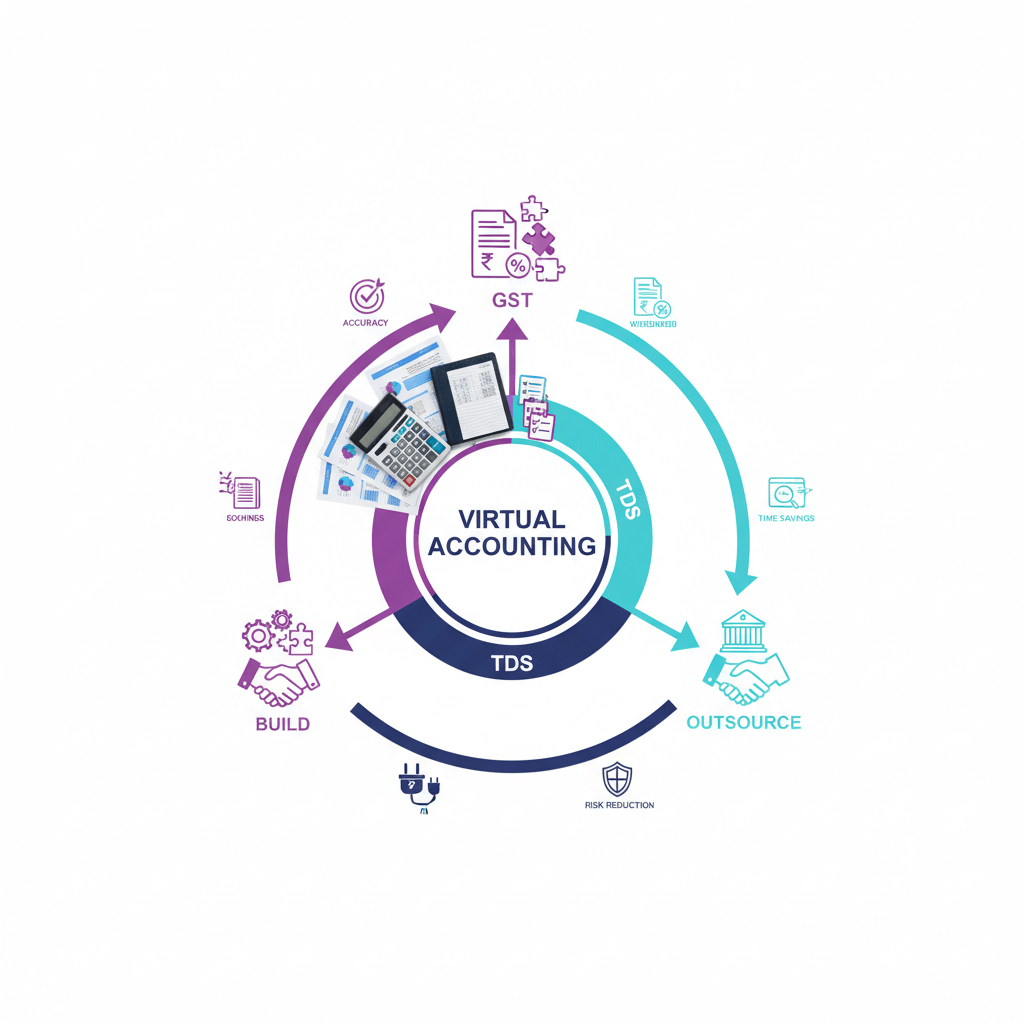
Build vs buy vs managed service
- Build, full control, but you own connectors, rule engines, and portal changes, which is costly.
- Buy, faster start with ready connectors, but you may hit gaps in custom flows, tools include ClearTax and TaxPro.
- Managed service, CA led team plus software and a dashboard, faster outcomes with less internal hiring, AI Accountant sits here.
Pick based on size and complexity, many startups choose managed for speed to value.
Sources: mochaaccounting.com, taxpro.co.in, aiaccountant.com
Implementation roadmap for tax filing automation integration
- Discovery, map GSTIN and TAN, document processes, tools, and due dates.
- Data mapping, clean masters, map chart of accounts, HSN or SAC, TDS sections, and place of supply.
- Sandbox, test APIs, run dummy filings, trial reconciliations, fix data quality.
- Pilot, one GSTIN or one TAN for a full month, refine maker checker.
- Rollout, phase by entity and return, train users, hypercare for two cycles.
This plan fits most businesses and is friendly to startups and small firms.
Sources: aiaccountant.com
How AI Accountant Virtual Accounting implements integration end to end
AI Accountant’s Virtual Accounting is a CA led managed accounting and compliance service with a live dashboard. You see revenue, expenses, P and L, balances, cash flow, burn, runway, recent transactions, bank analysis, AI alerts, and team chat in one place. On compliance, it covers GST with e invoice, TDS with challans and forms, Income Tax with ITR and advance tax, MIS, AR or AP, year end closes, a document store, a compliance calendar, and ROC for small companies.
Reference flow
Source systems like Tally or Razorpay, connectors pull sales, purchases, bank feeds, and payroll, validation and tax rules check GSTIN, PAN, HSN, RCM, and TDS sections, the dashboard shows drafts and alerts, the CA team reviews and green lights, the system e files to GSTN, TRACES, and the Income Tax portal, and acknowledgements, IRN or ARN and receipts go to the repository.
Use cases
D2C brands on Shopify and Razorpay, sales push to GSTR 1, e invoices get IRN, collections match to bank, 3B drafts in hours.
SaaS companies, apply place of supply, map TDS on payouts to the right section, keep recurring invoices in sync.
Freelancers, track TDS on receipts, match 26AS credits, and draft ITR from the ledger.
Small companies, align ROC forms with annual close, keep docs ready for secretarial filings.
Sources: aiaccountant.com
Recommended tools for accounting and automation
- AI Accountant, aiaccountant.com, CA led managed service and dashboard for accounting, GST, TDS, Income Tax, reconciliations, and ROC for small companies.
- QuickBooks, accounting with strong invoicing and bank feeds.
- Xero, cloud accounting with flexible reporting and multi currency.
- Zoho Books, Indian GST features with the Zoho suite.
- Tally, widely used ERP in India with GST support.
- ClearTax, GST and TDS connectors and filing.
- TaxPro, focused GST, TDS, and ITR workflows in India.
Pick tools that connect to your gateways and banks, and that support the reconciliations you need.
Sources: aiaccountant.com, taxpro.co.in
Pre go live checklist and pitfalls
Checklist
Validate GSTIN, PAN, TAN, check HSN or SAC completeness, confirm TDS section mapping per vendor and category, and test e invoice eligibility and IRN flow.
Pitfalls
Relying only on RPA without a backup path, skipping reconciliations, avoiding maker checker or audit trails, and letting tax rules go stale. Plan quarterly health checks to refresh mappings and rules.
Sources: aiaccountant.com
Deep dive on GST filing automation with reconciliations and e invoice
Sales, ensure invoice numbers, dates, customer GSTIN, HSN or SAC, and place of supply, push to GSTR 1 drafts on a schedule, fetch IRN and store QR codes where required.
Purchases, centralize supplier invoices, normalize vendor GSTIN, match GSTR 2B and flag missing, mismatched, or ineligible credits, manage ITC deferrals, reversals, and reclaims.
Returns, draft GSTR 3B with correct tax heads and offset ITC in the right order, file after maker checker.
Annual, prepare GSTR 9 and 9C from books and monthly filings, keep an adjustment trail and notes.
Sources: mochaaccounting.com, aiaccountant.com
Deep dive on TDS integration with TRACES and payroll
Vendors, enforce PAN and sections like 194C, 194J, or 194I, track exemptions or nil deduction certificates, and apply thresholds by financial year.
Challans and returns, prepare monthly challans, post to TRACES, file 24Q for salaries and 26Q for other deductions, generate Form 16A for vendors and Form 16 for employees.
Reconciliations, match TDS ledgers to 26AS and vendor statements, and cure short or excess deductions early.
Sources: taxpro.co.in, learn.microsoft.com, aiaccountant.com
Deep dive on Income Tax automation with 26AS and AIS matching
Books to ITR, pull P and L and balance sheet into ITR schedules, add depreciation from the fixed asset register, and include capital gains and interest income from ledgers.
26AS and AIS, match TDS credits and income, flag wrong PAN or section by deductors and request corrections to prevent credit loss.
Advance tax, use rolling forecasts and create challans on time.
Sources: mochaaccounting.com, taxpro.co.in, aiaccountant.com
Common integration edge cases and how to handle them
- Multi GSTIN groups, separate returns per registration, shared masters where safe, and clear ITC and cash splits.
- Exports and LUT, mark export invoices with LUT, handle foreign currency conversion, and track refunds.
- Credit or debit notes, link to original invoices and update GSTR 1 or 3B and ITC impacts.
- TDS exceptions, apply lower or nil certificates and watch year wise thresholds.
- ITC reversals, track reversals for non payment or blocked credits, reclaim when eligible.
Good design makes these cases routine, not risky.
Sources: aiaccountant.com
How to get your team ready
- Set clear roles, who prepares, who reviews, who files, who handles notices.
- Train on the dashboard, learn where to see returns, reconciliations, alerts, and comments.
- Standardize cutoffs, agree close dates and draft readiness, keep a shared calendar.
- Run drills, dry runs before deadlines to surface gaps early.
- Measure and improve, track cycle time and errors, run quarterly retros.
With a steady rhythm, filings become routine instead of stressful.
Sources: aiaccountant.com
Final thoughts and next steps with AI Accountant
Integration for tax filing automation is now essential in India, it keeps GST, TDS, and Income Tax steady, accurate, and on time. If you want a partner, AI Accountant’s Virtual Accounting blends a CA led team with a live dashboard and managed outcomes. Book a demo to get a compliance health check and an integration assessment, then pick a rollout plan that fits.
Source: aiaccountant.com
FAQ
What is integration for tax filing automation and how does it work for an Indian entity with multiple GSTINs?
It connects your ERP, commerce, payroll, banks, and gateways to GSTN, TRACES, and the Income Tax portal. Data is validated, drafted, and filed per registration, so each GSTIN gets its own GSTR 1, 3B, 9 or 9C, and ledgers stay separate. Reconciliations like GSTR 2B to purchases and 26AS or AIS to books run continuously. Sources: mochaaccounting.com, aiaccountant.com
How does automation reduce GST ITC leakage and improve working capital?
By normalizing vendor GSTIN and HSN or SAC, matching GSTR 2B to your purchase register, flagging ineligible or missing credits, and managing reversals or reclaims, you claim accurate ITC month on month. This reduces cash outflows, which improves working capital.
Can an automated setup handle e invoice IRN generation and QR code storage reliably?
Yes, through GSTN integration via a GSP or ASP. The system checks thresholds, requests IRN, stores the IRN and QR, and links them back to the original invoice for audits. Annual returns like GSTR 9 and 9C can also be prepared from the same dataset. Source: mochaaccounting.com
What controls should a CFO insist on before enabling one click filing?
Role based access with separation of duties, maker checker on every return and challan, audit logs, locked periods post filing, versioned tax rules, and anomaly dashboards. These reduce human error and strengthen audit readiness.
How does TDS automation ensure section wise accuracy across vendors and payroll?
Vendor masters enforce PAN and sections like 194C, 194J, 194I, track lower or nil deduction certificates, and apply year wise thresholds. Payroll integrates proofs and computes TDS for 24Q, while vendor deductions flow into 26Q. Monthly challans and Forms 16 or 16A are generated from the same ledger. Sources: taxpro.co.in, learn.microsoft.com
What is a realistic implementation timeline for a mid sized company, and where do delays occur?
Four to eight weeks for a pilot, then phased rollout over one to two quarters. Delays usually stem from dirty masters, missing HSN or SAC, weak vendor PAN mapping, or bank feed onboarding. A sandbox and a focused pilot reduce these risks. Source: aiaccountant.com
How do we quantify ROI for the board, beyond anecdotal time savings?
Track cycle time from close to file, pre filing errors caught, monthly ITC claim match to GSTR 2B, notice rate trend, and FTE hours saved in reconciliations. Convert penalty avoidance and interest savings into rupees, and show cash flow improvement from higher ITC realization.
Will automation handle exports under LUT and foreign currency invoices cleanly?
Yes, when the tax engine captures export flags, LUT references, and currency conversions. It ensures correct GSTR 1 reporting, 3B treatment, and links refunds where applicable. Good design also stores documents for quick scrutiny.
How does AI Accountant, as an AI enabled Virtual Accounting service, differ from a software only tool?
AI Accountant blends a CA led team with automation, you get connectors and dashboards plus expert reviews, maker checker, and notice handling. The service tunes rules, manages edge cases, and files on time, while you see status live and discuss actions with the CA team. Source: aiaccountant.com
What happens when GSTN or TRACES portals are down near due dates, will filings still complete?
A robust setup includes retries, queueing, and business continuity plans. Drafts stay approved, challans are prepared early, and filings attempt automatically when portals recover. The audit log records attempts and outcomes for each window.
Can we start with GST and add TDS and Income Tax later without rework?
Yes, if masters are normalized from day one for GSTIN, PAN, TAN, HSN or SAC, and place of supply. Start with GST flows, then extend to TDS and ITR by switching on sections, challans, and schedule mappings, without re entering historical data.
How do we ensure 26AS or AIS credits are fully captured in ITR for founders and professional income streams?
Automated matching ties ledger entries to 26AS or AIS lines, flags short credits or wrong sections, and prompts deductor corrections. For founders or professionals with multiple payers, this prevents credit loss and speeds ITR finalization.
What build versus buy decision factors matter for a startup with lean finance headcount?
If time to value, ongoing portal change management, and reconciliations are pain points, a managed service like AI Accountant is pragmatic. You gain ready connectors, CA oversight, and predictable filings, while avoiding the staffing and maintenance burden of a custom build.
How do maker checker and period locks prevent post filing changes that trigger notices?
Once a return is filed, the system locks the period, any adjustments move to the next period through journals or amendments. The approval trail proves who changed what and when, which reduces disputes during audits and inquiries.