-01%201.svg)
Key takeaways
- At 500+ invoices a month, GST, TDS, and vendor diversity make manual processing unscalable, yet 60-80% touchless throughput is achievable with a disciplined SOP and India-specific automation.
- Three non-negotiables for scale: standardized intake, clean vendor master, and intelligent matching, reinforced by strict compliance rules and audit trails.
- Adopt an eight-step workflow to cut cycle time to under one day, from intake and de-duplication to auto-coding, posting, payments, and GSTR-2B reconciliation.
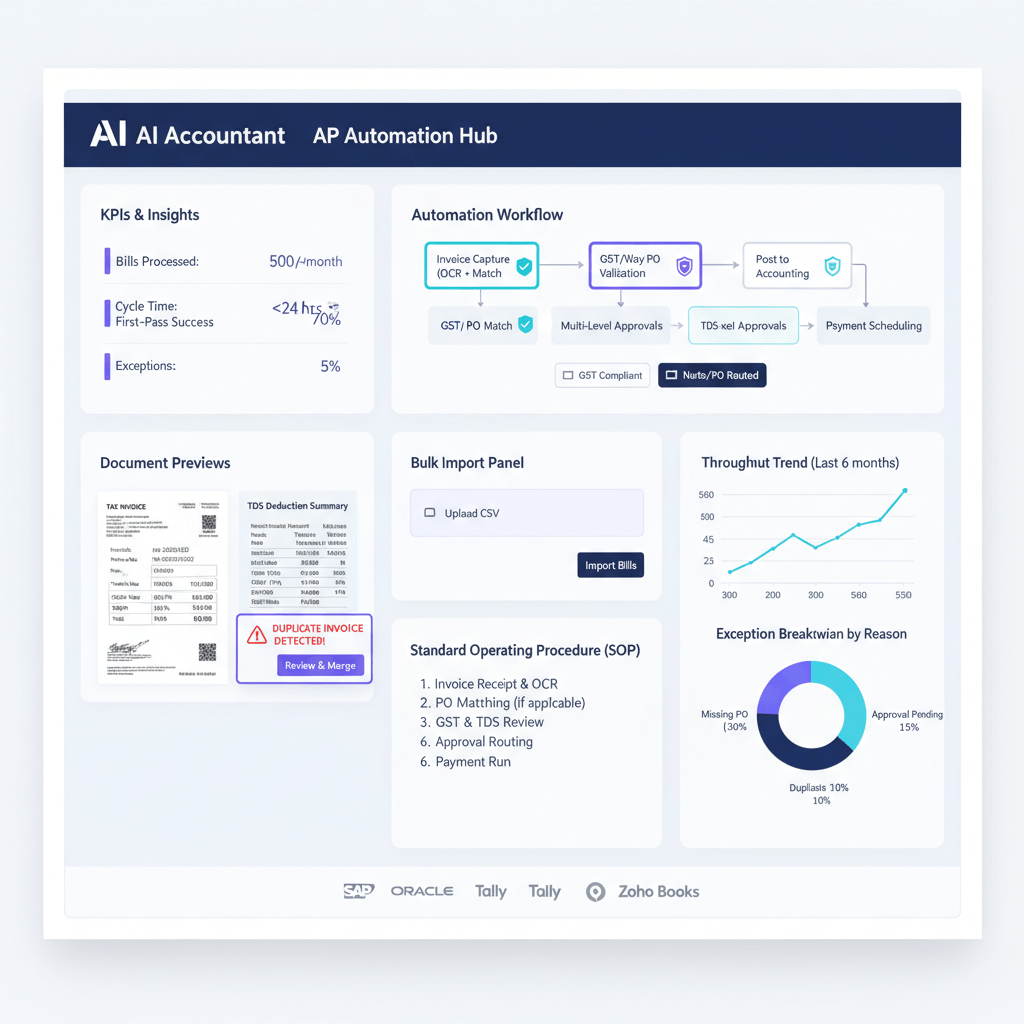
- Track core KPIs relentlessly, including touchless rate, first-pass yield, cycle time, exception rate, duplicate detection, ITC mismatch, and vendor master completeness.
- Choose tools that are India-native, with GSTIN checks, TDS/TCS logic, RCM handling, GSTR-2B reconciliation, and deep Tally or Zoho Books sync.
- Follow a 90-day rollout with a focused pilot, rule refinement, and KPI-driven scaling to deliver FTE savings, faster closes, and improved working capital.
- For a practical primer, see high-volume invoice processing, accounts payable automation India guide, and turnaround time for vendor payments India.
What “high volume” means in India
For most SMEs and CA firms, high volume starts at roughly 500 invoices per month. The count is only the headline, the real complexity comes from India’s compliance stack, GST slabs from 0% to 28%, e-invoicing validations, TDS and TCS application, and vendor diversity from handwritten MSME bills to enterprise PDFs.
- Error hotspots to hunt down: duplicate invoices, invalid or mismatched GSTINs, missing HSN or SAC, place of supply errors, incorrect ITC tagging, and RCM misclassification.
- Business impact: blocked ITC under the 180-day rule strains working capital, MSME payments beyond 45 days invite Section 43B(h) disallowance, audit penalties mount, and cash flow visibility erodes.
When invoice volume climbs, the hidden cost is rework, not headcount. Fix intake and master data first, then automate.
For additional context on throughput and pitfalls, review high-volume invoice processing.
The operating model to scale vendor bill processing in India
1) Standardize intake
Establish dedicated email dropboxes and bulk upload portals for PDFs, Excel, and CSV. Mandate native PDFs where available, set a minimum scan quality threshold, and ensure complete document sets at the point of entry, not later.
2) Vendor master hygiene
Codify your onboarding checklist. Every vendor must have validated GSTIN and PAN, MSME status, bank details, default ledger codes, and predefined TDS or TCS sections. For a step-by-step approach, see vendor onboarding automation India guide.
3) Matching and reasonability
Adopt two-way or three-way matching with POs and GRNs where relevant. Build reasonability rules that compare current rates against historical patterns. Learn the mechanics in 3-way matching in accounts payable.
4) De-duplication
Match on vendor code, invoice number, date, and amount concurrently. Use fuzzy detection to catch OCR or formatting variances like INV-1234, INV 1234, and INV1234. Reference practices in high-volume invoice processing and the accounts payable automation India guide.
India-specific accounting and tax treatment
- GST coding: classify between forward charge and RCM, auto-block restricted ITC categories, split mixed supplies correctly, validate place of supply and state codes.
- TDS and TCS logic: auto-suggest sections based on vendor type and transaction nature, for example 194C for contractors, 194J for professional services, 194H for commission, 194Q and 206C(1H) for threshold-triggered scenarios.
- Advances and prepayments: map to prepaid ledgers, amortize systematically, reconcile application against subsequent invoices.
- Credit and debit notes: always link to source invoices, reverse ITC when required, and maintain a clear audit trail.
- Enforce critical rules: 180-day ITC reversal tracking, MSME 45-day clock under Section 43B(h), and e-invoice IRN and QR verification at intake.
Deep dives: accounts payable automation India guide and turnaround time for vendor payments India.
SOP to process 500+ invoices a month with sub-1 day cycle time
This eight-step workflow consistently delivers 60-80% touchless throughput while upholding compliance.
- Intake and de-duplication
Aggregate through bulk upload, catch duplicates on vendor, invoice number, date, and amount before validation. - AI and OCR extraction
Extract GSTIN, invoice data, line items, HSN or SAC, tax breakup, totals, and e-invoice fields with confidence scoring and templates for recurring vendors. - Vendor and GSTIN matching
Resolve minor vendor name variations, escalate major mismatches, and validate format and checksum. For specifics, see GSTIN validation in AP workflow. - Auto-coding
Assign ledgers and cost centers, apply GST, TDS, TCS, and RCM logic, and split line items across appropriate heads. - Maker-checker review
Route only exceptions and high-risk cases to humans, bulk-approve clean transactions. - Post to Tally or Zoho Books
Maintain sequential numbering, enforce idempotent posting, preserve audit logs. - Payment preparation
Create payment batches with narrations, track status for ITC and MSME compliance. - GSTR-2B reconciliation
Match books to GSTR-2B, tag ITC eligibility, and generate vendor follow-ups for gaps.
Reference playbooks: high-volume invoice processing, accounts payable automation India guide, and turnaround time for vendor payments India.
Capacity planning and roles
Manual processing of 500 invoices usually requires around 3 FTEs with 6 to 8 day closes, while mature automation supports 5,000 invoices with 3 to 4 FTEs and 3 to 5 day cycles.
- At 500 invoices: 3 FTEs manually, 1 FTE with automation, sub-1 day cycle time.
- At 1,000 invoices: 5 to 6 FTEs manually, 1 to 2 FTEs automated, 2-day turnarounds.
- At 5,000 invoices: 15+ FTEs manually, 3 to 4 FTEs automated, 3 to 5 day cycles.
Define roles clearly: AP analyst as maker, reviewer as checker, CA or senior accountant for exceptions and compliance, vendor admin for master data and disputes. Lock in SLAs, extraction in 1 hour, review in 4 hours for routine bills, posting within 1 business day, with weekly payment runs.
See examples in high-volume invoice processing and turnaround time for vendor payments India.
Metrics and controls that keep scale safe
- Touchless rate: 60-80% for mature setups.
- First-pass yield: above 90% to minimize rework.
- Cycle time: under 3 days at peak, under 1 day at steady state for 500+ volume.
- Exception rate: trend by vendor and category to target fixes.
- Duplicate prevention: 99%+ capture before payment runs.
- ITC mismatch to GSTR-2B: below 3% sustained.
- Vendor master completeness: 95%+ for stable auto-coding.
Controls to codify: immutable audit trails, maker-checker segregation, IRN verification, systematic sampling of exceptions, and idempotent postings to avoid duplicates.
More guidance: high-volume invoice processing and the accounts payable automation India guide.
Tooling checklist for Indian AP scale
Essential ingestion
- Bulk uploads for PDFs, Excel, CSV, and images, OCR tuned to Indian invoices, template recognition, and confidence scoring.
Critical validation
- GSTIN verification, vendor mismatch workflows, de-duplication across multi-parameter keys, and PO or GRN matching.
Automated coding
- TDS, TCS, and RCM detection, rule-based ledgers and cost centers, multi-rate GST calculations, and split transactions.
Workflow and compliance
- Maker-checker routing, real-time KPIs, GSTR-2B reconciliation, multi-organization support for CA firms, and role-based access.
Integration and security
- Stable Tally Prime and Zoho Books sync, idempotent posting, encryption in transit and at rest, ISO 27001, and SOC-2 Type II.
Evaluation tips: high-volume invoice processing and the accounts payable automation India guide.
Top vendor bill processing tools for Indian businesses
- AI Accountant (website) purpose-built for Indian CA firms and SMEs on Tally or Zoho, with bulk ingestion, vendor resolution, automated tax coding, and GSTR-2B reconciliation, including multi-org management.
- Zoho Books effective for smaller volumes within the Zoho ecosystem, limited for complex GST at scale.
- Tally Prime with add-ons extensible with third-party modules, requires careful integration governance.
- SAP Concur enterprise-grade, suitable for large corporates, heavier on cost and change management.
- QuickBooks Online adequate for basics, not India-GST deep.
- ClearTax strong on GST and e-invoicing, lighter on end-to-end AP automation.
How AI Accountant streamlines AP in India
AI Accountant aligns directly to the eight-step SOP. Bulk ingestion accepts PDFs, CSV, and scans, extraction is tuned to Indian formats, vendor mismatches resolve with one-click master updates, Excel uploads return row-level error feedback, and auto-coding learns from your posting patterns.
Native Tally and Zoho Books sync eliminates manual exports, while GSTR-2B reconciliation auto-tags ITC eligibility. Dashboards track cycle time, touchless rate, and exceptions. Multi-organization control centralizes CA client operations, and security aligns with ISO 27001 and SOC-2 Type II. Explore the accounts payable automation India guide for deeper coverage.
Real-world results: a CA firm scales past 500 invoices
A Bangalore CA firm serving six SMEs on Tally and Zoho Books struggled with 3 FTEs on data entry, 6 to 8 day closes, and 15% ITC mismatches. After adopting AI Accountant, touchless rates hit 75% within two months, cycle time dropped to 2 days even at peak, and ITC mismatches fell to 3% with better validation. Duplicate payment risks over Rs 5 lakhs were averted in the first quarter, and the team shifted toward advisory work.
Case patterns are consistent with insights from high-volume invoice processing and turnaround time for vendor payments India.
Your 90-day implementation roadmap
Begin with a two-week pilot across two clients and one prior month of data to lock baselines: touchless %, cycle time, exceptions, and ITC mismatch.
Days 1–30: Foundation
- Standardize intake, cleanse vendor masters for GSTIN, PAN, MSME, bank details, and default codes, configure initial rules, and train the core team.
Days 31–60: Expansion
- Scale to more clients or departments, refine rules from pilot learnings, enable maker-checker flows, track KPIs daily, and document exception taxonomies.
Days 61–90: Optimization
- Target 60%+ touchless throughput, tune approvals, enable GSTR-2B reconciliation, formalize SOPs, and quantify ROI.
Expected ROI: 50-70% FTE reduction on AP processing, 60-80% faster month-end, 10-15% working capital lift from ITC optimization, and near-zero penalties.
Reference materials: accounts payable automation India guide, high-volume invoice processing, and turnaround time for vendor payments India.
Start scaling today
High volume vendor bill processing can be fast, accurate, and compliant, if you standardize intake, clean master data, apply smart validation, and deploy India-native automation. Monitor the right KPIs, iterate weekly, and scale deliberately.
Run a pilot, prove the metrics, and expand. Download a checklist tailored to Indian AP, or request a 20-minute walkthrough of AI Accountant to see the SOP in action. The difference between surviving 500 invoices and cruising at 5,000 is a systematic, automated operating model.
FAQ
How do I structure my AP process to reliably hit sub-1 day cycle time at 500 invoices a month?
Adopt the eight-step SOP, enforce strict intake quality and de-duplication, use AI extraction with confidence thresholds, auto-code GST, TDS, TCS, and RCM, route only exceptions to reviewers, and post idempotently to Tally or Zoho. Tools like AI Accountant implement this end-to-end and surface exceptions early.
What is the best way to validate GSTINs at intake without slowing down processing?
Automate format and checksum verification inline, then cache verified vendor GSTINs in the master. Only re-validate on detected changes. AI Accountant performs real-time structure checks and flags deltas for the vendor admin to resolve, minimizing reviewer load.
How do I configure TDS sections automatically, for example 194C versus 194J, without manual tagging every time?
Attach default TDS sections to vendor profiles based on service type, then layer transaction rules, for instance service descriptions or account heads. A learning engine like AI Accountant refines suggestions from historical postings and maker approvals, reducing misclassification over time.
What is the practical approach to handle RCM purchases, especially for freight, security services, and GTA?
Flag RCM-eligible vendors or categories in the master, auto-split tax lines, and post the correct self-invoice and tax liabilities. AI Accountant can tag RCM at the line level and generate postings aligned to Tally or Zoho conventions, ensuring accurate 3B reflection.
How should I link credit notes to original invoices to keep ITC adjustments audit-ready?
Use invoice number plus date and amount matching, with tolerance rules for rounding. Maintain a linkage table and auto-reverse ITC where applicable. AI Accountant enforces linkage at intake and preserves a clear audit trail with user stamps.
What controls ensure I do not pay a duplicate invoice across entities or periods?
Combine vendor code, invoice number, date, and amount keys, then run fuzzy checks for minor format variance. Block payment batch inclusion for duplicates. AI Accountant applies multi-parameter de-duplication and warns at both intake and payment preparation.
How can I keep MSME 45-day compliance without choking cash flow planning?
Tag MSME status in the vendor master, track invoice receipt dates, and run aged payment alerts tied to the 45-day rule. AI Accountant provides MSME-specific views and payment run prompts, preventing Section 43B(h) disallowance risks.
What is a workable cadence for GSTR-2B reconciliation at scale, and how do I minimize mismatches?
Reconcile weekly in peak cycles and at least monthly before close. Tag each invoice with ITC status and drive vendor follow-ups for missing 2B entries. AI Accountant auto-matches books to 2B and generates follow-up lists with supporting details.
How do I treat advances and prepayments when vendor bills arrive later, especially across financial year-end?
Book advances to prepaid or advance to supplier accounts, then apply against bills on receipt, amortizing if needed. AI Accountant tracks utilization and suggests application when the matching invoice lands, keeping year-end true up clean.
Can automation handle poor-quality scans and multi-page PDFs consistently for Indian invoice formats?
Yes, with OCR trained on Indian layouts, confidence scoring, and template fallbacks. Multi-page splitting plus QR and IRN extraction sustain accuracy. AI Accountant combines these with reviewer queues only for low-confidence fields.
What is the most efficient way to implement maker-checker without creating bottlenecks?
Set value thresholds and exception-based routing. Routine, compliant bills should auto-approve. Reserve human review for anomalies, new vendors, and high-value invoices. AI Accountant’s rules ensure reviewers see only what needs judgment.
How do I integrate with Tally Prime or Zoho Books while preventing duplicate postings?
Use idempotent posting keys tied to source invoice IDs, maintain sequential numbering, and lock records post-sync. AI Accountant’s native connectors to Tally and Zoho ensure stable sync and duplicate-safe updates.
Which KPIs should a CA firm track weekly to prove AP automation ROI to clients?
Track touchless rate, first-pass yield, cycle time, exception rate by vendor, duplicate detections, ITC mismatch, and vendor master completeness. AI Accountant dashboards present these KPIs, making ROI reporting client-ready.
What security and audit capabilities are essential for statutory and client audits?
Encryption at rest and in transit, ISO 27001 and SOC-2 Type II certifications, immutable audit trails with user and timestamp logs, and role-based access. AI Accountant provides these controls, satisfying auditor requests with minimal prep.
Is generic OCR or RPA sufficient for Indian AP, or do I need an India-native platform?
Generic tools extract text but usually miss GST context, TDS/TCS rules, RCM handling, and GSTR-2B workflows. India-native platforms like AI Accountant embed these rules and integrate tightly with Tally or Zoho, cutting rework and risk.
For additional reading on invoice capture accuracy, see smart invoice data capture.