-01%201.svg)
Key takeaways
- Vendor payment delays in Indian small businesses trace back to fragmented invoice intake, unclear approval chains, and GST or TDS data gaps. Fix these root causes and most follow up calls disappear.
- Standardize one invoice submission channel, lock a weekly payment run, and publish a clear approval matrix with backups. These three moves alone can cut your invoice cycle time from 12 days to under 5.
- MSME compliance is now non negotiable. Section 43B(h) disallows the expense if you cross 45 days, so tag MSME vendors at onboarding and never let ageing cross 40 days.
- Track five KPIs weekly: invoice cycle time, on time payment rate, first pass yield, GST 2B match rate, and MSME compliance rate. Weekly visibility replaces month end firefighting.
- Cash flow alignment through a 13 week rolling forecast and tiered payment priorities prevents payment slippage before it starts.
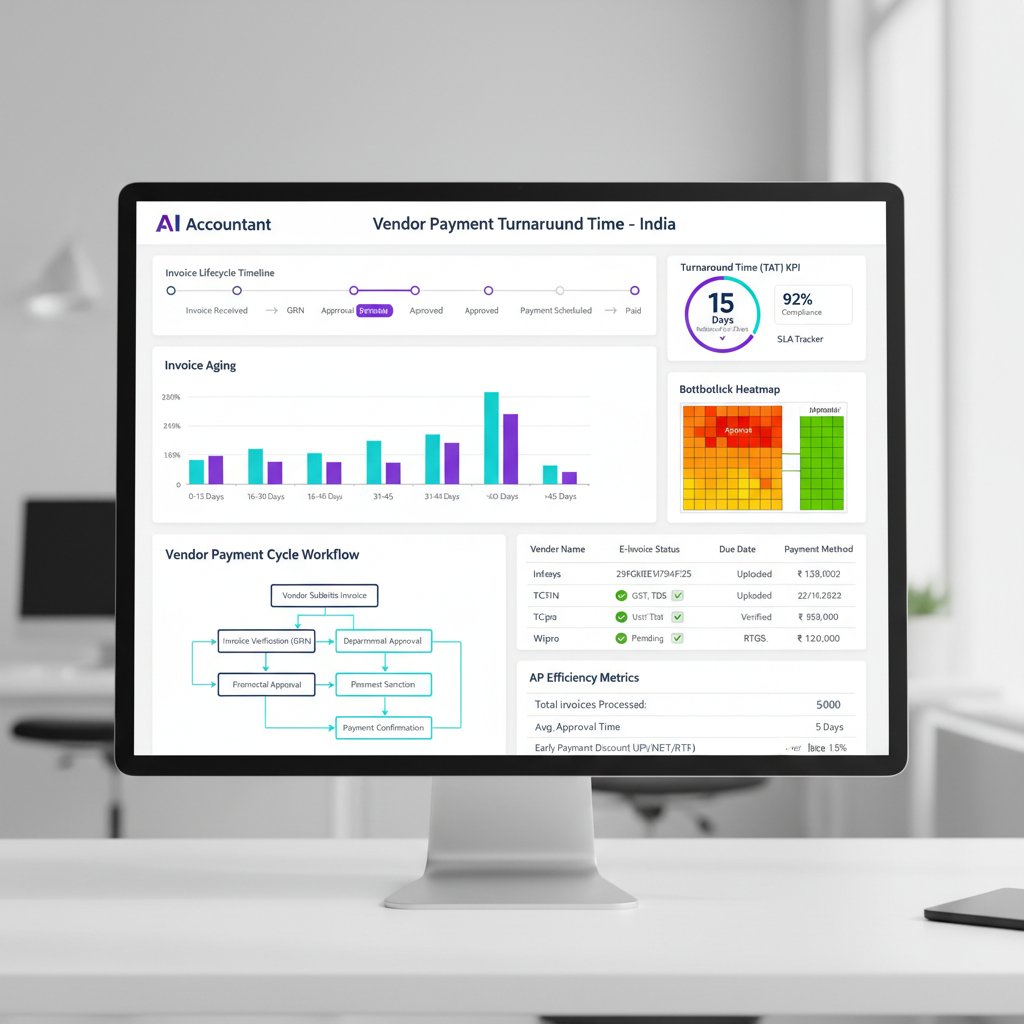
- Tools like AI Accountant's vendor bill matching automate multi format invoice capture, TDS section mapping, and MSME ageing alerts, turning repetitive grunt work into a predictable, auditable flow.
Vendor Payment Delays in India: What's New in 2026
Until March 2025, GST e invoicing applied only to businesses with turnover above ₹5 crore. From April 2025, the threshold dropped to ₹1 crore, pulling a significantly larger pool of SMEs into the e invoicing net. If your vendors now fall under this bracket, their invoices must carry a valid IRN (Invoice Reference Number) before you process payment. Invoices without an IRN are technically invalid under GST, and claiming ITC on them is a compliance risk. The GST portal's e invoice mandate now touches businesses that were entirely outside the net a year ago.
The operational shift is real. Your AP team now needs to verify IRN presence alongside GSTIN and HSN codes. Vendor onboarding forms need a new field confirming whether the vendor is e invoice compliant. Payment runs should include an IRN validation step, especially for new or infrequent vendors.
Section 43B(h) enforcement has also tightened. The Income Tax Department is actively flagging MSME payables that cross 45 days during assessments for FY 2024 25 onwards. The Income Tax Department expects clear documentation trails. Disallowance is no longer theoretical; it is showing up in notices.
Who does this hit hardest? Service businesses with 20 to 200 vendors, especially those still running manual AP on spreadsheets. If you lack automated MSME tagging or IRN checks, you are one missed invoice away from a penalty or a blocked ITC claim.
- Audit your vendor master for e invoice applicability by end of this quarter
- Add IRN validation to your invoice verification checklist
- Review all MSME payables weekly, not monthly, to stay within the 40 day safety buffer
Platforms with built in GST reconciliation can flag missing IRNs and MSME ageing breaches automatically, reducing the manual vigilance your team needs to maintain.
Understanding Your Vendor Payment Cycle: The India Reality
If you are reading this at 11 PM, reconciling vendor statements while WhatsApp pings with "payment kab milega" messages, you are not alone. Vendor payment delays damage relationships and can trigger MSME penalties.
Invoice delays are everything that slows an invoice from receipt to approval: missing data, wrong GST details, approval bottlenecks. Fix the second, and the first largely resolves itself.
The 10 Step Vendor Payment Journey
- Vendor onboarding and KYC collection (PAN, GSTIN, bank details, MSME certificate, applicable TDS section)
- Purchase order or approval (formal PO or casual email confirmation)
- Service delivery (timesheets, deliverables, statement of account where applicable)
- Invoice receipt (email, WhatsApp, physical copy, vendor portal)
- Invoice verification (GST compliance, TDS applicability, mathematical accuracy, PO matching)
- Approval routing (budget owner, finance team, authorized signatory)
- Payment run scheduling
- Bank execution (NEFT, RTGS, UPI processing, daily limits, portal uploads or API triggers)
- Books posting (Tally entry, TDS tagging, GST classification)
- Reconciliation and disputes (vendor statement matching, query resolution)
Where Delays Actually Hide
- Fragmented invoice collection across multiple email IDs and WhatsApp chats
- Missing or unclear purchase orders leading to endless back and forth
- GST mismatches when vendor GSTIN does not match 2B data
- TDS confusion about whether 194C, 194J, or 194H applies
- Approver bottlenecks when the only person who can approve is traveling
- Cash constraints and bank limits forcing payment deferrals
Each delay point compounds. A missing PO leads to verification delays, which causes approval holdups, which pushes you past the MSME 45 day deadline, which triggers penalties. It is a domino effect that starts small but ends expensive.
Root Cause Diagnosis: Why Invoice Delays Happen
Use this checklist to score your current state. Focus improvement effort where the score is highest.
Process Issues
- No standard channel for invoice submission; vendors send to random emails
- No defined approval matrix; only the founder or partner signs everything
- Ad hoc payment runs triggered by vendor pressure instead of a fixed schedule
Data Issues
- Wrong GSTIN or place of supply causing GST mismatches
- Incomplete vendor master data: missing MSME status, bank proof, PAN
- Duplicate invoices and inconsistent numbering systems
Policy Issues
- No written payment terms communicated to vendors
- No SLA for invoice approval turnaround
- No escalation path when approvers are unavailable
Technology Issues
- Manual data entry from PDF and photo invoices
- No systematic two way or three way matching (PO, delivery note, invoice)
- No automated reminders or payment status visibility
Behavioral Issues
- Processing invoices only during month end rush
- Gatekeeper mindset in finance teams
- Poor communication about submission requirements
Score yourself: 0 to 5 issues means you are efficient. 6 to 10 issues means stabilizing with room to improve. 11 to 15 issues means firefighting mode. The point is not to feel bad. It is to pinpoint focus.
Your Action Playbook: How to Reduce Vendor Payment Delays in Small Service Businesses
Quick Wins: Start This Week
Standardize invoice intake immediately
Create a single invoice email address or a simple Google Form. Auto acknowledge receipt so vendors know their invoice entered your system. This one change eliminates a large chunk of follow ups.
Publish your invoice requirements
Share a one page guide with fields you need: invoice number format, GSTIN placement, MSME declaration, applicable TDS section. Include sample invoices for clarity.
Fix approval bottlenecks today
Define thresholds and assign backups. For amounts under ₹25,000 allow department heads. For ₹25,000 to ₹1 lakh, route to the finance head. Above that, the founder or partner approves. Always have a backup approver.
Lock your payment schedule
Pick Tuesday or Wednesday as your payment run day. Communicate clearly: invoices received by Friday evening get paid next Wednesday. Keep an urgent queue for genuine exceptions only.
Process Upgrades: Next 4 to 8 Weeks
Clean up vendor master data
Capture legal and trade names, GSTIN and PAN, MSME registration number, bank account proof, applicable TDS section, and agreed payment terms. This master becomes your single source of truth.
Implement validation rules
Validate GSTIN format and checksum. Verify PAN structure. Enforce invoice number uniqueness per vendor. Apply basic two way matching where POs exist, and three way matching for goods purchases.
Automate TDS workflows
Map vendors to TDS sections during onboarding: 194C for contractors, 194J for professional services, 194H for commission agents. Schedule challan payments and Form 16A generation monthly. The Income Tax Department portal provides updated section references and rate charts.
Set up status communication
Send automatic updates at each stage: invoice received with reference number, under approval, scheduled for payment on a specific date, payment processed with UTR number. This alone kills most "where is my payment" calls.
Technology and AI Assistance
You can execute manually, yet the right tools turn grunt work into predictable flow.
Banking and Payments
- Use bank portals for bulk NEFT and RTGS uploads
- Leverage UPI for smaller vendor payments
- Adopt BBPS for utility payments
Accounting Automation
- Auto post payments to ledgers
- Tag TDS and GST automatically during ledger entry
- Create exception queues for failed transactions
AI Powered Assistance
Modern tools handle multi format invoice ingestion (PDFs, photos, Excel), predict ledger heads and TDS sections, and sync with Tally. AI Accountant extracts invoice data, maps it to the right ledger and GST code, and provides AP dashboards showing payment ageing, with SOC 2 Type II and ISO 27001 assurance.
Choose tools tuned for Indian needs: GST matching, TDS intelligence, MSME tracking, and integration with Tally. The CBIC regularly updates GST rules, so your tool must keep pace with notification changes.
AP Efficiency India: Metrics and Benchmarks That Matter
Core KPIs to Track
- Invoice cycle time: days from receipt to payment completion
- Approval lead time: days from receipt to final approval
- First pass yield: percentage of invoices processed without queries
- On time payment rate: percentage paid within agreed terms
- DPO alignment: days payable outstanding versus contractual terms
- Exception rate: disputes or rework per 100 invoices
- GST 2B match rate: percentage of invoices matching GSTN records
- TDS accuracy: percentage requiring no corrections
Realistic Benchmarks for Indian SMBs
- Invoice cycle time: 3 to 5 days after approval
- First pass yield: 90 percent or higher
- On time payment: 95 percent or higher
- DPO: aligned to terms, never exceeding 45 days for MSME vendors
- GST match rate: 95 percent or higher
- Exception rate: under 5 percent
Build Your AP Dashboard
Create a weekly view. The left panel shows invoice volume and pending value. The center panel shows four critical KPIs with red, amber, green status. The right panel shows the exception list and approval ageing.
Review every Tuesday morning. Watch trends, not snapshots. Week over week movement tells you more than any single number.
India Compliance Essentials Impacting Your Vendor Payment Cycle
GST 2B Matching Nightmares
When vendors delay filing or upload incorrectly, you may lose ITC if you pay before correction. Many businesses hold payments until GST compliance is confirmed.
Solution: Educate vendors monthly on timely GSTR 1 filing. Share a guide on how their delays cost you ITC. Consider preferred status for vendors with consistent compliance. The GST portal provides 2B data that you should reconcile weekly, not monthly.
TDS Complications Causing Delays
Wrong TDS sections lead to corrections, interest, and disputes. Confusion grows when one vendor provides multiple service types under a single GSTIN.
Solution: Map TDS sections during onboarding. Maintain a reference chart. When in doubt, consult your CA before processing. The Income Tax Department publishes updated TDS rate charts each financial year.
MSME Act and Section 43B(h) Pressure
MSME payments must be within 45 days, or you pay interest and lose the tax deduction for that year. This is not a future risk; it is being enforced in assessments now.
Solution: Tag MSME vendors at onboarding. Surface them prominently in every payment run. Track days to pay specifically for MSME vendors. Never cross 40 days. The Ministry of Corporate Affairs maintains the Udyam registration database for verification.
RCM Scenarios Creating Confusion
Reverse charge mechanism applies to specific services: goods transport agencies, legal services, director remuneration, and others.
Solution: Maintain an RCM list. Flag these vendors separately in your master. Process payments only after confirming the correct GST treatment and recording the liability entry.
Cash Flow Alignment: Preventing Payment Slippage
Build a 13 Week Rolling Forecast
List opening bank balance, expected collections, committed vendor payments, statutory payments, and closing balance. Update weekly. Share with leadership for clarity and alignment.
This forecast becomes the backbone of your payment scheduling. Without it, every Wednesday payment run is a guessing game.
Implement Payment Prioritization
- Tier 1 (must pay): statutory dues, MSME vendors nearing 45 days, critical infrastructure
- Tier 2 (should pay): regular vendors within terms, recurring services
- Tier 3 (can defer): large vendors with flexible terms, non critical purchases
Early Warning Signals
- Cash runway dropping below three months
- Approval queue increasing week over week
- Rising vendor escalations and follow up calls
- Budget variance exceeding fifteen percent
Maturity Based Playbooks: Choose Your Level
Low Tech Starter Pack
Shared Gmail inbox with labels for invoice stages. Google Forms for submission. Excel tracker for vendor master and payment schedule. Tally for books with manual entries. WhatsApp broadcast for payment updates.
Cost is minimal. Impact is meaningful. This works for businesses with under 50 vendors.
Mid Tech Enhancement
Tally Prime with approvals. AI assisted extraction via AI Accountant. Email approvals with mobile access. Bank integration for payment file uploads. Automated payment confirmation emails.
Cost is modest. Impact is sizable. Best for businesses processing 100 to 500 invoices per month.
High Tech Transformation
Full procure to pay suite with vendor portal. Policy engine for auto approvals. Bank API integration for real time payments. Advanced analytics for spend optimization. Vendor performance scorecards.
Cost is higher. Impact is dramatic. This suits businesses with complex multi entity operations.
Vendor Relationship Management: Reducing Invoice Delays at Source
Create a Vendor Education Pack
Share a simple PDF covering: standard invoice format, GST requirements with examples, TDS implications, submission process, payment schedule and cut off times, and MSME benefits including how to register.
Send at onboarding and refresh annually. A well informed vendor submits clean invoices. Clean invoices flow through faster.
Quarterly Reconciliation Rhythm
Every quarter, send statements. Ask for confirmation or disputes. Resolve differences promptly. Document all adjustments.
This rhythm prevents year end surprises and builds mutual trust.
Performance Based Incentives
Offer early payment discount for perfect invoices. Grant preferred status for 100 percent GST compliance. Provide faster terms for consistent performers.
Make collaboration profitable for both parties. Vendors who benefit from your process will protect it.
Tools Evaluation Checklist
Must Have Features
- Multi format invoice capture: PDF, images, Excel
- Indian bank statement parsing
- GST and TDS intelligence
- Tally integration
- Approval workflows with SLAs
- Payment file generation
- Audit trail maintenance
- SOC 2 or ISO 27001 certification
Indian Specific Capabilities
- GSTIN validation and IRN verification
- TDS section mapping
- MSME vendor tracking with ageing alerts
- Indian payment formats: NEFT, RTGS, UPI
- Rupee symbol and Indian number formatting (lakhs, crores)
Recommended Tools for Small Service Businesses
- AI Accountant: automated invoice processing with Indian tax intelligence, seamless Tally integration, and real time AP dashboards
- Tally Prime: trusted for compliance and widely adopted across Indian CA firms
- ClearTax: strong on GST and TDS filing
- RazorpayX: modern payment automation with bank integrations
- QuickBooks: global standard with Indian localization
- Zoho Books: comprehensive accounting with basic AP features
Real World Case Study: Bengaluru Digital Marketing Agency
The Baseline Chaos
- Invoice cycle time: 12 days average
- On time payment rate: 62 percent
- MSME escalations: 3 to 4 monthly
- TDS errors: 15 percent
- Team stress level: maximum
The Transformation Journey
Month one: Standardized intake via dedicated email. Vendor master created. Wednesday payment runs locked.
Month two: Vendor data cleaned. MSME vendors tagged. Acknowledgment emails enabled. Approval matrix rolled out.
Month three: AI based extraction deployed. Simple KPI dashboard went live. Vendors trained on submission requirements.
Month four: Bank integration for payment uploads. Automated confirmations. Weekly metrics review established.
The Results
- Invoice cycle time: down to 4 days
- On time payment rate: up to 96 percent
- MSME escalations: zero for three months
- TDS accuracy: 98 percent
- Vendor satisfaction: "best client to work with"
- Finance team: home by 7 PM
Templates and Resources for Immediate Implementation
Vendor Onboarding Checklist
- Basic Information: legal entity name, trade name if different, registered address, GSTIN, PAN, MSME certificate if applicable, Udyam registration number
- Banking Details: account holder name, account number, IFSC code, bank name and branch, cancelled cheque
- Compliance Information: applicable TDS section, GST rate for services, RCM applicability, e invoice compliance status, standard payment terms
Standard Invoice Format Guide
- Invoice number (unique and sequential)
- Invoice date
- Your company name and GSTIN
- Vendor name and GSTIN
- Description of services or goods
- HSN or SAC code
- Taxable value
- GST breakup: CGST, SGST, or IGST
- TDS section if applicable
- Total amount in words
- Payment terms
- MSME declaration if applicable
- IRN and QR code (if e invoice applicable)
Approval Matrix Template
- Up to ₹25,000: department head approves, backup is team lead, SLA 24 hours
- ₹25,001 to ₹1,00,000: finance manager approves, backup is CFO, SLA 48 hours
- ₹1,00,001 to ₹5,00,000: CFO approves, backup is founder, SLA 48 hours
- Above ₹5,00,000: founder approves, backup is board member, SLA 72 hours
Weekly Payment Calendar
Monday: Review cash position and pending payments.
Tuesday: Final approval collection deadline by evening.
Wednesday: Payment run execution mid day.
Thursday: Payment confirmation emails with UTR numbers.
Friday: New invoice submission deadline by evening.
FAQ
How should a CA design a vendor payment policy that aligns Section 43B(h) and MSME timelines without risking disallowance?
Tag every MSME vendor at onboarding using their Udyam registration number, enforce a maximum 40 day internal payment cut off, and reconcile unpaid MSME invoices weekly. In your tax computation, maintain a separate tracker for MSME payables cleared within the financial year, because any payment beyond 45 days triggers both interest liability and expense disallowance under Section 43B(h). The Income Tax Department is actively flagging these in assessments for FY 2024 25 onwards (2026 update).
How do I map vendor services to correct TDS sections when one GSTIN bills multiple service types?
Maintain a vendor service catalog at onboarding with default TDS sections per service type: 194C for contractor work, 194J for professional fees, 194H for commission. Override per invoice where the description differs from the default. Configure rule based checks so invoice descriptions matching your catalog trigger a section suggestion automatically, reducing manual errors.
How can I synchronize GST 2B matching with vendor payments without blocking cash flow?
Run a weekly 2B reconciliation, not monthly. Pay compliant invoices on schedule, hold only mismatched ones, and issue the vendor a corrective advisory with screenshots from the GST portal. Track recurring non compliance and shift those vendors to stricter terms. From April 2025, also verify IRN presence for vendors above ₹1 crore turnover before processing payment (2026 update).
What KPIs should a CA present in a board pack for AP efficiency in an Indian SMB?
Present invoice cycle time, on time payment rate, MSME compliance rate, first pass yield, GST 2B match rate, and exception rate. Provide week over week trend lines and aged buckets for approvals. Keep the pack concise and action linked, flagging any metric that moves by more than ten percent for immediate investigation.
Which low tech controls deliver the fastest improvement in AP predictability?
A shared inbox for invoices, a simple intake form, a published approval matrix with backups, a fixed weekly payment calendar, and automated acknowledgment emails. These five controls provide clarity, cut vendor escalations, and can be rolled out within one week at near zero cost.
Do I need to verify e invoice IRN for vendor bills before processing payment?
Yes, if your vendor's turnover exceeds ₹1 crore (the threshold effective from April 2025), their invoices must carry a valid IRN and QR code. Processing payment on an invoice without a valid IRN puts your ITC claim at risk (2026 update). Add IRN verification as a mandatory step in your invoice checklist, right alongside GSTIN validation and PO matching.
Is it practical to offer early payment discounts in Indian service businesses?
Yes, for critical vendors, a two percent early payment discount for perfect invoices received by cut off with full GST compliance can work well. Limit the program to select vendors, measure net savings versus cash cost quarterly, and tie preferred status to consistent compliance. The savings often outweigh the discount when you factor in reduced follow up time and smoother operations.
Taking Action: Your Next 30 Days
This week: Set up a standard invoice intake channel. Define your approval matrix with backups. Lock a weekly payment schedule.
Next week: Clean vendor master data. Focus on MSME identification, Udyam registration verification, and TDS section mapping.
Week 3: Implement validation rules including IRN checks. Publish vendor communication templates. Start sending status emails at each invoice stage.
Week 4: Build a simple AP dashboard. Record your baseline metrics for all five core KPIs.
Week 5 and beyond: Review metrics weekly. Iterate on processes. Consider adding automation like AI Accountant for invoice extraction, tax intelligence, and ledger sync.
Perfect is the enemy of done. Start with quick wins, build momentum, and then layer sophistication. Predictability beats perfection, every time.

Rohan Sinha is a fintech and growth leader building aiaccountant.com, focused on simplifying accounting and compliance for Indian businesses through automation. An IIT BHU alumnus, he brings hands-on experience across 0 to 1 product building, growth, and strategy in B2B SaaS and fintech.