-01%201.svg)
Key takeaways
- GSTR 2B reconciliation tools eliminate manual VLOOKUPs, match your purchase register with portal data, and prevent ITC leakage.
- Always claim ITC from GSTR 2B, use GSTR 2A for vendor nudges, see the Difference Between GSTR 2A and 2B for clarity.
- Automated exception handling helps you identify missing invoices, duplicates, and amendments in minutes, not days.
- Built in ITC claim optimisation applies eligibility rules, manages reversals, tracks the 180 day payment rule, and highlights reclaim opportunities.
- Vendor follow up automation systematizes reminders, escalations, and documentation, improving supplier compliance month on month.
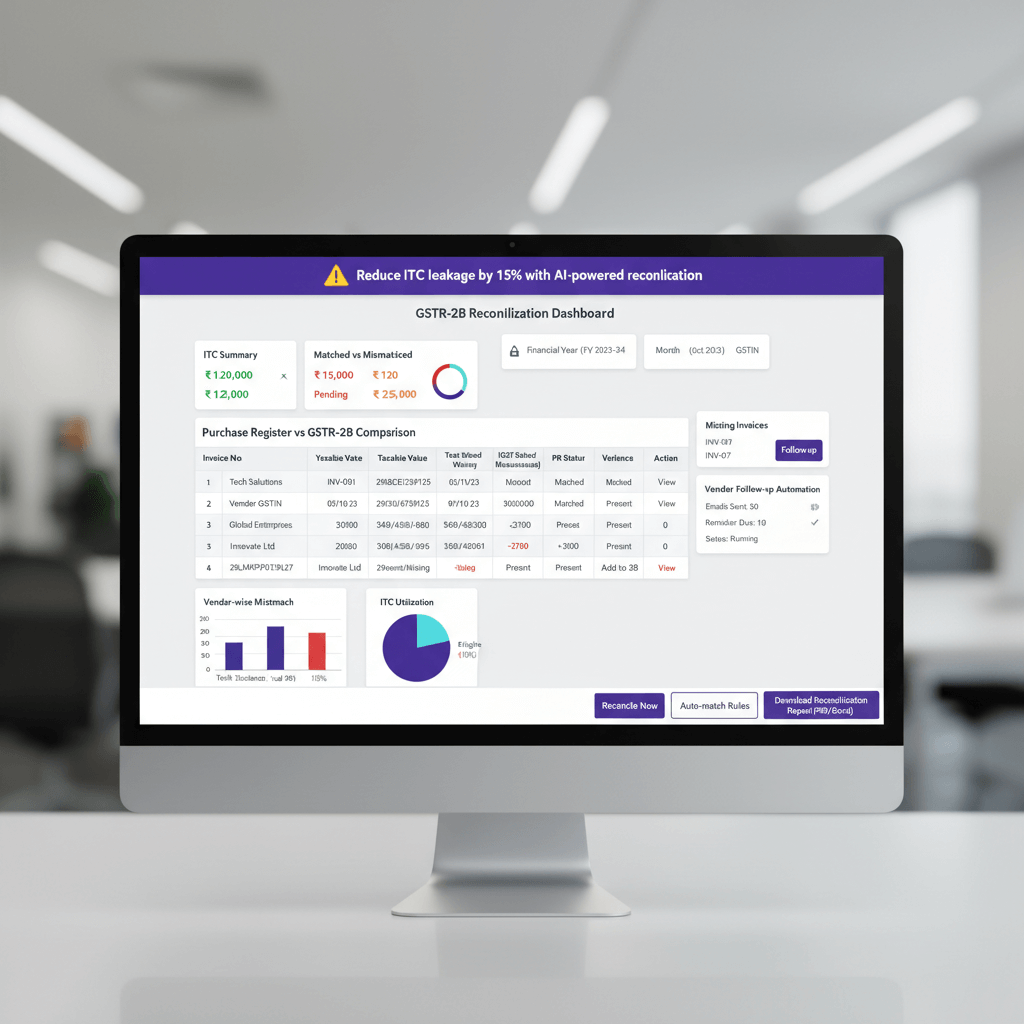
- A live monthly dashboard gives leadership instant visibility into ITC, unresolved mismatches, and recovery trends.
- Controls matter, look for audit trails, role based access, and explainable matching, as emphasized by ICAI GST tech use cases.
Quick primer, GSTR 2B and why reconciliation matters
GSTR 2B is your static, monthly snapshot of eligible ITC, it is generated from suppliers’ GSTR 1 filings, while GSTR 2A updates in real time. You reconcile against 2B to remain compliant, then use 2A mid month to anticipate issues and nudge vendors.
Confusion between the two drives errors, so bookmark this explainer on the Difference Between GSTR 2A and 2B and a concise GSTR 2B overview. For purchase side workflows, this guide to reconciling purchase is a useful reference.
Bottom line: mismatches lead to cash stuck in wrong ITC, reversals with interest, and painful audits. Right tooling prevents leakage, creates proof, and shortens month end.
Common pain points without a tool
Manual reconciliation means CSV exports, fragile formulas, and hours lost to name variations, amendments, and duplicates. Teams struggle to identify missing invoices at scale, then chase suppliers through untracked emails and messages, with no certainty on resolution.
Leadership asks for a status view, you end up sharing a spreadsheet that no one else can interpret. Guidance like GSTR 2B vs purchase register reconciliation and this step by step reconciliation guide highlights why structure, not spreadsheets, wins.
End to end workflow a modern tool should support
1) Data onboarding
- Import GSTR 2B JSON or Excel, pull purchase registers from Zoho Books or Tally, include credit notes, debit notes, and JVs.
- Auto mapping of columns, validation of GSTIN formats, and vendor master sync.
2) Matching engine
- Configurable rules to match purchase register to 2B on GSTIN, invoice number, date, value, and tax, with tolerances and date buffers.
- Confidence scores, exact versus probable matches, and PAN level options when GSTINs fail.
3) Classification and exceptions
- Green for exact, yellow for suggested, red for missing in 2B, plus missing in books, duplicates, and amendments.
- Instant filters to identify missing invoices and generate vendor wise issue lists with evidence.
4) ITC claim optimisation
- Eligibility tagging, blocked credit checks, RCM handling, place of supply validations, and period wise amendment logic.
- Automated reversals, tracking of the 180 day payment rule, and reclaim suggestions.
5) Vendor follow up automation
- Emails and WhatsApp reminders, escalation SLAs, communication logs, and vendor scorecards.
- One click vendor reports with supporting evidence that drive action.
6) Closure, audit trail, and reporting
- Lock decisions, push adjustments back to books, preserve audit logs, enforce role based access.
- Real time monthly dashboard for ITC trends, aging mismatches, and recovery progress.
For deeper context, review ICAI’s curated examples of GST technology in practice: ICAI GST tech use cases.
Deep dive on must have capabilities
Matching accuracy features
- Flexible rules, date buffers, amount tolerances, and credit debit swaps.
- Auto GSTIN validation with correction suggestions and PAN level fallbacks.
Exception handling tools
- Smart filters for exact, probable, and complete mismatches, duplicates, and amendments.
- Bulk actions, one click vendor packs, quick resolution workflows.
ITC optimisation functions
- Automated eligibility, reversal calculations, RCM tracking, and cross period amendment handling.
- Easy purchase entry creation for items present in 2B but missing in books.
Automation and insights
- Scheduled reconciliation runs, auto categorization based on history, and automated report generation.
- Dashboards with ITC breakdowns, aging analysis, vendor performance metrics, and month on month trends.
Useful primers from the ecosystem include this overview of reconciling purchase and a comparison of GSTR 2B vs purchase register reconciliation.
Accuracy and controls
Great results come from algorithms plus governance. Use deterministic and fuzzy logic appropriately, set tolerances with care, validate GSTINs automatically, and preview before committing matches. De duplication prevents double claims, while audit logs and separation of duties protect compliance.
Tip: Ask for an evidence pack download per reconciliation, with before and after snapshots, user actions, and communication trails.
For control focused practitioners, see ICAI GST tech use cases, and reinforce checklists with this practical guide to reconciling purchase.
Integrations and data readiness
Direct connectors to Zoho Books and Tally avoid CSV churn, multi GSTIN support keeps entities clean, and organization level rules reflect real operations. Demand modern security, including ISO 27001 or SOC 2 reports, with offline options if your industry requires.
For budgeting context, this market view on GSTR 2B reconciliation software pricing and value helps structure a cost benefit discussion.
Evaluation checklist for commercial investigation
- Volume and complexity fit: Multi GSTIN, amendment heavy, above 95 percent match accuracy at scale.
- Matching explainability: Confidence scores, side by side field comparisons, clear reasons for suggested matches.
- ITC claim optimisation depth: Configurable rules, RCM policies, automatic 180 day payment rule tracking.
- Vendor follow up automation maturity: Multi channel nudges, escalation SLAs, vendor self service, scorecards.
- Monthly dashboard quality: Custom KPIs, drill downs, aging and trend analysis, downloadable packs.
- Integration effort: Zoho or Tally readiness, push back posts to books, bidirectional master sync.
- Onboarding and support: Timelines, SLAs, training, and transparent pricing models.
- References and case studies: CA firm and SME wins, India specific results, 70 percent or higher reduction in unreconciled items.
Cross check findings with community write ups such as Masters India reconciliation notes, ClearTax’s step by step guide, and Saral’s GSTR 2B explainer, then estimate ROI with this view on pricing and value.
Build versus buy considerations
Spreadsheets suit low volume, but they lack auditability and break as you scale. Custom scripts give control, yet demand constant maintenance as GST rules evolve. Dedicated platforms deliver automation, accuracy, vendor automation, and dashboards that typically pay back quickly in recovered ITC and reduced effort, see practical market perspectives on pricing and value.
Implementation playbook for 30 to 45 days
- Week 1 to 2, Pilot and baseline: Reconcile last three months, capture unreconciled percentage, ITC leakage, and close time.
- Week 2 to 3, Configuration: Tune matching rules, set ITC claim optimisation policies, define roles and approvals.
- Week 3 to 4, Data prep: Clean vendor masters, standardize naming, set vendor follow up automation templates.
- Week 4 to 5, Training and testing: Run parallel reconciliation, refine tolerances and rules.
- Week 5 to 6, Go live: Reconcile current month, monitor the monthly dashboard, iterate based on feedback.
- Ongoing, Optimization: Review accuracy, evolve templates, automate adjacent GST processes.
Metrics and ROI model
- Reduction in unreconciled items: 70 percent or better within three months means cleaner books and fewer notices.
- ITC recovery rate: 3 to 5 percent additional ITC is common, a 50 lakh monthly ITC base can yield up to 2.5 lakhs in working capital.
- Cycle time improvement: Move from days to minutes, freeing 80 to 90 percent of compliance effort.
- Compliance score: Fewer reversals and penalties, stronger audit trails, better vendor discipline.
- Team satisfaction: Less drudgery, more analysis, better retention.
For adjacent reconciliation thinking, this perspective on 26AS reconciliation shows how automation raises control quality in other tax workflows too.
Mini case, Indian manufacturing SME
A Pune based manufacturer with five GSTINs and fifteen thousand plus monthly purchase entries moved from a week of manual work to sub thirty minute reconciliations. Unreconciled items fell by 70 percent in month one, vendor follow up automation sent eight hundred plus nudges with full logs, and legitimate ITC increased by up to 5 percent. The CFO now relies on a live monthly dashboard for compliance health.
Popular GSTR 2B reconciliation tools in the market
- AI Accountant, comprehensive reconciliation with Zoho and Tally integrations, automated matching, vendor workflows, and real time dashboards.
- ClearTax GST Software, strong reconciliation alongside filing and e invoicing, see their reconciliation guide.
- Masters India, advanced matching and detailed exception reports, check their notes on 2B vs purchase register.
- Zoho GST, native reconciliation for Zoho Books users.
- TaxiVaahan, multi GSTIN focused compliance features.
- Gen GST, desktop first with offline reconciliation options.
Where AI Accountant fits your reconciliation needs
If you use Zoho Books or Tally, AI Accountant plugs in seamlessly. It applies configurable rules to match purchase register entries to 2B, helps you identify missing invoices with vendor specific evidence packs, and drives ITC claim optimisation through eligibility tagging, reversals, and reclaim tracking aligned to your policies. Vendor follow up automation standardizes reminders and escalations, while a live monthly dashboard surfaces ITC, aging, and vendor performance without manual reporting.
Risks and pitfalls to avoid
- Over generous tolerances cause false positives, set amounts and date buffers conservatively, then scale up.
- Ignoring amendments creates duplicates and missed credits, ensure cross period logic is turned on.
- Not posting adjustments back to books separates compliance from accounting, break that silo.
- Treating vendor outreach as a one time event reduces impact, continuous follow up changes behavior.
- Forgetting historical cleanup leaves cash on the table, run a backlog reconciliation to unlock past ITC.
FAQ
How often should a CA firm run GSTR 2B reconciliation for clients, and what interim checks make sense?
Run a formal reconciliation monthly after GSTR 2B is available, typically by the 14th, then do mid month variance scans against 2A to flag missing invoices early. For structure, align your checklist with GSTR 2B vs purchase register reconciliation, and use AI Accountant to automate the cadence.
What is the current year difference between GSTR 2A and 2B for ITC claims, and how should I advise clients?
Claim ITC strictly from 2B since it is static for the period, use 2A for real time monitoring and vendor chasing. Share this explainer on the Difference Between GSTR 2A and 2B, then configure AI Accountant to trigger vendor reminders from 2A gaps while booking claims from 2B.
How do I set matching tolerances without increasing the risk of false positives?
Start with zero tolerance on GSTIN and invoice number, a narrow date buffer such as plus or minus three days, and a small value tolerance such as up to one percent for rounding. Review confidence scores and field wise comparisons, a feature available in AI Accountant, before widening limits.
What is the recommended approach to handle RCM and blocked credits during reconciliation?
Classify RCM and blocked credits as ineligible during reconciliation, post reversals automatically, and track their separate ledgers. Tools like AI Accountant tag eligibility, apply rules, and provide drill downs so your GSTR 3B tallies without manual recalculation.
How do I operationalize the 180 day payment rule without spreadsheet tracking?
Link invoice level payment status from your ERP and let the engine compute reversals and interest, then auto mark reclaim once paid. See a policy led approach in this note on the 180 day payment rule, which AI Accountant supports out of the box.
Our purchase register is messy, can reconciliation still be accurate?
Yes, but clean the inputs first. Run vendor master de duping, standardize GSTIN formats, and validate mandatory fields. Use pre validation reports like those in AI Accountant, then reconcile, create missing purchase entries for invoices found in 2B, and lock adjustments with an audit trail.
What playbook works when suppliers ignore follow ups for missing invoices or incorrect reporting?
Adopt automated multi channel nudges, set SLAs, escalate by aging, and integrate payment holds where appropriate. AI Accountant’s vendor follow up automation logs every touchpoint, produces evidence packs, and creates vendor scorecards so procurement can enforce compliance.
How do I evidence reconciliation choices to an auditor or during a departmental inquiry?
Maintain immutable logs of match rules, user actions, timestamps, and document snapshots, then export an evidence pack per period. ICAI highlights control centric automation in GST tech use cases, and AI Accountant aligns with this by preserving drillable audit trails.
Which KPIs should a CA firm track across clients to prove ROI from reconciliation automation?
Focus on unreconciled percentage, ITC recovered, cycle time, notice rate, and vendor response SLAs. A live monthly dashboard in AI Accountant tracks these, enabling firm wide benchmarks and quarterly reviews.
What integration depth with Zoho Books or Tally is needed to avoid manual back and forth?
Look for direct connectors that sync masters, pull purchase registers, and push reconciliation adjustments back to books. AI Accountant supports this flow, reducing CSV handling and eliminating version confusion.
How should we reconcile multi GSTIN entities with entity specific rules and approvals?
Run per GSTIN workspaces with their own rules, tolerances, and approvers, then consolidate reporting across the PAN. AI Accountant supports entity scoped controls while offering a group view for CFOs.
What is a practical timeline to implement and see benefits for a mid market client base?
Within six weeks, pilot three months of data, configure rules, clean masters, train users, and go live. Many firms report a 70 percent reduction in unreconciled items and 3 to 5 percent higher ITC recovery within the first quarter using AI Accountant.
Next steps and conversion assets
Download your buyer’s checklist, evaluate vendors against matching accuracy, exception handling, ITC claim optimisation, vendor follow up automation, and monthly dashboard depth. Then, book a demo using last month’s data to validate performance on your exact scenarios, and run a short pilot to establish baseline metrics and prove ROI.
The goal is a sustainable, accurate, and auditable compliance process. With the right reconciliation platform, your team claims every legitimate rupee of ITC, closes on time, and is always audit ready.

Rohan Sinha is a fintech and growth leader building aiaccountant.com, focused on simplifying accounting and compliance for Indian businesses through automation. An IIT BHU alumnus, he brings hands-on experience across 0 to 1 product building, growth, and strategy in B2B SaaS and fintech.