-01%201.svg)
Key takeaways
- Automated GSTR-2B reconciliation tools transform hours of manual matching into minutes with high accuracy.
- Modern platforms offer intelligent categorization, exception workflows, and comprehensive audit trails.
- Real-time processing and AI-driven pattern recognition deliver proactive insights and risk management.
- Strategic automation optimizes ITC claims, improves cash flow, and supports multi-entity compliance.
- AI Accountant sets a new standard with advanced matching algorithms, ERP integration, and scalable workflows.
Understanding GSTR-2B: The Foundation of Input Tax Credit Claims
GSTR-2B is a read-only, auto-drafted monthly ITC statement on the GST portal. It’s static—once it’s generated for a month, the data stays unchanged—so it becomes the clean benchmark for what ITC is available to claim.
GSTR-2B reconciliation simply means matching your purchase register/books against this statement, then fixing mismatches before you file GSTR-3B (because 2B is what you’re expected to use for the “right ITC” in 3B). Done well, it helps you claim maximum eligible ITC without panic before deadlines—and reduces the risk of errors that can trigger follow-ups later.
For a more detailed walkthrough, refer to the Complete Guide on GSTR-2B.
Common Challenges in Manual GST Reconciliation
Manual GSTR-2B reconciliation isn’t just “time-consuming”, it breaks down because 2B is a period-wise statement that’s only available after it gets generated, so any late/incorrect supplier reporting quickly turns into mismatches you have to chase.
Why manual reconciliation fails in real life:
- Too many invoices, too little time: Line-by-line matching doesn’t scale once volumes cross a few hundred invoices per month—especially near filing deadlines.
- Multi-GSTIN complexity: Separate matching, exception tracking, and follow-ups per GSTIN makes manual work error-prone fast.
- Vendor reporting issues: Wrong GSTIN, invoice number formats, late uploads, or amendments lead to repeated back-and-forth.
- Last-minute stress = conservative ITC: Teams either miss credits or intentionally under-claim to avoid risk, which hits cash flow.
The 4 mismatch buckets you end up handling every month:
Use these buckets (even if you’re reconciling in Excel) — they map directly to how you resolve issues:
- Matched – good to claim
- Only in Books – follow up with vendor / check if upload is pending
- Only in 2B – check if you missed booking the invoice / vendor billed wrong entity
- Partial / Mismatch – invoice/date/value/GSTIN differences that need correction
Quick checklist before filing:
- Check “Only in Books” invoices: vendor upload pending? wrong GSTIN? wrong invoice number format?
- Check “Only in 2B” invoices: not booked in purchase register? booked under different GSTIN/entity?
- Prioritize high-value mismatches first (top 20 invoices often drive most ITC impact).
- Keep a simple audit trail: what changed + who approved + vendor communication status.
Essential Features of Modern GSTR 2B Reconciliation Tools
Advanced reconciliation platforms address critical challenges through intelligent automation and user-friendly interfaces.
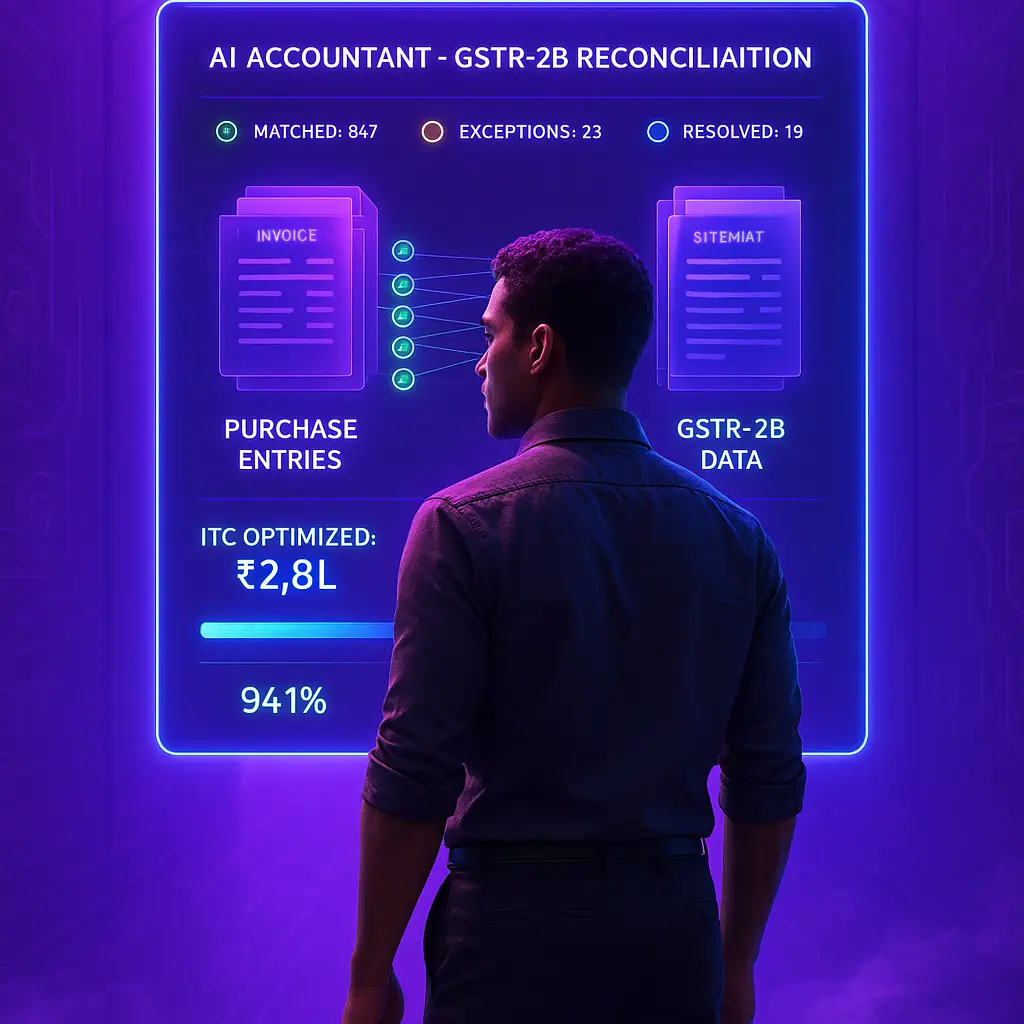
- Automated Data Fetching and Matching: Retrieves GSTR-2B data directly from the portal and cross-references it with purchase entries.
- Intelligent Categorization: Groups entries into perfectly matched, partially matched, only-in-books, and only-in-statement categories.
- Vendor-Wise Summary Views: Highlights patterns and recurring issues for specific suppliers.
- Exception Management Workflows: Tracks vendor communications and documents resolution steps for audit purposes.
- Comprehensive Reporting: Generates detailed reconciliation reports with summary statistics and mismatch analysis.
Learn more about reconciliation features in GSTR-2B Reconcile.
Automation Benefits: Transforming Input Tax Credit Matching
The shift from manual to automated reconciliation represents more than efficiency gains.
- Speed and Accuracy Revolution: Processes thousands of transactions in minutes, eliminating human errors.
- Intelligent Pattern Recognition: AI systems predict potential issues and suggest proactive solutions.
- Real-Time Processing: Provides ongoing visibility into ITC positions and early warning of discrepancies.
- Scalability: Handles increased transaction volumes without proportional resource increases.
- Audit Trail Maintenance: Logs matching decisions and resolution activities for regulatory reviews.
See how automation compares at SuviT Insights and explore AI-driven solutions at AI Reconciliation.
Identifying and Resolving Mismatched GST Invoices
Even with automated tools, understanding mismatch types and resolution strategies is crucial.
- Invoice Number Variations: Different numbering formats or characters in supplier filings.
- Date Mismatches: Differences between invoice dates and GSTN upload dates.
- Amount Discrepancies: Calculation errors or varied tax treatment interpretations.
- GSTIN-Related Mismatches: Registrations filed under unexpected GSTINs or due to business restructuring.
Advanced tools suggest structured workflows and communication templates, as detailed in the Tally Solutions guide.
Top GSTR 2B Reconciliation Tools for Indian Businesses
If your main goal is to quickly reconcile your Purchase Register and GSTR-2B without missing out on any eligible ITC and to do it fast - here are the most commonly used, India-relevant options grouped by the kind of workflow your business runs.
For CA Firms Managing Multiple Clients or GSTINs
- AI Accountant: One of the main features of AI Accountant is matching up GSTR-2B with your books - especially useful for handling exceptions and multi GSTIN clients, and even exports right back into your accounting flow.
- ClearTax (ClearGST): A strong contender for reconciling 2B vs Purchase Register (along with mismatch buckets and ITC-focused workflows - it provides 3B support in their reconciliation flow).
- Winman GST: This is a well-known GST suite that many CAs love, it does 2A/2B reconciliation and also imports data from Excel, Tally and JSON files and has many filing workflows included.
- KDK Spectrum Cloud (GST): Another CA practice-style platform with 2A/2B reconciliation and client handling workflows built right in - has Tally sync options.
- IRIS Sapphire: Used for doing GST reconciliation on a large scale, it's designed to handle bulk data and reconcile match/mismatch type workflows across many GSTINs.
- Suvit / Vyapar TaxOne: A tool that focuses on automated reconciliation (2A/2B/IMS) has ITC tracking workflows.
For SMBs Using Accounting Suites (keep it simple inside your books)
- TallyPrime: Native GSTR-2B reconciliation report and import workflow right inside TallyPrime, if you're already using Tally this makes a lot of sense.
- Zoho Books: Fetches GSTR-2B from GSTN and auto-classifies matched/partially matched transactions for you to review.
- RealBooks: Yet another accounting suite with GSTR-2B import and automated matching against purchase entries.
For Enterprise / Compliance-Heavy Stacks
- Avalara India (GST Returns + Reconciliation): A compliance oriented workflow with validation and reconciliation of purchase register vs supplier invoices built in for those who want structured controls.
- SAP Digital Compliance for India: For big orgs that run on SAP stacks - does inward invoice monitoring and reconciliation workflows right inside the compliance layer.
How AI Accountant Revolutionizes GSTR-2B Reconciliation
- Intelligent GSTN Integration: Automatic data fetch across all managed GSTINs.
- Advanced Matching Algorithms: Learns from user decisions and industry patterns.
- Unified Dashboard: Centralized compliance status, pending exceptions, and action priorities.
- ERP Integration: Seamless data flow with Tally and Zoho Books.
- Proactive Exception Management: Early issue detection and vendor communication workflows.
- Scalable Multi-Entity Support: Manages single or hundreds of registrations with ease.
- Comprehensive Audit Documentation: Automatic logs of all reconciliation steps.
Learn more about bank feed integration at AI Tools for CA Firms.
Implementation Best Practices for Reconciliation Tools
- Data Quality Foundation: Standardize vendor names, invoice numbering schemes, and GSTIN records before rollout.
- Team Training and Change Management: Focus on new workflow patterns and responsibilities.
- Gradual Rollout Strategy: Start with a single GSTIN or limited date range.
- Exception Handling Procedures: Define escalation paths, templates, and timelines.
- Performance Monitoring: Track match rates, resolution times, and process efficiency.
Future of GST Compliance Automation
- AI Advancements: Enhanced pattern prediction and natural language vendor communications.
- Blockchain Integration: Real-time transaction verification through distributed ledgers.
- Account Aggregator Framework: Direct bank feed integration for immediate reconciliation.
- RegTech Evolution: Standardized data formats and improved portal capabilities.
- Predictive Analytics: Proactive compliance issue identification and filing strategy suggestions.
Building Confidence in Your GST Compliance
Automation rebuilds confidence by reducing stress around filing deadlines and freeing teams for strategic analysis. Chartered accountants can shift from reactive data matching to proactive advisory roles, while SMB owners enjoy accurate ITC claims and better cash flow planning. Finance teams gain improved work-life balance and opportunities to develop higher-value skills. Modern tools like AI Accountant handle complexity quietly, so you focus on the thinking that drives business success.
FAQ
How can I use AI Accountant to reconcile GSTR-2B for multiple GSTINs?
AI Accountant automatically fetches GSTR-2B data for each GSTIN, matches invoices with purchase entries, and provides consolidated dashboards. You can view vendor-wise summaries, track exceptions, and resolve mismatches with built-in workflows.
What are the common reasons for amount mismatches in GSTR-2B reconciliation?
Amount discrepancies often result from calculation errors, varied tax treatment interpretations, or data entry mistakes. AI Accountant flags these mismatches and suggests resolution steps, such as verifying supplier filings or adjusting book entries.
Can I integrate AI Accountant with my existing Tally ERP system?
Yes, AI Accountant offers seamless integration with Tally ERP. Reconciliation results are automatically updated in your Tally books, eliminating duplicate data entry and ensuring consistency across systems.
How does AI Accountant handle invoice number variations during matching?
AI Accountant’s advanced matching algorithms recognize different numbering formats and additional characters. The system learns from past resolutions, improving match accuracy over time and reducing manual review efforts.
Is real-time reconciliation possible with AI Accountant?
Absolutely. AI Accountant performs continuous data fetch and matching as new invoices or GSTR-2B statements become available, providing real-time visibility into your ITC position and early warning of potential issues.
What audit documentation does AI Accountant maintain?
AI Accountant logs every matching decision, exception handling step, and communication with suppliers. These comprehensive audit trails satisfy regulatory requirements and simplify responses to tax authority inquiries.
How do I set up exception workflows in AI Accountant?
Within AI Accountant, you can define mismatch categories, assign resolution tasks to team members, and automate follow-up reminders. Built-in templates streamline vendor communications and ensure timely issue resolution.
Can AI Accountant forecast my ITC claims for better cash flow planning?
Yes. AI Accountant provides performance analytics and trend insights, enabling accurate ITC forecasting. You can integrate these forecasts into working capital plans and strategic budgeting processes.
What training resources are available for AI Accountant users?
AI Accountant offers comprehensive onboarding materials, including video tutorials, user guides, and live support sessions. These resources ensure your team adapts quickly to the new reconciliation workflows.
How do I ensure data quality before implementing AI Accountant?
Standardize vendor names, invoice numbering schemes, and GSTIN records in your purchase books. Clean data maximizes match rates and reduces manual exceptions when you switch to AI Accountant.

Rohan Sinha is a fintech and growth leader building aiaccountant.com, focused on simplifying accounting and compliance for Indian businesses through automation. An IIT BHU alumnus, he brings hands-on experience across 0 to 1 product building, growth, and strategy in B2B SaaS and fintech.