-01%201.svg)
Key takeaways
- GSTR 2B reconciliation is mission critical for accurate ITC, automation replaces VLOOKUP chaos with audit ready, vendor actionable outcomes.
- Prioritize intelligent matching, ITC optimization, vendor follow up automation, and accounting integrations, these drive the majority of ROI.
- Use a weighted scoring matrix to compare tools objectively, map features to your workflows and quantify the impact before buying.
- Run a focused 30 day pilot, measure auto match rates, ITC leakage reduction, and cycle time compression to make a confident rollout decision.
- CA firms and SME finance teams benefit most from tools that handle messy data, multi GSTIN setups, and bulk discrepancy resolution at scale.
Who This Guide Is For and Why GSTR 2B Reconciliation Tools Matter Now
The Teams Struggling Most
CA firms serving many GST clients juggle different purchase registers, vendor behaviors, and compliance nuances, manual work steals time from advisory. SME finance teams on Zoho Books or Tally wrestle with ITC delays, vendor non compliance, and long month end sprints.
The urgency is clear because GSTR 2B is static after the 14th, one mistake locks credit or invites notices. For a crisp explainer on the difference between GSTR 2A and GSTR 2B and another accessible comparison by Webtel, see this GSTR 2A vs GSTR 2B guide. Tally also provides a comprehensive background in its GSTR 2B guide.
Manual reconciliation is no longer just inefficient, it is risky in an era where analytics driven scrutiny flags small mismatches fast.
Quick Refresher, What GSTR 2B Reconciliation Actually Entails
Understanding GSTR 2B vs GSTR 2A
GSTR 2B is a monthly, static ITC statement, once generated it does not change. GSTR 2A is dynamic, it keeps updating as suppliers make changes. For deeper reading, see this GSTR 2A vs GSTR 2B overview and Webtel’s detailed comparison.
Core Reconciliation Outcomes
- Match purchase registers with portal data accurately.
- Identify missing invoices on either side quickly.
- Confirm ITC eligibility using current rules and timelines.
- Trigger vendor actions with clear, trackable follow ups.
For practical walkthroughs, see the ICAI use case on reconciliation here, India Compliance’s step by step purchase reconciliation guide, and ClearTax’s GSTR 2B vs PR recon.
Must Have Feature Checklist for GSTR 2B Reconciliation Software
Data Ingestion and Standardization Capabilities
Expect uploads for purchase registers, journals, credit and debit notes, and bulk GSTR 2B files, across Excel, CSV, JSON, even PDF. Smart auto mapping and pre validations reduce rework, pinpointing row level errors so teams can fix fast. If you are reformatting files for hours, the tool is not truly automated. See India Compliance’s reconciliation guide and the Tally primer on GSTR 2B.
Intelligent Matching Logic for Purchase Register Reconciliation
Go beyond exact matches. You need fuzzy and partial logic across GSTIN, invoice number, date, taxable value, and tax breakup, with tolerances for rounding or date formats, plus duplicate detection and PAN level matching for related entities. Explore ICAI’s approach here, India Compliance’s recon detail here, ClearTax’s match engine overview here, and a market view from Cashflo on GST reconciliation software.
Missing Invoice Detection and Discrepancy Management
- Flag PR only, 2B only, and value or GSTIN mismatches clearly.
- Use filters to prioritize high value issues, apply bulk actions, and track status to closure.
- Provide root cause hints to prevent repeats.
ITC Claim Optimization Features
Automation should apply eligibility rules for time limits, Reverse Charge Mechanism, imports, and blocked credits, with auditable reasons for each decision. For practical nuances on time based controls, see this primer on ITC reversal automation, and for RCM specifics, review Reverse Charge Mechanism accounting. Deep dives are also available in the India Compliance recon guide, ClearTax’s feature overview, and GSTHero’s GSTR 2B guide.
Vendor Follow Up Automation
Issue lists per vendor, templated emails and WhatsApp, reminder schedules, and communication logs make compliance collaboration reliable. PAN level rollups and vendor scoring surface chronic non compliance patterns.
Comprehensive Dashboards and Reporting
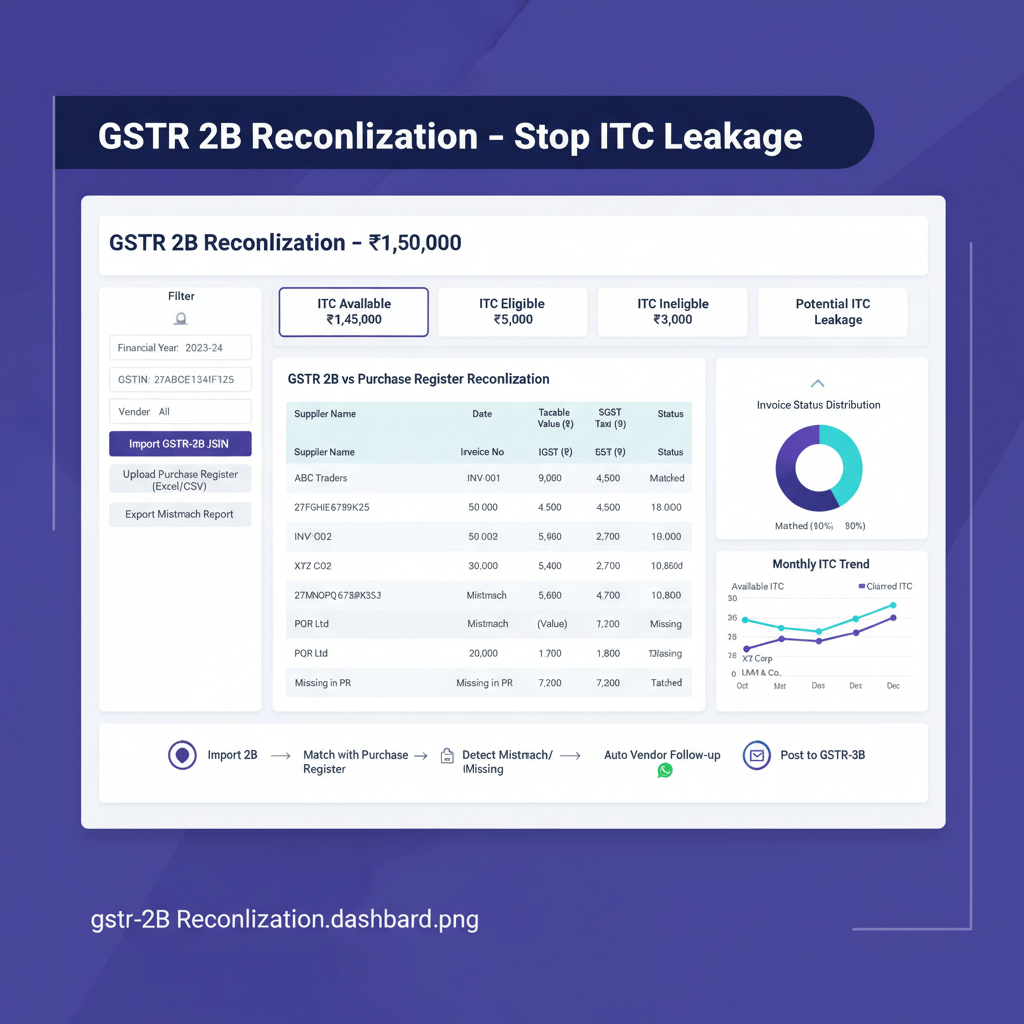
Great dashboards show eligible, availed, and deferred ITC, leakage hotspots, vendor trends, and aging at a glance. For a conceptual example of what to watch, scan this GST health check dashboard. Also review ICAI’s use case visuals and ClearTax’s reporting.
Seamless Integration and Posting Capabilities
Direct sync with Zoho Books and Tally, auto download from the GST portal, and posting back of reconciled entries keep books aligned. Depth matters, master data reads, amendment handling, and status updates separate pro tools from basic exporters.
Security, Controls, and Scalability
Demand role based access, maker checker approvals, audit logs, encryption, and certifications like ISO 27001 or SOC 2 Type II. At scale, performance with lakhs of invoices and multi user concurrency is essential. For context on established platforms, see ClearTax’s compliance stack, Tally’s GSTR 2B guide, Cashflo’s take on reconciliation software, and the ICAI use case overview.
How to Compare GSTR 2B Reconciliation Tools, A Practical Scoring Matrix
Building Your Evaluation Framework
Score each tool from 1 to 10, then apply weights that reflect your priorities. As a starting point, assess options like the ICAI tool, ClearTax, India Compliance, and TallyPrime, then tailor the weights to your environment.
Scoring Criteria and Weights
- Accuracy and Match Depth, 25%, fuzzy logic, multiple parameters, high auto match rates.
- ITC Optimization, 20%, rule engine coverage, auto bucketing, GSTR 3B integration.
- Vendor Automation, 15%, bulk communications, reminders, tracking, vendor scoring.
- Dashboard Clarity, 10%, trends, drill downs, exportable reports.
- Integration Effort, 10%, native connectors, back posting, amendment handling.
- Total Cost of Ownership, 10%, licenses, implementation, training, support.
- Support SLAs, 10%, response times, expertise, channels.
Sample Scoring Comparison
| Criterion | Weight | ICAI Tool | ClearTax | India Compliance | TallyPrime |
|---|---|---|---|---|---|
| Accuracy and Match Depth | 25% | 9 | 10 | 9 | 7 |
| ITC Optimization | 20% | 8 | 9 | 8 | 7 |
| Vendor Automation | 15% | 7 | 9 | 8 | 6 |
| Dashboard Clarity | 10% | 9 | 8 | 8 | 7 |
| Integration Effort | 10% | 6 | 9 | 8 | 10 |
| TCO/Pricing | 10% | 9 | 7 | 8 | 8 |
| Support SLAs | 10% | 7 | 9 | 8 | 8 |
| Total, Weighted | 100% | 8.0 | 8.8 | 8.3 | 7.6 |
Red Flags to Avoid
Beware CSV only workflows without audit trails, black box match logic, poor amendment handling, and no back posting. These look fine in demos, then cost hours in real closes. For a perspective on value tradeoffs, see this pricing oriented review on pricing and value.
Deep Dive Workflow, From Raw Data to Booked ITC
Step 1, Data Ingestion and Normalization
Upload PR, JVs, credit notes, and bulk 2B files. Intelligent parsers auto detect columns and formats. The ICAI tool is known for resilient parsing across Excel layouts.
Step 2, Automated Reconciliation Processing
Fuzzy logic and tolerances resolve real world variations, exact matches lock in certainty, and duplicates get isolated. ClearTax documents its approach in this feature guide, emphasizing learning from repeated reconciliations.
Step 3, Discrepancy Identification and Classification
Three buckets appear instantly, PR only, 2B only, and value or GSTIN mismatches. India Compliance showcases bulk resolution patterns in its how to reconciling purchase documentation and ICAI outlines outcomes here.
Step 4, ITC Optimization and Bucketing
Rules for time limits, RCM, imports, and blocked credits determine eligible, ineligible, deferred, or vendor dependent credits. For practical policy edges, read the GSTHero GSTR 2B guide.
Step 5, Vendor Communication and Follow Up
Templates, reminders, and logs scale outreach. ClearTax highlights vendor sharing flows in its product help.
Step 6, Posting and Dashboard Updates
Post reconciled entries back to accounting, then monitor ITC status, compliance KPIs, and trends. See examples in the ICAI tool overview and the Tally background on GSTR 2B. For a quick concept of monitoring, scan this GST health dashboard idea.
Top GSTR 2B Reconciliation Tools to Consider
1. AI Accountant
AI Accountant brings intelligent automation for GSTR 2B reconciliation with deep Zoho Books and Tally integrations, fuzzy matching on GSTIN and vendor fields, robust missing invoice filters, and auditable ITC bucketing. Vendor reminders, communication logs, and multi org access controls, backed by ISO 27001 and SOC 2 Type II certifications, suit CA firms handling many clients.
2. ClearTax
ClearTax emphasizes extensive match coverage, vendor report sharing, and automated GSTR 3B readiness, with broad ERP integrations and dashboards for enterprises.
3. India Compliance
India Compliance supports PAN level reconciliation with one click actions and strong exception workflows, a solid fit for SMEs including ERPNext users.
4. TallyPrime
TallyPrime offers native reconciliation inside Tally for simpler use cases where basic matching suffices.
5. ICAI Reconciliation Tool
The ICAI tool provides three tier fuzzy matching, rich charts, and professional outputs, often with competitive pricing.
Commercial Questions to Ask Vendors Before Buying
Security and Compliance Considerations
Confirm encryption at rest and in transit, certifications like SOC 2 Type II, data residency, backups, and data return or purge on termination. CA firms must protect client confidentiality, without compromise.
Implementation and Support Details
Ask about time to first successful recon, on boarding assistance, and training coverage. Clarify who supports the first few closes and what SLAs apply during cutover.
Pricing Structure and Hidden Costs
Understand per org, per GSTIN, or per transaction pricing, limits and overages, API call or storage charges, and paid support tiers. For tradeoffs, review this take on pricing and value.
Customization and Scalability
Check custom rule support for RCM heavy sectors, performance with large datasets, roadmap transparency, and release frequency. For baseline capabilities, scan ICAI’s use case and India Compliance’s recon docs.
ROI and Success Metrics Post Implementation
Time Savings Metrics
Measure hours saved per client or entity, track first pass auto match rates, and quantify manual exception effort. ClearTax notes practical expectations in its GSTR 2B recon resource.
Financial Impact Measurements
Calculate ITC leakage reduction and cash flow improvement, then monitor vendor responsiveness to accelerate claim availability. Even modest percentage gains translate to large working capital wins.
Process Quality Improvements
Track error rate drops, fewer notices, and faster month end closure. For perspective on compliance outcomes, review ICAI’s case overview.
Implementation Blueprint for a 30 Day Pilot
Week 1, Foundation and Setup
Standardize PR formats, clean vendor GSTINs, export the last month for testing, connect accounting systems, test sample transfers, and assign user roles with approvals and email settings configured.
Week 2, Configuration and Testing
Set match tolerances and date flex, run the first recon on historical data, fine tune rules, and validate results against manual outputs. For background concepts, check Tally’s GSTR 2B guide and the ICAI tool overview.
Week 3, Advanced Features Activation
Enable vendor automation, configure reminders, activate ITC rule engines including blocked credit handling and time validations, and tailor dashboards for operators and management.
Week 4, Review and Rollout Decision
Compare pilot metrics to the baseline, compile user feedback, assess vendor response times, then plan the rollout or document gaps. For hands on recon steps, keep India Compliance’s guide handy.
Common Pitfalls and How to Avoid Them
Over Relying on Simple Matching
Invoice number only matching misses valid pairs, use fuzzy and multi parameter logic with PAN level checks and tolerances to avoid false mismatches.
Ignoring Eligibility and Deferred Tracking
Without eligibility bucketing and audit trails, audits become stressful. Ensure you can explain every ITC decision with documented rules and references.
Unstructured Vendor Follow Up
Ad hoc emails create noise. Use templates, logs, and escalations, then monitor vendor scorecards to tackle root causes.
Accepting Shallow Dashboards
Static tables hide patterns, demand visual trends, drill downs, and exportable packs for auditors and leadership. ICAI’s use case illustrates the value.
Next Steps to Streamline Your GSTR 2B Reconciliation
Your 3 Step Action Plan
First, apply the scoring matrix to two or three finalists and compute weighted totals. Second, run a 30 day pilot with one closed month and track metrics. Third, decide on rollout, then scale methodically across entities or clients.
Getting Started with the Right Tool
For teams on Zoho Books or Tally, shortlisting purpose built tools is a quick win. Come to demos with real data, test matching depth, ITC logic, and vendor outreach. If you want an integrated platform, AI Accountant pairs GSTR 2B reconciliation with broader finance automation, deep accounting integrations, and vendor automation that addresses the core pain points we covered.
Move from spreadsheets to systems, claim accurate ITC, and reclaim your team’s time.
FAQ
How should a CA firm structure a 30 day GSTR 2B reconciliation pilot to prove ROI quickly?
Run a tight pilot on one closed month, measure baseline hours, auto match rate, exception count, and ITC leakage. Configure tolerances in week two, enable vendor automation in week three, then quantify time saved and leakage reduction in week four. Many firms use AI Accountant to push reconciled entries back to accounting and export auditor ready packs.
What auto matching thresholds do you recommend for high volume clients with frequent rounding differences?
Start with a small absolute amount tolerance and a one to two day date variance, then review false positives weekly. Use multi field scoring, GSTIN, invoice number, taxable value, and tax, before relaxing thresholds. Tools like AI Accountant and ClearTax allow per entity tolerances so you can tailor by client profile.
How do I ensure ITC eligibility logic is audit proof for blocked credits, time limits, and RCM?
Insist on a rule engine that tags eligible, ineligible, deferred, and vendor dependent buckets with a reason code and citation. Cross check samples against internal policies. For background, study ITC reversals and timelines in this ITC reversal automation explainer and RCM specifics in this RCM accounting guide. AI Accountant provides an audit trail on every credit decision.
What is the right way to manage PR only invoices that persist across multiple months?
Use status tracking with reasons, vendor outreach, and escalation rules. Age the discrepancies, focus on high value and old items first, and maintain communication logs to demonstrate due diligence. Automated reminders in tools like AI Accountant typically reduce cycle time for vendor corrections.
Can I reconcile back periods and then adjust current GSTR 3B safely?
Yes, upload historical PR and 2B files in bulk, reconcile, and let the system highlight amendments and their impact. Document prior period adjustments and ensure GSTR 3B mapping is consistent. ClearTax’s recon notes outline safe processes, and AI Accountant provides period wise audit packs.
How do I treat imports, SEZ, and RCM within automated reconciliation without manual workarounds?
Pick a tool that natively identifies import and SEZ documents, flags RCM, and applies correct eligibility logic automatically with manual override when needed. Validate with a small test set. Reference India Compliance’s how to guide and ClearTax’s feature overview. AI Accountant labels these categories clearly with reasons.
We rely heavily on Excel, can we keep it while adopting a tool?
Yes, retain Excel where it adds value. Ensure the tool supports Excel uploads, exportable exception lists, and pivot friendly reports. Many CA firms run AI Accountant for heavy lifting and keep Excel for bespoke analytics.
What vendor communication cadence works best to recover ITC without straining relationships?
Send a clear first notice with invoice level detail, follow with a gentle reminder in three to five days, then escalate after seven to ten days with a summary of pending items. Use branded PDFs and WhatsApp where appropriate, and log every touchpoint. AI Accountant’s templates and logs standardize this cadence.
How do I evaluate dashboard quality beyond pretty charts?
Ask for drill downs from entity to vendor to invoice, time based trends, aging views, and exportable auditor packs. A useful benchmark is a concise GST health view like this GST health check dashboard. AI Accountant and ICAI style dashboards emphasize actions, not just visuals.
What security questions should a CA partner ask before onboarding a reconciliation vendor?
Request SOC 2 Type II or ISO 27001 reports, confirm encryption, access controls, data residency, backups, disaster recovery RTO and RPO, and data deletion on exit. For reference on enterprise practices, see ICAI’s use case. AI Accountant provides role based access, maker checker, and comprehensive logs.
How do I compare total cost of ownership across vendors fairly?
Build a model covering licenses, implementation, training, integration, support, storage, and expected productivity gains. Normalize for volume and growth. For tradeoffs and pricing angles, read this pricing and value overview, then map to your usage profile. AI Accountant often reduces hidden costs through native integrations.
What KPIs should I report to management after go live?
Track auto match rate, exception aging, vendor response time, ITC utilization, leakage prevented, and hours saved per close. Present a before and after view for two cycles. A monthly snapshot with variance commentary keeps leadership informed and supportive of further automation.

Rohan Sinha is a fintech and growth leader building aiaccountant.com, focused on simplifying accounting and compliance for Indian businesses through automation. An IIT BHU alumnus, he brings hands-on experience across 0 to 1 product building, growth, and strategy in B2B SaaS and fintech.