-01%201.svg)
Key takeaways
- Modern GSTR-2B reconciliation tools cut effort by 3x, deliver high-accuracy matching across thousands of invoices, and eliminate ITC leakage with proactive alerts.
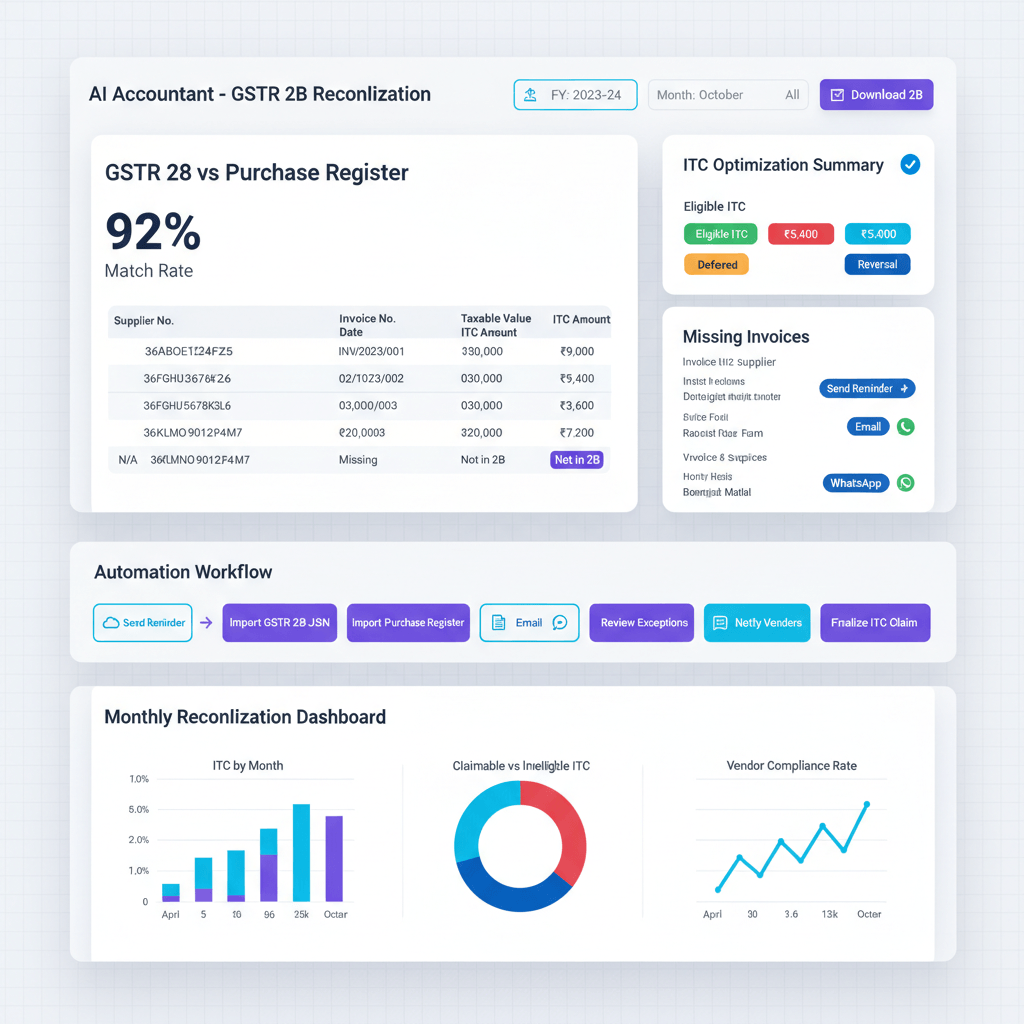
- Top platforms automate purchase register matching, identify missing invoices in both directions, streamline vendor follow ups, and surface insights on a monthly dashboard.
- A rigorous evaluation checklist should cover matching depth, exception categorization, ITC claim optimisation, workflow automation, integrations, dashboards, security, and pricing.
- Purpose-built solutions like AI Accountant and ClearTax GST fit CA firms and SME finance teams that need scale, accuracy, and audit-readiness.
- Typical ROI appears within 1-2 months through time savings, recovered ITC, improved vendor compliance, and reduced audit risk.
The month-end reality, and how smart tools change it
It is the 10th, your team is buried in spreadsheets, and a single typo can cost lakhs in ITC. Manual reconciliation steals 40 hours or more each month, vendor non-compliance is rising, and scrutiny keeps tightening. The good news, modern GSTR 2B reconciliation tools replace chaos with a streamlined, audit-ready flow, from automated purchase register matching, to early missing invoice detection, to proactive ITC optimisation, to automated vendor nudges, to CFO-ready dashboards.
Bottom line: Automation moves you from fire-fighting to predictable, compliant, and cash-flow friendly GST operations.
What good GSTR-2B reconciliation actually looks like
The essential inputs
Every robust process ingests four data sources, your Purchase Register, Credit and Debit Notes, Journal Vouchers, and GSTR-2B JSON or PDF. Good tools normalize formats, handle bulk uploads, and validate data quality upfront, so you start matching immediately, not cleaning data.
Smart matching logic that actually works
Modern engines compare GSTIN, invoice numbers, dates, taxable values, and tax breakups, then go further with fuzzy logic, tolerance rules, and many-to-many matching. ClearTax GST learns from how you resolve mismatches and suggests repeatable resolutions next time.
Clear status categories for every invoice
Every transaction falls into actionable buckets, matched, suggested, partial, missing in 2B, missing in books, duplicates, amendments, RCM, and blocked ITC. For deeper treatment of RCM concepts, see RCM transactions.
Actionable outputs that save time
You want posting-ready entries, ITC eligibility tags, vendor non-compliance lists, exception logs, and airtight audit trails. Platforms like Vyapar ship inspection-friendly reports, see the Vyapar TaxOne overview for examples.
Buying criteria, your evaluation checklist
Matching engine depth
Seek configurable rules, amendment handling, CDN support, multi-GSTIN capability, and financial year cut-offs. ClearTax GST handles 10,000 documents per minute with many-to-many matching. Validate using your data, including edge cases like partial payments and amended invoices. For a budget-friendly take, compare options in this Munim comparison.
Ability to identify missing invoices and exceptions
Detect what is missing in 2B and what is missing in books, with labels like amount mismatch, date variance, or GSTIN not found. Vyapar flags mismatches with clear reasoning, see the Vyapar TaxOne post for concrete examples.
ITC claim optimisation features
Ensure rules for eligibility, Section 16(4) timelines, reversals, provisional credits, and blocked credits. For deeper process automation, review reversals guidance. ClearTax GST assists with Table 4 and proactive alerts for expiring claim windows.
Workflow and vendor collaboration
Look for automated WhatsApp or email reminders, tracking of vendor responses, and escalation rules. Bulk reminders, vendor-wise assignment, and approval flows reduce errors and speed closure.
Integration capabilities
Verify push and pull with Zoho Books and Tally, bulk imports from Excel, and safe posting of reconciled entries back to ERP. The Vyapar TaxOne guide highlights native Tally connectivity.
Dashboards and reporting
Choose a monthly dashboard that shows ITC trends, vendor scores, alerts, and history. ClearTax GST provides PAN-level views with rich analytics, while Webtel’s summary is noted in this Webtel review.
Scale, security, and reliability
Ask about volumes, uptime, encryption, and certifications. ClearTax GST and AI Accountant operate at enterprise scale with compliance certifications.
Pricing models and total cost
Compare per organization, per document, or per GSTIN pricing, plus support. See the Munim comparison for starter tiers, and factor ROI from time saved and ITC recovered.
Step-by-step workflow, how modern reconciliation runs
Step 1: Data ingestion and normalization
Upload Purchase Registers, JVs, CDNs, and GSTR-2B. Top tools run hundreds of validations, standardize dates and GSTINs, and cleanse amounts before matching.
Step 2: Automated matching to purchase register
The engine scores matches, isolates exact versus probable, and learns from your decisions. You work from a clear queue, not from messy spreadsheets.
Step 3: Exception management and missing invoice detection
Bi-directional checks identify missing invoices with categorized reasons and suggested fixes. Bulk updates, comments, and assignments create a complete audit trail.
Step 4: ITC optimisation and claim preparation
ITC claim optimisation applies eligibility rules, flags blocks with reasons, and prioritizes items nearing Section 16(4) deadlines. Scenario simulation helps maximize cash flow.
Step 5: Automated vendor follow-up
Vendor follow up automation sends reminders via email or WhatsApp, tracks responses, escalates based on rules, and stores a communication log, which proves invaluable during audits.
Step 6: Posting back to accounting systems
Reconciled invoices post cleanly to Zoho Books or Tally, with correct ledger tagging and no duplicates.
Step 7: Dashboard analytics and monitoring
Your GSTR-2B reconciliation tools overview should include a monthly dashboard for ITC utilization, vendor compliance, completion rate, and exception aging. One CA firm recovered lakhs in unclaimed ITC by spotting trends early.
Comparison guide, which tool category fits your needs
Excel and manual methods
Pros: Zero software spend, complete control, flexible formats.
Cons: Error-prone, no scale beyond small volumes, no audit trail, no automation.
Best for: Very small businesses with minimal GST transactions.
Break-even: Below 50 invoices monthly, manual may suffice, above that, software wins.
ERP add-on modules
Tally or Zoho native modules work inside your accounting system.
Pros: Single interface, no extra data movement.
Cons: Limited matching sophistication and automation.
Best for: 100 to 500 invoices monthly when you already use the ERP.
Purpose-built GSTR-2B reconciliation tools
Standouts: AI Accountant, ClearTax GST, cost-efficient options in the Munim comparison, and the Vyapar TaxOne summary.
Pros: Advanced AI matching, vendor automation, dashboards, and scale.
Cons: Subscription cost and onboarding effort.
Best for: CA firms with multiple clients and SMEs with 500 plus invoices monthly.
Break-even: Commonly within one to two months via time saved and ITC recovered.
ROI and metrics, the business impact
Time savings that compound
Manual reconciliation often takes 30 to 60 minutes per 100 invoices, automation drops this to near 10 minutes. At 1,000 invoices, you recover about 40 hours per month, which is meaningful cost and capacity gain. ClearTax GST users frequently report faster filing cycles and fewer late fees.
ITC recovery and working capital
Unreconciled invoices lead to 3 to 5 percent ITC leakage. Proactive detection identifies missing invoices, tracks Section 16(4) windows, and unlocks working capital.
Vendor compliance improvements
Automated reminders improve vendor compliance materially. Track vendor scores, average resolution time, and manual intervention rate on your monthly dashboard.
Audit readiness and risk reduction
Purpose-built tools keep complete audit trails, decisions, and communications, which shortens audits and reduces penalties.
Real-world outcomes
CA firms adopting AI Accountant report large time savings and substantial recovered credits within the first quarter.
Common pitfalls and how to avoid them
The GSTR-2A versus GSTR-2B confusion
Use GSTR-2B for formal reconciliation since it freezes monthly, 2A is dynamic and unsuitable for compliance closure. Most tools default to 2B to avoid mistakes.
Missing Section 16(4) deadlines
Credits expire after statutory cut-offs, so you need proactive alerts. Good systems prioritize older invoices to protect claims.
Over-relying on OCR without validation
OCR is helpful, yet imperfect. Validate low-confidence extractions and let matching logic catch OCR errors.
Ignoring amendments and credit notes
Link amendments and CDNs to originals, reconcile on net values, and maintain chains completely.
Poor vendor master data
Clean vendor masters prevent recurring mismatches, especially across multiple GSTINs for the same supplier.
How AI Accountant addresses your reconciliation needs
Advanced matching engine
AI Accountant uses configurable fuzzy rules, supports amendments, CDNs, and RCM, and learns from your actions for higher accuracy across entities and GSTINs.
Comprehensive exception handling
Bi-directional detection shows what is missing in GSTR-2B versus what is missing in books, with meaningful categories and bulk actions, all with audit trails.
Intelligent ITC optimisation
ITC claim optimisation respects eligibility and Section 16(4), suggests optimal patterns, and prevents inadvertent reversals, supported by alerting and detailed dashboards.
Streamlined vendor collaboration
Vendor follow up automation delivers bulk reminders, response tracking, and escalation rules, with logs for audit defense and vendor scorecards for trend spotting.
Native Zoho and Tally integration
Seamless sync pulls masters, pushes reconciled entries, and supports Excel or PDF imports with validations to reduce rework.
Executive dashboards and analytics
The monthly dashboard surfaces ITC utilization, vendor gaps, reconciliation progress, and exception aging, with exports for stakeholders.
Enterprise-grade scale and security
Encrypted infrastructure, certifications, and high uptime ensure reliability, with role-based access controls for multi-client CA firms.
Transparent, value-based pricing
Plans scale with your volumes, and ROI is typically realized within the first or second month as teams save time and recover credits.
Implementation playbook, live in 7 to 10 days
Phase 1: Pilot setup, days 1 to 3
Import one month or one client, validate match quality, confirm exception categories, and set success metrics like accuracy, time saved, and ITC recovered.
Phase 2: Configuration, days 4 to 5
Tune matching rules and tolerances, set approval workflows, customize vendor templates, and map your chart of accounts with roles and permissions.
Phase 3: Parallel run, days 6 to 8
Run side by side with the current process, compare outputs, and fine-tune rules before switching.
Phase 4: Go-live and optimize, days 9 to 10
Move to the new flow, monitor closely, schedule data syncs, enable alerts, and review metrics monthly.
Success metrics to track
Reconciliation cycle time, matching accuracy, ITC recovered, vendor compliance score, and team productivity. Expect measurable improvements from month one.
Conclusion
With the right GSTR 2B reconciliation tools, you replace manual drudgery with intelligent automation, you match purchase register entries accurately, identify missing invoices early, drive ITC claim optimisation, scale vendor follow up automation, and lead with a monthly dashboard that informs decisions. Evaluate using the checklist above, run a pilot, and move from Excel chaos to automated excellence within days. If you want to see it on your data, book a demo with AI Accountant and experience the difference.
FAQ
As a CA, should I reconcile against GSTR-2A or GSTR-2B for audit readiness?
Always reconcile against GSTR-2B, it is the static reference that freezes mid month, while 2A keeps changing. Most modern systems default to 2B to ensure compliance-grade closure.
How do I validate the matching engine accuracy before I commit to a tool?
Run a time-bound pilot with your actual Purchase Register, GSTR-2B, and CDNs. Include tricky cases like amended invoices and partial payments. Ask for a hit rate report, exception taxonomy, and samples of suggested matches. Tools like AI Accountant and ClearTax GST handle many-to-many and fuzzy scenarios well.
What is the best way to track and claim ITC nearing the Section 16(4) deadline?
Use dashboards that bucket invoices by aging and deadline proximity, enable alerts for expiring credits, and prioritize those in your work queue. AI Accountant highlights expiring credits, and simulates claiming scenarios to optimize cash flow.
Can one platform manage reconciliation across multiple GSTINs and PAN-level analytics?
Yes, leading tools support multiple registrations with consolidated and entity-wise views. ClearTax GST and AI Accountant provide PAN-level dashboards and GSTIN-specific reports so you can reconcile centrally, while respecting legal separations.
How do I handle vendor non-compliance without manual chasing every month?
Adopt vendor follow up automation with bulk reminders, response tracking, and escalation rules. Maintain a vendor scorecard that shows filing delays, mismatch rates, and response times. AI Accountant logs communications and performance trends to drive better vendor outcomes.
Is OCR reliable for invoice capture, or should I rely on JSON from the portal?
OCR helps with paper or PDF invoices, yet JSON from the GST portal remains the gold standard. Combine both, validate low-confidence OCR fields, and let reconciliation logic catch OCR slips. A hybrid approach is pragmatic for CA firms and SMEs.
What exception categories are most actionable for monthly close?
The most helpful are missing in 2B, missing in books, GSTIN not found, amount mismatch, date variance, duplicate, amendment chain issues, and blocked ITC. Ensure your tool offers bulk actions and comments for each category with an audit trail, as seen in AI Accountant.
How do reconciliation tools support audit defense for my clients?
They maintain immutable logs of uploads, matches, user actions, comments, and vendor communications. During audits, you can retrieve the exact decision trail for any invoice, with linkage to CDNs and amendments, which reduces penalties and cycle time.
What KPIs should a CA firm track on the monthly dashboard to prove value?
Focus on reconciliation cycle time, matching accuracy, ITC recovered, percentage of invoices needing manual touch, vendor compliance score, and exception aging. Platforms with a strong monthly dashboard make these KPIs effortless.
How quickly can we implement and show ROI to the client or CFO?
A structured pilot can go live in a week. Immediate ROI appears in hours saved, faster filing, and recovered ITC from missing invoices. Many CA firms adopting AI Accountant report break-even within the first or second month.
What is the recommended process to migrate from Excel to a purpose-built tool?
Pick one client or one month, upload clean masters and the Purchase Register, run parallel for a cycle, compare outputs, tune rules, then switch over. Document SOPs, set roles and approvals, and lock a monthly cadence for imports and reconciliations.
Can reconciliation tools help reduce interest and penalties during scrutiny?
Yes, by driving timely reconciliation, surfacing mismatches early, enforcing Section 16(4) discipline, and preserving evidence, you reduce late claims, prevent overclaims, and shorten scrutiny with precise documentation, which lowers penalty risk.

Rohan Sinha is a fintech and growth leader building aiaccountant.com, focused on simplifying accounting and compliance for Indian businesses through automation. An IIT BHU alumnus, he brings hands-on experience across 0 to 1 product building, growth, and strategy in B2B SaaS and fintech.