-01%201.svg)
Key takeaways
- Automating GSTR 2B reconciliation cuts effort dramatically, improves accuracy, and creates clear audit trails that CAs and CFOs can rely on.
- The best tools deliver automated data import, intelligent invoice matching, real time discrepancy flags, and robust exception workflows.
- Deep integrations with Tally, Zoho Books, QuickBooks, and SAP reduce manual work, two way sync keeps ledgers and compliance status aligned.
- Evaluate tools on scalability, pricing transparency, support quality, and training resources, not just feature checklists.
- A disciplined rollout, clean vendor masters, and defined workflows maximize ROI, reduce notices, and safeguard input tax credit.
- AI driven matching, continuous reconciliation, and automated vendor follow ups are defining the future of GST compliance.
What is GSTR 2B Reconciliation?
GSTR 2B reconciliation is the process of matching your purchase register with the auto drafted GSTR 2B statement on the GST portal. Think of it as cross checking your ledger against an authoritative reference, with material impact on input tax credit and audits.
Each month, the system compiles your GSTR 2B from supplier GSTR 1 filings. Your job is to ensure invoice numbers, dates, taxable values, and GST amounts align with your books, then resolve mismatches that arise due to timing, data entry, or vendor filing gaps.
Skipping or delaying reconciliation can cause you to miss eligible credits or, worse, claim ineligible amounts. That is why rigorous control over input tax credit is essential for clean compliance and stress free audits.
Bottom line, reconciliation converts uncertainty into documented certainty, saving time, tax, and peace of mind.
Modern GSTR 2B reconciliation software simplifies this journey from upload to closure, bringing structure to an otherwise messy monthly grind.
Why GSTR 2B Reconciliation Software is Essential
Manual reconciliation is tedious, error prone, and slow, especially with large volumes. Teams wrestle with spreadsheets, fragile formulas, and PDF copy paste, which invites avoidable mistakes.
Automated reconciliation tools import data from the portal and your accounting system, normalize formats, match records intelligently, and surface exceptions instantly. The work shifts from searching for problems to solving them.
Three practical wins:
- Speed, days of work compress into hours with bulk processing and auto matching.
- Accuracy, consistent algorithms reduce fatigue driven errors and duplicates.
- Audit readiness, a clear trail of every action, mismatch, and resolution.
Key Features of GSTR 2B Reconciliation Tools
Automated Data Extraction and Import
Best in class tools fetch 2B data through APIs or via JSON uploads, then pull purchase registers from Tally, Zoho Books, QuickBooks, or SAP. They normalize invoice data across formats, including PDF, Excel, and scans with OCR, reducing manual edits.
Intelligent Invoice Matching Algorithms
Matching logic should handle GSTIN, invoice number, date, value, tax, and vendor name variations. Fuzzy matching links “ABC Enterprises Private Limited” to “ABC Enterprises Pvt Ltd”, detects duplicates, and aligns amended invoices and credit notes with the correct originals.
Real time Discrepancy Identification
As soon as imports complete, the software flags variances, such as tax differences, missing invoices, late supplier filings, or amendment impacts. Status tags and priority markers help teams sequence their work efficiently.
Bulk Operations and Exception Handling
Teams need bulk status updates, notes, and follow up markers when volumes spike. Exception rules, for example auto tagging habitual late filers, reduce repetitive triage and drive faster closure. Exportable exception reports support vendor coordination and CA reviews.
Integration with Accounting Systems
Two way sync keeps ledgers current, purchase data flows in, reconciliation results and notes flow back. This eliminates duplicate effort and preserves a single source of truth across finance and compliance.
Top GSTR 2B Reconciliation Software Options
AI Accountant
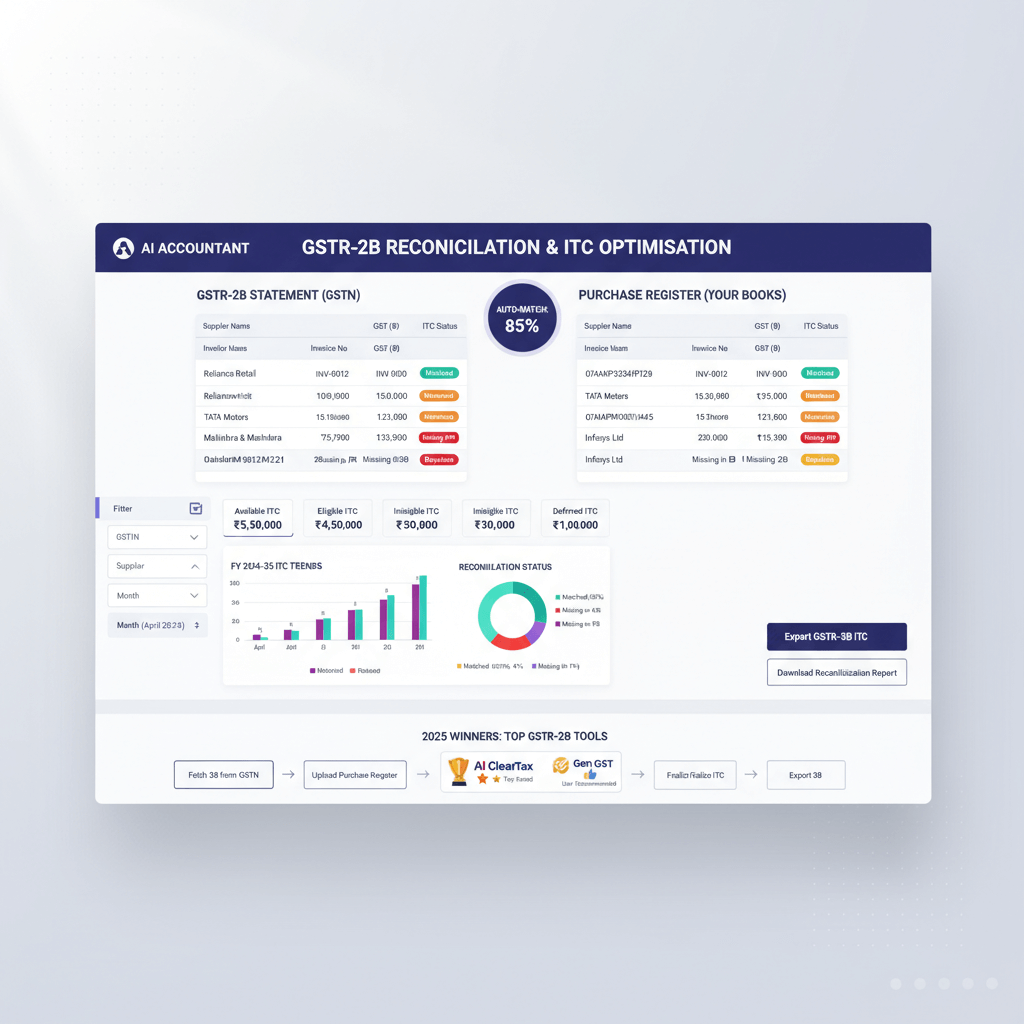
AI Accountant focuses on intelligent automation and native integrations for Indian businesses. It supports direct sync with Tally and Zoho Books, ingests purchase registers and GSTR 2B files, and applies AI driven matching that tolerates vendor name variations. Bulk exception handling, reconciliation status tracking, and clear audit logs make month close faster and more predictable.
Zoho Books
Zoho Books provides built in GST reconciliation suited to small and medium businesses. Automatic matching and straightforward reports help teams reach closure quickly, especially if you already operate within the Zoho ecosystem. Some advanced capabilities may require additional GST extensions.
Tally Prime
Tally Prime offers familiar, basic reconciliation that many teams already use. It covers core matching well, though bulk exception management and deeper workflows are more limited for high volume environments.
ClearTax
ClearTax delivers mature reconciliation features and detailed mismatch analytics. It handles scale effectively. Integration depth can vary, so confirm your exact ledger setup before rollout.
TaxRaj
TaxRaj supports end to end GST compliance with capable 2B reconciliation. CA firms handling multiple clients will appreciate multi entity management and reporting.
IRIS Sapphire
IRIS Sapphire serves enterprises with multi GSTIN, complex approval chains, and rich analytics needs. It is powerful, with a steeper learning curve that rewards large scale operations.
How to Choose the Right GSTR 2B Software
Assess Your Business Needs
Match solution depth to your invoice volume, complexity, and team size. Thousands of monthly records call for strong automation, bulk operations, and robust audit trails. Choose a platform that grows with your operations.
Evaluate Integration Capabilities
Confirm compatibility with your accounting stack and available APIs. Verify two way sync, multi source invoice capture, and support for both JSON and document based inputs.
Consider Pricing and Scalability
Understand per user, per transaction, or flat subscription models. Account for onboarding, training, and add on modules you will need. Check plan flexibility for peak periods.
Check Vendor Support and Training
Month close support windows matter. Review documentation depth, videos, and implementation assistance. User communities can accelerate adoption with practical tips.
Implementation Best Practices
Data Preparation and Cleanup
Standardize vendor names, validate GSTINs, and ensure complete purchase registers. Build a clean vendor master and, where needed, alias mappings to reduce false mismatches.
Setting Up Reconciliation Workflows
Define roles for exception review, vendor follow up, and approvals. Document treatment of late filings, amendments, and disputes. Schedule weekly mini reconciliations to spread the load.
Training Your Team
Invest in power users who champion adoption, then cascade training. Create short internal guides aligned to your ledger and approval processes, not just generic product steps.
Regular Monitoring and Optimization
Track cycle time, mismatch counts, and resolution rates. Identify vendor patterns and recurring root causes, then refine rules, templates, and communication cadences.
Common Challenges and Solutions
Vendor Name Mismatches
Minor naming differences derail naive matching. Use fuzzy logic and maintain a vendor alias table. Review and clean the vendor master quarterly.
Timing Differences
Late supplier filings push invoices into a later 2B. Tag such cases separately as pending filing, run aging, and communicate expected timelines to stakeholders.
Missing Invoices
Gaps in either books or 2B arise from data entry misses or supplier non reporting. Enforce timely capture, digitize all bills, and rely on tools with strong audit logs.
Amendment Entries
Link amended invoices to originals to avoid double counting. Establish clear steps for reversals versus adjustments, and ensure your tool preserves amendment lineage.
ROI of GSTR 2B Reconciliation Software
Time Savings
Teams that spend five days each month on reconciliation typically save more than half that time with automation. Redeploy hours to vendor management, cash flow planning, and analytics.
Error Reduction
Automation reduces manual error rates to near zero. Fewer errors mean fewer notices and penalties, while complete capture ensures no ITC is left on the table.
Compliance Improvements
Systematic workflows yield clean audit trails and faster responses to queries. Early detection prevents year end surprises.
Resource Optimization
Structured tools enable junior staff to handle the bulk of matching and exception prep, allowing seniors to focus on complex cases and advisory work.
Future of GSTR 2B Reconciliation
AI and Machine Learning Integration
Models learn from your history to predict matches and anomalies, while NLP extracts data from unstructured documents, even low quality scans.
Real time Reconciliation
As invoices are posted, they are checked against the latest 2B, enabling instant follow ups on gaps and unusual trends.
Enhanced Automation Features
Automation orchestrates the entire workflow, from data fetch to vendor nudges, while intelligent routing assigns the right reviewer to each exception.
Conclusion
GSTR 2B reconciliation can shift from a monthly scramble to a predictable, well documented routine. Select software that fits your volume, integration needs, and team skills, train well, and measure continuously. With the right stack and process discipline, you will claim eligible credits confidently, answer audits calmly, and free your finance team for higher value work. Start now, every month of delay keeps costly manual effort in place.
FAQ
How should a CA structure a month close workflow for GSTR 2B reconciliation across multiple GSTINs?
Adopt a weekly pre close cycle, import purchase registers and 2B per GSTIN, run auto match, tag timing differences, then push exception lists to vendors. In the final week, clear critical mismatches, approve adjustments, and lock a summary by GSTIN. Tools like AI Accountant enable bulk actions, per entity dashboards, and audit ready logs.
What data fields are mandatory for high confidence matching between purchase register and 2B?
Use GSTIN of supplier and recipient, invoice number, invoice date, taxable value, tax components, and place of supply. Add vendor aliases to absorb naming differences. Advanced tools compute confidence scores when one field, such as date or value, varies within a defined tolerance.
How do I treat suppliers who chronically file GSTR 1 late, yet business cannot pause purchases?
Maintain a vendor risk list, tag invoices as pending supplier filing, and run an aging report. Escalate beyond a threshold, for example 30 days, with automated reminders. Where policy permits, hold partial payments until the invoice appears in 2B. AI Accountant can auto classify such vendors and schedule reminders.
What is the right approach to handle amended invoices and credit notes that appear across periods?
Link amendments to the original invoice, reverse or adjust based on your accounting policy, and maintain a single narrative thread per transaction. Your reconciliation tool should present original, amendment, and credit note as a connected set to prevent double impact.
For a CA firm handling 50 clients, how can I standardize reconciliation without creating 50 bespoke SOPs?
Create a master SOP with variable inputs, for example ledger system, import method, approval roles. Use a template of exception categories, timing, rate differences, vendor filing pending, and standard notes. Roll out client specific checklists driven by the same template inside the tool so staff can switch contexts easily.
Does continuous, mid month reconciliation add value when statutory filing is monthly?
Yes, continuous reconciliation reduces month end peaks, shortens exception queues, and flags vendor lapses early. It also improves cash flow accuracy since ITC forecasts are more reliable. With AI Accountant, background sync and rolling matches keep you current with minimal effort.
How can I verify that claimed ITC equals eligible ITC as per 2B before finalizing returns?
Run a reconciliation finalization report that shows matched invoices, timing differences, ineligible credits, and pending clarifications. Ensure reason codes and reviewer sign offs exist for every exception. Lock the report, then tie it to return working papers for audit readiness.
What controls should I implement to prevent duplicate ITC when suppliers reissue invoice numbers?
Enable duplicate detection using composite keys, GSTIN, invoice number, date, and value. Apply tolerances carefully, and require manual approval where duplicates are suspected. Good systems quarantine suspected duplicates until cleared by a reviewer.
How do I reconcile when invoice values match but tax split, CGST, SGST, IGST, differs from books?
Classify the case as rate or place of supply difference, verify HSN, POS, and tax computation logic, then correct either the ledger or vendor document as needed. Tools should let you annotate the root cause and push a standardized query email to the vendor.
What is the recommended audit trail for reconciliation actions to satisfy departmental scrutiny?
Maintain immutable logs of data imports, matches, overrides, reason codes, user, timestamp, and supporting attachments. Exportable PDFs or spreadsheets that mirror the live trail help CAs respond quickly to notices. AI Accountant provides a detailed event log per invoice and per batch.
Can I drive reconciliation directly from Tally without exporting and importing files every time?
Yes, with two way connectors, the tool pulls purchase data from Tally and pushes reconciliation notes back. Schedule syncs, for example hourly, to reduce manual steps, then complete exceptions within the reconciliation console.
How should I calculate ROI for my client before recommending a paid reconciliation tool?
Estimate current hours per month, by role, multiplied by hourly cost, add a risk buffer for error correction and notices. Compare against subscription fees and onboarding cost. Include qualitative gains, faster month close, better ITC realization, lower audit stress. Most firms see savings within a few cycles, especially at higher volumes.

Rohan Sinha is a fintech and growth leader building aiaccountant.com, focused on simplifying accounting and compliance for Indian businesses through automation. An IIT BHU alumnus, he brings hands-on experience across 0 to 1 product building, growth, and strategy in B2B SaaS and fintech.