-01%201.svg)
Key takeaways
- GSTR-2B is a static, monthly statement, reconciliation ensures accurate ITC and fewer GST notices.
- Modern tools automate data ingestion, intelligent matching, exception handling, ITC optimization, and posting back to books.
- Fuzzy matching, vendor follow ups, and policy controls are must haves for CA firms and SME finance teams.
- Look for native Zoho Books and Tally sync, a clear monthly dashboard, and robust audit trails.
- Automation delivers 60–80% time savings, better cash flow from recovered ITC, and lower compliance risk.
- AI Accountant stands out for workflow automation, deep integrations, and proven scale with strong security.
Quick primer: GSTR-2B and reconciliation basics
GSTR-2B is a static monthly statement available on the 14th, it gives a frozen snapshot of your eligible ITC. GSTR-2A is dynamic, it changes as suppliers file. For a crisp explainer, see the difference between GSTR-2A and GSTR-2B and Webtel’s difference between GSTR-2A and 2B. For step by step reconciliation concepts, review GSTR-2B vs purchase register reconciliation.
Reconciliation means matching your purchase register with GSTR-2B, validating GSTINs, invoice numbers, dates, and values, then acting on mismatches. Manual Excel driven processes are tedious and error prone, automation is now essential for scale.
Think of GSTR-2A like a chat that keeps updating, GSTR-2B like a monthly bank statement that does not change.
Core evaluation criteria and feature checklist
Data ingestion and normalization
Your tool should import GSTR-2B via JSON, Excel, or API, and fetch purchase registers directly from Zoho Books or Tally. OCR for PDFs and images reduces manual entry. Automatic standardization of GSTINs, dates, and values prevents garbage in, garbage out.
Matching engine depth
Real world data is messy, so you need robust fuzzy matching, tolerance based date and amount checks, auto linkage of credit or debit notes, detection of duplicates, and treatment of RCM items. For RCM concepts, see reverse charge mechanism accounting in India. A good engine will match INV-001 with INV001, without drama.
Exception intelligence
Smart bucketing is key: in books not in 2B, in 2B not in books, partial matches, and suspected duplicates. The tool should also surface probable root causes, GSTIN errors, wrong FY, missing IRN, or supplier non filing, with clear next actions and ageing to drive vendor follow up before claims expire.
Policy engine for ITC claim optimization
Your tool must auto classify eligible, blocked, deferred, and restricted credits, enforce month locking, and run what if simulations. For deeper context on reversals and controls, check input tax credit reversal automation. Every decision should leave an audit trail, who did what, and when.
Workflow and collaboration
Automate vendor nudges via email or WhatsApp, use pre filled templates, and track responses. Internal assignment, notes, and status transitions keep your month end predictable.
Integrations and posting
Two way sync with Zoho Books and Tally is non negotiable. Pull masters and transactions, process, then post reconciliation results back, avoiding double entry and ensuring books reflect your true ITC position.
Reporting and visibility
Use a role based GST health check dashboard to view claimed versus potential ITC, vendor compliance scores, and ageing. Drill downs and exports should be one click away.
Scale, security, and governance
For CA firms, multi organization and role based access are vital. Demand ISO 27001 and SOC 2 validations, with encryption at rest and in transit.
Usability and support
Bulk actions, inline edits, and clear errors matter daily. Confirm onboarding support, SLAs, and India business hour coverage. For quick backgrounders, see Tally’s complete guide on GSTR-2B and ClearTax’s GSTR-2B vs purchase register reconciliation guide.
Top GSTR 2B reconciliation software options
- AI Accountant (AiA), automation first, deep Zoho Books and Tally sync, workflow centric
- ClearTax GST Software, popular, widely used for compliance and reconciliation
- IRIS Sapphire, enterprise grade matching and analytics
- Masters India, detailed reconciliation and comprehensive reports
- CashFlo, vendor collaboration strength with reconciliation
- GSTHero, friendly interface for small businesses
- TallyPrime with GST, native advantage for Tally users
How AI Accountant maps to the evaluation checklist
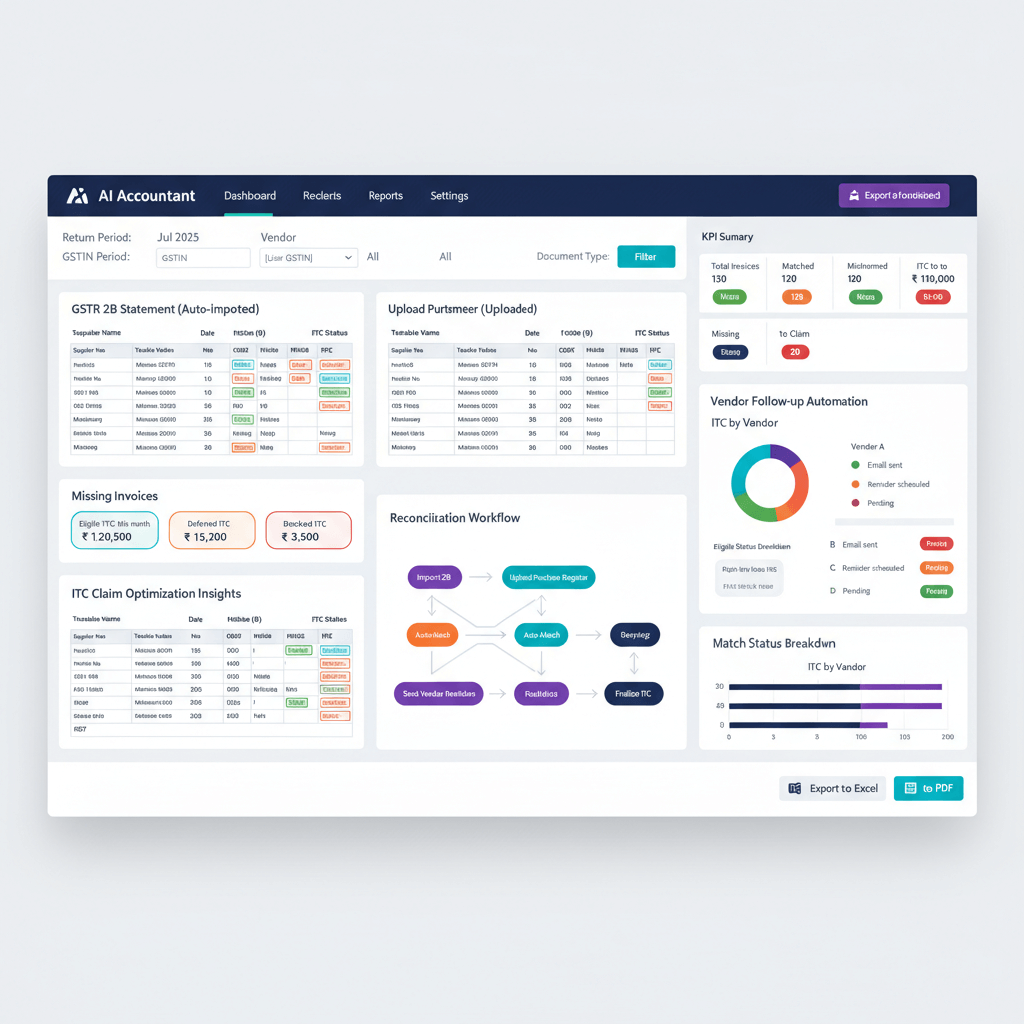
Data ingestion: Bulk imports of PDFs, CSVs, Excel, and images, normalization of GSTR-2B, seamless Zoho Books and Tally sync.
Matching logic: Intelligent rules to match your purchase register with GSTR-2B, including splits, transfers, and rounding tolerances.
Exception management: Automatic flags for missing invoices, partial matches, and duplicates, with reasons and guided fixes.
ITC optimization: Configurable ITC claim optimization aligned with policy, every decision tagged for audit.
Vendor collaboration: Built in vendor follow up automation with templates, trackers, and SLA reminders.
Reporting: A comprehensive monthly dashboard for cash impact, ITC, compliance, and ageing.
Scale and security: 450 plus customers, 100 plus CA firms, 300M plus transactions processed, ISO 27001 and SOC 2 Type II.
Comparison of different approaches
Manual spreadsheets with GST portal
Pros: Minimal direct cost, full control.
Cons: Error prone, no audit trail, hard beyond 1,000 invoices, fragile formulas.
Generic GST utilities
Pros: Faster than manual, affordable.
Cons: Limited workflow, weak integrations, heavy manual clean up persists.
Accounting suite add ons
Pros: Native integration, smooth data flow.
Cons: Basic exception handling, fewer automation levers, constrained for multi platform firms.
Specialized GSTR-2B reconciliation tools
Pros: Automation end to end, sophisticated fuzzy matching, dashboards, native Zoho or Tally sync. See primers like everything you need to know about GSTR-2B and Bajaj’s GSTR-2A vs GSTR-2B for context.
Cons: Higher subscription costs, may be overkill for very small ledgers.
Tip: Pair evaluation with your last month’s data, not demos alone, real data reveals true match rates and effort saved.
ROI and business case for reconciliation automation
Time savings
Expect 60–80% faster cycles. If 1,500 invoices take 2–3 days today, automation can compress this to half a day. For 20 client CA firms, that is 40–60 hours saved monthly, the subscription effectively self funds.
Cash benefits
Recovered ITC boosts working capital instantly. A 2% ITC improvement on ₹50 lakhs in purchases yields about ₹1 lakh. Early filing reduces interest and penalties, automated vendor nudges raise compliance.
Risk reduction
Audit ready trails, consistent policy enforcement, and reliable amendment handling de risk scrutiny. Pull six month old reconciliations in minutes, not days.
Cost considerations
Pricing scales by invoice volume, entities, and automation depth. Evaluate total cost of ownership, including the opportunity cost of manual reconciliation. For market context, see CashFlo’s GST reconciliation software and this pricing and value overview.
Step by step sample workflow, first login to filing
- Initial setup: Connect Zoho Books or Tally, sync masters, vendors, ledgers, and historical purchases.
- Data import: Bring in GSTR-2B for the period, the system normalizes and validates automatically.
- Automated matching: The engine runs, targeting a high auto match rate between the purchase register and 2B.
- Exception review: Triage missing invoices, partial matches, and suspected duplicates, with suggested fixes.
- ITC optimization: Apply ITC claim optimization rules, simulate, then lock.
- Vendor follow up: Trigger vendor follow up automation with pre filled lists, track acknowledgments.
- Book posting: Push reconciled outcomes back to the accounting system.
- Reporting: Review the monthly dashboard, export reports for filing and audits. For additional guidance, see 2B vs purchase register reconciliation and Tally’s complete guide on GSTR-2B.
Implementation plan and success metrics
Week 1: Pilot testing
Run a 7–10 day pilot with the last two months of data. Track match rate, hours saved, ITC recovered, and exception cycle time.
Week 2: Data preparation
Clean masters, validate GSTINs, standardize invoice numbering, and set tolerances. Upfront housekeeping slashes recurring exceptions.
Week 3: Process design
Define month end workflows, roles, cutoffs, and escalation paths. Document so new team members ramp quickly.
Week 4: Go live
Run current month in the new tool, keep legacy as fallback for one cycle, then roll to all entities or clients.
Common risks and pitfalls to avoid
- Over claiming ITC: Do not claim ITC outside 2B without robust documentation and governance.
- Ignoring amendments: Track amendments and credit notes that land in later months, ensure your tool maps them correctly.
- Skipping vendor follow ups: No tool can fix non filing suppliers unless you nudge them consistently.
- Quarterly reconciliation: Reconcile monthly to catch issues early, quarterly cleanups are costlier and riskier. For fundamentals, revisit GSTR-2A vs GSTR-2B and Masters India’s reconciliation guide.
Buyer’s quick reference checklist
- ☐ Reliable fuzzy matching to match purchase register with GSTR-2B, with tolerances
- ☐ Automated ability to identify missing invoices and duplicates
- ☐ Configurable ITC claim optimization with immutable audit trails
- ☐ Built in vendor follow up automation with templates and tracking
- ☐ Role based monthly dashboard with drill downs and exports
- ☐ Native Zoho Books and Tally integrations for seamless sync
- ☐ ISO 27001, SOC 2, and India data residency
- ☐ Clear onboarding, SLAs, and transparent pricing
- ☐ Bulk operations for high volume ledgers
- ☐ Multi organization management for CA firms
Making your decision
Choose a tool that fits your workflow, volume, and growth plans. Trial with your actual data, focus on match rates, exception effort, posting back to books, and policy control. Assess vendor track record and support depth because GST rules evolve continuously.
The goal is not just compliance, it is control and confidence every month. Explore a walkthrough with AI Accountant, test last month’s data, and use this checklist to benchmark capabilities.
FAQ
How should a CA quantify the ROI of moving from Excel to a dedicated GSTR-2B reconciliation tool?
Benchmark current hours per month, match rate, ITC leakage, and notice handling time. During a pilot, measure the delta. Many firms report 60–80% time savings and 1–3% ITC uplift. Use a simple model, hours saved at your billing rate plus recovered ITC, minus subscription cost, to get payback months.
What is the practical difference between GSTR-2A and GSTR-2B for ITC availment, and how does it affect reconciliation?
2A is dynamic, 2B is static. Reconciliation for claiming ITC should anchor to 2B, while 2A can help monitor supplier filing behavior mid month. For a refresher, see the difference between GSTR-2A and GSTR-2B.
How does an AI Accountant style engine handle fuzzy matching without inflating false positives?
It layers rules, exact GSTIN plus invoice number first, then normalized numbers, date tolerances, rounding thresholds, and credit or debit note linkages. Matches are scored, low confidence pairs route to review queues. Audit logs capture the final decision and user.
What controls should we configure to prevent over claiming ITC during month end rush?
Enforce 2B presence checks, set strict tolerance bands, enable month locking post filing, and require maker checker approvals for policy exceptions. Tools like AI Accountant let you simulate, then finalize with a clear audit trail.
How are amendments and credit notes across periods reconciled in practice?
Because 2B is static, amendments land in the period they are filed. A good tool maps the amendment to the original document, adjusts ITC in the current period, and keeps a cross period trail. See this reconciliation guide for the flow.
We have clients on both Zoho Books and Tally, what integrations matter most?
Bi directional sync, vendor and item masters, purchase registers, and posting reconciled adjustments back. AI Accountant supports both ecosystems, so CA teams do not maintain parallel files.
How do we treat RCM supplies in reconciliation and ITC planning?
RCM invoices typically do not appear as supplier outward in 2B in the same way, so your tool must identify RCM from books and handle tax payment and subsequent ITC eligibility correctly. For an overview, see reverse charge mechanism accounting in India.
What reports should an auditor get, ideally read only, during GST audits?
Give auditors read only access to reconciliation summaries, exception logs, amendment trails, and policy overrides. Also provide vendor wise ageing and compliance scores. Exports to Excel or PDF should be available on demand.
How quickly can a mid sized CA firm go live across 10 entities?
With clean masters, expect one to two weeks. Typical path, a two week pilot, a second week of data cleanup, then staggered go lives. AI Accountant onboarding teams often provision templates, tolerance presets, and training to accelerate adoption.
What vendor follow up workflows have proven most effective to recover missing invoices?
Weekly nudges with invoice level details, WhatsApp plus email, escalation on ageing beyond 30 or 60 days, and a simple acknowledgement link. Tools like AI Accountant track responses, by vendor and document, improving 2B reflection in the next cycle.
How should we evaluate security of a reconciliation platform handling client GST data?
Check ISO 27001 and SOC 2, encryption at rest and in transit, data residency in India, and access controls with MFA. Ask for pen test summaries and incident response SLAs.
Any authoritative primers we can share with junior staff before onboarding?
Start with Tally’s complete guide on GSTR-2B, a concise GSTR-2B primer, and IRIS’s GST reconciliation overview. Then run a sandbox in AI Accountant so they see the flow end to end.
For more structured comparisons and pricing context, you can also review this pricing and value overview and CashFlo’s GST reconciliation software page.

Rohan Sinha is a fintech and growth leader building aiaccountant.com, focused on simplifying accounting and compliance for Indian businesses through automation. An IIT BHU alumnus, he brings hands-on experience across 0 to 1 product building, growth, and strategy in B2B SaaS and fintech.