-01%201.svg)

Key takeaways
- Financial services for startups in India are foundational, clean books, timely filings, and clear cash views enable faster decisions and fewer risks.
- CA led virtual accounting with a live dashboard brings visibility, stronger controls, and lower penalty exposure from day one.
- Scope is end to end, accounting, GST, TDS, payroll, ROC, MIS, and audit readiness, all tied to a steady monthly close.
- Map your finance depth to stage, manage a compliance calendar, and run monthly GST and TDS reviews to stay investor ready.
- AI Accountant combines a CA led team and an AI enabled dashboard so you get clean, timely data without email chaos.
Introduction to financial services for startups
Financial services for startups are business basics, not a nice to have. If you are a founder in India, you need clean books, clear cash views, and on time filings. You also need a disciplined way to share numbers with investors. This guide shows how to set up accounting, tax, and compliance that work from day one, including virtual accounting, GST and TDS compliance, ROC and MCA routines, payroll, MIS, and audit readiness.
The result is a finance stack that supports growth with confidence.
With a strong process you do not guess, you know, and that certainty helps you scale.
Scope of financial services for startups
The scope is end to end, from daily accounting to investor readiness.
- Accounting and bookkeeping
- Tax and compliance
- Payroll
- ROC and MCA filings
- Management reporting and control
- Audit readiness
Accounting and bookkeeping
- Daily entries for sales, purchases, expense bills, and journals
- Bank and payment gateway reconciliations for UPI, cards, and wallets, see payment gateway integration for accounting
- Ledger review and clean up
- Fixed asset register with depreciation
- Inventory records and control for D2C and commerce
- Accounts receivable and accounts payable aging
- Month end close with P and L and balance sheet
- Year end schedules and support for audit
Tax and compliance
- GST registration and advisory
- GSTR 1 and GSTR 3B monthly or quarterly
- GSTR 9 and GSTR 9C annual filing
- E invoice enablement when you cross the threshold
- GST reconciliations with 2A and 2B
- TDS advisory and filings for Form 24Q, 26Q, 27Q
- TDS for property related forms 26QB, 26QC, 26QD
- Income tax returns for company, partnership, and founders
- Advance tax calculation and payment
- Tax audit preparation without certification
- 15CA preparation for foreign remittances
Payroll
- Salary TDS and payroll tax support
- Tax efficient salary structuring
- PF and ESI advisory when applicable
- Expat payroll guidance and DTAA considerations
ROC and MCA
- MGT 7 and AOC 4 annual filings
- DIR 3 KYC
- DIN updates and director changes
- AGM and board minutes and statutory registers
- Share capital increase and allotment
- MSME filings for vendors
Management reporting and control
- Monthly MIS with P and L, cash flow, burn, and runway
- Cost analytics with unit economics
- KPI dashboards
- Investor packs and board packs
Audit readiness
- Clean reconciliations and schedules
- Document repository and structured data room
- Support to statutory auditor
Why financial services for startups matter
- Better control of burn and runway, see cash in and cash out by week and by month
- Data for unit economics, margins, and pricing, understand true costs and gross margin by product or plan
- Avoid fines, GST interest can be 18 percent, TDS delay can cost 1 to 1.5 percent per month, ROC can be 100 rupees per day
- Faster fundraising, clean books and a ready data room cut weeks from diligence
- Safer global work, LUT for exports enables zero rated supplies, accurate place of supply reduces interstate risk
Do not leave finances to chance, put a monthly process in place and keep everything investor ready.
For registration and compliance context, see this overview from a practitioner resource, fintech registration and compliance.
Virtual accounting for startups with dashboard visibility
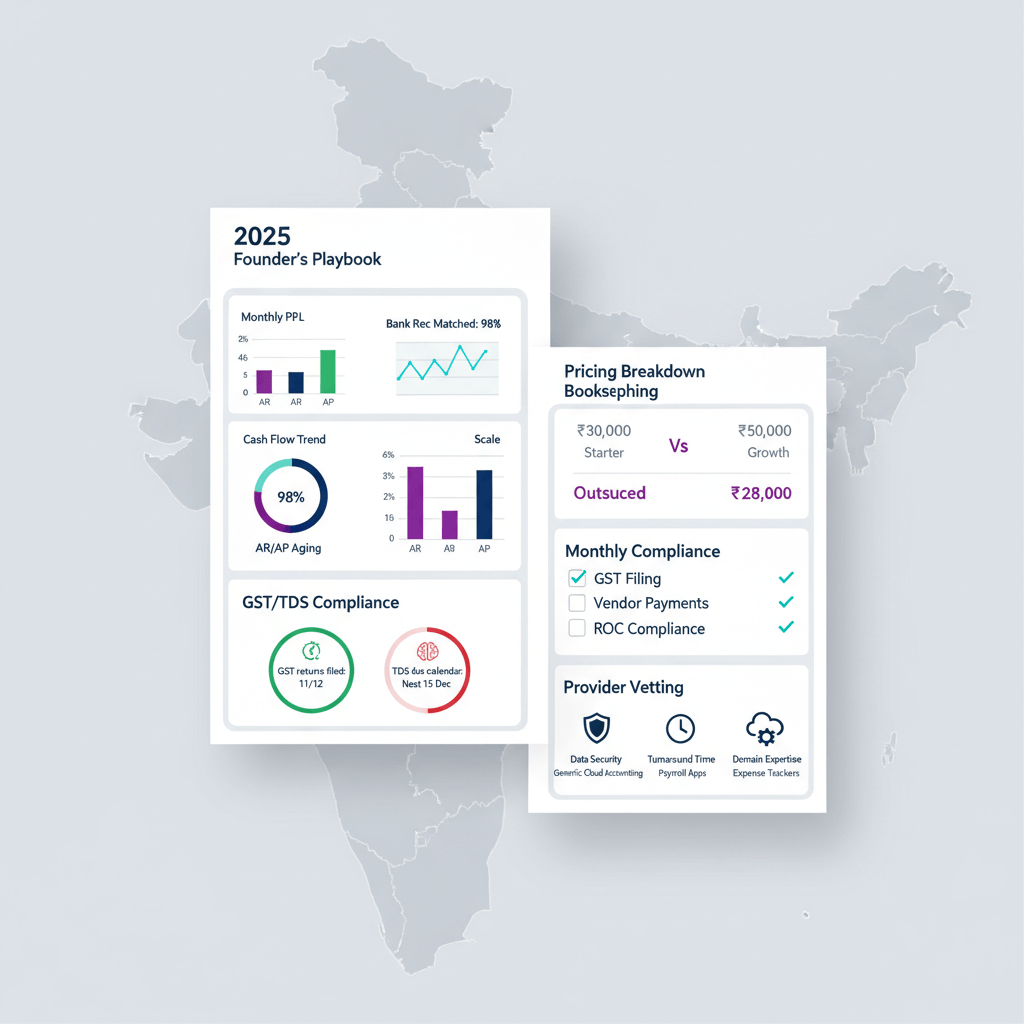
Virtual accounting is a simple model that works well for founders. It gives you a CA led team for managed accounting and compliance, plus a dashboard that shows live data and deadlines. See what virtual accounting typically includes. AI Accountant offers this model in one service.
You get expert execution and a single source of truth for numbers, documents, and deadlines.
What AI Accountant Virtual Accounting includes
- CA led execution for accounting, GST, TDS, income tax, payroll, and ROC MCA
- A dashboard that shows P and L, expenses, cash flow, burn, runway, recent transactions, and balances
- AI insights and alerts for outliers and due dates
- Bank statement analysis and payment gateway checks
- A document vault for invoices, challans, returns, and working papers
- A compliance tracker that shows filing status
- Central chat with the CA team
You and your team work in the dashboard, the CA team handles the work, you get visibility and support without email sprawl.
Stage by stage financial services for startups
Pre seed
- Bookkeeping basics and bank reconciliations
- GST registration if turnover crosses 20 lakh, or 10 lakh for special states
- TDS basics and vendor master setup
- Simple MIS with P and L and cash view
Seed
- Full GST and TDS rigor
- Monthly cash flow and MIS for burn and runway
- AR and AP processes
- Payroll TDS and payslips
- E invoice checks if aggregate turnover can cross 5 crore
- Start ROC routines
Series A plus
- Budgeting and variance tracking
- Board packs each month or quarter
- Internal controls and approval flows
- International tax and transfer pricing if needed
- Audit preparation
Cross border and SaaS
- LUT for exports and foreign receipts
- Place of supply rules for services and digital products
- 15CA for foreign remittance cases
India compliance calendar for startups
Know your calendar, missing due dates can cost money and peace.
GST
- GSTR 1 due by the eleventh for monthly filers and by the thirteenth for IFF under QRMP
- GSTR 3B due by the twentieth for monthly filers and by the twenty second or twenty fourth for QRMP
- Annual GSTR 9 and 9C due by thirty first December
- GST registration applies when turnover is above 20 lakh, it is 10 lakh for special states
- E invoicing applies if aggregate turnover is above 5 crore
TDS
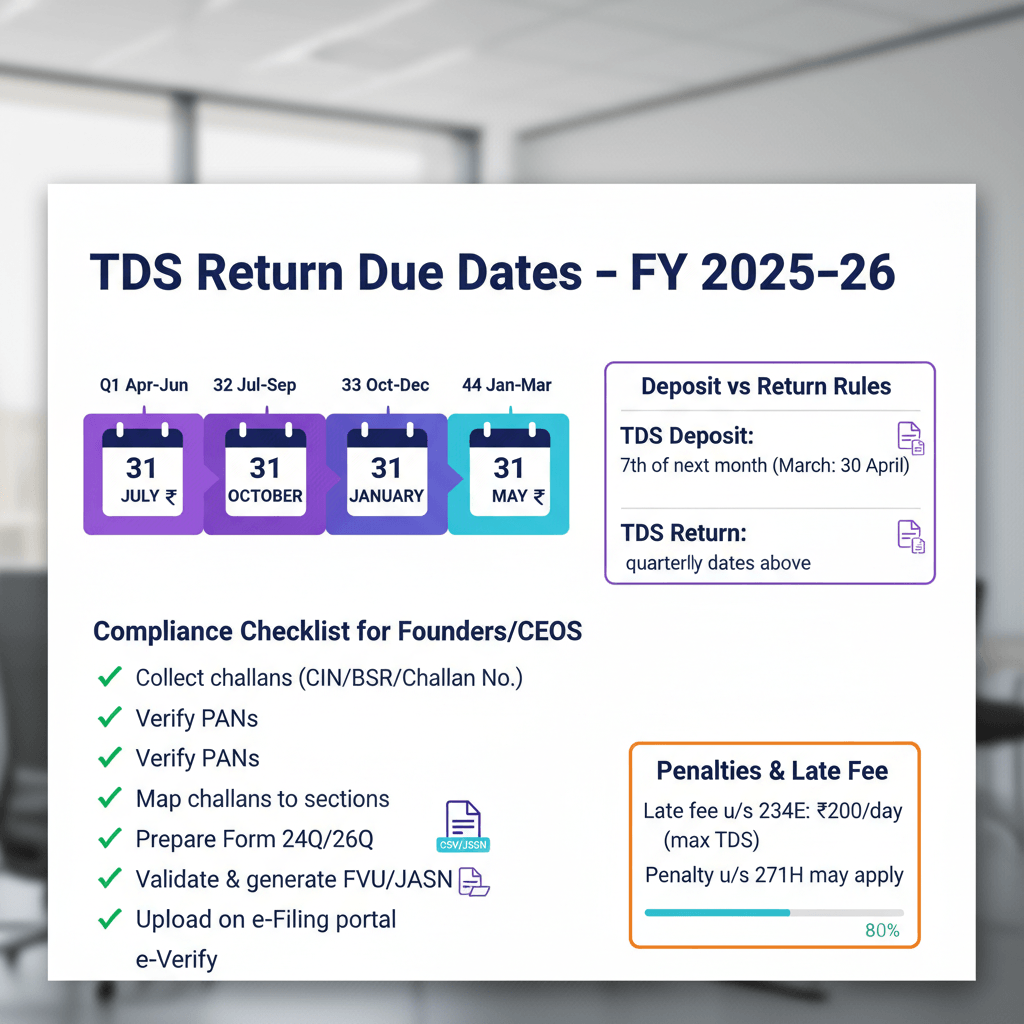
- Monthly challans by the seventh of the next month
- Quarterly TDS returns due by the thirty first after each quarter for Forms 24Q, 26Q, 27Q
- Property specific forms 26QB, 26QC, 26QD as per event
Income tax
- Advance tax payments due by fifteen June, fifteen September, fifteen December, and fifteen March at fifteen, forty five, seventy five, and one hundred percent
- ITR filing by thirty first July for non audit cases
- ITR filing by thirty first October for audit cases
- Tax audit applies if turnover is above 10 crore
ROC and MCA
- MGT 7 and AOC 4 by thirty October
- DIR 3 KYC by thirty September
- MSME half yearly returns
Keep a live tracker. The dashboard inside AI Accountant helps you track these. Reference overview, startup compliance calendar.
Building the finance stack for startups
Core processes
- Month end checklist with reconciliations for banks and gateways
- Accruals and expense coding rules
- AR and AP aging reviews
- Fixed assets and inventory control
- GST and TDS reconciliations
- Documentation and naming rules
Systems
- Accounting software with bank feeds and API integrations
- Payment gateway data sync for refunds and chargebacks
- E invoice portal setup when applicable
- A secure document repository
- A compliance tracker with due dates and status
Dashboard essentials
- P and L overview with trend lines
- Cash flow from operations and burn rate
- Runway calculation as cash divided by monthly burn
- Transactions and recent activity
- Bank analysis and balances
- Compliance status and alerts
Recommended tools for accounting and finance
- AI Accountant, CA led virtual accounting with a live dashboard and managed compliance
- QuickBooks Online
- Xero
- Zoho Books
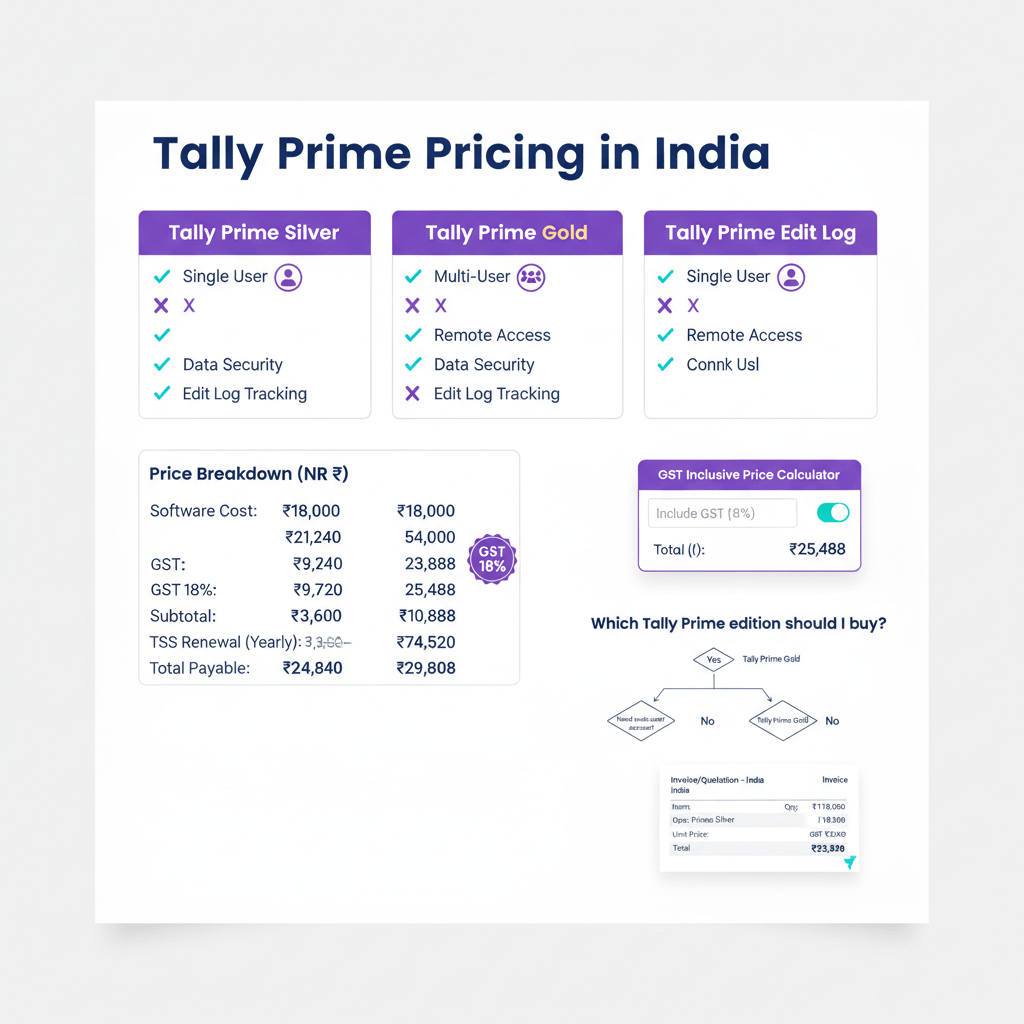
- TallyPrime
- FreshBooks
- Sage Intacct
Delivery models for financial services for startups
In house hire
- Pros, full control and in person context
- Cons, high fixed cost and limited depth early on
Freelance bookkeeper
- Pros, low cost
- Cons, inconsistent delivery and weak for audits and diligence
Traditional CA firm
- Pros, strong compliance depth
- Cons, limited real time view, work happens over email and sheets
CA led virtual accounting
- Pros, end to end service plus a dashboard for live data and documents, a single team with SLAs that can scale with you
- Cons, none major if you choose a proven provider
Many founders pick CA led virtual accounting to get the best of both worlds, expert execution with real time visibility.
Cost and ROI for financial services for startups
Typical ranges
- Private limited companies can see fifteen thousand to fifty thousand rupees per month for managed accounting and compliance
- Add ten thousand to twenty thousand rupees for ROC and event based work
- Costs rise with transaction volume, payroll size, integrations, and custom MIS
Return on investment
- Avoid penalties from five thousand to fifty thousand or more for late or wrong filings
- Save founder time each week for product and sales
- Speed up fundraising by one to two months with audit ready books
- Improve cash control and reduce leakage
Look at the net gain, clean books often pay for themselves.
GST and tax pitfalls for startups
GST pitfalls
- Place of supply errors can trigger wrong CGST and SGST or IGST, for many interstate services, IGST at eighteen percent applies
- Reverse charge applies on some services, track RCM and pay accordingly
- HSN codes and correct tax rates matter for invoices
- E invoicing is mandatory once aggregate turnover crosses 5 crore, check across PAN, not just one GSTIN
- Mismatch between GSTR 2A or 2B and your books can lead to loss of input tax credit
TDS errors
- Wrong TDS rates on contractors, rent, and professional fees, common rates include two percent and ten percent for contractors, ten percent for rent, and ten percent for professionals
- Missing TAN or wrong PAN can cause higher TDS and notices
- Payroll slab mistakes and missed perquisite valuations
Income tax basics
- Shortfalls in advance tax attract one percent interest per month
- LUT is needed for zero rated export of services so you do not pay GST and claim back later
- Use 15CA for foreign remittances when required
Set up a monthly tax review and use your dashboard to track gaps. Practical reference, filings and dues.
Payroll services and people planning
- Monthly payroll with TDS for salary
- Tax efficient structure with reimbursements where allowed
- Standard deduction up to fifty thousand applies for employees
- PF and ESI apply when you meet headcount and wage limits, PF often applies when you cross twenty employees, ESI can apply above ten employees depending on state and wages
- Expat tax planning, DTAA relief, and treatment of fees for technical services
Make payslips clear, keep proofs and declarations on file, and sync payroll with accounting and TDS returns.
Investor readiness and MIS reporting for startups
Investors expect clean, timely MIS. Build a monthly pack and a tidy data room. See a practical checklist, due diligence readiness.
Monthly MIS pack
- P and L, balance sheet, and cash flow
- Burn and runway, runway equals cash divided by net monthly burn
- AR and AP aging and collections
- Budget versus actual variance
- For SaaS, MRR, churn, CAC, LTV, gross margin
- For D2C, channel mix, returns, discounts, gross margin by SKU
Data room basics
- Ledgers and trial balance for the last twelve to eighteen months
- Bank statements and reconciliations
- GST, TDS, and income tax filings and challans
- ROC and MCA filings, cap table, and minutes
- Contracts and key policies
Common mistakes to avoid
- Delayed bank and gateway reconciliations
- Miscoding of expenses and revenue
- Missing TDS or wrong section codes
- Missing e invoices when the rule applies
- No document trail for expenses
- Ad hoc payroll without TDS and proofs
- ROC lapses and missed director KYC
- Scaling without process controls
- Ignoring reverse charge and export rules under GST
A monthly close checklist with owners and due dates prevents most issues, consistency beats intensity.
Case vignettes for startups using financial services
Pre seed SaaS
- Focus on LUT for export of services
- Keep invoices clean with correct place of supply
- Track runway weekly in the dashboard
D2C brand
- Gateway reconciliations must cover returns, cancellations, COD, and fees
- GST on mixed supplies and combo packs needs careful treatment
- Inventory control and cost of goods need monthly checks
Service company
- TDS on contractors and professionals is a must
- Interstate place of supply can change tax type
- AR follow up keeps cash cycle healthy
Final takeaway on financial services for startups
Set up your finance stack early. Use a CA led virtual accounting model to get both expertise and visibility. Keep a steady monthly close, finish reconciliations, and keep your data room warm. Watch GST and TDS rules, payroll, and ROC timelines. Build MIS that tells a clear story on burn, runway, and unit economics. With the right financial services for startups, you enable growth without stress. When you are ready, AI Accountant can partner with you to make this easy and reliable.
FAQ
What is the minimal finance stack I need in the first ninety days to pass diligence?
Implement bookkeeping with daily entries, bank and gateway reconciliations, GST and TDS setup where thresholds apply, and a basic MIS pack with P and L and cash flow. Maintain a document vault for invoices, challans, and contracts. A CA led service like AI Accountant delivers this with a monthly close and a dashboard that investors can review.
Should I register for GST now or wait until I cross the threshold, and how do e invoicing rules apply?
Register when you expect to cross 20 lakh turnover, or 10 lakh in special states. E invoicing applies once your aggregate turnover across the PAN crosses 5 crore, not just one GSTIN. Track this monthly through your compliance dashboard. For a practical overview, see registration and enablement guidance.
How should I structure my monthly close so the statutory auditor does not post adjustments later?
Use a dated checklist, lock bank and gateway reconciliations, review AR and AP aging, post accruals, verify GST 2B to books, and run variance analysis. AI Accountant automates status tracking, and the CA team reviews ledgers so audit adjustments are minimal.
What is the ROI of a CA led virtual accounting model versus hiring an in house accountant?
A virtual model usually replaces two to three part time roles, bookkeeping, tax, and ROC, with one managed service. You avoid penalties, reclaim founder time, and accelerate diligence. For many private limited companies, the monthly fee is in the fifteen to fifty thousand range, and the avoided penalties plus time saved often exceed this spend within a quarter.
How does an AI enabled service like AI Accountant integrate with Tally, Zoho Books, Xero, and payment gateways?
Data flows through bank feeds and gateway exports, with API syncs where available. The CA team configures charts of accounts, mapping for refunds and chargebacks, and recurring journals. The dashboard then layers analytics, burn and runway, and due date alerts. See integration thinking here, payment gateway integration.
For SaaS exports, what do I need for LUT, place of supply, and foreign receipts?
File LUT at the start of the year for zero rated supplies, issue export invoices with correct place of supply, and retain FIRS or bank advice for foreign receipts. Reconcile invoices to inward remittances each month. An AI enabled virtual accounting service can flag missing FIRC documents and LUT expiries before filings.
How do I track burn, runway, and unit economics without a data team?
Set a monthly MIS cadence, pull actual cash outflows, compute net burn, and divide cash by burn for runway. For SaaS and D2C, add MRR, churn, CAC, LTV, and gross margin by SKU. AI Accountant’s dashboard computes these from ledgers and bank data, then raises alerts when burn spikes.
What are the common TDS sections a startup hits, and how do I avoid notices?
Expect contractor and professional fees at two percent or ten percent, rent at ten percent, and salary TDS through 24Q. Validate PANs, maintain vendor masters with sections, and reconcile challans to returns. Run a pre filing review each month. A CA managed workflow reduces section errors and interest exposure.
When should I bring in a CFO, and what should remain with virtual accounting?
Most startups can rely on virtual accounting through Series A to B for operations, compliance, and MIS. Bring a CFO when you need capital strategy, pricing experiments at scale, complex cross border structures, or board level forecasting. Keep bookkeeping, tax, payroll, ROC, and the monthly close with the CA led team for continuity.
How do I prepare for GSTR 9 and 9C with minimal friction?
Lock monthly reconciliations, align books to 2B, close open credit notes, and maintain HSN wise summaries. Start the annual tie out in October so adjustments are posted before December. AI Accountant’s document vault and compliance tracker make annual collation straightforward.
What does investor ready MIS look like pre Series A, and how often should I share it?
Include P and L, balance sheet, cash flow, burn and runway, AR and AP aging, cohort or SKU level margins, and budget versus actuals. Share monthly with founders and quarterly with investors. Use annotations for major drivers. Virtual accounting helps produce this consistently, with a single link to support schedules.
What SLAs and data security practices should I expect from an AI enabled virtual accounting provider?
Expect clear SLAs for monthly close, GST and TDS filings, and query turnaround. Data should sit in audited systems, with access controls, audit trails, and encrypted storage. AI Accountant combines role based access, document vaults, and a central chat so context stays inside the dashboard, not across email threads.