-01%201.svg)
Key takeaways
- Expense report automation in India replaces manual receipt chasing and spreadsheet chaos with clean, GST compliant, audit ready workflows that close books in days instead of weeks.
- India specific design is non negotiable: native GST input tax credit handling, TDS logic by transaction type, UPI settlement support, and bi directional Tally sync must be built in, not bolted on.
- Smart OCR receipt capture, mobile approvals, and AI driven anomaly detection cut data entry errors from 15 to 20 percent down to under 5 percent while compressing reimbursement cycles by up to 75 percent.
- 87 percent of CFOs now prioritize automation for accuracy and compliance, making this a when not if decision for SMBs and CA firms managing growing transaction volumes.
- Real ROI shows up fast: firms save roughly ₹6,200 per expense report through reduced errors, lower leakage, and faster month end closes.
- For teams drowning in manual categorization and reconciliation, AI Accountant's bookkeeping automation handles GST aware ledger mapping, multi entity support, and Tally sync so finance teams focus on decisions instead of data entry.
Expense Report Automation India: What's New in 2026
The biggest shift between 2025 and 2026 is UPI's role in reimbursements. UPI now processes over 20 billion monthly transactions in India, and finance teams using UPI based settlement have cut reimbursement cycles from 14 to 21 days down to 2 to 3 days. That is a 75 percent reduction, and it changes how employees experience the entire expense process.
On the compliance front, GSTIN validation on every receipt is now essential for Input Tax Credit claims under Section 17(5) of the CGST Act. Tools that do not auto extract and validate GST numbers from receipts leave firms exposed to ITC reversals and penalty notices. Meanwhile, Account Aggregator feeds are replacing manual bank statement uploads for many firms, pulling transaction data directly and eliminating a step that used to eat hours each month.
AI driven anomaly detection has matured significantly. In 2025, most platforms flagged obvious duplicates. In 2026, detection engines catch split transactions designed to stay under approval thresholds, weekend spend patterns, and vendor clustering that suggests policy circumvention. For CA firms managing dozens of client entities, this means audit prep that used to take days now takes hours.
The cost of staying manual is becoming measurable. Firms still processing expense reports by hand spend roughly ₹6,200 more per report compared to automated counterparts. Multiply that across hundreds of monthly reports and the leakage adds up fast. If your practice handles GST reconciliation across multiple clients, automation is no longer optional, it is the baseline expectation.
The month end nightmare, late reimbursements and compliance risks
Picture this familiar scene. It is the twenty eighth of the month. Your finance team is buried under stacks of crumpled receipts. Employees are chasing reimbursements from two months ago. Your CA is flagging GST mismatches that could trigger penalties.
Indian SMBs battle these challenges daily:
- Error prone spreadsheets multiply mistakes
- Lost receipts create audit gaps
- GST or TDS mismatches spark compliance nightmares
- Approval delays frustrate employees and strain cash flows
Generic expense tools fail because they do not understand Indian complexity. Expense report automation in India demands GST aware design from day one. It must handle many Indian bank formats, manage UPI alongside corporate cards, and integrate cleanly with Tally workflows. AI accounting software that automates expense reports must address these realities natively.
The right automation cuts these risks while closing books faster. Let us explore what this means in practice.
What is expense report automation India, core outcomes for SMBs and CAs
Expense report automation in India digitizes the entire expense lifecycle. Think of it as a tireless digital expense assistant.
The system captures receipts through phones or scanners. It enforces policy checks automatically. Approvals happen on mobile devices in seconds. Ledger ready entries post directly to your books. Every action creates compliance audit trails.
Here is what changes once you implement automation:
- Month end closes become dramatically faster
- Manual data entry errors nearly disappear
- Tally books remain clean and updated through bi directional sync
- Employees smile because automated expense reimbursement delivers quicker payouts, often within 2 to 3 days instead of weeks
For CA firms managing multiple clients, automation means scaling without hiring. You handle many more expense reports with the same team. Premium dashboards become a value added service for clients.
The transformation is not just about speed. It is about accuracy, compliance, and employee satisfaction working together.
India specific must haves, insist on these in your tool
Not all expense tools understand India. When evaluating employee expense management software with Tally integration, demand these non negotiables:
- GST aware categorization: differentiate input tax credit claims from non GST expenses. Handle reverse charge. Treat per diem calculations correctly. Prepare for GSTN integration for GSTR matching and filing. Ensure every receipt carries a valid GSTIN as required under GST portal guidelines for ITC eligibility.
- TDS on reimbursements: flag vendor payments versus director reimbursements correctly. Automate TDS calculations by transaction type, applying correct thresholds per Income Tax Department rules.
- Payment method diversity: UPI dominates small expenses with over 20 billion monthly transactions. Corporate cards handle travel. Digital wallets cover daily needs. Your tool must auto classify all payment modes accurately. Expense management with GST invoice capture is critical for reconciling these diverse payment streams.
- Multi entity support: enable consolidated reporting across units and efficient entity switching for CA firms managing many clients.
- Bank format compatibility: parse statements across SBI, HDFC, and regional banks without manual intervention. Support for 50 plus formats is the minimum expectation in 2026.
These are survival essentials for Indian expense automation.
Feature checklist for expense report automation India
Smart receipt capture
Modern smart receipt capture removes manual entry completely. Employees snap photos of receipts. The system accepts JPEG, PDF, and crumpled paper scans.
OCR extracts vendor names, dates, GST numbers, and amounts automatically. Missing GST invoices get flagged. Duplicates are caught early. Foreign exchange transactions receive special compliance attention.
Bulk uploads process hundreds of receipts in minutes. The AI learns from corrections over time, improving accuracy with each batch.
Expense claim workflow with Tally integration
The expense approval workflow with Tally integration guides every transaction through proper channels. Employees create claims easily and attach proofs instantly.
Auto categorization maps expenses to correct ledger heads. Policy checks run in real time. The system knows travel limits, per diem rates, and approval hierarchies.
Out of policy expenses get flagged without blocking flexibility. Status tracking shows each claim's stage. The four step flow becomes transparent: Upload → Review → Approve → Sync.
Manager approval mobile
Manager approval on mobile changes the game. Managers review and approve from their phones. They add comments, request clarifications, or approve with one tap.
Escalation rules prevent stuck items. SLA nudges remind managers of pending approvals. Approval times get tracked to identify bottlenecks. This is especially valuable for expense approval workflows with UPI, where instant settlement is possible the moment approval lands.
Automated auditing expense reports
Automated auditing of expense reports acts as a twenty four seven compliance guard. AI detects duplicates across months. It identifies split transactions designed to bypass limits.
Weekend expenses, unusual vendors, and out of pattern spending trigger alerts. Every action is timestamped with user details and attachments. The reconciliation assistant matches bank statements with claims and surfaces discrepancies for review.
How AI Accountant maps to expense report automation India needs
AI Accountant addresses each automated expense reporting need specifically for Indian businesses.
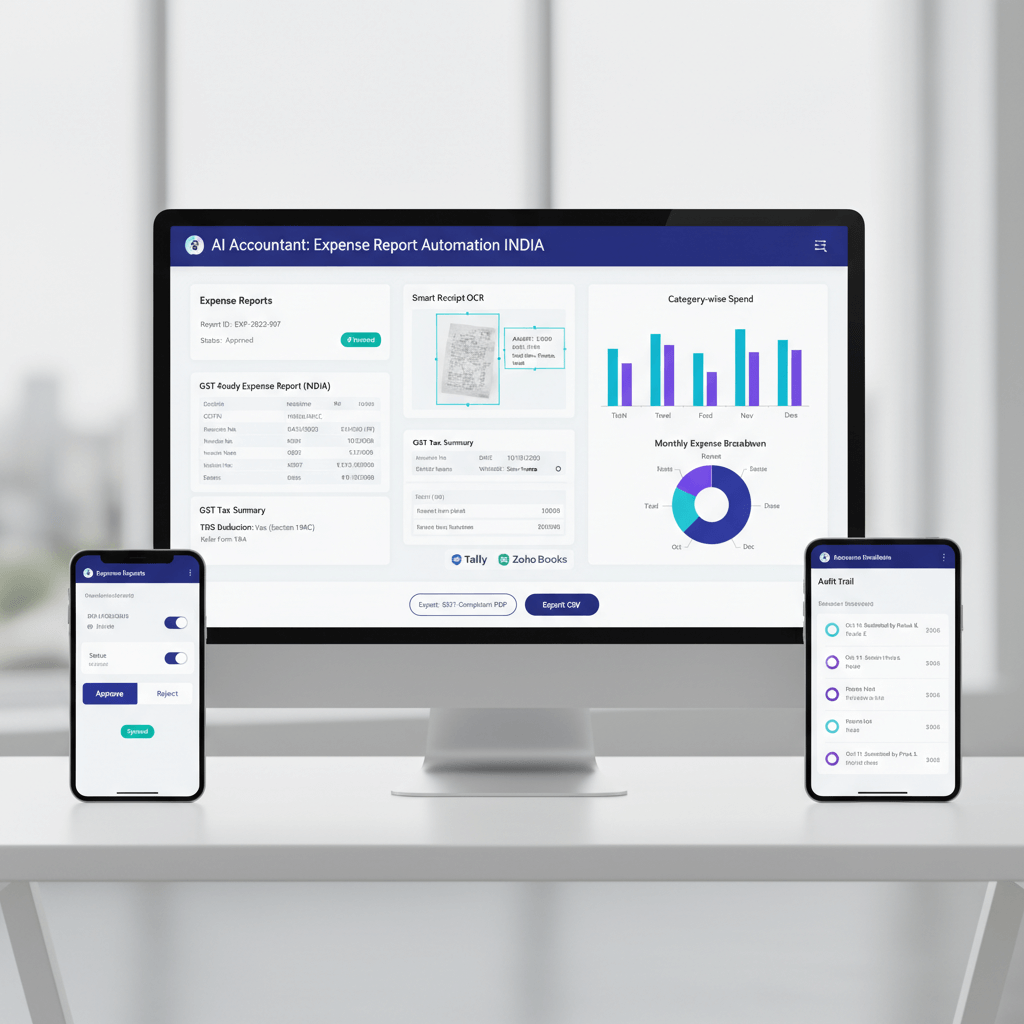
- The Bills module delivers smart receipt capture in many formats. PDFs, JPEGs, and phone photos process quickly through specialized OCR.
- The expense claim workflow follows Upload, Review, Approve, Sync. Ledger mapping happens automatically with GST and vendor predictions learned from patterns.
- Manager approval on mobile uses a responsive interface optimized for swift decisions. Managers handle approvals during commutes or between meetings.
- Expense audit automation runs continuously. Anomaly detection flags unusual patterns. Complete audit trails satisfy SOC2 Type 2 and ISO 27001.
- One click bi directional sync with Tally removes double entry. Real time dashboards visualize trends and tax impacts across all entities.
The roadmap strengthens India specific capabilities. GSTN integration automates GST filing. Account Aggregator feeds remove manual uploads. Predictive cash flow helps plan reimbursement timing.
Step by step, a day in expense report automation India with AI Accountant
Morning: Rajesh returns from a client visit. He uploads five receipts using smart receipt capture on his phone. OCR extracts details and auto categorizes each expense.
Noon: the system maps expenses to correct ledgers with GST codes. It routes the claim to Rajesh's manager based on the approval matrix.
Afternoon: the manager receives a mobile notification. She reviews Rajesh's expenses during lunch and approves with one tap.
Evening: approved expenses sync to Tally with bi directional integration. Each expense links to the corresponding vendor bill.
Night: expense audit automation runs background checks. Dashboards update trends and flag outliers for tomorrow's review.
ROI, real metrics from expense report automation India
The numbers tell a compelling story. Manual classification work drops dramatically. Reimbursement cycles compress from weeks to days. Companies report faster month end closes with fewer errors. Leakage reduces and compliance improves. TDS calculations become consistent.
According to industry research on expense management automation, organizations using automated systems see a 67 percent reduction in processing time globally. In India, UPI based settlement pushes that number even higher.
| Metric | Manual process | Automated with AI Accountant |
|---|---|---|
| Reimbursement time | 14 to 21 days | Two to three days (75% faster) |
| Data entry errors | Fifteen to twenty percent | Under five percent |
| Month end close | Seven to ten days | Two to three days |
| Compliance issues | Monthly | Rare |
| Employee satisfaction | Low | High |
| Expense leakage | Five to eight percent | Under two percent |
| Cost per report savings | Baseline | Approx ₹6,200 saved per report |
Implementation guide, onboard in weeks
Getting started with digital expense management is fast when planned well.
- Week one: connect Tally for bi directional sync. Upload sample receipts to test OCR. Configure company expense policy with Tally integration, including approval hierarchies and spending limits.
- Week two: pilot with one department. Train employees on mobile capture. Set up manager approval workflows.
- Week three: review pilot outcomes and adjust configurations. Expand to additional departments. Monitor adoption metrics.
- Week four: full rollout. Generate the first automated reports. Celebrate quick wins with the team.
Data requirements remain minimal: chart of accounts, GST rate codes, vendor master, and approval matrix. Most of this exists in your current Tally setup.
Success tips: start with clear policies. Prioritize mobile first for field teams. Schedule monthly reviews to optimize workflows.
Security considerations: verify ISO 27001 and SOC2 certifications. Confirm India data residency. Ensure encryption for data in transit and at rest.
Top expense report automation tools for Indian businesses
- AI Accountant: purpose built for Indian SMBs and CA firms. Deep Tally integration, GST and TDS automation, and 50 plus Indian bank formats. Proven scale with 450 plus customers, 300M plus transactions, SOC2 and ISO certifications.
- Happay: Indian solution with corporate card integration and spend visibility. Suitable for mid size companies with travel heavy expenses.
- Zaggle: strong policy enforcement and corporate card programs. Good for companies focused on spend control.
- SAP Concur: enterprise grade capabilities. Suited for large corporations with international operations.
- Expensify: user friendly interface with smart scanning. Limited Indian tax handling requires workarounds.
- FreshBooks: simple expense tracking with accounting. Best for freelancers and very small teams.
Buying checklist, key questions for vendors
- Does your smart receipt capture achieve high accuracy with Indian receipts including handwritten bills. What is your OCR success rate for regional language invoices.
- Can you demonstrate custom expense claim workflows with multi level approvals. How does mobile approval work for managers on the go.
- How robust is your expense audit automation for catching duplicates and anomalies. What specific checks run automatically.
- Do you offer true bi directional sync with Tally. How many Indian bank formats do you support today.
- What is your GST and TDS handling today. What is your roadmap for GSTN integration.
- Can you show proof of scale with transaction volumes and CA firm deployments. Are you SOC2 and ISO certified.
- For CA firms, can you handle many client entities in one platform. How does entity switching work.
- Does your employee reimbursement policy engine support Tally integration natively, or does it require manual configuration.
Common pitfalls to avoid in expense report automation India
- Generic tools ignore Indian tax requirements: choose India first solutions that understand GST input tax credit rules, reverse charge, and TDS thresholds. Using a tool that lacks native GST Council aligned logic means manual workarounds and compliance risk.
- Missing audit trails create disputes: enforce complete logging from day one to handle employee queries and auditor requests.
- Email based approvals create bottlenecks: demand manager approval on mobile that works on any smartphone. Aim for adoption rates above 80 percent.
- Partial integration means double entry: verify bi directional, real time sync before committing. Expense reimbursement with Tally integration should be seamless, not a manual export and import dance.
- Ignoring change management kills adoption: train employees, create champions, and celebrate early adopters.
Case study, 120 employee services firm transforms month end
A professional services firm with one hundred twenty employees struggled with expense chaos. Consultants submitted receipts late. Finance spent two weeks every month on processing. Reimbursement delays frustrated top performers.
They implemented AI Accountant for expense report automation in India within three weeks.
- Smart receipt capture enabled immediate uploads after client meetings
- Manager approval on mobile cut approval time from days to hours
- Expense audit automation flagged duplicate meal claims and unusual travel patterns
- Tally sync ran automatically every evening
Month end close compressed from ten days to three days. Employee satisfaction rose. Finance overtime fell. The CFO shifted focus to analysis instead of data entry.
Future of expense management in India
Expense automation in India is evolving quickly. GSTN integration will automate compliance further. Account Aggregator feeds are already removing manual bank uploads for early adopters.
AI powered predictions will forecast cash flows and flag budget overruns before they happen. Voice based expense entry will speed capture for field teams. Blockchain audit trails will deliver tamper proof compliance records.
The trend is clear: corporate expense management with Tally integration is becoming the default expectation, not a premium feature.
Security and compliance in expense automation
Financial data demands fortress level protection. Here is what to verify:
- Encryption at rest and in transit
- Role based access controls
- Comprehensive audit logging
- ISO 27001 and SOC2 Type 2 certification
- Data residency in India
- Daily backups with point in time recovery
AI Accountant maintains these standards, with independent certifications validating controls.
Integration ecosystem for expense automation
Modern expense automation connects across your financial stack. Accounting software integrations sync with Tally, QuickBooks, and SAP. Bank statements import automatically for reconciliation.
HRMS connectivity aligns employee data and approval matrices. Travel platforms feed bookings into expense reports. Corporate card programs ingest transactions and match receipts. Payment gateways enable direct reimbursements once approvals complete.
Training your team for expense automation success
Technology alone is not enough. Train people well:
- Create video tutorials for common workflows
- Designate department champions
- Run monthly refreshers to share best practices
- Gamify adoption with friendly competitions
- Provide quick reference guides for mobile apps
- Set up help desk channels on WhatsApp or Slack for quick resolutions
Measuring success, KPIs for expense automation
Track these metrics to confirm impact:
- Processing time from submission to reimbursement
- Error rates in categorization and amounts
- Policy compliance percentage
- Adoption rate by department (aim for 80 percent plus)
- Month end close acceleration
- Audit findings related to expenses
- Employee satisfaction trends via NPS
- Cost per expense report
Steady improvements across these KPIs confirm your automation is working.
Next steps, get started with expense report automation India
You have learned what automation achieves, which features matter, and how to implement quickly. Now act.
Book a demo with AI Accountant to see India specific automation in action. Use a two week pilot checklist to test with minimal risk.
Do not let another month pass with manual expense madness. Your employees deserve faster reimbursements. Your finance team deserves efficient workflows. Your business deserves accurate, compliant books.
Frequently asked questions
How does GST calculation work on employee expenses, including mixed tax scenarios
Modern platforms auto calculate GST based on expense categories and tax codes. They validate GSTIN on each receipt for ITC eligibility under Section 17(5) of the CGST Act (2026 update). AI Accountant maps GST rates to ledger codes and splits mixed tax items into correct components for accurate input tax credit treatment.
Can managers really approve claims from mobile without logging into a laptop
Yes, responsive mobile approval flows show all details including receipts, amounts, and policy flags. Managers can comment, request clarifications, or approve with one tap. No app install is required, and SLA reminders keep approvals moving so reimbursements happen within days instead of weeks.
How are UPI, corporate card, and wallet payments handled for reconciliation
UPI transactions link to claims via reference IDs and now support near instant settlement, cutting reimbursement cycles by up to 75 percent (2026 update). Corporate card feeds import automatically and match receipts. AI Accountant supports 50 plus Indian bank and card formats to streamline matching and reconciliation.
How does Tally sync work in practice for expense reimbursement
Approved expenses create journal entries or vendor bills and push directly to Tally through bi directional sync. Updates flow back to the expense system for status tracking and reconciliation. Chart of accounts, tax codes, vendors, and cost centers stay aligned automatically. This eliminates double entry and keeps books audit ready.
How does automated auditing catch split claims or duplicate submissions
AI based anomaly detection flags split transactions designed to stay under approval thresholds, duplicate invoices across months, and weekend or out of pattern spending. In 2026, detection engines also identify vendor clustering patterns that suggest policy circumvention (2026 update). Reviewers receive alerts with full context for focused investigation.
What is the typical implementation timeline for an SMB using Tally
Most SMBs complete onboarding in two to four weeks using a phased approach: connect Tally in week one, pilot with one department in week two, expand in week three, and go live in week four. Complex multi entity setups for CA firms may need six to eight weeks. Data requirements are minimal since most configuration data already exists in Tally.
Can CA firms manage many client entities in a single platform with clean data separation
Yes, multi entity support allows entity switching with strict access boundaries and data segregation. CA firms can view consolidated reports across permitted entities while keeping each client's financial data isolated. This makes managing dozens of client books practical without switching between platforms.

A results-driven finance and sales professional with hands-on experience through finance internships and a fast-paced sales role. With a strong interest in accounting and business finance, Harsh focuses on turning complex topics into clear, practical takeaways for founders and finance teams.