-01%201.svg)
Key takeaways
- Cost allocation is the backbone of project profitability for Indian IT, consulting, and creative agencies, get this right to protect margins and cash flow.
- Use a hybrid approach, direct tag what is traceable, allocate time driven costs with TDABC, spread remaining overhead with simple rates.
- Compliance matters, track GST Rule 42 and 43 apportionment, TDS on contractors, and inter branch IGST cross charges with clear documentation.
- Build a clean workflow, standardize project codes, enforce tagging, reconcile monthly, and automate repetitive steps to avoid errors.
- Measure what moves the needle, monitor project gross margin, contribution margin, utilization, blended hourly rate, and overhead absorption.
- Automation saves hours, bank mapping, ledger prediction, and GST logic can be handled by tools so your team focuses on analysis.
- Start simple, document your policy, and iterate quarterly, consistency and transparency beat perfection.
What are cost allocation methods and why should you care
Cost allocation distributes shared expenses across projects fairly, think of it like splitting a restaurant bill, except you divide based on who consumed what. Project cost tracking monitors these costs against budgets in real time, job costing then rolls everything up to show true project profitability. These three work together like gears, allocation feeds tracking, which feeds costing.
Direct costs trace straight to a project, a freelancer hired only for Client A is direct. Indirect costs serve multiple projects, office rent, admin salaries, accounting software, these need fair splitting. Pass through costs are client reimbursements with no markup, for example travel or printing billed at actuals.
Agencies often struggle because timesheets are incomplete, bank transactions are untagged, prepaid licenses span clients, and reimbursements are misclassified for GST. Fix the system, and your margins will tell a different story.
Core cost allocation methods
Direct costing method
When to use: Billable, project specific expenses like a freelancer assigned to one client.
Pros: Simple and accurate for traceable costs.
Cons: Ignores shared resources, which distorts true project costs if used alone.
Formula: Cost to project equals actual spend, one hundred percent.
Activity Based Costing
When to use: Shared services like design reviews, QA, or account management.
Pros: Precise for multi service firms, shows which activities drive cost.
Cons: Data heavy and complex to set up.
Formula: Overhead to project equals activity usage divided by total activity multiplied by overhead pool.
Time Driven Activity Based Costing
When to use: Firms with reliable timesheets.
Pros: Simpler than ABC, keeps accuracy, fits hourly billing models.
Cons: Depends on accurate time tracking.
Formula: Cost rate multiplied by time per project, for example ₹500 per hour multiplied by 20 hours.
Departmental overhead absorption
When to use: Clear departmental structures, design, development, account management.
Pros: Easy to implement with org charts.
Cons: Averages costs within departments, less precise than activity methods.
Formula: Overhead rate equals total overhead divided by base, for example hours, project share equals rate multiplied by project base.
Hybrid method
When to use: SMB agencies with mixed cost structures.
Pros: Balances accuracy with simplicity, flexible for real world complexity.
Cons: Needs clear policy by cost category.
Formula: Direct plus TDABC share plus overhead rate multiplied by revenue.
For long engagements, consider percentage of completion, allocate costs to certified milestones, and capitalize unbilled work in progress for clean monthly P and Ls.
India specific cost allocation rules
GST input tax credit apportionment
Rules 42 and 43 require apportioning common input credits between taxable and exempt supplies, for example shared rent. Track monthly and reverse non eligible portions, many agencies lose legitimate credits due to poor records.
TDS on contractors and freelancers
Classify contractor payments as direct project costs under Section 194C or Section 194J. Deduct TDS at the prescribed rate by service type, then allocate the post TDS amount to the project, not the gross invoice.
Inter state branches and cross charges
Offices in Mumbai and Bengaluru must treat inter branch supplies as IGST liable. SEZ projects are zero rated for exports, yet still need careful cost allocation for profitability analysis.
Other compliance considerations
- Map payment gateway fees and forex charges to projects based on actual usage.
- Loan interest stays as overhead unless linked to project specific financing.
- Under the pure agent model, reimbursements sit outside GST valuation if documented separately, keep robust evidence.
Setting up project cost tracking, a step by step workflow
Step 1, design your chart of accounts
Create project codes in your accounting system, for example PROJ CLI 001 Direct and PROJ CLI 001 Indirect. Tally and Zoho Books support cost centers natively.
Step 2, establish tagging conventions
Define what is direct versus indirect, use consistent client, job, phase naming across all systems, document rules so everyone follows them.
Step 3, gather and import data
Pull bills, bank statements, payroll, and timesheets. Build approvals to catch errors early. Clean in, clean out.
Step 4, set budgets and track variances
Set baseline budgets per project, track actual versus budget weekly. For long projects, capitalize WIP to avoid profit distortion.
Step 5, Monthly Close Checklist
- Review untagged transactions, fix coding gaps.
- Amortize prepaids, accrue pending costs, reconcile inter entity cross charges.
- Apportion GST ITC, process TDS, revalue foreign currency at month end.
Common pitfalls and solutions
- Incomplete timesheets: Use utilization percentages as proxies, refine quarterly.
- Annual software licenses: Split by seats or usage hours across projects.
- Mixed expenses: Tag pass throughs separately from fee earning work.
- Unallocated bank charges: Create auto rules by vendor and amount patterns.
Agency expense allocation, real world examples
Salary allocation
Use TDABC, if a team member works 30 hours on Project A and 10 hours on Project B, split their weekly cost 75 to 25.
Software and SaaS tools
Allocate by seat count for user priced tools, for enterprise licenses, use actual usage hours or headcount ratios, for example Adobe Creative Cloud used by five designers mapped to their projects.
Office rent and utilities
Headcount proportion works for most agencies, if Project A uses 10 people and Project B uses 5, split two to one, for dedicated spaces use square footage.
Travel and entertainment
Direct tag to projects whenever possible, client dinners, site visits, and project travel should hit the project code immediately.
Marketing and business development
Usually overhead unless directly tied to winning a specific project, some firms allocate by revenue contribution.
Creative agency case
A Mumbai agency with retainers and production work allocates freelancers directly to jobs, salaries via timesheets, rent by headcount, and printing as pass throughs with zero GST markup, result, a fifteen percent improvement in margin visibility within three months.
IT services firm case
A Bengaluru IT firm uses ABC for shared QA and architecture reviews, revenue based overhead for admin, and careful WIP tracking for milestone billing, result, unbilled WIP reduced by forty percent.
Always issue formal change orders for scope changes, tag extra costs separately to protect the original budget and margin narrative.
Automating cost allocation workflows
Bill processing automation
Upload bills in bulk, extract vendor details, amounts, and GST splits, auto tag to projects via rules, route for approval, then sync to your books.
Bank transaction mapping
Parse statements automatically, detect forex gains, refunds, and recurring charges, map to projects using vendor patterns and amount ranges.
Ledger and GST automation
Predict ledger codes and cost centers from history, auto compute GST positions, post entries to Tally or Zoho Books with project tags, see ledger mapping automation for Tally and Zoho for a practical blueprint.
Real time dashboards
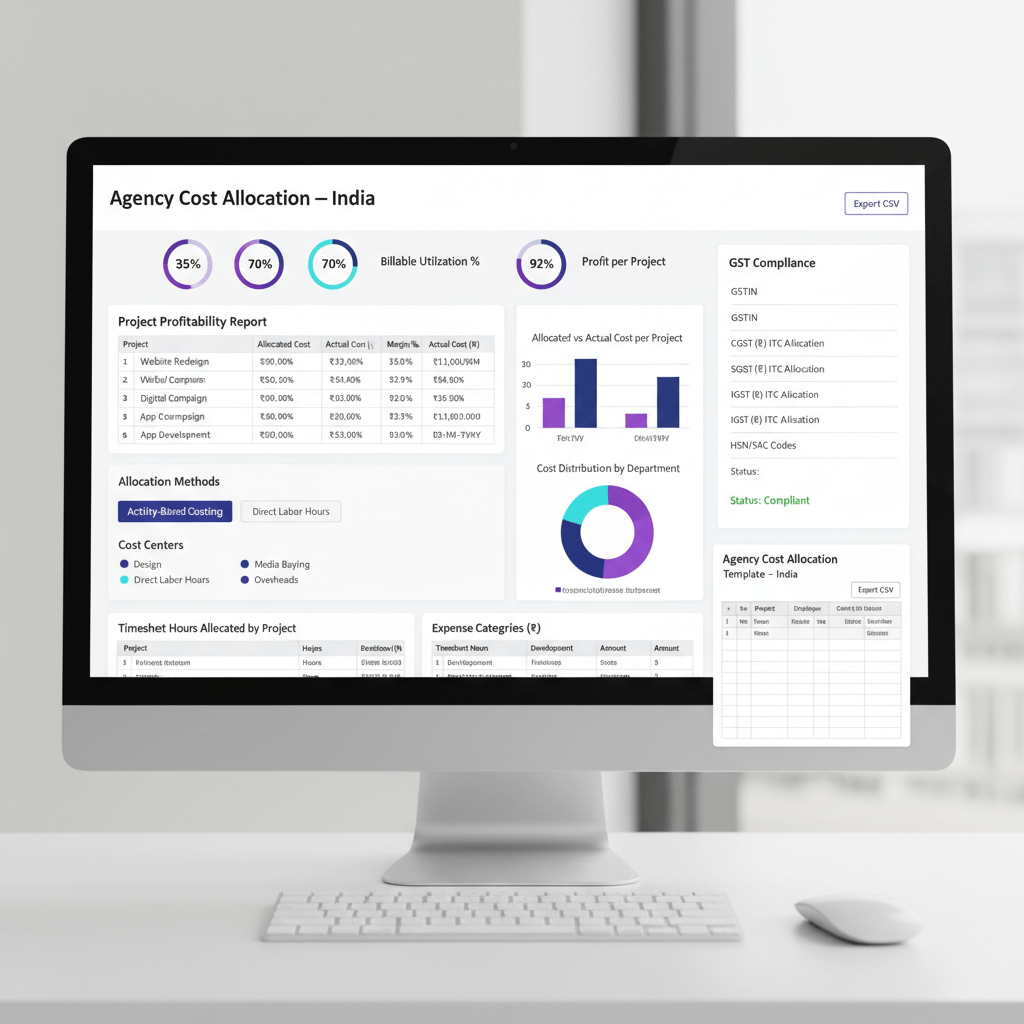
Generate visual insights after each sync, track project profitability, variance alerts, and cash flow projections without manual spreadsheets.
Accounts payable and receivable tracking
Monitor days payable outstanding and days receivable outstanding by project, set alerts for overdue items, track vendor aging at project level.
Smart business rules
Create learning rules, auto tag by vendor, flag exceptions for review, queue approvals by amount thresholds.
Key metrics for monitoring project health
Project gross margin
Formula, revenue minus direct costs divided by revenue, target 40 to 60 percent for most service firms, below 30 percent signals pricing or scope issues.
Contribution margin
Includes direct and allocated indirect costs, shows true project profitability after fair overhead share.
Utilization rate
Formula, billable hours divided by total available hours, target 70 to 80 percent for delivery teams.
Blended hourly rate
Formula, total revenue divided by total billable hours, compare with cost per hour to ensure healthy margins.
Overhead absorption rate
Formula, allocated overhead divided by budgeted overhead, aim for near one hundred percent, large gaps indicate method issues.
Cash flow indicators
- Cash by pipeline stage
- DPO and DRO trends
- Budget variance percentage
- Unbilled WIP aging
- Write off rates
Templates and checklists for quick implementation
Allocation base selection matrix
| Expense category | Hours | Headcount | Revenue | Seats | Square feet |
|---|---|---|---|---|---|
| Salaries | ✓ | ||||
| SaaS licenses | ✓ | ||||
| Office rent | ✓ | ✓ | |||
| Admin support | ✓ | ||||
| Insurance | ✓ |
Monthly close checklist
- Week 1, review untagged transactions, split and accrue prepaids, reconcile timesheets.
- Week 2, apportion GST ITC, process TDS, review WIP positions.
- Week 3, run variance reports, flag unusual allocations, process inter company charges.
- Week 4, generate project P and Ls, review margin trends, plan next month allocations.
Sample chart of accounts structure
- Expenses, Projects, PROJ 001, Direct Freelance, GST 18 percent, TDS 194C
- Expenses, Projects, PROJ 001, Indirect SaaS, Allocated 30 percent
- Expenses, Overhead, Admin Salaries, Unallocated
Timesheet best practices
Enforce weekly entry deadlines with approvals, use 80 percent default utilization for missing entries, review patterns quarterly to refine proxies and improve TDABC rates.
Recommended tools for cost allocation
- AI Accountant automates bank statement ingestion, ledger mapping, and expense allocation for Indian formats, syncs with Tally and Zoho Books, delivers real time project profitability dashboards.
- QuickBooks Online provides project, class, and location tracking for basic allocation.
- Zoho Books includes native project modules with time and expense assignment.
- Tally Prime offers cost centers and categories for traditional allocation.
- FreshBooks suits smaller agencies with simple project tracking.
- Xero brings strong multi currency support with project add ons.
Moving forward with confidence
Start simple with direct tagging and a basic overhead rate, then layer time driven allocation and activity refinements as your data matures. Consistency and clarity outrun perfection, document your policy, review quarterly, and adjust based on results. Automate repetitive tasks so your team focuses on pricing, scope control, and decisions.
Treat cost allocation as an investment in clarity, it pays back through sharper pricing, cleaner client conversations, and stronger profit. Begin with one project, tag every cost, calculate the true margin, then scale across the portfolio.
FAQ
How should a CA structure an overhead allocation policy for a multi project agency without overcomplicating compliance
Adopt a hybrid policy in your accounting memo, direct tag traceable costs, apply TDABC for salaried delivery using standard hourly cost rates, and absorb remaining overhead with a simple base like revenue or headcount. Document the bases, frequency, journals, and review cadence. Use a tool like AI Accountant to automate recurring journals and retain an audit trail.
What evidence is required to support GST Rule 42 and 43 ITC apportionment during scrutiny
Maintain a monthly ITC register with taxable versus exempt turnovers, working papers showing the formula, invoices mapped to cost centers, and reversal entries posted in the books. Keep reconciliations to GSTR 2B and ledger screenshots. Systems like AI Accountant can produce a repeatable Rule 42 worksheet and posting file.
How do I compute TDABC cost rates for blended teams across locations and currencies
Build a standard capacity model, for example 160 hours per month less leave buffers, compute cost per hour including salary, benefits, and statutory contributions, convert foreign costs at month end RBI rates. Keep separate rates by role or band to avoid distortions, update quarterly. Post allocations automatically via your project tags.
How should TDS under 194C versus Section 194J be handled when freelancers charge GST
Deduct TDS on the taxable value as per the section applicable to the nature of service, then allocate the net payment to the project. Record TDS payable separately, claim GST input based on the vendor invoice if eligible. Reconcile monthly to Form 26AS and your GSTR returns.
What is the correct treatment of WIP for milestone based projects under Ind AS 115
Use percentage of completion aligned to certified milestones, recognize revenue accordingly, capitalize unbilled WIP as contract asset, and match costs to the same stage. Maintain a WIP aging and a reconciliation from opening to closing balance with allocation entries attached.
How do we allocate payment gateway and forex charges at project level with aggregator statements
Build rules by descriptor, merchant ID, and amount ranges to auto map charges to projects, where attribution is unclear, allocate by revenue share for that gateway in the period. Reconcile net settlements to gross sales plus fees plus taxes. AI Accountant can auto detect and post these splits.
How should inter branch cross charges be priced for IGST while keeping allocations defensible
Adopt an arms length policy, cost plus a reasonable markup for the service center functions, raise monthly tax invoices with clear descriptions, and mirror allocations in the receiving branch projects. Maintain workings for cost base and markup rationale.
What is the best way to allocate annual SaaS when seats shift during the year
Amortize monthly, allocate by active seats per month captured from admin logs, for shared enterprise licenses, use usage hours. Post monthly journals and adjust prospectively when seat counts change, disclose your method in the policy note.
How do I reconcile pass through reimbursements with the pure agent model to avoid GST disputes
Bill reimbursements separately, reference underlying vendor invoices, collect client authorization, and exclude markup. Map these as pass through cost centers, outside your service value. Keep a reconciliation of bills to client claims. Systems like AI Accountant can link source invoices to claims automatically.
Which allocation base is more reliable for admin overhead, revenue share or headcount
For client management and sales support, revenue often reflects benefit received, for facilities and HR, headcount is more faithful. Where in doubt, test both against the stability of contribution margins and pick the base that yields the most consistent story across projects.
How should prior period corrections to allocations be handled in the ledgers and reports
Post adjusting journals in the current period with clear narration and project tags, avoid reopening closed returns unless material. Provide a management report bridge from prior reported margins to restated margins. Lock the methodology going forward to maintain comparability.
Can an AI tool replace manual timesheet based allocations if compliance is weak
Not fully, but you can blend proxies with automation, for example, calendar events, commit history, or ticket data to estimate hours, then apply confidence scores. AI Accountant can auto allocate from patterns, while you enforce minimum timesheet compliance for critical roles to keep TDABC credible.