-01%201.svg)
Key takeaways
- A dedicated cost allocation dashboard, built for Indian workflows, automates overhead distribution and eliminates spreadsheet errors.
- Activity based costing delivers accurate allocations by linking expenses to real drivers, machine hours or headcount, improving pricing and profitability decisions.
- Deep Zoho Books and Tally syncing keeps ledgers, vendors, and cost centers current, reducing manual data prep and mapping work.
- Department cost tracking becomes transparent with drill downs, giving stakeholders quick answers on variances and spikes.
- GST aware processes, including GSTR 2B matching, ensure clean inputs for allocations and stronger audit trails.
- Rules engines enable preview, bulk operations, and split handling, then post allocations back to books with clear documentation.
- Modern AI powered tools, like AI Accountant, deliver quick implementation, measurable time savings, and faster month end close.
- With the right drivers and governance, teams see fewer disputes, better visibility, and confident compliance.
Table of contents
What makes a great cost allocation dashboard for Indian businesses
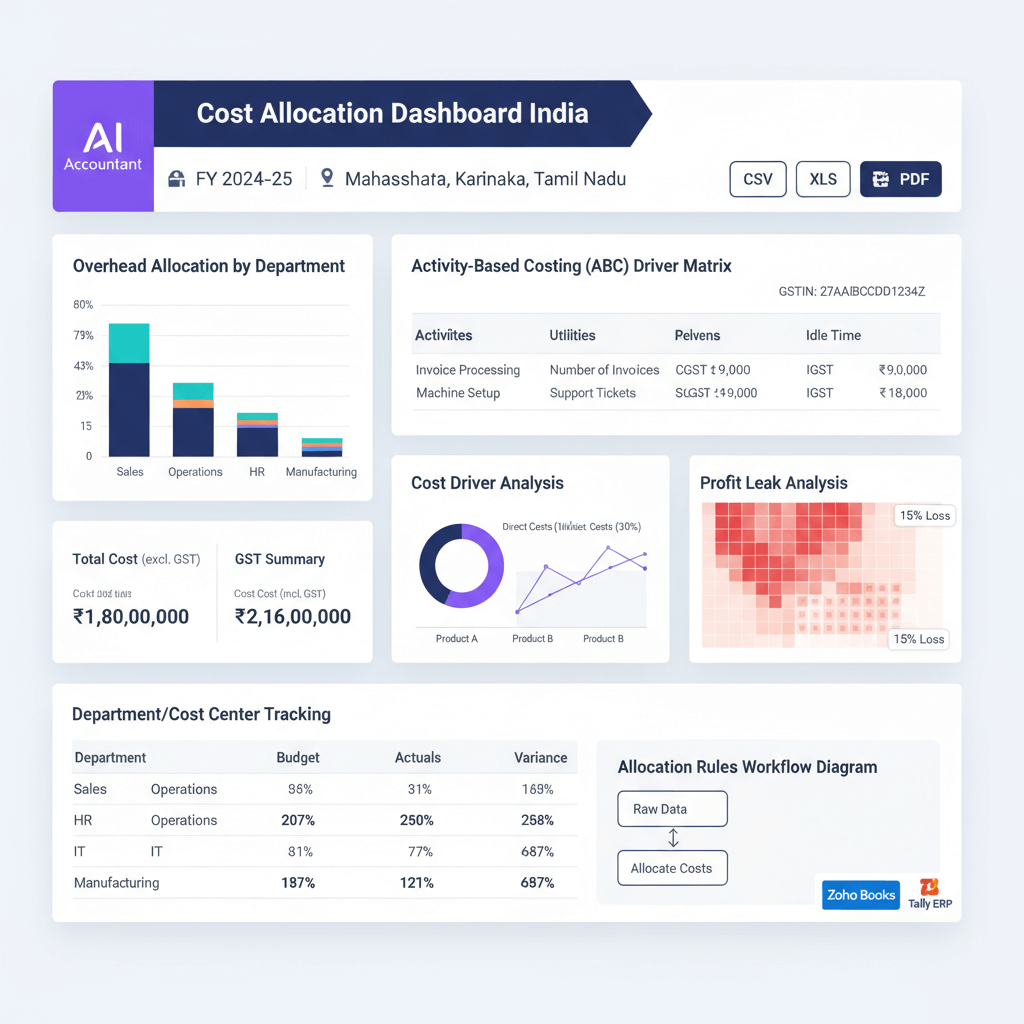
A cost allocation dashboard built for India focuses on automation, compliance, and compatibility with your existing accounting. Native syncing with Zoho Books and Tally keeps masters aligned without manual exports, ledgers, vendors, and cost centers stay up to date automatically.
Activity based costing support is essential, define activities clearly, assign drivers like headcount, floor space, or machine hours, and automate allocations based on usage patterns.
Department cost tracking should leverage your cost centers or projects, with drill down to transaction level details, so leadership gets instant clarity when costs move.
For overhead rules, demand robust automation, driver weights, split transaction handling, preview modes, and audit trails. GST aware workflows matter, including purchase registers and GSTR 2B reconciliation, plus multi org and role based access for CA firms.
Scenario testing strengthens planning, can you compare actual versus budgeted allocations easily, and export results back to books with read only dashboards for executives.
For deeper context, explore cost allocation for Indian agencies and cost allocation fundamentals.
How modern tools support cost allocation needs
- AI Accountant, automates ABC preparation, overhead rules, and deep Zoho or Tally syncing, handles bill ingestion, transaction mapping, dashboards, and GST workflows.
- QuickBooks, suitable for simple class or location tracking, limited for advanced ABC.
- Xero, helpful for project tracking in services, less suited to complex manufacturing.
- Zoho Books Plus, strong project costing modules, manual effort for advanced allocations.
- Tally Prime, native cost centers and Indian compliance, additional setup for automation.
AI Accountant stands out by cleaning bills, bank statements, and card transactions, mapping to correct ledgers and vendors using AI, then enabling bulk edits and month end filters.
Link payments automatically, manage splits and transfers for overhead spreading, and surface cost visibility through overview, payables, and receivables dashboards.
GST reconciliation ensures accurate purchase inputs before allocation runs, multi org support lets CA firms manage multiple clients under one login, each organization learns and improves mapping accuracy over time, as explained in cost allocation for Indian agencies.
Step by step implementation guide for Indian context
Start by connecting Zoho Books or Tally, sync ledgers, vendors, cost centers, and departments, building a reliable foundation.
- Define activities and departments clearly, set cost drivers that reflect reality, machine hours in manufacturing, tickets or project hours in services, headcount for shared services.
- Configure overhead allocation automation, set driver weights, define cycles monthly or quarterly, and include exceptions for special cases.
- Ingest AP bills and bank statements, let auto categorization handle mapping, resolve flagged vendor mismatches.
- Run cost driver analysis to validate allocations against actual spending, adjust weights as trends emerge.
- Execute allocations in preview mode, make bulk edits, then push results back to books when satisfied.
- Review dashboards with stakeholders, lock periods after approval, archive logs for compliance.
For structured guidance, see cost allocation for Indian agencies, cost allocation fundamentals, and cloud cost allocation basics, benefits, and types.
Activity based costing beats flat percentage allocations
Activity based costing links expenses to drivers, creating accurate allocations that support pricing and profitability. Manufacturing examples show factory rent tied to machine hours or floor space, services shift office costs based on billable hours per client.
AI powered tools automate driver assignment and recalculation when drivers change, no more fragile spreadsheets or missed formulas. Precision improves quotes and exposes unprofitable offerings quickly.
Deep dives, cost allocation for Indian agencies and cost allocation fundamentals help you build robust ABC.
Department cost tracking through smart cost center setup
Proper cost center configuration in Tally or Zoho is the backbone of department visibility, sync those centers to your dashboard for real time tracking and instant alignment.
- Drill down to transaction details to answer stakeholder questions and reduce disputes.
- Use hierarchical centers to roll up departments while keeping granular insights.
- Configure alerts for unusual variances, act before month end.
- Tag cross functional projects for shared initiatives without disrupting normal allocations.
Learn practical patterns in cost allocation for Indian agencies.
Overhead allocation automation with compliance built in
Automation turns month end into a sprint, yet must preserve controls and documentation. Modern dashboards handle splits and bulk operations with GST compliant audit trails, every allocation records source data, rules, and postings.
- Rules engines allocate rent by square footage, utilities by headcount, IT costs by device count, all in one run.
- Bulk reallocation updates prior periods in minutes, not days.
- Split transactions maintain links between original and allocated amounts for audits.
- Approved allocations post back to Tally or Zoho automatically, reducing manual entries and errors.
Generate methodology reports with calculations and approvals, tax teams appreciate transparency, you gain confidence, see examples in cost allocation for Indian agencies.
Cost driver analysis for smarter business decisions
Driver analysis reveals consumption patterns and allocation effectiveness, track trends across periods, keep models aligned with reality.
- Monitor variances, investigate deviations between actual and allocated amounts quickly.
- Run sensitivity tests, model driver changes and see budget impact before committing.
- Use charts to communicate clearly, executives grasp insights faster with visuals.
- Benchmark when possible, discover optimization opportunities by comparing drivers to peers.
Iterate monthly and refine quarterly, sustained improvement depends on regular review, see guidance in cost allocation for Indian agencies and cloud cost allocation basics, benefits, and types.
Real world use cases from Indian businesses
- A Pune manufacturing SME allocates plant overheads using machine hours, tracks maintenance costs per department through Tally, monthly dashboards show production line profitability for data driven decisions.
- A Bangalore services firm implements ABC on tickets and project hours, headcount based driver analysis refines allocations quarterly, client profitability reports uncover hidden losses and drive action.
- A Mumbai CA firm uses multi org dashboards to deliver monthly summaries across clients, reporting time drops significantly while accuracy improves.
- A Delhi NCR retail chain allocates warehouse costs to stores based on inventory movement, RFID data gives precise drivers, excess stock falls noticeably.
Explore more examples in cost allocation for Indian agencies.
Measuring ROI and success metrics
Measure time savings, accuracy gains, and faster variance detection. Most SMEs reduce close times significantly, disputes decline as transparency improves.
- Executive visibility increases with dashboards and shareable views.
- Implementation usually completes in one to two weeks, high volume systems demonstrate reliability.
- Positive ROI often appears within three months, compliance confidence rises with strong audit trails.
Reference frameworks, cost allocation for Indian agencies and cloud cost allocation basics, benefits, and types.
Comparing approaches, spreadsheets vs ERP modules vs modern solutions
| Approach | Pros | Cons |
|---|---|---|
| Spreadsheets | Free, flexible | Error prone, no automation, weak audit trail, poor scalability |
| ERP modules | Deep features, integrated with books | Rigid workflows, high cost, slower setup for SMEs |
| AI powered tools | Agile automation, easy integration, GST awareness | Focused workflows, not a full ERP |
Spreadsheets suit very small teams, but formula errors scale quickly. ERP modules deliver breadth, yet may be too heavy for focused allocation needs. AI powered tools like AI Accountant balance automation and flexibility for growing businesses. For context, see cost allocation for Indian agencies and cost allocation fundamentals.
Common implementation pitfalls and how to avoid them
- Poor drivers harm accuracy, test multiple options against historical data.
- Missing cost centers create gaps, ensure complete coverage to prevent distortions.
- GST mismatches pollute inputs, reconcile registers and GSTR 2B reconciliation before allocations.
- Ignoring exceptions leads to manual workarounds, codify special cases in rules.
- Insufficient training slows adoption, invest in process education alongside tools.
- Weekly reviews during initial months catch issues early, pilot with a few departments first.
- Maintain master data hygiene, clean vendors and current cost centers drive accurate results.
See a field tested checklist in cost allocation for Indian agencies.
Take action today
Book a live demoAI Accountant, examine cost allocation workflows purpose built for Zoho and Tally, watch automation handle your exact scenario.
Download our ABC driver checklist and allocation template, begin defining drivers and rules with confidence, run a guided pilot for one cycle with two departments, validate and then roll out.
Do not let another month end be consumed by manual work, modern cost allocation dashboards deliver automation, accuracy, and insights, the move from manual chaos to automated clarity begins with one decision, make it today.
Frequently asked questions
How do CA firms implement activity based costing in Zoho or Tally without custom scripts
Use an AI driven allocation tool like AI Accountant, sync masters from Zoho or Tally, define activities and drivers, run preview allocations, then post journals back to books automatically. This removes custom scripting, keeps an auditable trail, and aligns with GST workflows.
What is the recommended driver set for overhead allocation in a multi department Indian SME
Start with headcount for shared services, machine hours for production, floor space for rent, device count for IT, and billable hours for services. Validate with one quarter of history, run sensitivity analysis, then finalize weights. AI Accountant lets you compare scenarios before posting.
How can I ensure GST compliant inputs before running any allocations
Reconcile purchase registers with GSTR 2B reconciliation, resolve vendor mismatches, and lock the period. AI Accountant automates matching, flags exceptions, and maintains logs that support audits.
Can allocations be reversed or adjusted for prior periods without manual journals
Yes, use bulk operations in the rules engine, rerun with updated weights or splits, and let the system post reversal and adjustment entries back to Zoho or Tally. AI Accountant maintains clear links between original and adjusted postings for auditability.
What reporting structure should a CFO request for department cost tracking
Set hierarchical cost centers, enable transaction level drill downs, and configure variance alerts. Provide read only dashboards for leadership, export allocation summaries for board packs, and lock approved periods. AI Accountant supports these governance workflows natively.
How do we handle split transactions where one invoice serves multiple departments
Define split ratios at the line item or invoice level, assign drivers per department, then let the system create linked allocation entries. During audits, show the original document, the rule applied, and the final split posting. AI Accountant automates this with minimal manual effort.
What controls should a CA implement to prevent allocation rule misuse across clients
Use role based access, client specific rule libraries, and change approval workflows. Multi org isolation ensures one client’s rules do not affect another. AI Accountant enforces separation while enabling standardized reviews.
How quickly can an SME move from spreadsheets to an automated dashboard
Typical timelines are one to two weeks, onboarding includes master sync, driver definition, pilot allocations, and approval process setup. Many teams see time savings from the first month end, with full ROI inside three months.
How do we justify the allocation methodology to tax authorities during an audit
Provide documentation that includes driver definitions, rule weights, preview outputs, approvals, and final postings. Include reconciliations like GSTR 2B matching for input integrity. AI Accountant generates method and calculation reports that satisfy audit requests.
Which approach is best for a growing SME, ERP module or AI powered allocation tool
For focused allocation automation, AI powered tools deliver faster setup, flexible rules, and strong audit trails at lower cost. ERP modules offer breadth but can be rigid and slower to deploy. Many firms begin with AI Accountant, then integrate further as needs expand.
Can we run budget versus actual allocation comparisons for board reviews
Yes, load budgets and compare with actual versus budgeted allocations, highlight variances by driver and department, and present scenarios for corrective action. AI Accountant makes this analysis routine for monthly and quarterly reviews.
How do I manage client wise visibility in a CA practice with multiple organizations
Use multi org features to isolate data, assign roles per client, and provide read only views to owners. The AI Accountant platform keeps organizations separate, learns each client’s patterns, and improves mapping accuracy over time.

Rohan Sinha is a fintech and growth leader building aiaccountant.com, focused on simplifying accounting and compliance for Indian businesses through automation. An IIT BHU alumnus, he brings hands-on experience across 0 to 1 product building, growth, and strategy in B2B SaaS and fintech.