-01%201.svg)
Key takeaways
- Tested change management accounting gives CA firms and SME finance teams a safe, auditable way to implement changes, while protecting GST compliance and month end integrity.
- Always work in a staging environment, secure approvals, and keep a clear rollback path with versioned exports and checksums.
- Focus on accounting risks, not just IT procedures, traceability with full audit trails, segregation of duties with SOX style controls for Indian SMEs, reversibility, and minimal downtime.
- Parallel runs, reconciliation first, and explicit GST, TDS, and invoice sequence validations prevent compliance failures.
- AI Accountant acts as a secure staging layer for Indian businesses, enabling tested changes, audit logs, and fast rollback.
Why Tested Change Management Accounting Matters for Indian Businesses
GST reconciliations, vendor master updates, and bank statement mappings are accounting changes that can cause compliance failures if mishandled. Generic IT change management does not address these nuances, you need accounting specific controls that prevent GST mismatches, protect vendor integrity, and stop duplicates before they enter the books.
The philosophy is straightforward, test changes in a safe environment, secure approvals before touching live data, and make every change reversible. Management accounting in India is moving toward data driven decisions, yet this progress requires disciplined change controls.
One wrong GSTIN update can cascade into GSTR 2B mismatches, a bulk vendor edit can create duplicate invoices, these are daily risks. That is why tested change management accounting emphasizes testable, reversible, approved changes. No surprises, no audit panic, only clean, controlled execution. See Source for broader context.
Change safely, reconcile rigorously, document relentlessly, that is how you protect compliance and trust.
Core Principles of Change Management Accounting
- Traceability requires end to end logs, use full audit trails so every edit shows who, what, when, and why.
- Segregation of duties separates roles, requestors are not approvers, preparers do not review their own work, this prevents errors and fraud.
- Reversibility is non negotiable, if you cannot restore yesterday’s state in two hours, you are not ready.
- Minimal downtime protects month end, time changes around frozen posting windows, do not disrupt critical closes.
These controls target accounting risks like erroneous GSTIN updates causing GSTR 2B mismatches or bulk vendor edits triggering duplicates, not just IT concerns. See Source.
Common Change Types and Their Scope
- Data changes touch masters, vendor details, customer GSTINs, payment terms, simple edits can ripple across systems.
- Configuration changes alter behavior, chart of accounts, tax rules, invoice templates, each affects downstream processes.
- System changes involve integrations and automation, APIs for Zoho Books or Tally, rules, dashboards, these require careful tests to avoid corruption.
- Migration scenarios are big ticket changes, ledger moves, reclassification of history, onboarding tools like AI Accountant for AP automation or bank reconciliation.
Each type demands different controls, validate data changes against source documents, perform parallel testing for configurations, run integration checks for systems, and reconcile fully for migrations.
End to End Process Framework for Accounting Changes
- Discovery and impact analysis, map affected ledgers, identify GST implications, trace workflow changes.
- Design and documentation, write specs, build a RACI, capture current state versus future state.
- Test environment prep, mirror production, copy live data to staging, isolate experiments.
- Dry runs and UAT, run parallel processes, compare outputs, secure user validation.
- Migration approvals, package test results, document risks, get signatures, no verbal okays.
- Release checklist, pre flight checks, validation steps, sign offs, skip nothing.
- Go live and monitoring, execute, watch dashboards for exceptions, stay alert.
- Rollback plan, define triggers, specify reversal steps, assign ownership, test quarterly.
- Post change review, reconcile outcomes, update DR plans, document lessons learned.
Key Artifacts and Controls in Change Management
Versioned Exports for Accounting Data
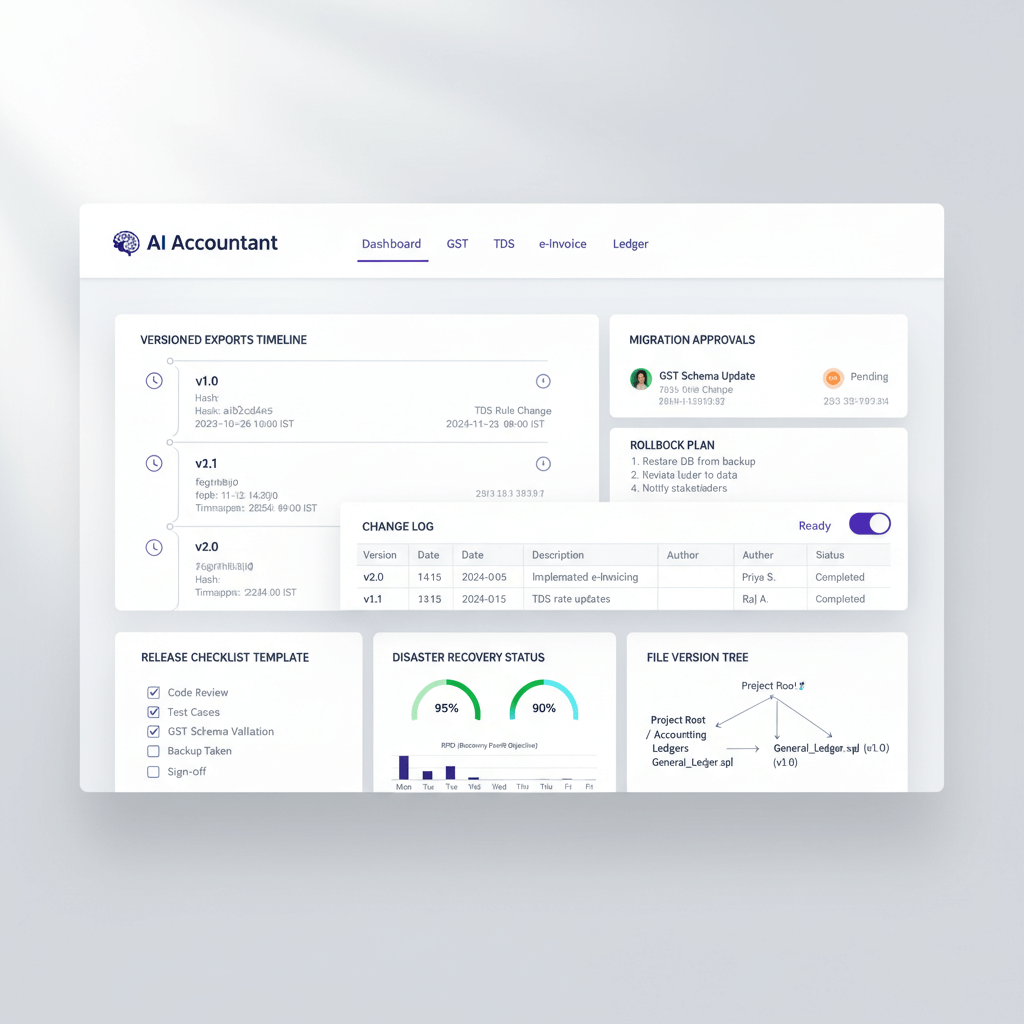
Versioned exports are your time machine. Before any change, export vendor masters, trial balances, purchase registers, and open AP or AR. Name files consistently, for example, VendorMaster_v1.2_20241215.checksum, include versions, dates, and checksums. These enable before and after comparisons, provide audit evidence, and support rollbacks. Store securely, retain multiple versions, and test restorations. See Source.
Migration Approvals Framework
Migration approvals prevent cowboy changes. Define roles with a RACI, requestors set business needs, preparers build and test, reviewers validate, approvers authorize. Your packet should include scope, test evidence, reconciliation results, risk assessment, and a documented rollback plan.
Release Checklist Components
A robust release checklist reduces execution risk. Pre flight checks include backups and versioned exports, freeze posting windows, notify stakeholders, and review cutover. Validation covers sample postings, GST rules, duplicate detection, and bank mappings. Sign offs from business users, accounting, IT, and compliance confirm readiness.
Rollback Plan Essentials
Your rollback plan needs clear triggers, for example, AP or AR variances over one percent, posting failures beyond thresholds, GST anomalies. Document reversal steps, halt syncs immediately, restore prior versioned exports, revert masters, reverse postings, and notify stakeholders. Aim for restoration within two hours, assign ownership to the approver, and test quarterly.
Disaster Recovery Considerations
Disaster recovery goes beyond backups, define RPO and RTO, for most SMEs, RPO of one hour and RTO of four hours are workable. Schedule daily backups with offsite storage, create runbooks for GST reconciliation recovery, document AP, AR, and bank reconciliation restoration. Run quarterly DR drills, actually restore, verify integrity, and test full recovery. See Source.
Accounting Specific Testing Strategy
Accounting changes demand rigorous testing. Run parallel cycles for one to two iterations, reconcile every difference, and do not proceed until variances are explained. Emphasize high risk areas, AP bills extraction accuracy, bank statement normalization, mapping precision, and GST reconciliation between GSTR 2B and purchase registers.
Define clear success criteria, zero critical variances in totals, minor mapping errors under zero point five percent, clean API pushes to Zoho Books or Tally without rejections. Test edge cases, cancelled invoices, amendments, year end adjustments. Validate compliance, GST calculations, TDS computations, and invoice numbering sequences.
Operational Playbook for Implementation
Time changes strategically, post month end reduces pressure, freeze posting periods for twenty four to forty eight hours, and communicate across channels. Enforce segregation with role based access controls, prevent preparers from approving their own work, and require dual authorization for critical changes.
Monitor continuously, use dashboards for cash positions, AP aging, and AR status, configure alerts for exceptions, and schedule weekly reconciliations during transition. Document everything, communication logs, test results, approval emails, this trail is vital for audits.
How AI Accountant Enables Safe Tested Change Management
Having the right tooling accelerates safe change management. The following solutions support tested change management accounting for Indian businesses:
- AI Accountant, a secure staging layer for testing before changes hit live books, automated bill extraction, bank reconciliation, and GST matching, with audit trails and fast rollback capabilities.
- QuickBooks Online, sandbox environments and change history suitable for configuration tests.
- Xero, detailed audit logs and permissions that strengthen segregation of duties.
- Zoho Books, comprehensive backup and restore, API support for automated testing.
- Tally Prime, data synchronization and multi user controls for controlled implementation.
AI Accountant focuses on Indian compliance, it ingests and cleans data, then pushes to Zoho or Tally after validation. The platform auto generates versioned exports and immutable audit trails, every mapping, edit, and reconciliation is traceable.
Bulk operations include guardrails, filters before edits, error report review before posting, mismatch alerts for vendor details or GSTINs. Migration approvals are built in, reconciliation tags, review tracking, and in workflow sign offs. The release checklist catches format issues, flags vendor mismatches, and identifies duplicates. Rollback is straightforward, pause syncs instantly, revert to clean states, re link payments and receipts. Security includes encryption, ISO 27001 and SOC 2 Type II compliance, multi org isolation, and full audit logs. See Source.
India Context Examples for Change Management
Indian businesses face unique requirements. For GSTIN updates, use AI Accountant mismatch detection, validate against GSTR 2B before and after, ensure no compliance gaps. When moving from manual AP to automated extraction, keep audit trails end to end, export existing bills, run one month of parallel processing, reconcile extracted data against manual entries, then cutover.
For ledger migrations, reconcile changes against GSTR 2B, tax authorities scrutinize mismatches closely, one wrong classification can trigger notices, thorough testing prevents issues. For TDS changes, test sample calculations, verify certificate generation, and confirm quarterly returns reflect updates accurately.
Metrics and Reporting for Change Success
- Month end close time reduction, track hours saved after automation, document improvements.
- Parallel run variance counts, monitor discrepancies between old and new, ensure counts decline with each cycle.
- Mapping exception rates, measure transactions needing intervention, aim for steady reduction.
- Approval cycle time, days from request to implementation, identify bottlenecks and remove them.
- Rollback incidents, frequency and learnings, improve planning quality.
- DR drill success rates, achieved recovery times versus targets, prove preparedness.
Common Pitfalls and How to Avoid Them
- Unversioned exports undermine audits, always use systematic naming with checksums, store multiple versions.
- Skipping approvals under pressure invites risk, use templates, make approvals mandatory.
- Incomplete release checklists, customize for Zoho or Tally, include duplicate detection and GST validations.
- Missing rollback plans, define triggers, document steps, assign ownership before you start.
- Confusing backups with DR, backups are copies, DR is complete restoration, test quarterly.
- Inadequate testing, include edge cases and exception handling, not just happy paths.
- Poor communication, notify early, update regularly, and document decisions clearly.
Quick Start Templates for Implementation
Versioned exports naming convention: DatasetName_vMajor.Minor_YYYYMMDD_SHA256.checksum, for example, VendorMaster_v2.1_20241215_a7b9c2d4.checksum.
Migration approvals form includes change scope and objectives, identified risks and mitigation, test evidence and results, stakeholder signatures and dates.
Release checklist includes separate tabs for Zoho, Tally, and AI Accountant, add pass or fail checkboxes for each validation step.
Rollback one pager outlines trigger conditions, step by step reversal process, role assignments and contact info, target timeline under two hours.
DR runbook captures RPO and RTO, backup schedule and locations, test script with expected outcomes, recovery verification steps.
Getting Started with Tested Change Management
Start with low risk changes, update a few vendor GSTINs with a controlled process, test thoroughly, document every step, build confidence before larger changes.
Use AI Accountant as your staging environment, test automation workflows safely, validate data quality, keep a complete audit trail automatically.
Create your first release checklist today, customize for your tools and processes, run it on a minor change, refine based on learnings.
Build your rollback plan before you need it, define triggers, document steps, test with non critical data. Tested change management accounting helps you move fast, while keeping books accurate, compliant, and auditable.
Move fast, do not break compliance, earn auditor confidence with disciplined change management.
FAQ
As a CA partner, how many parallel cycles are sufficient before I sign off?
Run one to two complete cycles minimum, continue until zero unexplained variances are achieved, for complex migrations, a full month of parallel processing is prudent, AI Accountant helps reconcile cycle to cycle differences quickly.
What documentation should I attach to a migration approval packet for a multi client roll out?
Include scope, business objectives, risk assessment, test execution logs, reconciliation reports, screenshots, stakeholder sign offs, and a detailed rollback plan, AI Accountant can auto export audit logs and versioned files to attach.
When do I rollback versus remediate during go live if I see GST exceptions?
Rollback for critical compliance failures, for example, GST calculation errors, invoice sequence breaks, or reconciliation gaps that breach thresholds, remediate minor issues post go live if they stay within defined tolerance, AI Accountant supports instant sync pauses and reverts.
How do versioned exports help with Zoho Books or Tally restorations during a failed change?
Export CSV or Excel snapshots with checksums, upon failure, import prior versions through API or manual upload, then reconcile masters and postings, AI Accountant maintains versioned exports and restoration runbooks to accelerate recovery.
For Indian SMEs, what is the minimum testing coverage I should enforce?
Cover AP processing, bank reconciliation, GST calculations, and financial reporting end to end, test at least ten percent of transaction volume or one hundred transactions, whichever is higher, include edge cases and exceptions.
How frequently should a CA firm review and update its change management SOPs?
Review quarterly during initial adoption, then semi annually once stable, any major failure or near miss warrants immediate SOP updates, AI Accountant’s audit logs can highlight patterns that drive SOP improvements.
How do I structure segregation of duties for a lean SME finance team?
Separate requestor, preparer, reviewer, and approver, enforce dual authorization on critical steps, use role based access in Zoho or Tally, AI Accountant supports review workflows with tagged reconciliations and sign offs.
What variance thresholds are practical for triggering rollback in AP or AR during migrations?
Common practice is one percent variance on AP or AR aging totals, zero tolerance on GST computation errors and invoice sequence breaks, define thresholds upfront and test them in staging, AI Accountant dashboards can alert on breaches.
How should I validate GSTIN updates to prevent GSTR 2B mismatches?
Run mismatch detection pre and post change, compare vendor masters against GSTR 2B, reconcile exceptions, and only then push updates live, AI Accountant automates pre validation and post validation checks.
What goes into a good release checklist for Zoho Books or Tally Prime changes?
Pre flight backups and versioned exports, posting window freeze confirmation, stakeholder notifications, sample postings, GST rule verification, duplicate detection, bank mapping validation, and sign offs from business, accounting, IT, and compliance.
How do I differentiate backups from disaster recovery in finance operations?
Backups are data copies, disaster recovery is complete restoration to a working state, define RPO and RTO, test full recovery quarterly, AI Accountant’s runbooks and audit trails help verify end to end recovery success.
Can AI Accountant act as a staging layer for automated bill extraction and bank reconciliation before I touch live ledgers?
Yes, AI Accountant ingests and cleans data, runs validations, generates versioned exports, and supports audit logs, you can test mappings, GST computations, and reconciliations in staging, then push to Zoho or Tally once results meet your criteria.

A results-driven finance and sales professional with hands-on experience through finance internships and a fast-paced sales role. With a strong interest in accounting and business finance, Harsh focuses on turning complex topics into clear, practical takeaways for founders and finance teams.