-01%201.svg)
Key Takeaways
- Calculate true burn rate including all hidden costs: GST interest at 18% annually, TDS penalties, advance tax, and the 15-20% compliance overhead most founders miss
- Build your runway model with Indian realities: 45-day MSME payment cycles, quarterly tax outflows, and festival season cash crunches that can spike burn by 30%
- Track both gross burn (all expenses) and net burn (after revenue) weekly, because monthly tracking misses the GST deposit crunch on the 20th of each month
- Virtual Accounting by AI Accountant's automated tracking catches compliance deadlines before they become penalties, turning burn rate from a monthly surprise to a daily dashboard metric
Understanding Burn Rate in the Indian Context
You check your bank balance, you know your monthly expenses, but between GST filings, TDS deposits, advance tax, and that vendor payment stuck for 47 days, you have no idea how many months of cash you actually have left. This uncertainty kills more Indian startups than competition ever could. One missed compliance deadline triggers compliance penalties. One delayed client payment throws off your calculations, and suddenly, the 18 months of runway you thought you had is actually 11.
Short answer: Burn rate is monthly expenses minus monthly revenue, and runway is cash in bank divided by monthly burn. In India, include statutory outflows like GST, TDS, and advance tax, then add a 15% compliance buffer. Many founders target 24-36 months of runway. Virtual Accounting by AI Accountant automates this tracking with real-time dashboards that factor in Indian compliance calendars.
Your burn rate is the speed at which you spend to keep the company alive. In India, this includes statutory payments that hit at different times, penalties that appear without warning, and cash flow gaps created by payment culture.
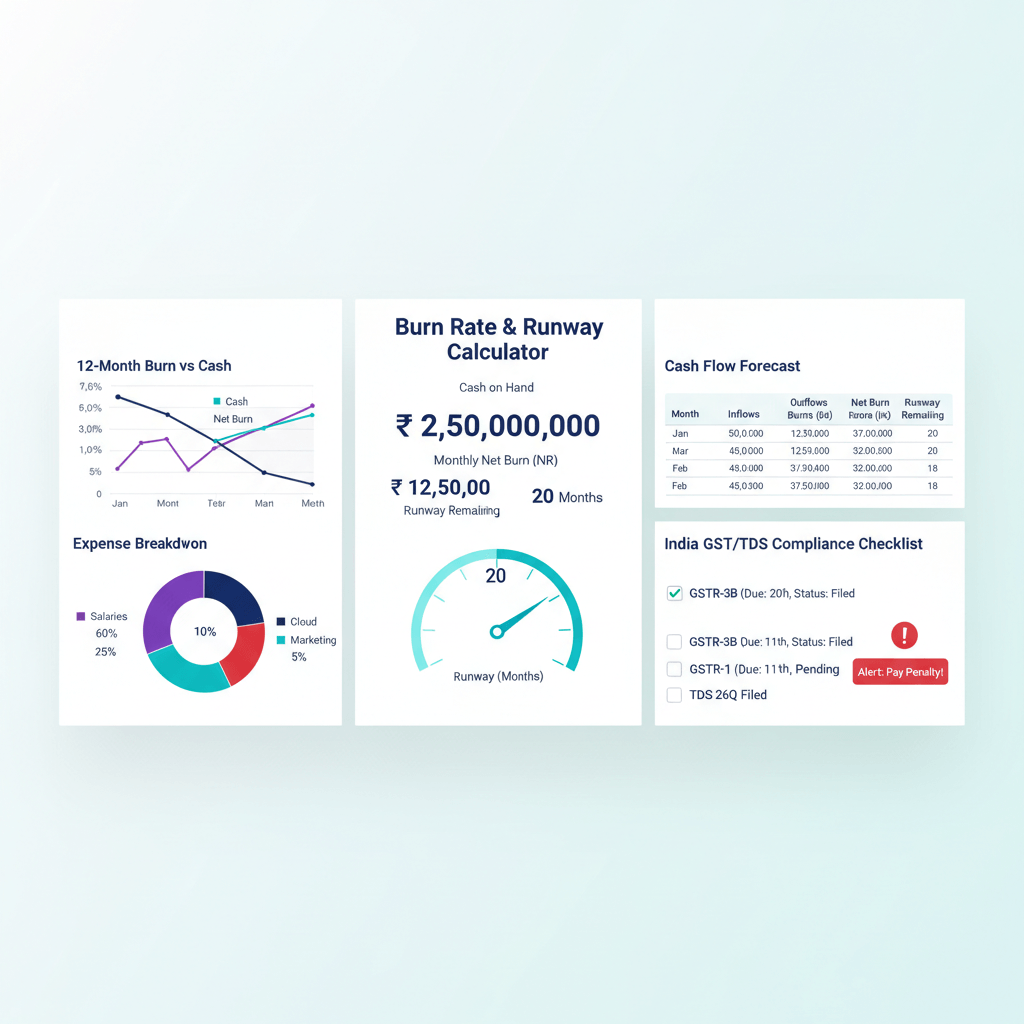
Gross burn is every rupee that leaves your accounts: salaries, rent, cloud, marketing, professional fees, GST payments, TDS deposits, advance tax, EPF and ESI, even that chai-samosa budget. For a 10-person startup, gross burn often runs ₹8-12 lakhs monthly, but the real number usually lands 15-20% higher once you include compliance and penalties.
Net burn subtracts revenue from gross burn. If gross burn is ₹10 lakhs and revenue is ₹3 lakhs, net burn is ₹7 lakhs. The catch: Indian revenue is lumpy. B2B payments arrive in 45-60 days, government in 90-120 days, which means your spreadsheet runway often diverges from your bank balance.
What costs do Indian founders typically miss in burn rate calculations?
- GST reconciliation fees, TDS deposit charges, and late fees that escalate quickly
- State-specific levies like professional tax, plus EPF and ESI contributions that add ~24% above salaries
- Registered office costs, compliance support retainers, and year-end audit surges
- “Exception” costs: fixing GSTR mismatches, late advance tax interest, blocked input tax credit
These “one-offs” occur almost every quarter, which is why theoretical burn is consistently 15-20% lower than reality.
How do payment delays affect burn rate tracking?
Payment cycles create phantom runway. You show 12 months of runway based on booked revenue, but your bank indicates 7 months because collections trail expenses. Salaries, rent, and tax deposits land on time, clients do not. This mismatch compounds when statutory payments are due, forcing founders into short-term borrowing or penalties.
Calculating Your True Runway
Top investors now recommend startups raise capital to achieve 24-36 months of runway, a shift driven by longer fundraising cycles and tighter capital. Many regions have seen volatility, and seed-stage funding fell 30% year-over-year, increasing the need for conservative buffers.
The basic formula is simple, Cash in bank ÷ Monthly burn = Runway in months. But the India-ready version is more accurate: (Cash in bank − Advance tax due − Pending payables + Collectible receivables within 60 days) ÷ (Average burn × 1.15 compliance buffer).
Example: You have ₹1 crore. Subtract ₹8 lakhs advance tax and ₹3 lakhs pending bills, add ₹6 lakhs of reliable under-60-day receivables, then divide by burn with a 15% buffer. Your headline 20 months might compress to 14-15 months — a difference that determines whether you fundraise calmly or in crisis.
When should you include receivables in runway calculations?
- Money in bank: 100% counted
- Invoices under 30 days, reliable clients: 80% counted
- Invoices 31-60 days: 50% counted
- Invoices over 60 days: 0% counted
- Signed contracts or POs not invoiced: 0% counted
- Government receivables: count them at 0% until cash arrives
This conservative approach prevents the classic mistake of counting promises as runway.
How do you factor in growth and variable costs?
Model three scenarios: conservative, realistic, aggressive. Pre-build hiring plans, CAC payback, and expected payment lags. For Series A stage, median valuations range between $40-50 million, which demands real revenue traction. Track burn-to-growth weekly — for every ₹1 rise in burn, target ₹1.5-2 in monthly revenue growth within 90 days.
The Hidden Costs: Compliance and Penalties
Indian startups navigate 40+ filings a year. Miss a GST or TDS deadline and you incur penalties plus interest, which directly reduces runway. The most damaging hits include:
- GSTR-1 and GSTR-3B delays: daily late fees plus 18% annualized interest on tax amounts
- TDS deposit and return delays: penalties under Sections 234E and 271H
- Advance tax shortfalls: interest under Sections 234B and 234C
- Blocked input tax credit due to vendor non-compliance, instantly straining working capital
Build these costs into your base burn as fixed, predictable outflows. Better yet, automate reminders and cash planning against each due date. Want to see a live example of proactive alerts and dashboards? Watch this short video.
Building Your Burn Rate Tracking System
Weekly is the minimum viable frequency. Every Monday, log five numbers: total cash across accounts, receivables by age bucket, payables due this month, last week’s spend by category, and this week’s expected large payments. From these, compute weekly burn and projected runway. For a deeper dive on forecasting in the Indian context, see cash flow forecasting for Indian SMEs.
Track burn-rate efficiency too: what did you accomplish per lakh burned? When you tie spend to milestones, you cut faster and smarter.
What tools work best for Indian startups?
Start with Google Sheets for collaboration and speed. Use simple forms for expense capture, and connect your bank to Tally or Zoho for reconciliation. Then overlay a custom sheet that adjusts for receivable lags and statutory outflows. Manual systems break in crises, which is why many founders move to Virtual Accounting by AI Accountant for automated updates, compliance calendars, and real-time runway projections.
How do you communicate burn rate to investors and boards?
Share burn as a trend, not a point. Annotate spikes with causes, like advance tax or annual insurance. Send a standard monthly investor update with opening cash, gross and net burn, runway, efficiency metrics, next month’s expected burn, and asks. For templates and automation ideas, see board reporting automation in India. Be radically transparent when numbers worsen, and explain the plan, investors can help if they trust your visibility and discipline.
Strategies to Extend Runway
When runway drops below 9 months, you have three levers: reduce burn, accelerate cash in, or raise a bridge. Cut smart, not blindly. Preserve spend that creates revenue within 30-60 days, pause the rest.
- Eliminate unused subscriptions and perks
- Renegotiate vendors, annualize SaaS for discounts
- Downsize office, or go remote
- Structure temporary salary deferrals with clear agreements
- Restructure the team only after exhausting non-people cuts
To accelerate cash, tighten collections, offer small discounts for upfront payment, move to quarterly or annual billing, and productize services for faster cash generation.
What are the regulatory considerations when cutting costs?
Pay salaries timely, and continue EPF and ESI contributions. Document any salary deferrals. Follow proper layoff processes and severance norms. Non-compliance invites penalties and litigation, which drain runway faster than the savings you might realize.
When should you raise bridge funding versus cutting costs?
Raise a bridge when you have near-term milestones that unlock the next round or breakeven. Bridges are dilutive, and expensive, but warranted if cuts would kill the business’s path to traction. Use real-time dashboards to model scenarios before you decide, founders using Virtual Accounting by AI Accountant often act within hours because their numbers are live.
Common Mistakes Indian Founders Make
- Treating burn as an accounting metric, not a survival metric
- Optimizing CAC while ignoring collections and working capital
- Believing optimistic spreadsheets that assume flawless execution and on-time receivables
Why do founders consistently underestimate burn rate?
Optimism bias, and the compound effect of “small” expenses. A series of ₹5,000-₹15,000 line items quietly adds ₹1-2 lakhs a month. Confront the brutal truth, then adjust fast. The founders who survive catalog every rupee, weekly.
How do you balance growth spending with runway preservation?
Use the 40% rule: growth rate plus profit margin should exceed 40%. Test growth channels in small, time-bound experiments. Scale only when CAC payback is proven. Pre-PMF, spend to find fit. Post-PMF, spend to scale what is proven, otherwise, cut.
Conclusion
Tracking burn and runway is not a spreadsheet hobby, it is survival. India’s compliance cadence, payment delays, and lumpy cash collections make “simple” formulas dangerously optimistic. The startups that endure build real-time visibility, automate compliance before penalties hit, and model decisions weekly. Know your true runway, protect it aggressively, and bias toward conservative assumptions. Startups rarely die from competition, they die when the money runs out and the founder realizes too late that their runway math was fiction.
Frequently Asked Questions
What's the ideal burn rate for an Indian seed-stage startup?
There is no universal ideal, but many seed-stage teams run at ₹5-8 lakhs monthly with 5-8 people, minimal office, and disciplined tooling. Consumer companies may need ₹8-12 lakhs due to marketing. The key is alignment: burn should buy milestones within the time investors expect. Virtual Accounting by AI Accountant helps you see whether each rupee moves a core metric.
How do you calculate burn rate if revenue is irregular?
Use a 3 to 6 month rolling average for both revenue and expenses, then compute net burn. This smooths project-based and government payment lumps. Virtual Accounting by AI Accountant automates rolling averages and shows trend lines so you react to signals, not noise.
Should you include founder salaries in burn rate?
Yes. Include fair founder salaries even if deferred, otherwise your model understates real burn. Disclose deferrals to investors for transparency, and document them to avoid future tax or accounting confusion.
What happens if you run out of runway before raising funds?
Act in phases. First 30 days: cut non-essential spend, pursue bridge from insiders, restructure payables. Days 31-60: explore partnerships or acquisition. Days 61-90: plan an orderly wind-down if needed. Early visibility via Virtual Accounting by AI Accountant increases the odds you act while options still exist.
How do payment terms affect burn rate calculations?
They create a gap between paper profitability and cash survival. If collections lag payables by 30 days, you need added working capital. Always model on a cash basis for runway decisions, and push for upfront or shorter terms where possible.
Should you track burn rate differently for product vs service startups?
Yes. Product burn is steadier, track weekly and tie spend to product and growth milestones. Services are variable, track daily during delivery, include bench time, and maintain tighter cash buffers since invoices drive revenue timing.
What's the relationship between burn rate and valuation?
Valuation reflects progress per rupee burned. A lower burn with strong growth improves burn multiple and investor confidence. High burn without proportional traction signals inefficiency, which compresses valuation. Use burn to buy durable growth, not vanity metrics.
How do you adjust burn rate for seasonal variations?
Bake in predictable spikes: increments in April, Diwali bonuses in Oct-Nov, advance tax in March, and festival season productivity dips. Model quarterly adjustments and keep buffers. Virtual Accounting by AI Accountant factors seasonal patterns into cash forecasts automatically.
What burn rate metrics do VCs track?
Burn multiple (net burn ÷ net new revenue), CAC payback, gross margin, and months of runway. They also watch cohort quality and whether burn reduces time-to-milestone. Share these in monthly updates, consistently.
Is there a burn rate threshold where you should shut down?
Consider a clean shutdown when you have ~3 months runway and no credible path to profitability or funding. This protects employees and investors better than drifting. The true threshold is the intersection of runway, progress, and founder conviction.
How do Indian tax laws impact burn rate planning?
GST, TDS, and advance tax create periodic cash spikes that can add 20-30% to outflows in certain months. Map every due date and pre-fund them. Virtual Accounting by AI Accountant overlays tax calendars on cash so you are never surprised on the 7th, 11th, or 20th.
Should you include contingency funds in runway calculations?
No. Exclude contingency from primary runway, treat it as emergency-only. If you begin using it for operating costs, your real runway is already exhausted. Keep explicit rules for when it can be tapped.
How do you communicate burn rate problems to your team?
Share the truth with a plan. Below 9 months, inform leadership. Below 6 months, address the whole team with actions, timelines, and how they can help. Consistent sharing builds trust, surprise layoffs destroy it.
What's the difference between gross burn and net burn for fundraising?
Gross burn is total spend per month, net burn is spend minus revenue. Pre-revenue companies emphasize gross burn discipline, post-revenue highlight shrinking net burn and progress to breakeven. Virtual Accounting by AI Accountant tracks both, in real-time dashboards you can share.
How do you factor ESOP costs into burn rate?
ESOPs are not direct cash burn, but they create admin and tax obligations. Include valuation fees and platform costs, and plan for perquisite tax and TDS on exercise where applicable. Budget 2-3% of burn for ESOP-related overhead that founders often overlook.

Rohan Sinha is a fintech and growth leader building aiaccountant.com, focused on simplifying accounting and compliance for Indian businesses through automation. An IIT BHU alumnus, he brings hands-on experience across 0 to 1 product building, growth, and strategy in B2B SaaS and fintech.