-01%201.svg)
Key takeaways
- Burn is about cash that actually leaves your accounts, not your P&L loss, track both gross burn and net burn, then compute runway as cash divided by average monthly net burn.
- For India, exclude GST from revenue and vendor payments, track TDS separately, account for PF and ESI timing, and reconcile payment gateway settlements to avoid phantom revenue.
- Follow a six step process, pull bank and ledger data, classify operating versus investing versus financing, compute and smooth, validate against your cash flow, create runway scenarios, and monitor weekly and monthly.
- Use 3 month or 6 month rolling averages to handle lumpy collections and seasonal spikes, then set alert thresholds and a simple dashboard.
- Avoid classic mistakes, using P&L loss, mixing fundraising with burn, double counting GST and TDS, and ignoring settlement delays or one time outflows.
- Start simple with Google Sheets, then automate data pulls and reconciliations, or use Virtual Accounting by AI Accountant for real time burn dashboards and CA backed reconciliations.
- Investors evaluate consistency, trend, and burn multiple, see startup burn rate benchmarks for context.
What Burn Rate Actually Means, And Why Most Founders Get It Wrong
Burn rate is the speed at which your startup spends cash each month, not your P&L loss, not your accrued operating expenses. Accruals distort reality because you book revenue when invoiced and expenses when incurred, while cash cares only about what moved in and out.
Gross burn is total monthly operating cash outflows, salaries, rent, AWS, marketing, tools. Net burn is gross burn minus operating cash inflows, your actual revenue collections, post GST, post TDS, post processing fees. Runway equals current cash divided by average monthly net burn.
Your unpaid invoice does not reduce burn until the money hits your bank.
Investors also watch burn multiple, net burn divided by net new ARR, below 1 is excellent, above 2 is a red flag. For a crisp primer see what is burn rate and a practical overview from Graphite Financial’s burn rate guide.
Burn Rate India, The Local Nuances That Mess Up Your Numbers
GST creates timing gaps, you collect GST from customers and remit later, you pay GST to vendors and claim input credit. For burn, exclude GST from both collections and vendor base amounts, track GST remittances and refunds as working capital movements, not operating revenue or expense.
TDS reduces cash received today, but becomes a future credit. Record customer payment as base value minus TDS, do not treat the TDS deduction as an expense, maintain a TDS schedule for offsets or refunds.
Payroll includes PF and ESI with specific deadlines, your true monthly cash cost includes employer PF, admin charges, EDLI, and ESI, often on dates different from salary credit. For penalties and timing nuances see PF and ESI penalties and timing.
Payment gateways settle with delays and fees, reconcile Razorpay, PayU, Stripe, and UPI settlements to bank credits monthly, use settlement date for burn. International collections through PayPal or Stripe can take a week or more.
Seasonality and year end spikes, Diwali bonuses, advance tax, annual insurance, should be smoothed with a rolling average. FX adds noise, separate FX gains or losses from operating burn to keep efficiency clean. For additional context, see how to calculate burn and extend runway.
The Best Way to Track Burn Rate from Accounting Data, Your Six Step Process
Step 1: Gather your raw materials
Collect bank statements for all accounts and wallets, export accounting reports, trial balance, general ledger, cash flow statement, and pull supporting schedules, receivables aging, payables aging, payroll register, GST returns, and TDS certificates. Tally daybook and cash or bank book are goldmines, Zoho Books and QuickBooks exports are useful too.
Step 2: Classify every transaction correctly
Tag transactions as operating, investing, or financing. Only operating flows count in burn. Treat CAPEX as investing, equity or debt flows as financing, and call out one off items like security deposits or fundraising legal fees. Separate GST collected and GST paid, both sit outside operating revenue and expense, and track TDS deductions as credits, not expenses.
Step 3: Calculate gross burn and net burn
Sum operating cash outflows for gross burn. For net burn, subtract operating cash inflows based on collections, net of GST, TDS, and processing fees. Smooth volatility with 3 month or 6 month averages for decision making.
Step 4: Validate against your cash flow statement
Cross check against the operations section of your cash flow statement. Differences often reflect working capital movements or classification errors, investigate advance payments, customer advances, refunds, reversals, and timing differences.
Step 5: Create your runway calculation
Runway equals cash and cash equivalents divided by average monthly net burn. Build three scenarios, base, conservative, and optimistic, and weight committed inflows by probability. Layer seasonality where relevant. For planning depth, see cash flow forecasting for Indian SMEs.
Step 6: Build your monitoring system
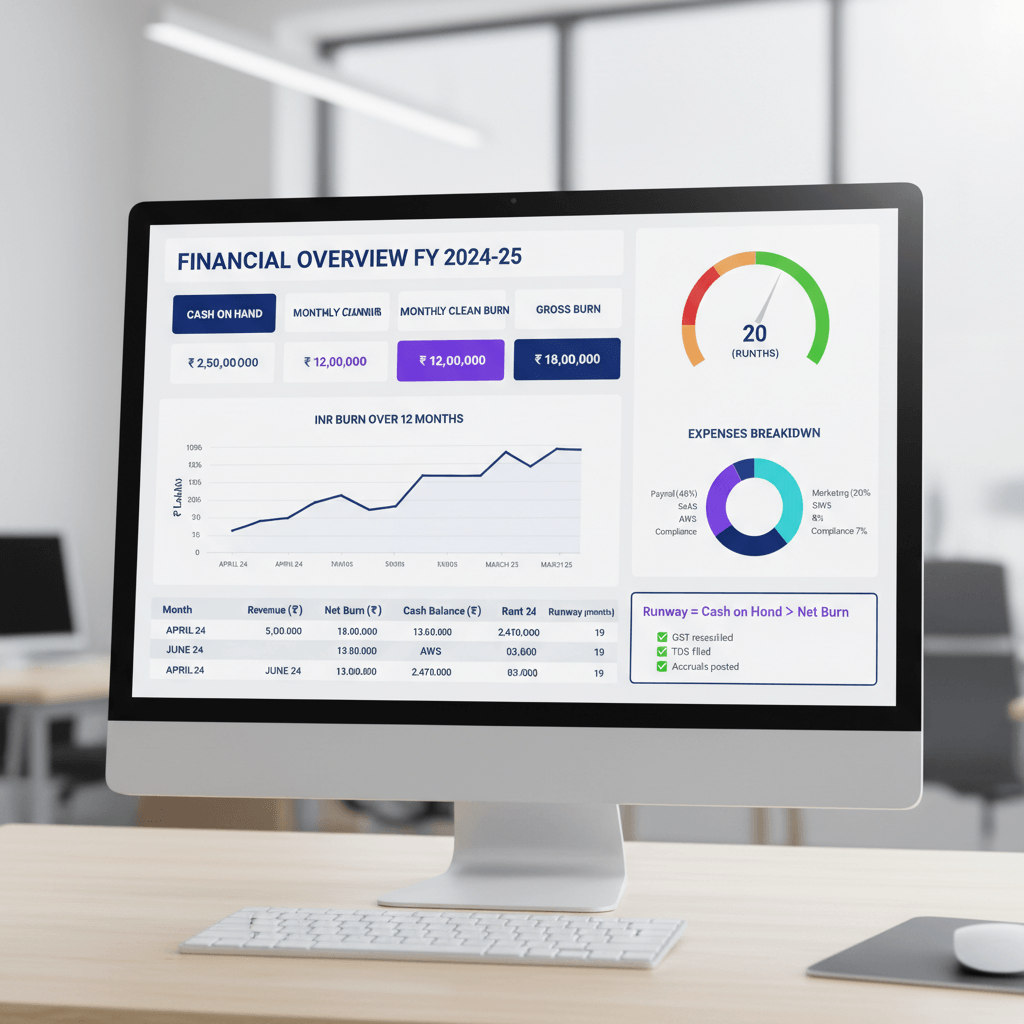
Do weekly cash snapshots, monthly full burn analysis, and runway alerts by zone, green above twelve months, yellow nine to twelve, orange six to nine, red below six. Keep a simple dashboard with gross and net burn, runway trend, cash balance, and burn multiple. For benchmarks and ideas see startup burn rate metrics and this burn guide.
Real Examples, How Indian Startups Track Burn and Runway
Case 1: Early stage B2B SaaS in Bengaluru
P&L showed an eight lakh monthly loss, but collections were lumpy across quarters. Gross burn around twenty six lakh, average collections fifteen lakh, net burn eleven lakh, burn multiple near 0.6 on net new ARR, very healthy once smoothed with a three month average.
Case 2: D2C ecommerce with working capital gaps
P&L loss eighteen lakh, actual cash burn twenty two lakh. Inventory purchases hit cash immediately, EMI settlements landed late, vendor credit shifted payments to the next month. Correct classification revealed the real gap and informed stock and payment terms.
Case 3: Services firm with project based revenue
Collections varied from zero to fifty lakh, while fixed expenses sat near twenty lakh. A six month rolling average, plus a separate pipeline view, showed negative net burn on average and justified a six month gross burn buffer.
For extra context on peer patterns, scan Stripe’s explainer on burn.
Common Mistakes That Inflate or Hide Your True Burn
Mistake 1, Using P&L loss instead of cash burn. Fix, ignore P&L for burn, use only actual cash movements.
Mistake 2, Including fundraising in burn. Fix, exclude equity and debt flows, measure operating efficiency cleanly.
Mistake 3, Missing hidden cash drains. Fix, scan bank lines for CAPEX, EMIs, advance tax, and deposits, tag them separately.
Mistake 4, Double counting GST and TDS. Fix, use base amounts, keep GST and TDS schedules outside operating flows.
Mistake 5, Ignoring settlement delays and fees. Fix, reconcile gateway dashboards to bank by settlement date.
Mistake 6, Forgetting prepayments and accruals. Fix, burn records the full cash when paid, annotate as prepayment.
See these deeper guides for nuance, startup burn rate metrics, what is burn rate, how to calculate burn rate, and a practical burn guide.
Connecting Burn to Your Broader Startup Metrics
Burn threads through your core startup metrics. Burn multiple equals net burn divided by net new ARR, keep it below one if you can. CAC payback shows how long growth investments weigh on burn. Gross margin improvements drop straight to lower net burn. Revenue growth efficiency tells you how fast revenue grows compared to burn. And a clear Zero Cash Date turns runway from a vague count into a real deadline.
For a bird’s eye frame, skim startup burn rate metrics.
Tools and Templates to Track Burn and Runway
Google Sheets structure works great through Series A, an input sheet with date, description, amount, account, inflow or outflow, category and sub category, GST and TDS, one off flag, plus a calc sheet for gross and net burn with rolling averages and a dashboard for cash, burn trend, runway, and burn multiple.
Automation saves time, Zoho Books and Tally exports, or APIs to Sheets, Razorpay and Stripe reporting for settlements, and bank statement parsers. For inspiration, see Digits on burn rate and a roundup of forecasting tools on best forecasting tools for founders.
Recommended stacks by stage:
- DIY, Google Sheets, bank exports, gateway dashboards, a monthly two to three hour process.
- Growing teams, Virtual Accounting by AI Accountant for automated burn tracking with CAs, Zoho Books or Tally for accounting, Sheets automation, and BI if needed.
- Scale ups, enterprise ERPs and FP&A tools, dedicated finance and custom dashboards.
How to Present Burn and Runway to Investors
Lead with a single clarity slide, current net burn, runway months, burn multiple, and cash balance. Show a twelve month burn trend with a three month average line, call out CAC payback, gross margin, and growth efficiency. In the appendix, include a gross burn breakdown, scenario runway table, and a credible path to profitability.
Prepare for questions on why burn is where it is, what drives changes, how fast you can cut, and your burn multiple trend. Be explicit about one offs, and keep definitions consistent across slides. Promise realistic, stepwise efficiency moves.
Setting Up Your Burn Monitoring Rhythm
Weekly, a fifteen minute cash check, balances, expected collections, due payments, quick runway. Post a short update to your team.
Monthly, a two hour review, compute gross and net burn, compare to budget, update rolling averages, refresh runway scenarios, and assign actions.
Quarterly, a planning deep dive, trend analysis, benchmarks, efficiency metrics, updated projections, and a clear funding timeline. Configure alert thresholds by runway months and variance to budget, and define ownership by stage, founder at seed, finance lead at Series A, CFO later.
Burn and Runway, Your Action Plan Starting Today
Today, export three months of bank statements, do a quick net burn using opening cash minus closing cash divided by three, compute runway as current cash divided by monthly burn, if under six months, prioritize this immediately.
This week, set up the template, classify three months, compute gross and net burn, and compare to your quick cut.
This month, automate feeds where possible, publish your first monthly burn report, share it internally, and start your weekly rhythm.
This quarter, refine tagging, connect burn to efficiency metrics, build investor ready charts, and plan targeted improvements.
Perfect can wait, survival cannot. Measure burn now, buy yourself time, and earn the right to build something remarkable.
If you want this running in the background with clean reconciliations and a live dashboard, consider Virtual Accounting by AI Accountant. Or keep it lean in Sheets, just start today.
FAQ
How do I calculate my startup’s burn rate the right way in India?
Use operating cash only. Gross burn equals total operating cash outflows in a month, salaries, rent, vendors, tools, marketing. Net burn equals gross burn minus operating cash inflows, actual collections, excluding GST and after TDS and processing fees. Average over three to six months for decisions. If you want this automated, Virtual Accounting by AI Accountant sets up the tagging and rolling averages for you.
What is the difference between P&L loss and cash burn, and which one do investors care about?
P&L loss follows accruals, cash burn follows money movement. Investors care about cash control and consistency, so they look at net burn, runway months, and burn multiple. For a quick refresher read what is burn rate and then align your reporting to cash.
How should I handle GST and TDS in burn calculations?
Exclude GST from both collections and vendor payments, track it separately as a liability or input credit. Treat TDS as a receivable or credit, not an expense. Record the customer cash as invoice base minus TDS, then reconcile TDS certificates against your tax liability or refund.
My payment gateway shows big sales, but my bank is quiet, what do I count?
Use settlement date and settled amount, after fees, for burn and collection figures. Reconcile Razorpay or Stripe settlement reports to bank credits weekly to avoid counting phantom revenue. Virtual Accounting by AI Accountant can auto pull settlement files and match them to your bank.
How do I compute runway if my collections are lumpy across quarters?
Use a three month or six month average net burn to smooth volatility, then divide current cash by that average. Also create scenario runways, conservative assumes higher costs and lower collections, optimistic includes specific cost cuts or high probability deals.
What is a good burn multiple for an early stage SaaS company?
Under one is excellent, one to one point five is solid, above two means you are burning too much for the growth you are adding. Track it quarterly, net burn divided by net new ARR. If you need help instrumenting ARR movements and burn, Virtual Accounting by AI Accountant can integrate your billing and accounting data.
How do I validate my burn math with my accounting system?
Compare your computed net burn to the cash flow from operations in your accounting cash flow statement. They will not match exactly due to working capital, but large gaps usually mean classification errors, advances, refunds, or timing issues. See a walkthrough here, cash flow, burn, and runway.
What should I show investors on my burn slide during a fundraise?
Lead with four numbers, current net burn, runway months, burn multiple, and cash balance. Add a twelve month burn trend with gross, net, and a three month average line. Include a gross burn breakdown and a scenario runway table in the appendix. Keep definitions consistent and call out one offs.
How can I reduce burn quickly without killing growth?
Target vendor renegotiations, infra optimization, hiring pauses, and non essential tools first. Protect high return channels by watching CAC payback. Model a forty percent cut path that preserves your core roadmap. A service like Virtual Accounting by AI Accountant can quantify savings by category and track post cut impact monthly.
Is negative burn always a good thing?
Negative burn means you are cash generative on average, which is great, but watch timing risk, a services firm can have profitable quarters and still face cash crunches if collections slip. Keep at least three to six months of gross burn as buffer, even when negative on average.
How fast should I act if my runway drops below six months?
Immediately. Trigger your orange or red alert plan, freeze non critical hiring and spend, accelerate collections, and start investor conversations if relevant. Publish a weekly cash update until stability returns. If you want a ready playbook, Virtual Accounting by AI Accountant provides alerting, dashboards, and a standard short runway checklist.
Can I manage all of this in Google Sheets, or do I need software?
You can absolutely start in Sheets, one input tab, one calc tab, one dashboard, and two to three hours a month. As volume grows, automate bank and gateway feeds and reconciliations. If you prefer a done for you option with clean data and CA oversight, use Virtual Accounting by AI Accountant.

Rohan Sinha is a fintech and growth leader building aiaccountant.com, focused on simplifying accounting and compliance for Indian businesses through automation. An IIT BHU alumnus, he brings hands-on experience across 0 to 1 product building, growth, and strategy in B2B SaaS and fintech.