-01%201.svg)
Key takeaways
- A budget control dashboard for expense tracking in India connects Tally, GST, and bank feeds into one live view, giving you real time alerts, tight expense limits, and proactive overspend prevention before cash leaves the bank.
- India specific logic for GST (CGST, SGST, IGST), TDS sections, UPI normalization, and multi entity rollups is non negotiable for accurate department budget tracking and statutory compliance.
- Core features to look for include department budget tracking, expense limit alerts at configurable thresholds, budget utilization reports (MTD, QTD, YTD), overspend notifications with run rate prediction, and drill down analytics with GST and TDS context.
- SMBs that implement a structured seven step playbook (connect, ingest, automate, budget, alert, report, sync) typically see first meaningful reports within five days, replacing weeks of spreadsheet firefighting.
- Without automated budget control, 71% of small businesses lack clear visibility into expenses, leading to month end shocks, compliance gaps, and runway risk that could have been prevented.
- AI Accountant's MIS reporting dashboards deliver native India integrations, automated GST and TDS handling, and real time department wise overspend alerts, solving the exact fragmentation problem that makes manual budget control fail.
Budget Control Dashboard for Indian Expenses: What's New in 2026
Until March 2025, GST e invoicing applied only to businesses with turnover above ₹5 crore. From April 2025, the threshold dropped to ₹1 crore, pulling a significantly larger pool of SMEs into the e invoicing net as per GST portal notifications. For budget dashboards, this means every vendor bill now needs IRP validation before it can count as confirmed spend. Dashboards that do not ingest e invoice data risk showing stale or unverified expense numbers.
The operational shift is tangible. Finance teams now reconcile IRN (Invoice Reference Number) status alongside ledger postings. Bills rejected by the IRP must be flagged before they hit department budgets, otherwise utilization reports overstate actual committed spend. The daily workflow now includes an IRN validation step that did not exist 18 months ago.
This hits SMEs between ₹1 crore and ₹5 crore turnover hardest. These businesses often lack dedicated compliance staff and relied on quarterly manual checks. Now, real time validation is essential. The cost of inaction includes blocked ITC claims, penalties under Section 122 of the CGST Act (up to ₹25,000 per instance), and downstream budget reports that auditors will reject as unreliable. CBIC has also tightened scrutiny on ITC mismatches through automated GSTR-2B reconciliation, making dashboard accuracy a compliance requirement, not just an operational preference.
What to do now:
- Verify your dashboard ingests e invoice IRN data and flags rejected invoices before they enter department budgets
- Update GST reconciliation workflows to match GSTR-2B auto populated data monthly, not quarterly
- Confirm your expense limit alerts account for GST inclusive committed spend post e invoicing
Teams using automated GST reconciliation can absorb these new validation steps without adding manual headcount, keeping budget dashboards accurate as thresholds tighten further.
The Real Problem for Indian SMBs
Fragmented Spend Sources
Your expenses do not live in one place. They are scattered across vendor invoices in Tally, bank and credit card statements, UPI transactions, petty cash registers, reimbursements, and employee advances.
Each source has its own format. Each needs different handling. By the time you consolidate them into a single view, the money is already spent.
Department Blind Spots
Sales runs campaigns. Operations manages logistics. Marketing launches influencer partnerships. Admin handles facilities. IT subscribes to new tools. Yet finance only sees ledger entries.
Without a clear mapping to departments or cost centers, you discover overspend only after a manual export and analysis. This lack of real time expense monitoring is where budget breaches begin.
Month end shocks
Delayed bill posting, late vendor invoices, GST input credit mismatches, and year end adjustments are frequent. Overspend becomes visible only after the books close. By then the damage is done.
Spreadsheets do not scale
Manual exports from Tally seem manageable initially. But they break under real time control needs, multi entity consolidation, and CA or auditor reviews that demand fresh reports.
Research shows that 71% of small businesses lack clear understanding of their expenses, as highlighted in studies on small business expense management for context on the gap.
Surprises at month end are not a bug. They are a system outcome when budgets are invisible during the month.
What a Budget Control Dashboard Should Include
A budget control dashboard expense India is a live spend control layer on top of Tally plus bank feeds. It tracks budgets by department, flags breaches, and surfaces drill downs with GST and TDS context. It is not just another report. It is an active monitoring system that prevents overspend before it happens.
Core components
- Department budget tracking ties cost centers and ledgers to clear allocations. Every transaction (or ledger entry) has a home.
- Expense limit alerts provide early warning when categories, vendors, or departments hit thresholds.
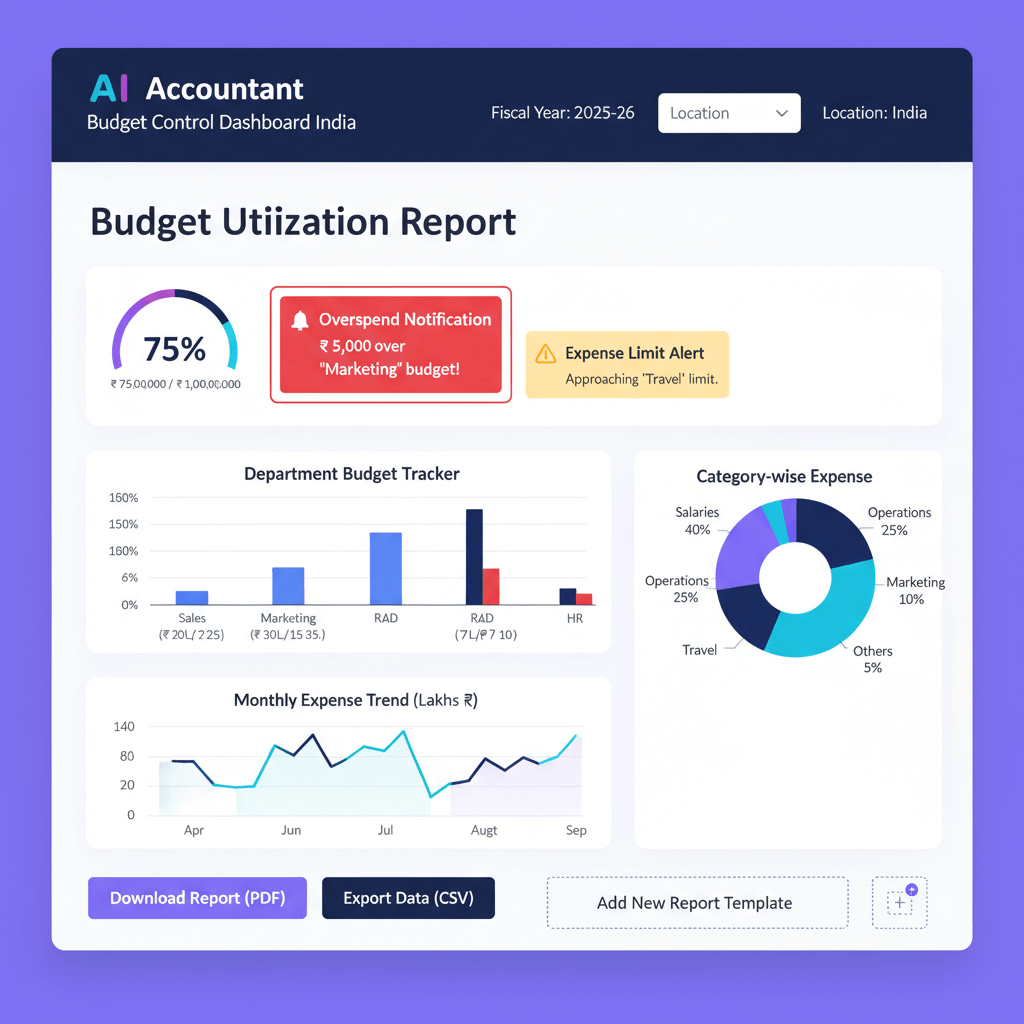
- Budget utilization reports show MTD, QTD, and YTD budget versus actual with variance and trends.
- Overspend notifications catch breaches and predict run rate overshoot. You act before cash leaves the bank.
- Drill down analytics expose highlighted transactions, vendor wise ageing, and tax components, including GST split and TDS deducted.
Department Budget Tracking
Define your structure
In Tally, create cost centers for each department: Sales, Operations, Marketing, Admin, IT, and any other logical divisions. In Zoho Books, use tracking categories or reporting tags to represent departments and locations. The principle is simple. Every expense needs a home.
Map ledgers and vendors
Link frequently used vendors to default departments and ledgers. Your digital marketing agency maps to Marketing. Your logistics partner maps to Operations. Your SaaS tools map to their respective departments.
This mapping reduces classification error, speeds processing, and improves period consistency.
Set budgets
Create monthly or quarterly budgets per department. Split fixed overheads like rent and core salaries from variable spends like campaigns, travel, and raw materials.
Decide carry forward logic upfront. Unused budget may lapse, or carry forward partially. Different departments may need different rules.
Multi entity nuance
For multiple companies, maintain separate department budgets per entity and a group level rollup for consolidation. Your holding company requires visibility across all subsidiaries.
Expense Limit Alerts
Threshold configuration
Set limits by category, vendor, and department. Marketing may cap monthly at five lakhs. Your AWS bill may cap at fifty thousand per month. Travel may trigger alerts at eighty percent of budget.
Configure warning thresholds and hard stops. A warning at seventy percent gives time. A hard stop at one hundred percent prevents overspend.
Alert channels
Route alerts to the right people through the right channels. CFOs and controllers need immediate notification for major breaches. Accountants need daily digests. Department heads need visibility into their own budgets only.
Email suits formal notifications. Slack or Teams works for quick updates. WhatsApp handles urgent alerts.
Alert content
Each alert should include threshold type, amount spent versus limit, and top contributing transactions with links to vendor bills or invoices. Add quick actions like approve exception, freeze vendor, or request clarification.
Context matters. Do not just say Marketing overspent. Show that influencer payouts spiked three hundred percent this week and link the specific invoices.
Make alerts actionable, not just informational.
Budget Utilization Reports
Visual design
Budget versus actual with variance percentages makes comparison instant. Trend lines for the last six to twelve months reveal patterns. MTD, QTD, and YTD views provide time perspective.
Use simple color cues. Green means under budget. Yellow means approaching. Red means overspend. Summaries work at a glance.
Breakdowns
Provide vendor wise and ledger wise splits alongside department and location views. Offer GST inclusive and exclusive views since statutory books reflect gross while decisions rely on net.
Vendor wise helps rate negotiation. Ledger wise ensures proper classification. Department wise drives accountability.
Views for different users
Founders and CFOs need high level budgets, runway impact, and cash flow correlation. Department heads need their budgets and top overspend categories. Auditors need period locked reports with complete audit trails.
Overspend Notifications
Trigger logic
Use two triggers. First, actual breach when spend exceeds budget for the period. Second, run rate breach that predicts overshoot based on current pace.
If a department spends sixty percent of monthly budget by day ten, it will likely overshoot. Do not wait for the breach to alert stakeholders.
Root cause hints
Surface recent spikes automatically. FX charges jumping due to rupee moves. Payment gateway fees rising from higher volumes. Retention bonuses hitting in a single month. SaaS renewals clustering at quarter end.
Compare to prior period averages. A fifty percent travel increase may be seasonal. A two hundred percent spike needs investigation.
India Specific Data Model and Mapping
Department linkage
Tally uses cost centers and cost categories. Zoho uses tracking categories, tags, or custom fields. Map these consistently, document the mapping, and train your team on proper usage.
GST handling
Apply correct GST codes and rates on every expense line. Split input GST into CGST, SGST, and IGST from the base expense. Check input tax credit (ITC) eligibility including blocked credits and reverse charge mechanism (RCM).
Your dashboard must handle gross amounts for cash planning and net amounts for profitability. As per GST Council guidelines, ITC reconciliation against GSTR-2B is now the standard benchmark for compliance.
TDS handling
Apply correct TDS sections and rates at vendor and payment level. Track TDS ledgers separately but link back to department spend.
Professional fees, contractor payments, and rent have different TDS treatments under the Income Tax Act. Incorrect TDS impacts both compliance and cash flow. Your dashboard must flag discrepancies.
Bank, UPI, and card normalization
Indian businesses handle dozens of bank statement formats. Corporate cards add another layer. UPI transactions often lack descriptions.
Standardize formats and auto match to bills and invoices using amount, date, vendor, and UTR references. Then create a single source of truth. The Reserve Bank of India's Account Aggregator framework is making consent based bank data access increasingly viable for real time reconciliation.
Unified treatment of all spend types
Vendor invoices, employee reimbursements, corporate cards, UPI wallets, petty cash, and advances all represent spend. Your dashboard must capture everything. Missing one source creates blind spots that turn into budget breaches.
Implementation Playbook
Step 1, connect accounting systems
Set up bi directional sync with Tally or Zoho Books. Pull in your chart of accounts, cost centers or tracking categories, vendors, and customers. This connection forms the foundation. Everything else builds on top.
Step 2, ingest source documents
Upload bills and bank statements in PDF, JPEG, or CSV. Modern OCR and parsing (sometimes called robotic process automation or RPA) convert messy documents into clean transactions. Do not worry about perfect formats. The system should handle real world documents.
Step 3, Ledger Mapping and Posting Automation
Auto classify transactions to ledgers and departments. Apply GST and TDS rules. Surface exceptions for accountant review.
Automation should handle the majority of transactions. Humans focus on exceptions and edge cases.
Step 4, define departmental budgets
Import existing budgets or define new ones per department and cost center. Configure monthly or quarterly periods. Set carry forward rules. Start conservative. Increases are simpler than reductions.
Step 5, configure expense limit alerts
Set category and department limits. Add vendor specific caps for SaaS, agencies, and logistics partners. Choose alert channels and digest frequency.
Begin with daily digests. Move to real time alerts once the system stabilizes.
Step 6, operationalize budget utilization reports
Schedule weekly CFO and finance reviews. Subscribe stakeholders to relevant reports and overspend notifications. Make dashboard review a ritual. Consistency drives adoption.
Step 7, sync back to Tally or Zoho
Push approved entries and adjustments back to your accounting system. Ensure statutory books remain the system of record. The dashboard enhances your workflow. It does not replace it.
Ongoing Operating Routine
Weekly tasks
Review department budget tracking weekly. Investigate highlighted transactions and new vendors. Clear exception queues including mis mapped ledgers and missing GST.
Small corrections prevent large problems.
Mid month checkpoint
Run variance analysis versus budget mid month. Adjust forecasts based on spending patterns. Flag likely overspend to department heads while there is time to correct.
Re tune alerts if patterns change.
Month end close
Freeze utilization reports for the month. Document variance causes and corrective measures. Reconcile GST, TDS, and bank statements.
Clean closes build confidence and improve future budgeting.
Quarter end planning
Re baseline budgets using trend data. Update thresholds and vendor caps based on learnings. Align group and holding level budgets across entities.
Quarterly reviews balance stability and adaptability.
Real Stories from Indian SMBs
D2C brand marketing overspend
A fast growing D2C brand saw influencer payouts spike three times in a week. COD and gateway fees exceeded budget during an unplanned festive sale.
The dashboard flagged overspend. Marketing rebalanced mid month away from low ROI channels, avoiding a forty percent overshoot.
Services firm travel drift
A consulting firm's travel run rate hit double the plan mid month. The CFO capped per trip spends and negotiated hotel rates with preferred vendors. This saved six lakhs that quarter and established discipline.
Manufacturing SME raw material shock
Utilization reports exposed raw material price increases versus contracts and rising FX charges. Finance renegotiated supplier contracts and hedged FX for the next quarter, turning a crisis into controlled planning.
Key Metrics to Monitor
- Budget versus actual by department with variance percentage and three to six month trends.
- Top overspend categories and vendors, plus run rate projections.
- Cash flow trends versus expense commitments, and impact on DPO (Days Payable Outstanding), DSO (Days Sales Outstanding), and collection cycles.
- Operating runway from OPEX at current burn. Know exactly how long cash will last.
Build vs Buy Decision Matrix
Setup speed: Spreadsheets and Tally exports are slow and manual. Integrated India specific systems deliver faster go live with connectors.
Flexibility: Spreadsheets are flexible but fragile. Products are configurable within proven guardrails.
Alerts: Spreadsheets lack real time capability. Integrated systems offer native expense limit alerts and overspend notifications.
Data quality: Manual formulas and mappings are error prone. Automated mapping with exception queues improves quality.
Compliance: Manual GST and TDS handling lacks audit trails. Built in logic, audit logs, and role based access protect compliance. The ICAI increasingly emphasizes technology adoption in audit and assurance standards, reinforcing the need for system generated trails.
Scale and multi entity: Maintaining spreadsheets across entities is hard. Integrated systems are designed for rollups.
Once you cross one hundred transactions a month or two entities, buying typically beats building.
Vendor Evaluation Checklist
India stack compatibility
Does the solution integrate with Tally and Zoho Books? Does it handle GST, TDS, and e invoicing requirements out of the box, without fragile workarounds?
Core feature assessment
Confirm department budget tracking tied to cost centers. Look for configurable expense limit alerts, drillable utilization reports with exports, and overspend notifications with workflow support.
Security and compliance
Look for ISO 27001, SOC 2 Type 2, India data residency options, role based access, SSO, and audit logs. Financial data demands enterprise grade security.
Multi entity and CA firm capabilities
Evaluate group rollups across companies and multi org workspaces suitable for CA firms managing multiple clients.
Support and implementation
Assess typical go live timelines, historical data migration help, and training for finance teams and department heads.
Recommended Tools for Budget Control
- AI Accountant, purpose built for Indian SMBs with native Tally integration, automated GST and TDS handling, real time budget tracking dashboards, and normalization for Indian bank formats, plus instant department wise overspend alerts.
- QuickBooks, global accounting with basic budgets, requires customization for Indian GST and lacks deep Tally integration.
- Xero, cloud accounting with expense capabilities, workable for simple budgets, needs add ons for India specifics.
- FreshBooks, user friendly with project budgets, limited cost center capabilities and no native Indian bank parsing.
- Zoho Expense, integrates with Zoho Books for reimbursements, but lacks comprehensive department budget control dashboards.
- Tally Prime, strong for compliance, requires customization for real time budget monitoring and automated bank reconciliation.
Common Pitfalls and Solutions
Weak ledger to department mapping
Poor mapping undermines everything. Run a one time mapping exercise. Lock mappings. Route unmapped entries into a review queue.
Clean mapping is foundational.
Ignoring committed spend
Budgets often miss committed but not invoiced spend. Include purchase orders, annual SaaS, and retainers in utilization logic. Track committed and invoiced amounts separately.
Not separating GST components
Mixing base expense with GST confuses analysis. Always separate base from GST components. Provide gross views for cash planning and net views for P and L analysis.
Alert fatigue
Too many alerts create noise. Set minimum thresholds. Prefer aggregated digests. Escalate only repeated or major breaches to the CFO.
How AI Accountant Enables Budget Control
Automated ingestion
AI Accountant parses bills, bank statements, and supporting documents automatically. It maps them to ledgers and departments with AI trained on Indian formats. Manual data entry disappears. Accuracy improves.
Real time dashboards
Instant utilization reports, department budget views, and highlighted risk transactions update as new data arrives. No more waiting for exports.
Configurable alerts
Set custom thresholds for expense limit alerts and overspend notifications. Route via workflows and approval queues. The right person gets the right alert at the right time.
Clean statutory books
Approved postings sync back to Tally or Zoho. GST and TDS, vendor ageing, and customer ageing align with compliance. Statutory books stay the source of truth.
Enterprise security
ISO 27001 and SOC 2 Type 2 certified. Encryption in transit and at rest. Audit trails for budget and alert configuration changes. Security is built in.
Future Proofing Your Budget Control
Account Aggregator Feeds
Direct, consent based bank feeds from dozens of Indian banks will eliminate CSV uploads. Real time transaction flow enables instant budget updates.
Predictive cash flow
Machine learning will forecast working capital needs and likely overspend by department and vendor using historical trends. Prevention beats correction.
Multi entity rollups
Group level dashboards for holding companies and CA firms managing multiple organizations will become standard. Consolidated views drive better decisions.
Take Control of Your Spending Today
If you want to see how a budget control dashboard expense India works with your own Tally data, request a short live walkthrough. We also offer a free checklist for setting up department budget tracking and expense limit alerts tailored to Indian SMB workflows.
Stop discovering overspend after month end. Start preventing it in real time.
The difference between companies that scale and those that struggle often comes down to spend control. A proper dashboard transforms expense management from reactive firefighting to proactive planning.
Every day without proper budget control risks overspend. Every month end surprise could have been prevented. Every department operating without clear budgets is a risk to your runway.
FAQ
As a CA, how should I structure departments when the client's chart only has ledgers in Tally
Group related ledgers into logical departments such as Sales, Marketing, Operations, Admin, and IT. In Tally, create cost centers and cost categories mapped one to one with those groups. Validate with last quarter's spend, then lock the mapping. This structured approach ensures every transaction is traceable to a department for budget versus actual reporting.
How do I configure vendor specific expense limit alerts tied to POs or contracts
Set department level budgets first, then add vendor caps aligned to PO or contract values. Configure warning thresholds at seventy percent and hard stops at one hundred percent of the commitment. Attach PO references, monitor committed versus invoiced amounts, and trigger alerts when either approaches the limit.
What is the recommended approach to handle GST inclusive versus exclusive budgets in a dashboard for Indian clients
Maintain both views simultaneously. Use GST exclusive for operating decisions and profitability analysis, and GST inclusive for cash planning and liquidity. The dashboard should toggle between the two, with CGST, SGST, and IGST separated from base expense lines. Post the April 2025 e invoicing threshold reduction, ensure IRN validated amounts flow into both views for accuracy (2026 update).
How can I reduce alert fatigue for finance teams while keeping strong budget control
Introduce minimum thresholds and aggregate low value alerts into a daily digest. Escalate only repeated or high severity breaches to CFOs. Define quiet periods around known high spend events like campaigns or quarter end SaaS renewals. Role based digests ensure controllers see detail while CFOs get only strategic exceptions.
What workflow do you recommend mid month to prevent month end shocks in Indian SMBs
Run a mid month variance review by department comparing run rate versus budget. Adjust forecasts, communicate likely overspend early to department heads, and re tune thresholds if patterns change. This single checkpoint, taking roughly one to two hours, prevents most month end surprises for SMBs processing under five hundred transactions monthly.
What is the typical implementation timeline to get first budget utilization reports for a new client
Three to five days for initial connection and first meaningful reports. Full setup including department budgets, alerts, workflows, and sync back to statutory books typically takes two to three weeks. Pre built connectors and India specific templates (Tally chart of accounts, GST and TDS rules) accelerate the process significantly.
How do I ensure TDS logic is correctly applied across professional fees, contractors, and rent within department budgets
Define vendor categories with TDS sections (194J, 194C, 194I, etc.) and applicable rates, then link those to ledgers and departments. Track TDS ledgers separately but report spend both net and gross to show cash and P and L impact. Validate postings during ingestion and flag rate mismatches or missing TDS deductions for review before payment.

A results-driven finance and sales professional with hands-on experience through finance internships and a fast-paced sales role. With a strong interest in accounting and business finance, Harsh focuses on turning complex topics into clear, practical takeaways for founders and finance teams.