-01%201.svg)
Key takeaways
- Advance expense management India
- Automate OCR bill capture, intelligent matching, and a robust advance recovery system, then tie it to payroll for dependable deductions.
- Pick India-specific capabilities, including GST auto-calculation, TDS flags, and deep Tally or Zoho sync, see ledger mapping automation for Tally and Zoho.
- Chase outcomes, not features: <5 average settlement days, >70% auto-settled, and -30% QoQ drop in outstanding advances.
- AI Accountant
Understanding Advance Expense Management in the Indian Context
Advance expense management India
Common triggers include travel bookings, project floats, petty cash for on-site work, and urgent vendor prepayments. Many SMBs lack real-time visibility, which inflates spend and compliance risk, therefore a unified process and system is essential.
Employee advances differ from vendor prepayments, which hit different ledgers, and salary advances that follow payroll rules, all three require audit-ready trails. For definitions and context, use the expense advance glossary, and benchmark your policies against small business expense management 2025.
When advances are managed as a lifecycle, not a spreadsheet, finance gains control, compliance strengthens, and month-end stops feeling like a fire drill.
Core Challenges Plaguing Indian Finance Teams
The Visibility Problem
Fragmented tracking across WhatsApp and spreadsheets creates blind spots. Pending settlements drift, suspense ledger balances grow, and reconciliation becomes guesswork. Ageing advances in suspense accounts multiply audit risk.
Manual Settlement Matching Chaos
Without intelligent matching, partial settlements, carry-forwards, and policy checks are painful. Teams chase bills, amounts do not align, and month-end is a scramble. A robust advance recovery system reduces chasing and enforces discipline automatically.
Tally and Zoho Integration Gaps
Unreconciled entries pile in suspense ledgers, journal vouchers need manual fixes, and ageing reports lag reality. GST or TDS mismatches grow, while operational records and books disagree. Study SMB expense management, and the basics in what is expense management software, then evaluate your ledger flow with the advance glossary.
Must-Have Capabilities for Advance Expense Management India
Employee Advance Tracking
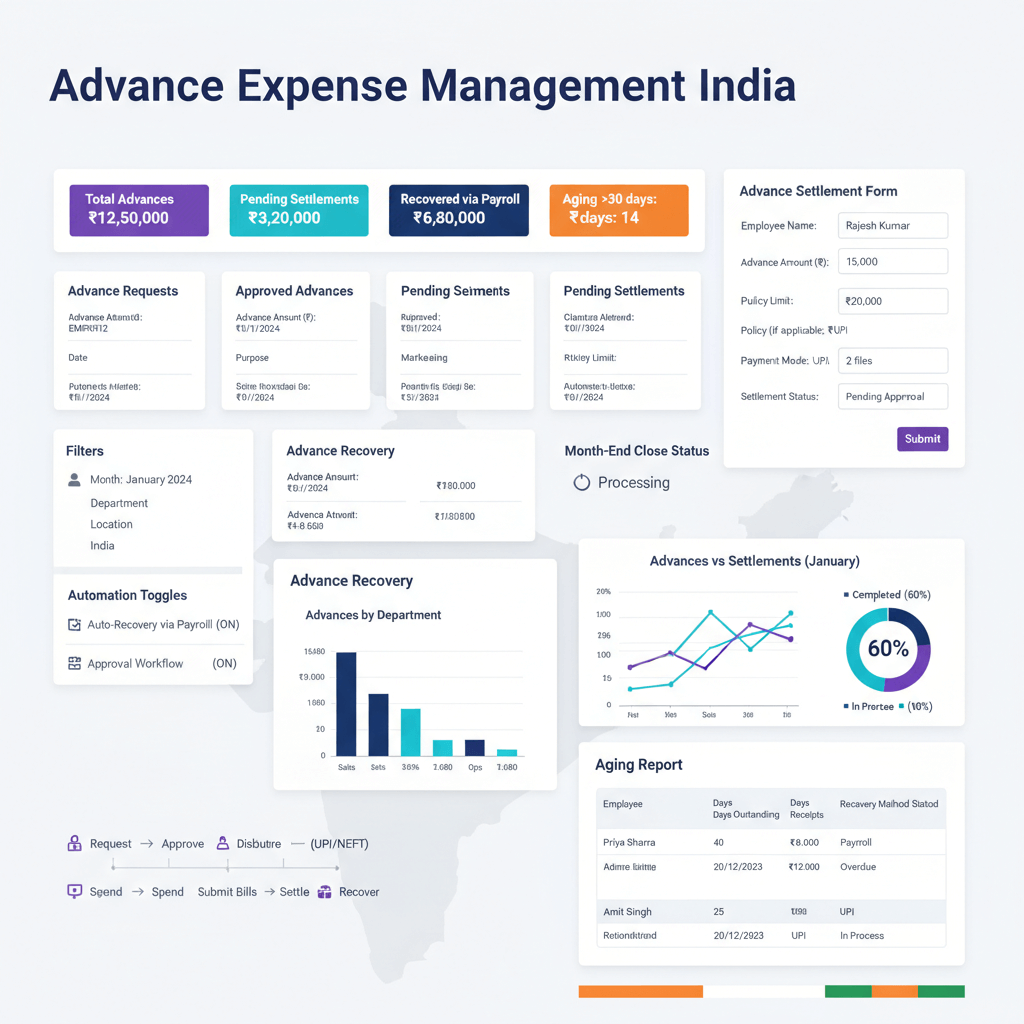
Capture requests, approvals, disbursements, and utilization in real time, track by employee, project, department, and purpose. Standardized forms, automated approvals based on thresholds, and notifications create clarity, and accountability.
Advance Settlement Automation
Auto-match bills and transactions to advances with OCR that reads PDFs, receipts, and even WhatsApp forwards. Handle partial settlements, excess amounts, and carry-forwards, without manual work.
Pending Advance Reports
Get real-time ageing analysis by employee, project, and entity, flag long-outstanding amounts, missing bills, and policy violations. Visualize utilization, settlement trends, and recovery rates, then adjust policies to change behavior.
Advance Recovery System
Automated reminders at preset intervals keep advances moving. Configure escalation rules, payroll recovery triggers, and write-off controls. The advance recovery system should integrate with payroll, enabling deductions when deadlines pass.
India-Specific Compliance Features
Auto-calculate GST by category, validate e-invoices, flag TDS, and generate audit trails. Seek bi-directional Tally and Zoho sync that posts to the right ledgers, see ledger mapping automation for Tally and Zoho, and ensure multi-entity support with ISO 27001 or SOC 2 Type 2. For landscape overviews, see SMB expense management 2025, expense management software basics, and the advance glossary.
Recommended Workflow Design for Indian Teams
Step 1: Request and Approval
Use standardized forms capturing purpose, amount, duration, and project codes. Approvals should follow hierarchies with amount caps, for example, amounts under ₹40,000 need only a manager sign-off. Policy checks run automatically and flag violations instantly.
Step 2: Disbursement
Disburse through UPI, NEFT, corporate cards, or cash, and tag each payment to the correct advance ledger. Record transaction IDs, dates, and modes for downstream reconciliation.
Step 3: Utilization Tracking
Enable bill uploads via mobile apps, email, or WhatsApp, OCR extracts data automatically. Validate bills against advance amounts, categories, and policy rules, exceptions are flagged for review.
Step 4: Settlement Processing
Auto-match uploaded bills to the right advance, handle partials, excess claims, and carry-forwards. Generate settlement vouchers ready for Tally or Zoho posting.
Step 5: Recovery Management
Schedule reminders at 7, 14, and 30 days, escalate to managers and HR for defaulters. Trigger payroll deductions when grace periods pass, and let exception workflows handle special cases.
Step 6: Audit Trail Maintenance
Maintain immutable logs of transactions, approvals, and modifications. Store attachments, emails, and settlement documents centrally, generate compliance reports for GST, TDS, and policy adherence, see SMB expense management 2025, advance glossary, and software basics.
Design for the lifecycle, not the task, the right workflow turns settlement chaos into a predictable close.
Building Your Reporting and Control Tower
Pending Advance Reports
Dashboards show status by employee, project, and entity, with ageing buckets 0-15, 16-30, 31-60, and >60 days. Track utilization, settlement patterns, and recovery metrics, then target interventions with precision.
Exception Management Dashboards
Flag long-outstanding advances, missing bills, duplicates, or suspicious transactions. Create alerts for upcoming deadlines to prevent end-of-month fire drills.
Month-End Checklists
Standardize checks for unreconciled advances, GST or TDS validation, and suspense account clearances. Automate report packs for management with trends, recovery rates, and policy violations.
Key Performance Indicators
| KPI | Target for SMBs | Benefit |
|---|---|---|
| Average Settlement Days | <5 | Faster closes by 2-3 days |
| Percentage Auto-Settled | >70% | 70% cost reduction |
| Outstanding Value Trend | -30% QoQ | Better cash flow |
Monitor monthly, teams hitting these targets often report 75% time savings. For context and tooling choices, review SMB expense management 2025 and software primers.
Tool Recommendations for Advance Expense Management India
Leading Solutions for Indian SMBs
1. AI Accountant
OCR captures bills in any format, then validates and links to advances, the Transaction module maps Indian bank lines to entries, and deep Tally or Zoho integration auto-tags GST or TDS. Dashboards track pending advances, utilization, and cash impact, the AP or AR module manages vendor and employee advances with DPO or DRO metrics, and upcoming features include Account Aggregator feeds and AI flags for unreconciled advances.
2. Zoho Expense
Affordable, mobile OCR is strong, and it integrates with Zoho Books. Multi-entity support is limited, and TDS flagging may require manual intervention.
3. Fyle
UPI integration speeds disbursements, mobile-first suits field teams. Tally integration depth is shallow, vendor advances stay siloed from employee flows.
4. Happay
Corporate card programs plus a strong policy engine. Pricing can be steep for smaller SMBs, Indian compliance needs extra configuration.
5. ExpenseIn
Easy interface and quick implementation, basic OCR and approvals work for starters, but recovery features and deep accounting integrations are limited.
Comparison Framework
| Option | Pros | Cons | India Example |
|---|---|---|---|
| Spreadsheets, Tally | Free, familiar | Manual errors, no ageing reports | GST mismatches on advances |
| Native Tally | Ledger-native | Weak automation, limited recovery | Project floats untracked |
| Zoho Expense | Affordable, mobile OCR | Limited multi-entity | TDS flags manual |
| Fyle, Happay | UPI-fast, real-time visibility | Integration shallow | Vendor advances siloed |
| AI Accountant | Deep Tally or Zoho sync, GST auto, recovery built-in | Newer entrant | Auto-matches travel advances at scale |
Evaluate compliance features, automation depth, integration quality, and pricing, typically ₹300-600 per user per month delivers 6-12x ROI. For market overviews, see SMB expense trends and software fundamentals.
Implementation Playbook for 14-Day Rollout
Days 1-3: Foundation Setup
Map policies, approvals, amount limits, and settlement timelines. Document expense categories, GST rates, and TDS applicability, configure Tally or Zoho ledgers for advance tracking, create suspense and recovery accounts, and settlement voucher templates.
Days 4-7: Team Onboarding
Train employees to request advances, upload bills, and settle on time. Pilot with one team or project, configure approval workflows to match hierarchy, test disbursement methods, and validate integration points end to end.
Days 8-14: Testing and Optimization
Run full lifecycle tests, measure ageing reduction and auto-settlement rates, target 30% reduction in aged advances and 70% auto-settled. Fine-tune workflows based on feedback, document SOPs, and create quick reference guides for common scenarios.
For playbook ideas, skim SMB expense management 2025 and expense management software basics.
Handling Edge Cases in Indian Operations
Cash and Per Diem Advances
Track cash advances with OCR receipt capture, set UPI limits aligned to policies, configure per diem by city tiers, and automate duration-based calculations.
Foreign Travel and Currency Management
Support multi-currency advances with real-time exchange rates, compute GST correctly on foreign expenses, manage carry-forwards between trips, and track forex gains or losses in entries.
Inter-Company Advances
Enable entity-level tracking with holdco consolidation, support cross-entity settlement and recovery, keep separate books while providing unified management views.
Partial Settlements and Write-offs
Automate logic for partial settlements and thresholds for write-offs, integrate payroll splits for gradual recovery, and define exception paths for special cases.
Salary Versus Expense Advances
Maintain distinct recovery rules, salary advances follow payroll cycles, expense advances need immediate settlement, track separately for compliance and audit trails. See SMB expense management 2025 and the expense advance glossary.
Security, Compliance, and Audit Readiness
Data Protection Standards
Ensure ISO 27001 and SOC 2 Type 2 certifications, configure role-based access, and approval hierarchies to prevent unauthorized changes.
Compliance Documentation
Maintain immutable logs of all transactions, store bills, approvals, and settlement records, generate audit trails for GST or TDS with e-invoice validation for vendor payments.
Regular Compliance Checks
Run monthly reviews of advance ageing and recoveries, validate GST returns against settlements, cross-verify TDS deductions with disbursements, and confirm advances reflect correctly in financial statements, reference SMB expense management 2025 for checklists.
Practical Resources and Templates
Advance Request Form Template
- Employee details and cost center
- Advance purpose and project code
- Estimated amount with breakdowns
- Expected settlement date
- Manager approval section
Settlement Checklist
- Bill validation against advance amount
- GST rate verification
- Expense category mapping
- Supporting document attachment
- Approval trail completion
Reminder Schedule Framework
- Day 7, gentle email reminder
- Day 14, manager copied on reminder
- Day 30, HR escalation for recovery
- Day 45, payroll deduction trigger
Sample Pending Advance Report
| Employee | Amount | Date | Ageing Bucket | Status |
|---|---|---|---|---|
| A. Sharma | ₹25,000 | 15-Dec | 0-15 days | Bill pending |
| B. Patel | ₹10,000 | 01-Dec | 15-30 days | Reminder sent |
| C. Kumar | ₹50,000 | 15-Nov | 31-60 days | Under review |
| D. Singh | ₹5,000 | 01-Nov | >60 days | Recovery initiated |
Use these buckets to prioritize follow-ups and accelerate settlements.
Moving Forward with Better Advance Management
Advance expense management India
Assess readiness, document policies, map pain points, and identify quick wins, share ledgers and workflows with solution providers for tailored demos. Target outcomes, 30% ageing reduction, 70% auto-settlement, and two-day faster closes, these are achievable with structured rollout.
Every delay leaks spend, increases audit exposure, and drains productivity. Schedule a demo aligned to your Tally workflows, test with real advances, measure month-end impact, then iterate. The path to efficient management starts with understanding what is possible, then taking the first step today.
Frequently Asked Questions
How should a CA configure advance ledgers and suspense clearing in Tally for employee advances?
Create dedicated employee advance ledgers mapped to current assets, route disbursements through these ledgers, and use settlement vouchers to move amounts to the right expense heads. Keep a separate suspense account for exceptions, then clear with audit trails. An AI Accountant workflow can auto-create vouchers and post GST or TDS tags consistently.
What is the correct GST treatment for advances against travel or project floats in India?
GST depends on the underlying expense category, not the advance itself. When bills are uploaded, apply category-specific GST, for example, 5% for certain transport, higher for hotels. Systems like AI Accountant auto-categorize and compute GST during settlement, preserving a clean audit trail.
How do I design an advance recovery system that integrates with payroll?
Set reminder cadences at 7, 14, and 30 days, escalate to managers, then trigger payroll deductions at day 45. Configure percentage-based recovery, for example, 20% of salary until cleared. AI Accountant supports policy-driven recovery and can push deductions into payroll files.
What controls help prevent duplicate or fraudulent bill settlements against advances?
Use OCR with de-duplication, vendor GSTIN validation, and amount or date variance checks. Flag suspicious patterns in dashboards, then enforce second-level approvals for exceptions. Tools like AI Accountant run AI-driven anomaly detection and block duplicates proactively.
How can CA firms manage multi-entity advances while maintaining separate books?
Operate entity-level ledgers and workflows, enable cross-entity settlement and recovery, then provide consolidated holdco views for management. AI Accountant supports multi-entity separation with unified reporting, easing audits across entities.
What ageing buckets and KPIs should we track for advances to ensure timely closure?
Use 0-15, 16-30, 31-60, and >60 days buckets, then track average settlement days, percentage auto-settled, and outstanding trend. Aim for <5 days average, >70% auto-settlement, and -30% QoQ outstanding. Dashboards in AI Accountant visualize these KPIs for weekly reviews.
Which integration pitfalls should we test when syncing advances to Zoho or Tally?
Validate ledger mapping, GST or TDS tagging, and bi-directional posting of settlement vouchers. Test partial settlements, carry-forwards, and write-offs. Review the ledger mapping automation for Tally and Zoho approach, then pilot with real entries before go-live.
How do we handle missing bills or policy breaches without slowing month-end?
Centralize exceptions in dashboards, block new advance requests for users with overdue settlements, and enable override approvals for genuine cases. OCR-driven policy checks in AI Accountant reject non-compliant bills and prompt corrective actions automatically.
What is the recommended workflow for partial settlements and carry-forwards?
Match available bills to the advance, record partials, then carry-forward the remaining amount with a revised deadline. Auto-generate settlement vouchers for each tranche, so the ledger stays tidy. AI Accountant automates partials and tracks carry-forwards until closure.
How should salary advances be separated from expense advances for compliance?
Maintain distinct ledgers and recovery rules, salary advances align to payroll cycles, expense advances require immediate bill-based settlement. Reporting should segregate both for audits, AI Accountant keeps flows separate with tailored policies.
Can we map bank statement lines directly to advance entries for faster reconciliation?
Yes, map transaction IDs and narratives to the originating advance, then auto-link disbursements with OCR or bank feeds. AI Accountant reads Indian bank formats and ties lines to advances, reducing manual reconciliation work.
What training and change management steps help teams adopt structured advance workflows?
Start with pilot teams, publish SOPs, run short training for requests, uploads, and settlements, and set visible KPIs. Use gentle reminders first, then escalate. Feature champions and simple cheat sheets accelerate adoption, AI Accountant provides in-app guidance and reporting to sustain discipline.

A results-driven finance and sales professional with hands-on experience through finance internships and a fast-paced sales role. With a strong interest in accounting and business finance, Harsh focuses on turning complex topics into clear, practical takeaways for founders and finance teams.