-01%201.svg)
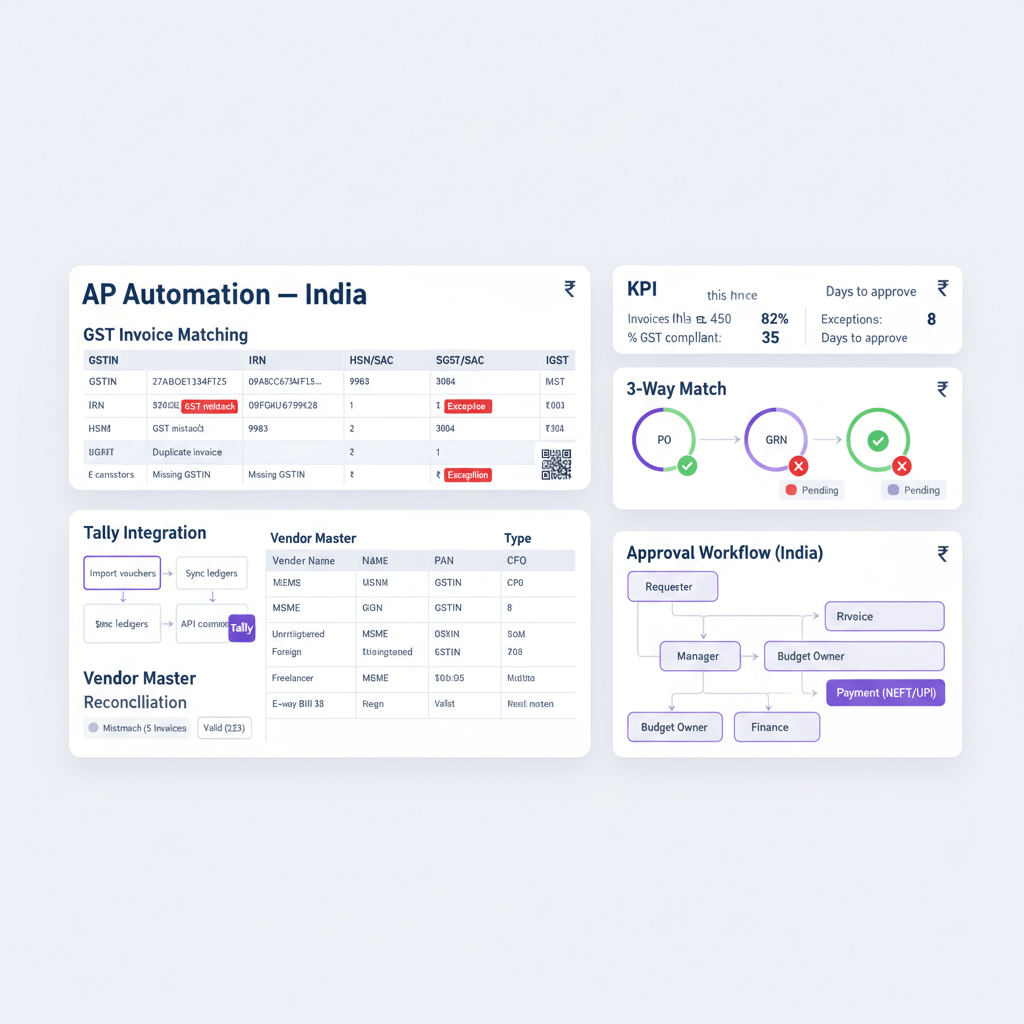
Key takeaways
- Despite tool adoption, 68% of finance teams still process most invoices manually, the root cause is failed implementation across technology, process, and people.
- Legacy systems like Tally, inconsistent vendor data, and exception heavy workflows keep Indian AP stuck in manual mode.
- Standardization and data cleanup, not software alone, drive straight through processing and faster month ends.
- Design for exceptions from day one, advances, partials, credit notes, and GST mismatches are routine, not rare.
- Measure outcomes with clear KPIs, invoice cycle time, exception resolution time, STP rate, and month end closure days.
- Start small, pilot, then scale, and treat AP automation as ongoing change management, not a one time install.
Understanding the AP Automation Paradox
Most AP teams in India have purchased tools, yet manual entry remains the norm. Globally, 77% of departments use some invoice automation, still 68% process most invoices by hand. Meanwhile, 88% of finance leaders report heavy pain from manual workflows. The paradox stems from a common mistake, treating automation as a software buy rather than a business transformation.
Automation amplifies whatever you feed it, standardized processes become efficiently standardized, chaos becomes efficiently chaotic.
In India, real world AP is messy, scanned PDFs in mixed formats, bilingual invoices, advances and adjustments, TDS and GST reconciliation, multi entity approvals, and vendor data inconsistencies. Without reengineering processes and data, tools struggle and teams slip back to manual work.
Why AP Automation Projects Fail, The Three Layer Problem
Technology layer failures
Legacy accounting platforms were not built for real time APIs or flexible data models. When automation pushes into systems without robust mapping, vendor codes drift, invoice numbers collide, and tax logic diverges. The result is manual workarounds that defeat the promise of automation.
- OCR tuned for uniform templates fails on vernacular and low quality scans.
- Batch only updates delay posting and reconciliation.
- Brittle integrations and thin API documentation break under edge cases.
- No row level error reporting, teams chase blind exceptions.
Process layer failures
Forty one percent of companies lack enterprise wide automation approaches, another twenty two percent lack a clear vision. Ad hoc approvals via email or WhatsApp, inconsistent vendor masters, undocumented exception handling, and manual payment to bill matching mean you automate chaos.
Organizational layer failures
Change management often lags. Teams get minimal training, vendors are not onboarded, and ownership is unclear. Month end pressure competes with implementation tasks, so projects stall. People risks outweigh tool features.
India Specific AP Automation Challenges
GST compliance complexities
GSTR 2B matching, TDS, and e invoicing require validation and reconciliation, not just data capture. Tools must import government data, reconcile purchase registers, track credit notes, and handle GSTIN changes. Regulations evolve, so workflows must adapt without breaking.
Vendor ecosystem diversity
Suppliers range from digital first enterprises to small traders who send handwritten bills. Your solution must accept PDFs, Excel files, scans, and smartphone photos, understand bilingual descriptions, and respect informal terms and advance settlements.
Multi entity operations
Different entities often have distinct charts of accounts, approval hierarchies, compliance needs, and banks. Without true multi org support and role based access, teams create silos and parallel processes.
Integration with Indian accounting systems
Tally and Zoho Books dominate Indian SMBs, and integration depth determines success. For a practical perspective, see the Tally integration AP automation guide. Common hurdles include limited real time APIs, rigid masters, custom fields that do not map, and version specific differences, which cause sync breaks and duplicate records.
Common AP Automation Mistakes to Avoid
Rushing implementation without preparation
Skipping standardization and data cleanup is the fastest path to failure. Document approvals, define exception playbooks, and clean vendor masters before you touch configuration. Plan for at least four to eight weeks with time for testing and training.
Ignoring exception handling
Exceptions are daily reality in India. Design processes for advances, partials, non PO invoices, debit or credit notes, and GST mismatches from day one. For deeper guidance, review exception handling in automated AP workflows.
Underestimating change management
Automation changes roles and habits. Involve the accounts team early, define ownership, set realistic goals, onboard vendors with simple instructions and templates, and communicate that automation removes drudgery, not jobs.
Choosing OCR only solutions
Text extraction alone is insufficient. You need context aware capture, master matching, tax validation, and ledger prediction. Otherwise, the exception queue becomes your real process.
Building a Successful AP Automation Strategy
Start with process standardization
Create submission templates, approval matrices, and exception playbooks. Baseline your current state, volumes by vendor and format, bottlenecks, and peak periods. A few weeks of groundwork prevents months of rework.
Focus on data quality and master data management
Clean vendor masters are the foundation. Standardize names, GSTINs, and addresses, define ledgers and categories, and set governance for who can add or change records. For a walkthrough, see vendor master data management.
Design comprehensive workflows
Cover ingestion, validation, approvals, payment, and reconciliation. Build multi level approvals by amount and category, define escalation paths, set vendor query handling, and enable three way matching. Keep audit trails for accountability at month end.
Plan phased implementation
Pilot with one entity or category, learn, refine, and expand. A practical cadence is two weeks for standardization, two weeks for ingestion and validation, two weeks for approvals, two weeks for payment and reconciliation. This protects continuity and builds confidence.
Essential Features for AP Automation in India
Multi format invoice processing
Support PDFs, Excel, scans, and photos with bulk ingestion. Prefer row level error reporting for rapid exception clearance. Use intelligent extraction that recognizes advances, partials, and credit notes.
GST reconciliation capabilities
Import GSTR 2B, match against purchases, flag reasons for variance, track status, and generate compliance reports. Without native GST reconciliation, teams end up juggling multiple tools.
Vendor master management
Require GSTIN validation, duplicate detection, mismatch alerts, bulk uploads with checks, and a portal for supplier updates. The system should recognize common name variations and map to a single vendor record.
Integration capabilities
Choose tools with deep, prebuilt connectors to Tally and Zoho Books. Demand bi directional master sync, clean field mapping for posting, payment status pull, and graceful error handling to preserve referential integrity.
Measuring AP Automation Success
Key performance indicators
- Straight through processing rate, target eighty to ninety percent for clean invoices.
- Invoice cycle time, from receipt to posting.
- Exception resolution time, average hours to clear non standard cases.
- Vendor master accuracy, mismatch and duplicate rates after cleanup.
- Month end close time, days reduced versus baseline.
- Payment accuracy and on time percentage.
- Compliance readiness, GST reconciliation completion rate.
ROI calculation methods
Include time savings, error reduction and penalty avoidance, early payment discounts, audit effort reduction, working capital gains from better cash visibility, and productivity lift when staff shifts from data entry to analysis. Many Indian SMBs see payback in six to eight months with disciplined implementation.
Continuous improvement strategies
Review exceptions monthly, fix root causes, update vendor templates, tweak approvals to remove bottlenecks, expand scope, and retrain users on new capabilities. Create feedback loops with suppliers to increase first time right submissions.
Choosing the Right AP Automation Tool
Evaluation criteria checklist
- Multi format ingestion with bulk processing and row level errors.
- GST reconciliation that ties to GSTR 2B and purchase registers.
- Prebuilt Tally and Zoho Books integrations with deep mapping.
- Exception handling workflows with escalation and audit trails.
- Vendor master matching and duplicate prevention.
- Multi entity support with role based access and segregation.
- Security credentials such as ISO 27001 and SOC 2 Type II.
- Real time dashboards for payables and cash position, plus mobile approvals.
Top AP automation solutions for Indian businesses
- AI Accountant, purpose built for India with native Tally and Zoho Books connectors, comprehensive GST reconciliation, multi entity support, and ISO 27001 and SOC 2 Type II safeguards.
- SAP Concur, strong enterprise workflows and integrations, typically larger implementation effort.
- Zoho Expense, fits the Zoho ecosystem, better for simpler vendor bills.
- ClearTax, strong on GST and e invoicing, expanding AP capabilities.
- Tally Prime with automation add ons, depends on provider depth and support.
Implementation partner versus self service
Use partners when volumes exceed one thousand invoices per month, when entities or approvals are complex, or when IT bandwidth is limited and timelines are tight. For many SMBs handling five hundred to two thousand invoices per month, a self service tool with robust support and prebuilt integrations strikes the right balance.
Future of AP Automation in India
Emerging technologies and trends
AI now predicts ledger mappings, flags duplicate invoices pre posting, highlights anomalous vendor behavior, optimizes payment timing, and auto categorizes expenses. As e invoicing expands, formats standardize, simplifying ingestion while the transition period remains hybrid.
Preparing for digital transformation
Adopt supplier portals, move approvals from email and messaging apps to structured workflows, establish data governance, and train teams for analytical work. Treat automation as an ongoing program with quarterly improvements.
Building scalable AP processes
Design for ten times growth, choose cloud infrastructure that scales, standardize processes across entities, make approval matrices flexible, give vendors self service options, and build integrations that can accommodate new systems and banks.
Conclusion
Most AP teams that still key invoices by hand despite owning tools do not have a technology problem, they have an implementation problem. Standardize processes, clean masters, design for exceptions, roll out in phases, and pick tools aligned to Indian realities. Done right, teams cut invoice cycle time by more than half, close month end three to five days faster, strengthen GST readiness, and reallocate hours from typing to analysis.
Every successfully automated invoice is one less manual entry, one less error, and one step closer to a finance function that is strategic, insightful, and value adding.
FAQ
How do I calculate a realistic straight through processing rate for Indian invoices?
Segment by vendor quality and format, then track clean invoices that post without human touch. For mature vendors with consistent PDFs or e invoices, aim for eighty to ninety percent. For mixed formats with advances and partials, sixty to seventy percent is a good starting point that improves as masters and templates are cleaned. Tools like AI Accountant learn mappings over time, which raises the rate month by month.
What is the best way to reconcile GSTR 2B with my purchase register inside an automated flow?
Import 2B monthly, normalize supplier GSTINs against your master, auto match by GSTIN, invoice number, and tax amount, then bucket mismatches by reason, not uploaded by vendor, wrong GSTIN, value variance, and timing. Systems such as AI Accountant maintain a status trail and produce exception lists for vendor follow ups and credit note tracking.
We use Tally for books, how can we avoid duplicate vendor records during integration?
Enforce GSTIN as the primary key, run a one time dedupe pass on names and addresses, and lock vendor creation behind a maker checker flow. During sync, allow only mapped fields to write back, and block creates from AP unless approved. AI Accountant provides duplicate detection and GSTIN validation that reduces merge cleanups later.
How should I handle advances and partial payments in automated approvals?
Create explicit workflows for advance requests, link advances to POs, map settlement rules, and require supporting documents during invoice posting. Your tool should recognize lines such as advance adjusted and route for the right approval. AI Accountant identifies advances in narration and applies correct posting logic to prevent manual journals.
What timeline should a mid sized Indian company plan for AP automation rollout?
Plan two to three weeks for process standardization and master cleanup, two weeks for ingestion and validation setup, two weeks for approvals, and two weeks for payment and reconciliation, with a limited pilot in between. Month end blackout weeks may extend this. Resist compressing testing or training, they protect go live stability.
How do I quantify ROI beyond time savings for my CFO?
Combine several elements, error reduction and penalty avoidance from duplicate or late payments, early payment discounts captured, audit effort reduction through better trails, fewer vendor escalations, and improved working capital from accurate cash visibility. AI Accountant customers often see six to eight month payback when these are tallied.
What data quality rules should we enforce on vendor masters before go live?
Validate GSTIN and PAN formats, standardize legal names, unify addresses, normalize payment terms, define ledger and tax categories, and restrict who can create or edit vendors. Run a pre go live report for duplicates and near duplicates. Many teams use AI Accountant to bulk validate GSTINs and surface conflicts for resolution.
Can OCR only solutions work for India if we train custom templates?
Template libraries help, yet India specific variations, bilingual text, advances, and credit notes require context understanding and master matching. Use OCR as a component, not the system. Choose platforms that combine extraction with validation, prediction, and exception workflows. AI Accountant blends these layers, which shortens human review time.
How do I manage multi entity approvals without slowing everything down?
Create shared policies, but entity specific approval matrices by amount and category, enable delegation and out of office rules, and allow mobile approvals for managers. Use dashboards to monitor bottlenecks. AI Accountant supports role based access and entity segregation while preserving consolidated visibility.
What is the right way to phase vendor onboarding for maximum adoption?
Start with your top twenty vendors by volume, provide submission templates and examples, and accept multiple formats initially while you educate toward cleaner PDFs or e invoices. Share a portal link and clear SLAs for dispute resolution. Track first time right rates and give feedback. AI Accountant offers supplier portals that streamline this education loop.
How should we treat non PO invoices in an automated three way matching environment?
Route non PO invoices to a separate approval path based on amount and cost category, require attachments such as contracts or work completion notes, and post to predefined ledgers with budget checks where possible. AI Accountant distinguishes PO and non PO invoices at ingestion and applies the correct path automatically.
What reports should auditors expect from an automated AP system?
Expect audit trails for every invoice, capture, validations, approvals, posting, and payment, vendor master change logs, GST reconciliation status and variance reasons, duplicate invoice checks, and user access logs. AI Accountant produces these on demand, which reduces audit fieldwork and questions.
How do we prevent sync failures between AP automation and Tally or Zoho Books?
Map fields explicitly, version control integration settings, schedule sync windows to avoid lock conflicts, and monitor error queues with alerts. Keep a rollback plan for failed batches. AI Accountant uses prebuilt connectors with robust error handling and retries, which minimizes manual intervention.