-01%201.svg)
Key takeaways
- Exception handling AP automation India thrives on structured queues, clear ownership, and SLA driven resolution to cut backlog and protect ITC.
- Most ap automation errors India originate from vendor master mismatches, GST and e-invoicing gaps, and weak purchase discipline that derail matching.
- Building triage categories, prioritization logic, and governance cadences transforms chaos into predictable throughput with better audit readiness.
- Standard playbooks for vendor mismatches, GST recalculations, e-invoicing fixes, and three way match variances drive consistent results at scale.
- Compliance nuance matters, manage GSTR-2B reconciliation, IRN and QR validations, TDS and TCS application, and RCM cases proactively.
- Dashboards tracking first pass yield, time to resolution, and ITC at risk create visibility, while prevention upstream reduces exception volume permanently.
- Tools built for India, notably AI Accountant, accelerate detection, auto suggest fixes, and sync clean data to Zoho Books or Tally.
Why exception handling defines AP automation success in India
Automation promises touchless invoice processing, yet Indian finance teams face GSTIN mismatches, e-invoice failures, and compliance nuances that force manual work. Exceptions delay ITC, stall vendor payments, and extend month end close. The fix is not more ad hoc firefighting, it is robust exception handling, built on queues, playbooks, and prevention.
One Mumbai manufacturer saw a 35% exception rate during peak months, with 45 minutes per exception, turning 500 invoices into 87 hours of rework. Structured exception handling cut that by more than half within a quarter.
With the right design, you catch issues early, resolve them fast, and prevent most from recurring.
Understanding AP exceptions, the real cost of manual intervention
An exception is any invoice that cannot proceed without human help. In India, these spike due to inconsistent vendor data, evolving GST and e-invoicing rules, purchase order gaps, and reconciliation mismatches. The costs are tangible, delayed ITC, missed GSTR-2B windows, blocked payments, escalations from auditors, and strained vendor relationships.
- Delayed posting means delayed input tax credit, directly impacting cash flows.
- Rule 36(4) and Section 16(2)(aa) compliance adds urgency to reconciliation discipline.
- Payment bottlenecks ripple into procurement and supply continuity.
Common AP automation errors India, a complete taxonomy
Data capture and OCR failures
Low quality scans, handwritten notes, and skewed PDFs cause misreads. Dates swing between DD/MM and MM/DD, currency symbols confuse engines, and decimal placement can distort lakhs versus crores.
Vendor master mismatches
Legal versus trade names diverge, GSTINs differ from records, and duplicate vendor codes split history. Strengthen vendor verification, and consider reviewing GSTIN validation in AP workflow to reduce misposts and ITC risk.
GST compliance exceptions
Invalid GSTINs, missing HSN or SAC, wrong tax rates, RCM applicability, and inter versus intrastate misclassification all demand manual checks and recalculation.
E-invoicing and e-waybill errors
For entities over the ₹5 crore threshold, missing IRNs, failed QR validations, late cancellations, and ERP to IRP sync gaps cause stoppages. See the e-invoice IRN and QR integration guide to close integration gaps early.
Matching failures
Two way and three way matches fail when POs are missing, GRNs are pending, or price and quantity tolerances are unclear. Tighten rules, and align with the principles in 3-way matching in accounts payable.
Duplicate detection issues
Same vendor, invoice number, and date should flag duplicates, but year reuse and partial payments create false positives. Improve near duplicate logic and link credit notes accurately.
Accounting configuration problems
Wrong ledgers, TDS 194Q and TCS 206C(1H) identification gaps, reverse charge splits, and missed cost center allocation all create rework and reconciliation noise.
Build your invoice exception queue India
Set up triage categories
Group exceptions into three buckets, compliance critical, financial and matching, and data quality. Route ownership clearly to AP analysts, buyers, vendors, and CA advisors, and publish a RACI so nobody guesses next steps.
Prioritization logic that works
Sort by business impact, due dates for discounts and penalties first, high value invoices that affect cash next, and ITC deadline proximity as a top signal. A Bangalore tech firm cut backlog 60 percent by auto sorting the queue with rules and SLAs.
SLA targets and tracking
- Critical GST or e-invoice exceptions, acknowledge within 4 hours, resolve within 24 hours.
- Standard data and matching exceptions, resolve within 24 hours.
- Complex compliance queries, resolve within 48 to 72 hours.
Track first response time, mean time to resolution, and re-open rate, then review weekly.
Governance frameworks
Daily standups clear blockers, weekly governance analyzes trends, month end freezes ensure clean closes, quarterly reviews refine rules with data. Consistency beats heroics.
Failed invoice processing fix playbooks
Initial triage process
As invoices hit the queue, automate exception type detection, propose fixes through AI, assign owners, and set due dates per SLA. Log root causes for analytics, then feed learnings back to prevention.
Vendor mismatch resolution
Sync vendor masters, search alternate names, validate GSTIN on the government portal, split merged vendors, and update addresses and contacts. Document changes for audit. Teams using AI Accountant often report 70 percent fewer vendor exceptions after this discipline.
GST error corrections
Validate GSTINs, fix HSN or SAC, recompute tax based on supply type, apply RCM correctly, and mark inter versus intrastate accurately. Auto regenerate tax splits to reduce manual recalculation.
E-invoicing exception handling
Check threshold applicability, fetch or regenerate IRN and QR, mark exemptions appropriately, and manage cancellations within timelines. Keep a durable audit trail for every IRN action.
Three way match fixes
Request missing POs, chase pending GRNs, apply tolerance thresholds, escalate larger variances to buyers, and record approvals in a clear trail. No undocumented overrides.
Duplicate management
Auto close exact duplicates, investigate near duplicates, link related credit notes, verify partial payments, and block duplicate disbursements upstream in banking workflows.
Period and date corrections
Shift invoices to open periods, accrue via JVs when closed, reverse cleanly, and maintain precise notes for audit and tax review.
TDS and TCS processing
Detect sections like 194Q and 206C(1H) automatically, compute on the right base, post withholding entries, generate certificates, and notify vendors promptly.
India specific compliance deep dive
GST compliance nuances
Rule 36(4) limits ITC without GSTR-2B match, Section 16(2)(aa) ties credit to payment, RCM categories vary by service, place of supply drives rates, and SEZ and import of services need special documentation. Automate GSTR-2B downloads and reconciliation, then flag and pursue vendor filings quickly.
E-invoice thresholds and requirements
With the ₹5 crore threshold, validate IRNs within 30 days, manage cancellations within 24 hours, use credit notes for amendments, and preserve QR codes. ERP to IRP integration should be real time to prevent downstream exceptions.
TDS and TCS complexities
Apply 194Q to purchases above ₹50 lakhs, manage 206C(1H) on sales, consider resident versus non resident rates, and ensure certificates are on time. Detection logic and proper ledger mapping reduce post entry cleanup.
KPIs and dashboards for exception management
- Exception processing: First pass yield, touchless rate, exception rate by category, mean time to resolution, cost per exception.
- Compliance and risk: ITC at risk, GSTR-2B gaps, e-invoice compliance rate, duplicate payment prevention, penalties avoided.
- Operational efficiency: Month end close duration, vendor query turnaround, payment accuracy, master data quality scores.
Real time dashboards surface hotspots quickly, while trend analysis and predictive models highlight systemic issues before they spike.
Prevention strategies, reduce AP automation errors India upstream
Vendor onboarding excellence
Collect legal name, trade name, GSTIN, PAN, HSN and SAC, bank details, e-invoicing readiness, emails, and an escalation matrix. Use a portal for self service updates and periodic revalidation.
Template standardization
Provide standard invoice templates, specify mandatory fields, share examples, and auto reject non compliant submissions to avoid late rework.
Purchase discipline
Enforce POs before procurement, maintain GRN rigor, set approval matrices, and define tolerances clearly. Train buyers and approvers regularly.
Master data governance
Deduplicate vendors, validate GSTINs, standardize naming, maintain a single source of truth, and implement change control with audit logs.
File quality standards
Accept machine readable PDFs, offer Excel templates with validations, reject poor scans, and prefer portal uploads with quality scorecards.
AI training and learning
Feed resolved exceptions back into models, refine matching and categorization, improve predictions, and add vendor specific rules to reduce false flags.
Tools for effective exception management
- AI Accountant for India specific workflows, bulk PDF and Excel ingestion, row level validations, GSTIN checks, e-invoice compliance, and GSTR-2B reconciliation, with direct Zoho Books and Tally integration.
- QuickBooks Online for smaller teams needing basic exception handling and reporting, with limited India compliance depth.
- Xero with strong automation and decent exception workflows, but limited Indian GST and e-invoice support.
- Zoho Books with native Indian compliance, improving automation, and some manual exception handling still required.
- FreshBooks for services oriented businesses with simpler exception needs.
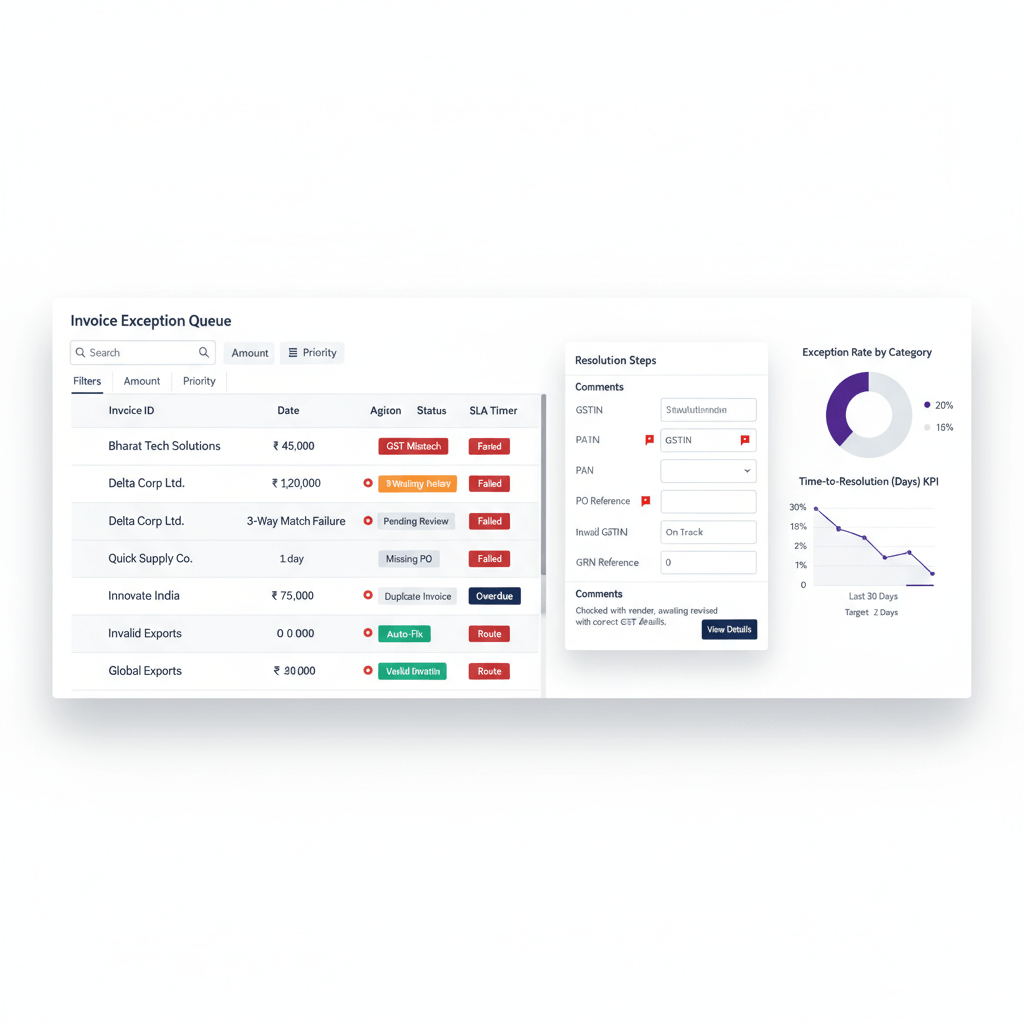
AI Accountant stands out with an exception queue that tracks status and SLAs, auto detects vendor mismatches, GST and e-invoice issues, suggests fixes from history, and syncs clean data back to your ledger.
Implementation roadmap, from pilot to scale
Phase 1, pilot program, weeks 1 to 2
Pick two to three high exception vendor groups, baseline metrics, document processes, identify quick wins, and secure stakeholder buy in.
Phase 2, configuration, weeks 3 to 4
Configure GST and e-invoice rules, TDS and TCS sections, matching tolerances, exception categories, and routing logic.
Phase 3, process definition, weeks 5 to 6
Assign category owners, set SLAs, publish SOPs, build dashboards, and train users.
Phase 4, parallel run, weeks 7 to 8
Process one month in parallel, compare results, iterate rules, refine AI, and document learnings.
Phase 5, full rollout, week 9 onwards
Migrate vendors in waves, monitor metrics daily, run weekly reviews, publish monthly scorecards, and schedule quarterly improvements.
Templates and checklists your team will use
Exception priority matrix
Classify by urgency and impact, put critical GST and e-invoice items at the top right, and nudge routine data fixes to the bottom left for batch handling.
Vendor onboarding checklist
Mandate legal and trade names, GSTIN, PAN, HSN or SAC, banking, e-invoice capability, contacts, and escalation paths, make this the activation gate.
Resolution playbook flowchart
Start with exception type, branch by error detail, define owner and approvals, end with documentation and audit trail steps, repeat for each major category.
Month end ITC checklist
Download GSTR-2B, reconcile, resolve mismatches, chase vendor filings, confirm RCM and eligibility, lock timelines before return submission.
Real world success stories
GSTIN mismatch recovery
A Chennai distributor flagged 200 GSTIN mismatches at month end, validated on the portal, updated vendor master the same day, and recovered ₹15 lakhs of ITC before filing.
Three way match automation
A pharma company introduced clear tolerances and buyer workflows, reduced exceptions by 65 percent, met SLAs, and closed month end three days faster.
Duplicate payment prevention
An auto parts maker used enhanced duplicate logic to block ₹8 lakhs in repeat payments, linking credit notes and partial payments to eliminate false positives.
Taking action on exception management
Exception handling is more than fixing errors, it is building resilient, compliant, and auditable processes. Start with a narrow, high impact scope, prove quick wins, then scale with governance and data. If you use Zoho Books or Tally, consider AI Accountant to stand up exception queues, intelligent routing, and compliance aware processing that lower exception rates and speed resolution.
FAQ
How should I prioritize exceptions when the GSTR-2B reconciliation deadline is close?
Rank by ITC impact first, then due dates and invoice values. Filter your queue to surface invoices missing in GSTR-2B, push them to a dedicated squad, and set four hour acknowledgment SLAs. Tools like AI Accountant can auto tag ITC risk and trigger alerts, so your team focuses where cash flow is at stake.
What three way matching tolerances should I set for Indian vendors without increasing risk?
Start with quantity variance at 2 to 3 percent and price variance at 1 to 2 percent for stable categories, then tune by category and vendor performance. Ensure escalations route to buyers for higher variances, and document every approved override. AI Accountant can apply vendor specific tolerances and record approvals for audit.
How do I handle backdated invoices received after the period close without breaking audit trails?
Accrue via a journal voucher in the current period, then reverse and post to the correct period when reopened. Keep narrative notes with PO, GRN, and vendor references. Systems like AI Accountant attach the audit trail to both the JV and the subsequent correction automatically.
What is the best practice to validate GSTINs at scale during vendor onboarding and invoice posting?
Validate GSTIN against the government database during onboarding, then revalidate on every invoice post or at least monthly. Flag discrepancies for vendor master correction before posting. With AI Accountant, GSTIN checks run in bulk and mismatch queues route to AP analysts instantly.
How can I reduce duplicate payment risk when vendors reuse invoice numbers each financial year?
Design duplicate checks using a composite key, vendor, invoice number, invoice date, amount, and GSTIN. Add fuzzy logic for near duplicates and link credit notes. Block bank release until exceptions close. AI Accountant applies exact and near duplicate detection and auto holds disbursements until cleared.
What KPIs should I present to management to prove ROI from exception handling?
Show first pass yield improvement, mean time to resolution reduction, exception rate by category drop, ITC at risk decline, duplicate payment prevention value, and month end close acceleration. Many teams see 60 to 80 percent time savings and ₹30,000 to ₹50,000 monthly cost reduction within a quarter using AI Accountant.
How do I operationalize e-invoice IRN and QR validations without slowing down AP?
Integrate real time IRP validation and store IRN and QR against the invoice record. Mark exemptions by rule, set alerts for cancellations inside 24 hours, and restrict posting without a valid IRN where applicable. Platforms like AI Accountant fetch and attach IRNs in bulk, reducing manual checks.
What controls should I set for TDS under 194Q and TCS under 206C(1H) in AP and AR?
Auto detect threshold breaches based on year to date aggregates, compute on the right base amount exclusive of GST when applicable, post entries to dedicated ledgers, and generate certificates promptly. AI Accountant maintains running aggregates and posts with the correct sections to avoid rework.
How can I structure my exception queue so buyers, vendors, and the CA firm collaborate efficiently?
Segment by category and impact, assign owners by role, set SLAs, and expose a vendor portal for corrections. Use comment threads and approval stamps for traceability. AI Accountant supports role based routing and SLA timers with collaboration logs for audit.
What is a practical month end ITC checklist for a multi entity group running Zoho Books or Tally?
Download GSTR-2B for each GSTIN, reconcile invoices, chase vendor filings for gaps, verify RCM and place of supply, lock e-invoice IRNs and QRs, clear high value exceptions, and archive evidence. AI Accountant automates multi GSTIN reconciliation and produces a sign off pack for reviewers.
How does AI learning actually reduce exception volume over time for Indian AP?
By capturing resolved exception outcomes, AI refines extraction, matching, categorization, and vendor specific rules. False positives drop, recurring patterns get auto fixed, and new anomalies surface earlier. Customers using AI Accountant typically see a 15 to 25 percent FPY lift within three to six months.
What playbook steps should I publish for a failed three way match when GRN is pending?
Auto notify the warehouse, request GRN within SLA, apply tolerance if GRN confirms minor variance, escalate to buyer for larger gaps, and document approvals. If GRN remains pending past cutoff, accrue and hold payment. AI Accountant can trigger these steps with reminders and lock payment release until resolution.