-01%201.svg)
Key takeaways
- AI tools turn raw finance data into forward looking forecasts, alerts, and recommendations, helping founders and finance teams decide faster with confidence.
- Clean books, CA oversight, and explainable AI are essential, they keep compliance correct and improve forecast accuracy toward ninety percent.
- Focus first on cash flow, GST and TDS, and spend control, quick wins create momentum and measurable ROI.
- Use a build versus buy lens, most SMEs benefit from CA managed Virtual Accounting, with audit trails, security, and India specific flows ready on day one.
- Track MAPE, runway days, decision cycle time, and compliance SLAs, these metrics prove impact and guide improvements.
Table of contents
AI tools for financial decision-making
Introduction
AI tools for financial decision-making help you see money clearly and act fast. They use machine learning, predictive analytics, and natural language processing to read your financial data, forecast cash flow, spot anomalies, and recommend actions. They go beyond basic reporting, they move you from looking back to looking forward.
If you are a founder, freelancer, or part of a finance team, these tools can cut analysis time from days to minutes. They support better cash planning, sharper budget control, and timely compliance for GST and TDS. With the right setup, they give you confidence in every decision. For deeper context, explore industry perspectives at Hebbia, Scry AI, Jump, and Datarails.
Why AI tools for financial decision-making matter now
Markets move quickly, rules in India are complex, GST filings, TDS deductions, and e invoice needs can pile up. Many teams still work across email, Excel, and chat apps, this slows decisions and increases risk of cash gaps or penalties.
AI tools speed up the cycle, they turn reactive reporting into proactive alerts. You get reminders for compliance deadlines, you see spend spikes before they become a problem. Forecast accuracy can improve to near ninety percent with clean data, cash runway becomes clear, tax planning can happen in real time.
This shift matters most when growth is the goal and timelines are tight, simple, trusted signals help you decide today, not next week. See broader adoption signals at Microsoft Industry Blog, and practical tool overviews from Jump, Hebbia, and Datarails.
Signal over noise, AI converts scattered spreadsheets into clear actions, like “AR spike in enterprise segment, call top five accounts today.”
Financial decisions improved by AI tools
- Cash flow forecasting and runway planning, time series models like LSTM look at bank inflows and outflows, they learn patterns and predict when cash might dip, you get burn rates and likely runway days you can trust, see an example approach in the AI Accountant cash flow dashboard.
- Budgeting and variance analysis, automated tracking compares plan to actual, deviations are flagged right away, you can drill down by cost center, vendor, or category to find the reason.
- Pricing and revenue optimization, for SaaS and e commerce, AI simulates demand changes under different price points, you can test promos, discounts, or bundles and see likely impact on sales and margins.
- Credit risk and receivables prioritization, overdue accounts are scored, the system can suggest which customers to call first and which ones need a payment plan or escalation.
- Spend control and vendor optimization, pattern analysis shows duplicate charges, rate creep, or better vendor options, you can put policies in place and get alerts when spend goes off track.
- Tax planning and compliance, GST and TDS calendars are tracked, e invoice needs are flagged, reconciliations connect your entries to filings, you see status and next steps.
- Scenario planning, teams can model best, base, and worst cases, sensitivity analysis lets you move a lever and watch results, hiring plans, marketing spend, and capex can be tested before you act.
- Bank analysis and anomaly detection, rules and models scan bank statements to find unusual transactions, duplicate entries, fraud signals, or errors can be caught early, see AI Accountant bank analysis for illustrations.
For more perspectives, review Hebbia, Scry AI, Datarails, Microsoft Industry Blog, and Jump.
Types of AI tools
- Forecasting models, time series like ARIMA and LSTM predict revenue, expenses, and cash, they handle seasonality and trends, good for runway, ARR, and collections, see AI Accountant forecasting tools.
- Anomaly detection, these tools flag irregular transactions and potential fraud, they look for outliers and risky patterns in banks and ledgers.
- Categorization and enrichment, OCR reads invoices, bank parsing maps lines to categories, e invoice data is matched to entries for cleaner books.
- Recommendation engines, they suggest cost cuts, payment timing, and which receivables to chase, prescriptions are tied to constraints like budgets or cash caps.
- NLP chat assistants, natural language assistants answer finance questions, they can pull policy details, show last month spend, or run quick variance checks.
- Compliance intelligence, GST health checks, TDS alerts, and filing trackers help avoid missed deadlines, you see your compliance status at a glance.
- Treasury optimization, simple suggestions help place idle cash in safe options for SMEs, they bring discipline to cash management.
- Prescriptive analytics, these tools optimize decisions under limits, they can propose the best mix of actions to hit goals with minimal risk.
Useful comparisons are covered by Hebbia, Cube Software, Datarails, Jump, Scry AI, and Microsoft Industry Blog.
Features checklist
- Native integrations, connect banks, payment gateways, accounting ERP, and GSTN when needed, smooth data flow reduces manual work.
- Explainable AI, the tool should show why a forecast changed or why an alert fired, clear drivers build trust and ease audits.
- Human in the loop, CA or finance review workflows catch errors, compliance needs human eyes, AI suggests, people approve.
- Real time dashboards, daily views of cash trends, burn, runway, and P and L help teams act without waiting for month end.
- AI insights and alerts, action items work like a coach, TDS due soon, AR spike by vendor, high spend on a category this week.
- Compliance tools, calendars, reminders, and statuses for GST, TDS, and e invoice keep filings on track.
- Audit trails and access control, role based access and a document repository support MCA and Income Tax readiness, nothing is lost.
- Data governance, privacy, India localization, and security are key, align with RBI and GDPR rules where needed.
Reference checklists from Datarails, Jump, Hebbia, Scry AI, and Microsoft Industry Blog.
Data foundations and readiness
AI needs clean data, start with a tidy chart of accounts, keep ledgers reconciled, make sure AR and AP are accurate, fixed assets should be tracked, categories should be consistent.
CA oversight helps, bookkeeping hygiene reduces noise, year end closing and schedules make the base solid, proper reconciliations keep the system honest, this avoids garbage in garbage out.
Think of it like a flow, data comes from banks and ledgers, AI processes it for forecasts and alerts, a CA reviews key items, then you make a decision with confidence. See background notes at Hebbia and Datarails.
Clean books are your AI superpower, they raise accuracy, reduce false alerts, and make every review with your CA faster.
Implementation guide
- Assess needs, start small, pick top priorities like cash flow, GST and TDS, and spend control, write them down.
- Audit data, check integrations, fix bank connections, clean categories, close old reconciliations.
- Quick wins, launch cash forecasts and compliance alerts first, these deliver value fast for most teams.
- Configure, set thresholds for alerts, define SLAs with your CA team, make review steps clear.
- Pilot KPIs, track forecast accuracy and cycle time to insights, measure how fast a decision moves from data to action.
- Scale, add scenario planning when the base is stable, train the team, use change management to build new habits.
For FP and A rollout notes, see Cube Software’s guide.
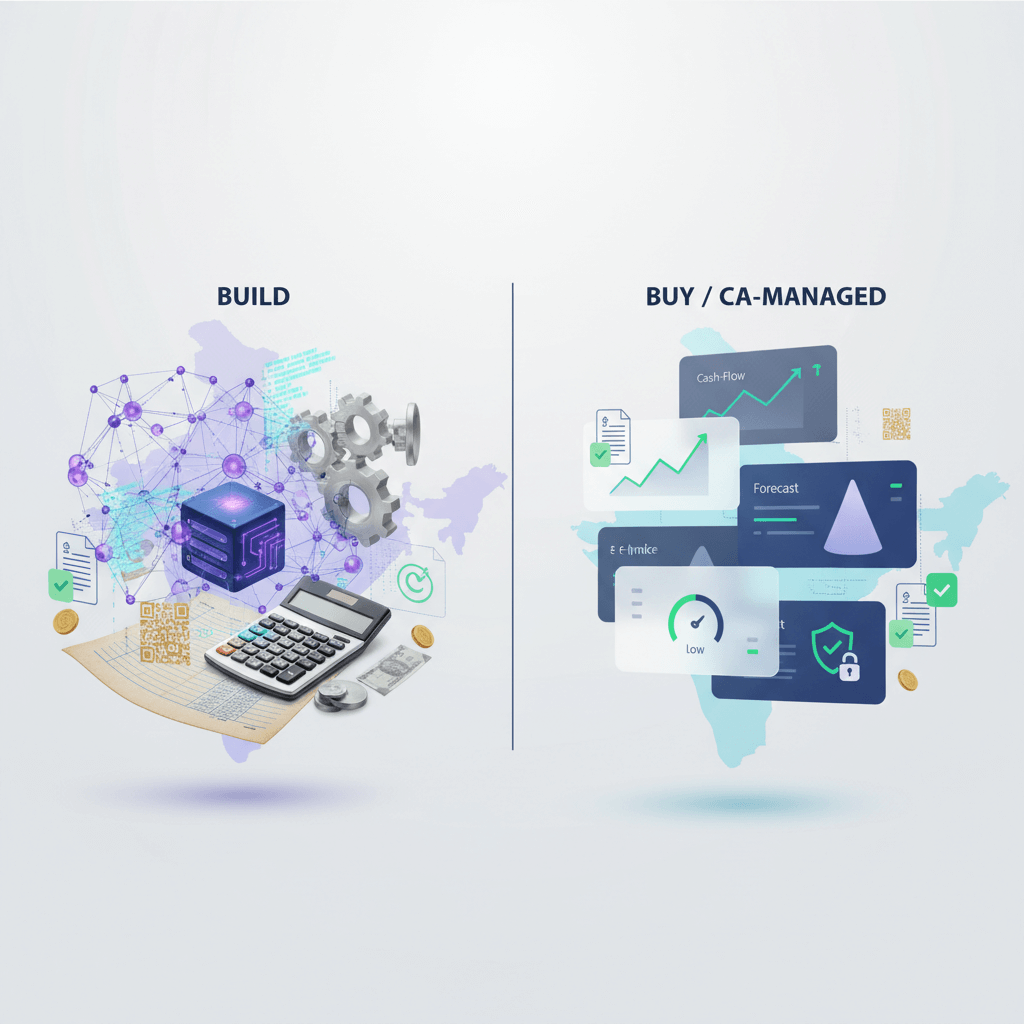
Evaluation criteria, build versus buy
- Total cost, building is expensive, development and operations add up, buying a managed service is often lower cost.
- India compliance, custom builds must handle GST and TDS rules, pre built options often include e invoice and local flows.
- Scalability and security, self builds can be risky for SMEs, managed tools bring enterprise grade security and scale.
- Explainability, if you build, making models clear is hard, many bought tools include native explanations with citations.
Most teams benefit from buying, you get audit trails, vendor roadmaps, and faster onboarding. Compare options at Datarails, Microsoft Industry Blog, Hebbia, and Jump.
Principle, buy for speed and assurance, build when your process or data is uniquely differentiated and worth the engineering investment.
Metrics to track
- Forecast accuracy, aim for MAPE below fifteen percent, check this monthly, ask why it moved.
- Cash variance and runway days, compare actual cash to forecast, watch runway change after big bills or receivables.
- Decision cycle time, measure how long it takes to reconcile and decide, reduce it step by step.
- Compliance SLAs, track filing timeliness, watch penalties avoided due to early alerts.
- AR aging and savings realized, see how faster collections change cash, capture savings from vendor renegotiations.
For benchmarks and tooling ideas, review Hebbia, Scry AI, and Datarails.
Risks and limitations
- Garbage in garbage out, poor bookkeeping skews outputs, fix the base to fix the insights.
- Model drift, data patterns change, retrain models on a schedule, review accuracy often.
- Bias, auto categorization can tilt, spot check categories and vendor grouping, correct and retrain.
- Security, enforce logs, use role based access, ensure localization to India rules when needed, keep backups, review access quarterly.
AI is a helper, not a replacement, pair it with CA oversight to keep compliance correct, and see industry cautions at Hebbia and Microsoft Industry Blog.
Use cases by segment
Freelancers
- Auto categorize income and expenses, see clear tax ready summaries.
- Get TDS alerts, prepare for advance tax, keep cash buffers.
- Track cash flow weekly, avoid surprise shortfalls.
Startups
- Monitor burn rate and runway, plan hiring and marketing with scenarios.
- Run GST reconciliations, tie invoices to filings, reduce risk.
- Share simple MIS with board, focus on facts and fast decisions.
Growth companies
- Manage multi entity P and L views, consolidate with clean rules.
- Optimize spend across vendors, track savings and contract renewal dates.
- Build board packs with trends and commentary, use AI for first draft, add human review.
Mini cases
- SaaS startup, AI alerts reduced GST penalties by eighty percent, runway accuracy rose by forty percent after reconciliations improved.
- Freelancer, TDS tracking streamlined advance tax work, hours were saved each quarter, stress dropped.
Further reading, Scry AI, Cube Software, Microsoft Industry Blog, and Datarails.
Tool recommendations
If you want a shortlist to explore, start here:
- AI Accountant aiaccountant.com
- QuickBooks Online
- Xero
- FreshBooks
- Zoho Books
- Sage Intacct
Pick based on your size, integrations, and compliance needs, always test with a small pilot first.
How AI Accountant Virtual Accounting helps
AI Accountant offers a CA led managed accounting and compliance service, it is supported by a centralized dashboard. This dashboard shows live accounting data, cash trends, burn rate, runway, AI insights and alerts, recent transactions, bank statement analysis, compliance dates, filing status, and a document repository, you can also message the CA team inside the system.
The service includes end to end accounting, GST, TDS, income tax, payroll, and annual ROC compliance for small companies. This covers monthly bookkeeping, ledger clean up, year end closing, fixed asset register maintenance, inventory reconciliation, AR and AP management, bank and gateway reconciliations, and MIS reporting. It also supports GST registration, GSTR filings, e invoice enablement, TDS advisory and filings, advance tax, tax audit preparation without certification, and international tax advisory. Payroll support includes monthly TDS calculation and salary structuring advice, ROC support for small companies covers MGT 7, AOC 4, DIR filings, MSME vendor filings, board meetings, minutes, and annual reports.
It replaces fragmented workflows like email and spreadsheets with a structured service model, you get continuous visibility, your CA team handles execution, this balance gives you reliable decisions with clear oversight.
If you are a freelancer, a startup, or a growth stage company, Virtual Accounting provides a foundation for AI tools, clean books and active compliance help AI insights stay accurate.
Explore service pages, Virtual Accounting, GST, and TDS.
Getting started
- Book a free bookkeeping and compliance health check, identify quick fixes and data gaps.
- Run a pilot dashboard for cash forecasts and compliance alerts, focus on one bank and a few categories.
- Set up a consultation to plan Virtual Accounting with CA support, align on scope and timelines.
Book a consultation at aiaccountant.com/consult.
Glossary
- MAPE, Mean Absolute Percentage Error, it is a forecast accuracy metric.
- AR and AP, Accounts Receivable and Accounts Payable.
- RCM, Reverse Charge Mechanism under GST.
- E invoice, mandatory digital invoice under GST rules.
- NLP, Natural Language Processing, it powers chat assistants.
- Anomaly detection, AI spotting unusual transactions in your data.
Resources
- GST Filing Guide aiaccountant.com/gst-guide
- TDS Compliance aiaccountant.com/tds-guide
- Virtual Accounting Overview aiaccountant.com/virtual-overview
Closing
AI tools for financial decision-making are now a practical way to run finance with speed and clarity, pair them with clean books and CA oversight, use a focused pilot, track the right metrics, scale steadily. With a strong foundation like AI Accountant Virtual Accounting, your insights will stay sharp and your decisions will stay sound.
FAQ
What MAPE threshold should a founder or finance head target for cash flow forecasting, and how does AI Accountant help reach it
A practical target is MAPE below fifteen percent for rolling thirteen week cash forecasts, AI Accountant improves accuracy by enforcing clean categorization, daily bank reconciliations, and variance reviews with a CA, then the AI model is retrained monthly on corrected actuals, lifting accuracy steadily toward ten to twelve percent.
How should we structure a chart of accounts so that scenario planning and variance analysis work reliably
Use a lean, consistent chart aligned to revenue streams, cost centers, and key spend categories, avoid duplicate or overlapping codes, enforce vendor mapping and tax tags, AI Accountant standardizes the chart during onboarding, so scenarios like hiring, marketing shifts, or capex changes flow clearly into MIS and board packs.
Can AI tools replace our CA for GST, TDS, and ROC compliance
No, AI accelerates data prep, alerts, and reconciliations, a CA is needed for interpretations, edge cases, and filings, AI Accountant runs AI assisted workflows, but CA review and approvals remain mandatory to ensure accuracy and audit readiness.
What bank and GSTN integrations are essential for a reliable weekly cash and compliance view
Direct bank feeds for all operating accounts, payment gateways, and credit cards, GSTN integration for GSTR reconciliation where applicable, AI Accountant connects these sources and maintains daily reconciliation, so cash positions, liabilities, and filing statuses are current.
How do we make AI insights explainable enough for auditors and board members
Require driver breakdowns for forecasts, attribution for variances, and clear rules for alerts, AI Accountant provides narrative explanations with figures, for example, “runway moved from 178 to 154 days due to vendor prepayment and slower collections,” supported by transaction level links.
What is the fastest path to ROI, if we are evaluating build versus buy for FP and A automation
Start with buy, pilot cash forecasting, anomaly detection, and compliance alerts in four to six weeks, measure MAPE, decision cycle time, and penalties avoided, building custom models and pipelines typically takes months and requires ongoing engineering, AI Accountant delivers managed outcomes with CA oversight, reducing risk and time to value.
How can we prioritize receivables collections using AI, without hurting customer relationships
Use risk scoring, invoice aging, and payment behavior to rank follow ups, combine AI suggested next actions with human judgment, AI Accountant flags top accounts to call, suggests payment plans, and tracks outcomes, so AR days fall while relationships remain intact.
What controls should we put in place for access, audit trails, and MCA or Income Tax readiness
Implement role based access, document repository with retention, and immutable activity logs, review access quarterly, AI Accountant includes audit trails across reconciliations, adjustments, and filings, making evidence collection for audits faster and more complete.
How do we reduce decision cycle time from data to action across finance and operations
Automate data ingestion, reconciliation, and alerts, then codify human review steps with SLAs, AI Accountant’s dashboard consolidates cash, AR and AP, and compliance views, so finance can communicate actions quickly, for example, “pause discretionary spend, accelerate collections in enterprise accounts,” within the same day.
Can AI Accountant produce board ready MIS packs with commentary and scenarios
Yes, AI Accountant compiles monthly MIS with trend charts, KPI tables, and commentary, scenarios are generated from baseline forecasts and key levers such as hiring or marketing spend, the CA team reviews and finalizes the deck, ensuring consistency with ledgers and filings.
What steps should a CA led team follow to keep GST and TDS clean while scaling
Maintain invoice validation, tax tagging, and e invoice readiness, reconcile GSTR 2B to purchase entries, and run TDS deduction reviews before payroll and vendor payouts, AI Accountant automates reminders and anomaly checks, while the CA signs off on edge cases and filings.
How do anomaly detection alerts translate into practical remediation for bank and ledger errors
Alerts pinpoint duplicates, unusual amounts, or off cycle transactions, the remediation flow includes verifying source documents, correcting ledger entries, and updating categorization rules, AI Accountant logs the fix and retrains the model on corrected data, reducing repeat issues over time.