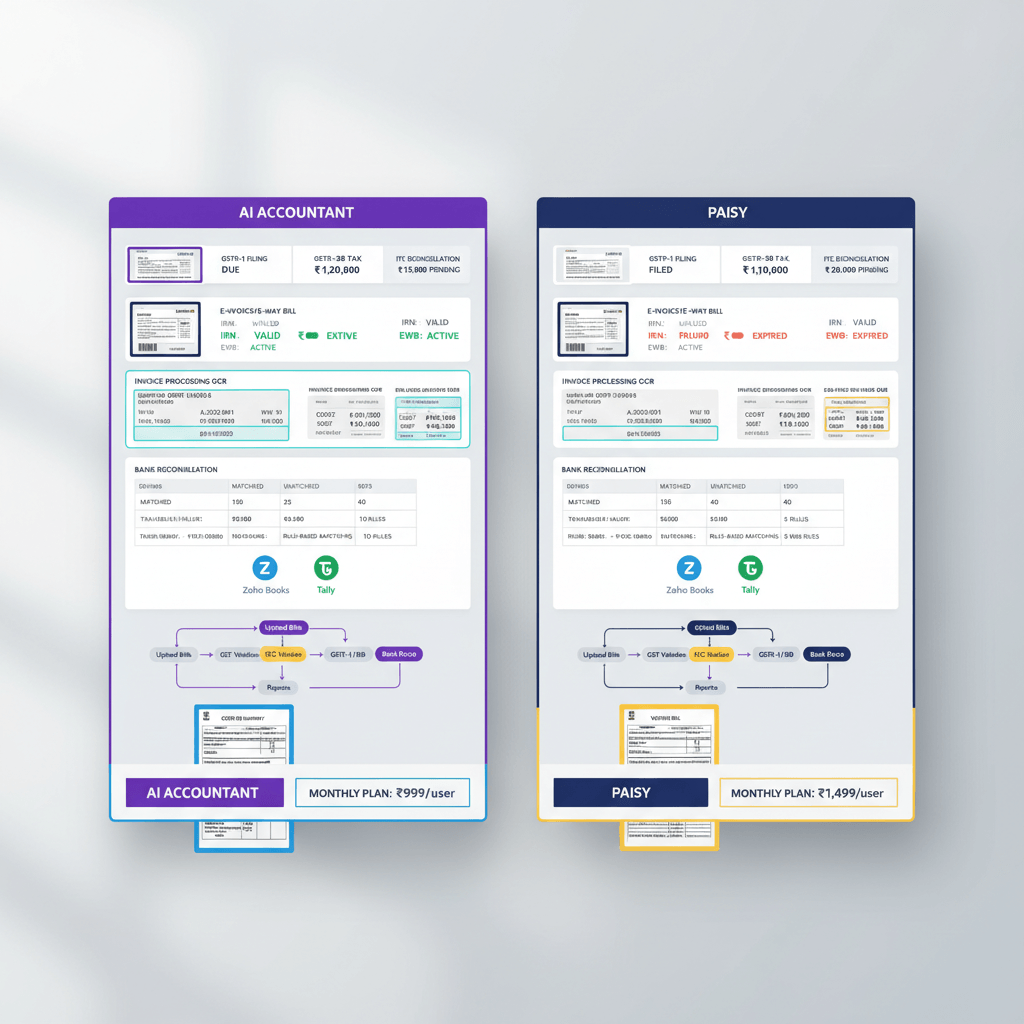
-01%201.svg)

Key takeaways
- If your books are simple and volumes are light, Paisy can work, but growing CA firms and SME finance teams usually outpace its automation depth quickly.
- AI Accountant delivers India-first workflows, with bulk AP ingestion, bank normalization, and GST, especially GSTR-2B, cutting manual work by 60 to 70 percent.
- True bi-directional sync with Zoho and Tally, multi-organization controls, and real-time dashboards make AI Accountant a strong Paisy alternative for scale.
- Total cost matters, license fees are only part of the picture, time saved on reconciliation and data cleanup often drives the real ROI.
- Run a short pilot with last month’s data, then compare cycle time, reconciliation accuracy, and user effort, this reveals the best fit faster than any demo.
Quick Decision Guide: Who Wins and Why
Choose Paisy if your operations are basic, your team is small, and monthly transactions are under five thousand. For many early stage firms this is adequate. Choose AI Accountant if you handle high volume AP, need GSTR-2B reconciliation, require Zoho or Tally sync, manage multiple entities, or want real-time visibility. Many teams report 50 to 70 percent faster month-end closes within two to three months of adoption. For a deeper side by side, see the full Paisy vs AI Accountant comparison.
The 30 second takeaway: AI Accountant reduces manual time on AP entry, bank mapping, and GST tasks through bulk processing and AI learning, which compounds month after month.
What to Evaluate in Any Paisy Alternative
Start with GST capabilities. Can the tool handle GSTR-2B reconciliation smoothly, including purchase register handling and debit or credit notes, with clear status tracking and resolution workflows.
Next, evaluate AP automation depth. Robust solutions ingest PDFs, CSVs, Excel files, and scanned images in bulk, with strong OCR on Indian invoices, plus vendor mismatch detection that flags GSTIN name discrepancies instantly.
Assess bank and credit card statement handling. You should see normalization across Indian bank formats, intelligent categorization, split handling, predictions, and automatic bill matching.
For teams on Zoho Books or Tally, native bi-directional sync is essential, masters should flow in, cleaned and validated data should flow out, without CSV juggling.
Consider multi-organization access and controls, single login with role based permissions, consolidated dashboards for AR or AP and cash position, and per entity audit trails.
Security and scale matter, look for ISO 27001 and SOC 2. Finally, calculate true total cost of ownership, including overages, extra users, API access, and the value of India time zone support. For more context, see another field tested comparison.
Paisy Bookkeeping Review: A Balanced Practical Lens
Paisy suits small teams running simple books, with basic bookkeeping, GST field capture, and statement handling. As volumes rise, gaps show up around scale, GST-2B reconciliation, multi bank formats, and multi entity workflows. Test bill extraction on your Indian PDFs, measure onboarding speed, and ask about Zoho or Tally sync, not just CSV exports. Clarify OCR limits, accuracy on Indian documents, multi organization experience, and how volume pricing escalates. For more real world notes, review this practical lens on Paisy vs alternatives.
Tip: During trials, use your last month’s invoices and statements, not sample data, then track exception rates, correction time, and reconciliation accuracy.
Paisy Pricing India: What Buyers Should Know
Sticker price rarely equals total cost. Paisy uses tiers across organizations, users, and transactions, with potential overages from statement volumes, OCR limits, GST add ons, exports, and API calls. Low volume teams might be fine, but costs scale quickly as you add entities or clients. When you price AI Accountant, include the manual time you save, teams often cut processing time by 70 percent, which reduces your effective cost per transaction. Confirm contract terms, price locks, and cancellation policies. For sample scenarios, read this pricing focused comparison.
Paisy vs AI Accountant: Feature by Feature Comparison
AP and Bills Automation
Paisy handles basic ingestion with manual checks. AI Accountant processes PDFs, CSVs, Excel files, and scanned images in bulk, extracts GSTIN, vendor details, and line items accurately, and flags vendor or GSTIN mismatches, with validations that reduce errors before posting.
Bank and Credit Card Statements
Paisy can require manual tagging across formats. AI Accountant normalizes all major Indian bank formats, learns from corrections, and achieves high categorization accuracy over time.
Transaction Mapping and Matching
Paisy relies on rules and manual splits. AI Accountant predicts ledgers, vendors, and customers, supports bulk edits, links bills automatically, and handles split or transfer scenarios gracefully.
GST Reconciliation
Paisy offers basic GSTR coverage. AI Accountant delivers end to end GSTR-2B reconciliation with purchase registers, journal vouchers, credit or debit notes, and resolution workflows at scale.
Zoho and Tally Sync
Paisy may depend on one way exports. AI Accountant provides true bi directional sync, masters in, validated entries out, no duplicate headaches.
Dashboards and Reporting
Paisy includes basic reports. AI Accountant offers real time AR or AP overviews, cash position, aging, and spend visibility, without exporting to spreadsheets.
Multi Organization Support
Paisy can require separate logins and workarounds. AI Accountant supports single login, organization switching, role based permissions, and per entity AI learning that scales from one to hundreds of entities.
Security and Scale
Verify Paisy’s certifications. AI Accountant holds ISO 27001 and SOC 2 Type II, and has processed hundreds of millions of transactions across hundreds of customers, including many CA firms. For another angle, see this feature by feature breakdown.
Why CA Firms and SMEs Pick AI Accountant as Their Paisy Alternative
India first automations reduce GST mismatches and manual hours significantly. Teams consistently report 60 to 70 percent time savings on routine AP, bank, and GST workflows, measured across real month end cycles. Data quality improves due to validations and direct Zoho or Tally sync, so duplicate entries and CSV import errors disappear. Scale is proven, with reliable performance during peak cycles. Most teams become productive within a week, with full proficiency in under a month. For user stories and benchmarks, check this field comparison.
Who Should Choose What: A Practical Fit Guide
Choose Paisy if you have:
- Simple books with low complexity
- Under one thousand transactions monthly
- Strict budget constraints
- No immediate growth plans
- Basic GST needs without 2B reconciliation
Choose AI Accountant if you have:
- Five thousand or more transactions monthly
- GSTR-2B reconciliation requirements
- Multiple organizations or clients
- Zoho Books or Tally as your accounting system
- Real time reporting needs and cash visibility goals
- Growth plans that demand scale and controls
Consider error tolerance, if small manual errors are acceptable you can live with basic tools, if compliance and client trust are critical you need robust automation and validations. For more context on fit, review this practical guide to selection.
Migration from Paisy to AI Accountant: Smooth Transition Path
Export bills, vendors, and bank data from Paisy, then import through AI Accountant templates with built in checks. Run both systems in parallel for a cycle to validate results. Migrate clients in batches, map fields carefully, and train users while they process familiar data. Many CA firms complete a two week pilot that demonstrates time saved and reconciliation accuracy with their own records. For a step by step plan, see this migration friendly comparison.
Making Your Decision: Next Steps
List your non negotiables, for example deep GST reconciliation, multi entity support, and specific integrations. Calculate true costs including user time. Pilot with real data, ask for references from similar firms, and consider near term and future compliance needs. A short, focused pilot usually reveals the clear winner within two weeks.
Pro tip: Start with AP ingestion and bank reconciliation, then layer in GST, dashboards, and multi entity automation.
The Bottom Line
Paisy serves basic bookkeeping well for simple, stable operations. As complexity and volume rise, AI Accountant emerges as a strong Paisy alternative, with comprehensive AP automation, accurate GST reconciliation, seamless Zoho and Tally sync, and real time visibility. Validate with a time boxed pilot, measure cycle time and error rates, then choose the platform that scales with your firm. When you are ready to dive deeper, explore the complete Paisy vs AI Accountant guide.
FAQ
Which is the best Paisy alternative in India for a CA firm managing 20 plus clients with heavy GST-2B workflows
AI Accountant is a strong choice because it handles end to end GSTR-2B reconciliation at scale, supports multi organization setups under one login, and offers bi directional sync with Zoho and Tally. Firms typically see faster closes and fewer GST mismatches once validations and bulk processing kick in.
How does AI Accountant compare to Paisy for bulk AP ingestion and Indian invoice OCR accuracy
AI Accountant ingests PDFs, CSVs, Excel files, and scanned images in bulk, with OCR trained on Indian invoices, including GSTIN, vendor details, line items, and tax fields. In practice, CA firms report fewer exceptions and faster verification versus manual heavy flows on basic tools.
Can an SME finance team move from Paisy to AI Accountant without disrupting month end timelines
Yes, teams typically export masters and transactions from Paisy, import into AI Accountant templates, and run a parallel month to validate entries. Because the learning curve is gentle, users become productive quickly, keeping month end on track.
Do CA firms get granular role based access and client wise segregation on AI Accountant
Yes, AI Accountant supports single sign on style organization switching, role based permissions, and per entity controls, which lets partners, managers, and associates work client wise without data overlap.
How reliable is bank statement parsing for Indian formats compared to Paisy
AI Accountant normalizes statements across major Indian banks, learns from user corrections, and improves categorization accuracy over time. This reduces manual tagging and speeds up bank reconciliation versus rule only approaches.
What is the learning curve for staff shifting from Paisy to AI Accountant
Most teams achieve basic proficiency within a week, with full productivity in under a month. Starting with AP and bank workflows, then adding GST and dashboards, helps teams realize early wins and build confidence.
Is there a risk of duplicate entries when syncing with Zoho or Tally from AI Accountant
AI Accountant uses bi directional sync with deduplication checks and validations, so masters flow in cleanly and posted entries flow out without duplicates. This reduces the CSV shuffle and manual cleanup that often causes errors.
How should a CA partner evaluate total cost, Paisy versus AI Accountant, when advising clients
Model license fees, expected overages, additional users, and API costs, then add staff hours for AP entry, bank mapping, and GST reconciliation. Many firms find that AI Accountant reduces manual hours by more than half, which lowers the effective cost per transaction.
Can AI Accountant handle multi GSTIN vendors, credit or debit notes, and journal adjustments during 2B reconciliation
Yes, AI Accountant supports complex Indian GST scenarios including multi GSTIN vendors, credit or debit notes, purchase registers, and journal vouchers, with status tracking and resolution workflows that scale for CA firms.
What is a low risk way to test AI Accountant as a Paisy alternative before committing
Run a two week pilot using last month’s invoices, statements, and GST data. Compare exception counts, verification time, reconciliation accuracy, and overall cycle time. Many firms see a clear delta within the first cycle.
Does AI Accountant support consolidated dashboards for partners who want real time visibility across clients
Yes, AI Accountant provides real time AR or AP, cash position, and aging views across entities, which helps partners prioritize reviews and communicate with clients proactively.
How does AI Accountant’s vendor mismatch detection help with compliance
It automatically flags discrepancies between vendor names, GSTINs, and addresses, so teams correct issues before posting, which improves compliance posture and reduces downstream GST reconciliation errors.
What are the typical migration steps for a mid sized CA firm moving multiple clients off Paisy
Prioritize clients by volume, export masters and ledgers, import into AI Accountant using validated templates, run a parallel month, resolve mapping gaps, and roll forward in batches. This phased plan minimizes risk while letting teams learn and standardize.
Will AI Accountant scale during peak cycles, for example year end or quarterly GST peaks
AI Accountant is built for scale, with proven performance across hundreds of customers and heavy month end loads. Bulk operations, queueing, and parallel processing help maintain speed when volumes spike.
Can an internal audit or risk team get evidence of controls and certifications easily
Yes, AI Accountant maintains ISO 27001 and SOC 2 Type II certifications, and provides documentation to support audits. Combined with in product validations, this satisfies most internal risk reviews.

Rohan Sinha is a fintech and growth leader building aiaccountant.com, focused on simplifying accounting and compliance for Indian businesses through automation. An IIT BHU alumnus, he brings hands-on experience across 0 to 1 product building, growth, and strategy in B2B SaaS and fintech.