-01%201.svg)
Key takeaways
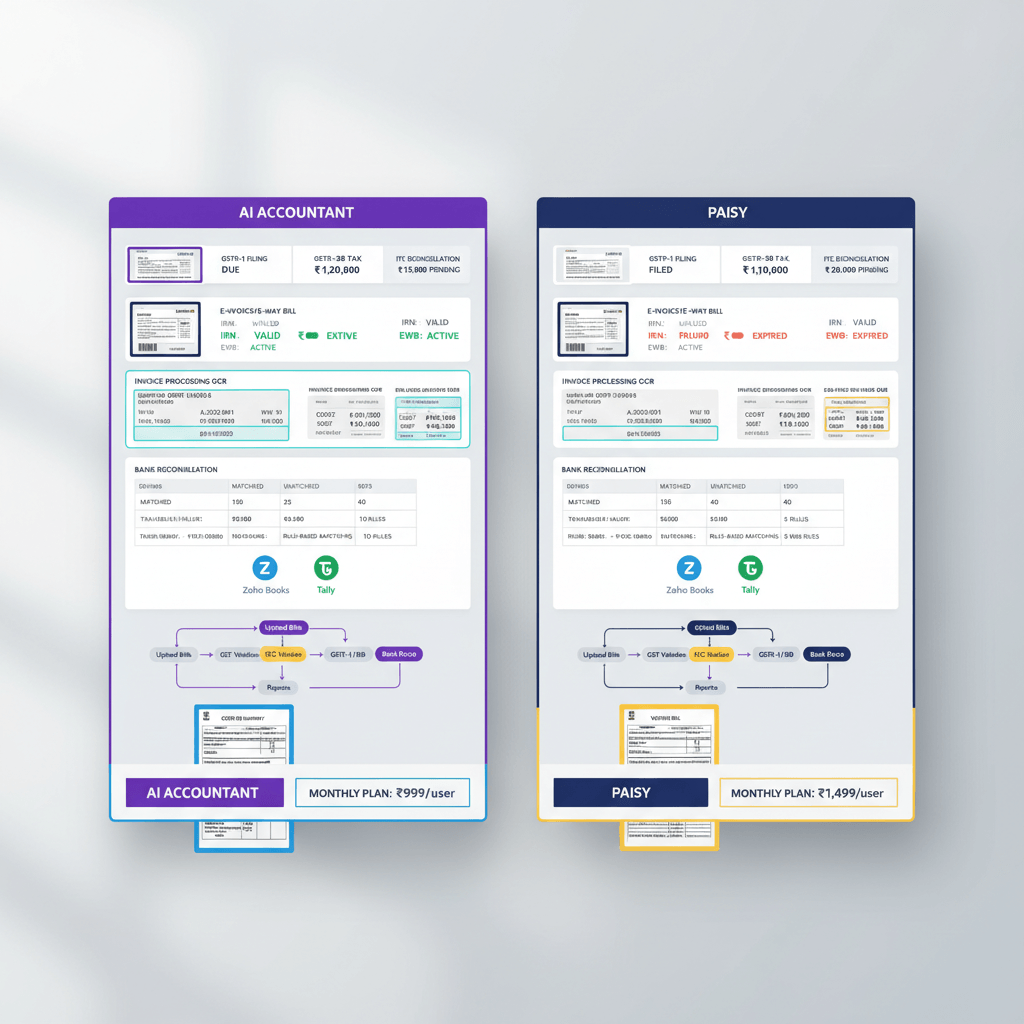
- If you are evaluating Paisy vs AI Accountant, focus on GST reconciliation depth, bank statement automation, and quality of integrations with Tally and Zoho Books.
- AI Accountant emphasizes intelligent extraction, vendor validation, and bulk operations that compress AP cycle time, helping Indian teams cut manual entry by large margins.
- For bank work, AI Accountant’s advanced bank and credit card statement processing predicts categories, links payments to open bills, and learns from your edits.
- GST remains make or break in India, AI Accountant’s comprehensive GST reconciliation flags mismatches early and scales for CA firms managing many clients.
- Integration depth, data security, and onboarding support drive real ROI, not just sticker price, most teams see payback in a few months when automation replaces even a third of manual tasks.
Why accounting automation matters now for Indian finance teams
Manual bookkeeping slows decisions and introduces preventable errors. Indian finance teams wrestle with GST reconciliation, vendor bill processing, TDS tracking, and bank categorization, all while month end deadlines loom. The right automation platform learns your patterns, reduces repetitive work, and surfaces exceptions early so your team can focus on analysis, not data entry.
“Automation does not replace judgment, it reserves your judgment for the ten percent that actually needs it.”
For India, local nuance is everything. From invoice formats and GSTIN validations to Tally voucher types and Zoho custom fields, specialized automation that respects Indian workflows delivers outsized gains.
Paisy vs AI Accountant, the feature by feature reality
Bill processing and AP automation
AI Accountant ingests PDFs, scans, and Excel, captures all critical fields, validates GSTIN, checks duplicates, and compares vendor names and addresses with your master. You can resolve exceptions inline, create manual bills when needed, or use Excel templates with row level error reporting. Teams processing hundreds of invoices each month report major time savings, tighter controls, and cleaner vendor masters.
Paisy offers automated data extraction and validation for Indian invoices. Public documentation on depth of vendor validations, duplicate checks, and exception workflows is limited, so confirm specifics in a live demo.
Bank reconciliation capabilities
AI Accountant leads with predictive mapping and bulk operations for statements of all sizes. The platform normalizes formats, predicts transaction types, assigns ledgers, and auto links receipts and payments. Advanced features handle splits and transfers while preserving audit trails, and the system becomes smarter with your corrections. Read more here: bank and credit card statement processing.
Paisy includes bank reconciliation as part of its suite. Matching accuracy, mass edits, and learning behavior should be tested with your own statements to validate performance.
GST reconciliation features
AI Accountant offers end to end workflows that compare purchase registers, JVs, and credit notes with GSTR 2B, providing status tracking, standardized export formats, and strong exception handling for amended returns and credit notes. Explore the guide here: comprehensive GST reconciliation.
Paisy likely supports GST compliance for Indian businesses. Validate how it identifies mismatches, surfaces ineligible ITC, and scales across multiple GSTINs for CA practices.
Integrations that matter for Indian stacks
Zoho Books integration
AI Accountant syncs vendors, customers, COA, tax rates, and history, applies automation, then posts clean entries back to Zoho Books. It handles custom fields, multi currency, projects, and respects Zoho validations, which means no export import drama, just consistent books and real time sync.
Tally integration
AI Accountant connects with Tally Prime and ERP 9, understands voucher types, cost centers, inventory linkages, and returns cleaned results back to ledgers. You keep your Tally comfort, you gain modern automation.
Other accounting software compatibility
AI Accountant focuses on deep Zoho and Tally coverage, which already fits a large share of Indian SMBs and CA firms. The API architecture allows future expansion. For Paisy, verify integration depth and reliability with your live data, not sample files.
Pricing, ROI, and the real cost of doing nothing
AI Accountant typically prices by transaction volume and entity count, with partner friendly options for CA firms. Paisy pricing is not widely published, expect custom quotes. When you evaluate, include onboarding, training, and support. Cheap upfront tools can cost more in rework, exceptions, and manual patches.
A practical ROI approach: estimate monthly hours saved across AP, bank reconciliation, and GST tasks, multiply by team cost, then compare with subscription. Many teams see payback within a few months when automation replaces even a third of manual work.
User experience and dashboards
Dashboards that drive actions
AI Accountant offers Overview, Receivables, and Payables views with aging, due versus overdue, and category wise spend patterns. Real time sync keeps cash visibility current, enabling confident decisions on collections and vendor payments.
Learning curve and usability
Spreadsheet like bulk edits, inline fixes, and clear error hints make AI Accountant easy to adopt for Excel native teams. The more you use it, the smarter it gets with categorization and vendor logic.
Security and Indian compliance
Data security
AI Accountant uses encryption at rest and in transit, ISO 27001, and SOC 2 Type II. Role based access and MFA protect sensitive data, with automated backups for continuity.
Paisy security specifics should be confirmed. Any credible accounting platform should meet enterprise expectations for Indian finance data.
Compliance for India
AI Accountant supports GST filing workflows, audit trails, and reporting in regulator friendly formats. TDS, advance tax, and data retention rules align with Indian norms, which reduces audit friction and surprises.
Customer support and training
Onboarding
AI Accountant provides migration help, configuration, hands on training, and bulk onboarding assistance for CA firms that need to standardize across many clients.
Ongoing support
Indian context matters, so AI Accountant pairs channels like email, chat, and phone with experts who understand GST, Tally, and Zoho, plus webinars and community resources.
Scalability and performance
Multi entity and CA practice scale
AI Accountant supports many orgs under one login with separate data and permissions. The platform serves 450 plus customers, including 100 plus CA firms, and processes 300M plus transactions with sustained growth.
Speed under pressure
Bulk operations stay responsive during peak close. Parallel processing lets many preparers and reviewers work together without slowdowns, so you do not outgrow the tool as volumes rise.
Best accounting automation tools for Indian teams
- AI Accountant, comprehensive automation with deep Zoho and Tally integrations, GST reconciliation, and intelligent categorization for Indian workflows.
- QuickBooks Online, global cloud accounting with Indian GST features and strong adoption in small businesses.
- Xero, modern cloud accounting with rich automation and an extensive app marketplace.
- FreshBooks, service friendly accounting with time tracking and simple invoicing.
- Sage Business Cloud Accounting, robust reporting and multi currency support for growing teams.
- Wave Accounting, a free option for freelancers and very small businesses starting automation.
How to choose between Paisy and AI Accountant
List your top bottlenecks, GST 2B matching, AP exceptions, or bank categorization, then map each to the tool that solves it best. Validate integration depth with your live Tally or Zoho dataset, not demo screenshots. Include user adoption, support responsiveness, and multi entity needs in your decision. Finally, negotiate onboarding deliverables and success metrics so value is measurable.
Decision checklist you can use in your next demo
- Show a real vendor invoice set, including poor scans, duplicates, and GSTIN typos, how many clicks to post cleanly.
- Upload three months of bank statements across two banks, demonstrate auto matches, splits, transfers, and mass edits.
- Run a GSTR 2B reconciliation for one month, show mismatch categories, ineligible ITC, and export formats.
- Sync with Zoho Books or Tally, verify custom fields, voucher types, cost centers, and round tripping without errors.
- Measure time to onboard a second entity, including user roles, approval flows, and templates.
- Confirm audit trail depth, who changed what and when, with reprocessing history.
Closing thoughts
Both platforms aim to reduce manual work, but outcomes depend on depth of automation, quality of integrations, and support. If your stack is Zoho or Tally, if GST reconciliation and statement automation are core pain points, AI Accountant is purpose built for Indian teams that need speed, accuracy, and scale.
The right tool turns month end from a scramble into a routine, giving your finance team time to advise the business, not just record it.
FAQ
Which tool closes GST 2B reconciliation faster for a typical CA monthly cycle?
AI Accountant provides end to end GSTR 2B comparisons against purchase registers, JVs, and credit notes, with clear mismatch categories and exports. CA firms report that AI Accountant’s standardized workflows and batch actions reduce reconciliation time materially, especially when handling many GSTINs simultaneously.
How well does AI Accountant learn custom categorizations, for example mapping bank narration patterns to our chart of accounts?
AI Accountant trains on your edits and approvals, predicting ledgers and tax treatments for recurring patterns. For example, if you consistently map a narration containing “AWS Mumbai” to Cloud Expenses and apply the correct GST treatment, the system suggests the same going forward, reducing reviewer touches.
Can either tool maintain Tally voucher types, cost centers, and inventory linkages without breaking reports?
AI Accountant respects Tally conventions during sync, preserving voucher types and cost center structures, and posts cleaned entries back while maintaining referential integrity. In practice, this means your Tally reporting remains intact while automation handles ingestion, categorization, and validation.
What does the audit trail look like for statutory audit and internal QA?
AI Accountant maintains a detailed audit trail, who created, edited, approved, and posted, including timestamps and before after values. Reviewers can sample exceptions, trace vendor validations like GSTIN checks, and export evidence for auditors without manual screenshots.
How do I model ROI for a 6 member finance team doing AP, bank reconciliation, and GST every month?
List the hours per month for AP entry and validation, bank categorization and matching, GST 2B reconciliation and exception handling, then apply fully loaded hourly cost. AI Accountant users commonly reclaim a significant portion of these hours. If your team saves even one day per member per month, payback often arrives within a few months.
Does AI Accountant support Zoho Books vendor deduplication and master hygiene during onboarding?
Yes, AI Accountant compares incoming invoices with vendor masters, flags name and GSTIN mismatches, and supports cleanup via inline edits or Excel templates with row level errors. This reduces duplicate vendors and improves downstream posting accuracy.
Will bank statement automation work across Indian formats like PDF scans, CSV exports, and bulk ZIP uploads?
AI Accountant ingests multiple formats, normalizes data, and predicts categories across banks and cards. Finance teams can filter, edit inline, and update in bulk, while the platform auto links transactions to open bills and invoices where possible.
How do I switch from Paisy to AI Accountant mid financial year without disrupting books?
Run a phased approach, connect AI Accountant to your accounting system, sync masters, process new bills and statements in AI Accountant, and backfill older periods in batches. Use reconciliation checkpoints at month boundaries to ensure opening balances and vendor ledgers tie out, and keep a short parallel run if risk tolerance is low.
Is there a CA partner program and multi client management for practice scale?
AI Accountant supports multi org management under one login and offers partner friendly pricing for CA firms. Templates and role based access help you onboard new clients quickly, enforce consistent workflows, and monitor exceptions across the portfolio.
What security assurances can I give enterprise clients, especially around data access and backups?
AI Accountant uses encryption in transit and at rest, ISO 27001, and SOC 2 Type II controls, with MFA and role based access. Automated backups and regular vulnerability assessments strengthen continuity. For client NDAs, provide architecture and control summaries during vendor due diligence.
Can the system handle complex AP cases like partial receipts, credit notes, and multi line GST treatments?
AI Accountant captures line level details, validates GST treatments, and supports credits and adjustments. During posting, it preserves references and audit trails, allowing reviewers to see exactly how partials and credits affected vendor balances and ITC.
How do month end dashboards help CFOs manage cash and payables without waiting for final books?
AI Accountant’s Overview, Receivables, and Payables dashboards surface aging, due versus overdue, and category wise spending from continuously synced data. CFOs can sequence vendor payments, chase collections proactively, and make cash decisions without end of month delays.

Rohan Sinha is a fintech and growth leader building aiaccountant.com, focused on simplifying accounting and compliance for Indian businesses through automation. An IIT BHU alumnus, he brings hands-on experience across 0 to 1 product building, growth, and strategy in B2B SaaS and fintech.