-01%201.svg)

Key takeaways
- An AI accounting dashboard gives mid-market teams real-time visibility into cash, margins, and close progress without waiting for manual MIS preparation.
- The hybrid model (CA oversight plus AI automation) delivers 25 to 40 percent lower finance costs and two to three times faster month-end closes, proven across 450+ customers and 300M+ transactions.
- Build versus buy depends on transaction volume, compliance complexity, and internal bandwidth. Most mid-market firms see faster ROI by buying a platform with native Tally integration rather than building dashboards from scratch.
- Success requires strong controls, clear SLAs, and phased onboarding, not just a tool purchase. Define exception thresholds and review gates before go-live.
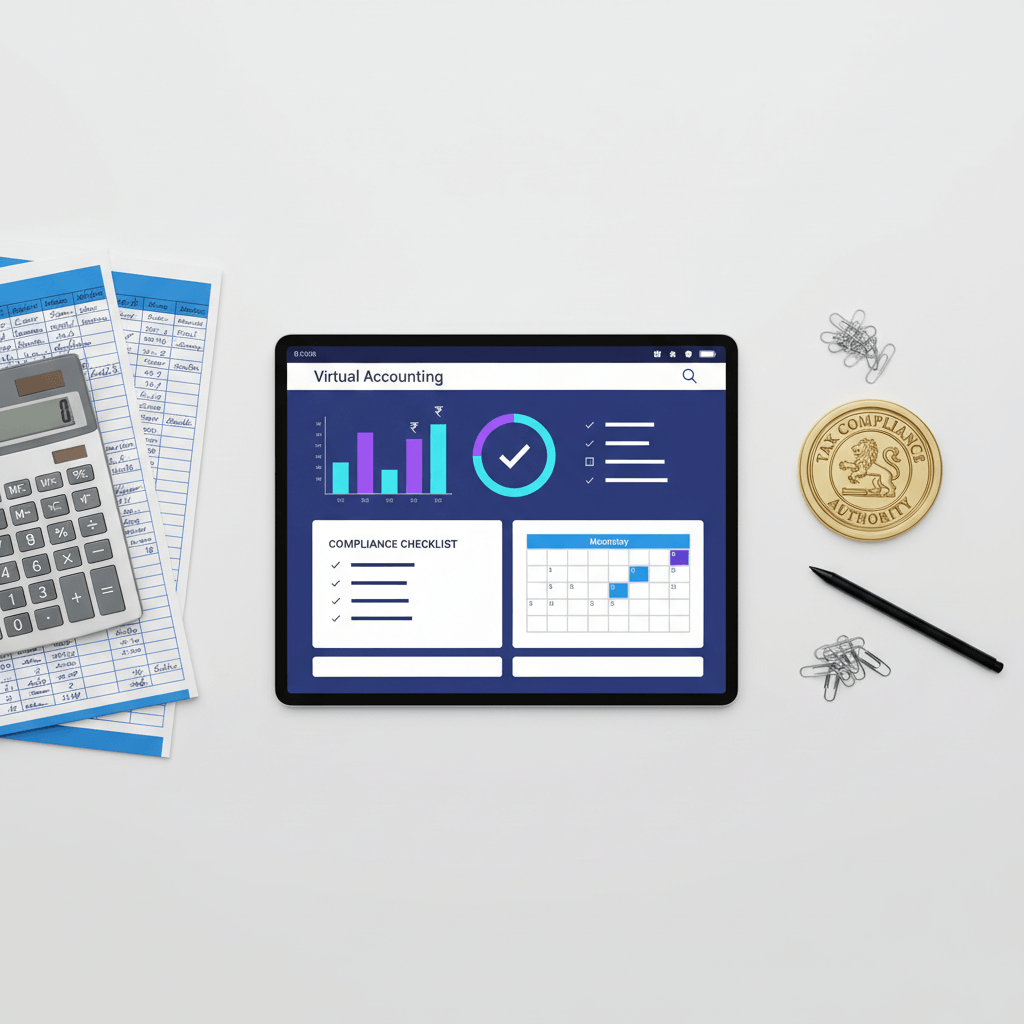
- Customizable dashboards should surface close timelines, reconciliation coverage, AP aging, and compliance calendars in one view, reducing leadership's dependence on ad hoc requests.
- For teams struggling with reconciliation bottlenecks or delayed MIS, AI Accountant's MIS and reporting automation connects directly to your ledger and produces drill-down packs without manual assembly.
AI virtual accountant dashboards: what's new in 2026
Until mid-2025, most mid-market accounting dashboards were essentially static MIS packs assembled manually after close. In 2026, AI-driven platforms now ingest bank feeds, credit card statements, and vendor bills in real time, producing live dashboards that update as transactions land. The shift is from "reporting on the past" to "monitoring the present."
Operationally, this means finance teams no longer batch-process bank reconciliations weekly. Daily automated matching is the new baseline, with platforms achieving over 95 percent auto-match rates on standardized transaction flows. Unmatched items surface immediately on exception dashboards, with suggested reasons and escalation paths built in. According to recent analysis from Consilium on AI in accounting, AI tools now handle categorization, anomaly detection, and predictive analytics as standard features, not premium add-ons.
Who does this hit hardest? Mid-market companies processing 500+ invoices monthly on Tally, especially those with multi-entity structures or GST compliance across states. For these teams, manual dashboards simply cannot keep pace. The cost of inaction is tangible: delayed closes beyond T+10 mean stale numbers reaching the board, missed early payment discounts, and audit prep that drags for weeks instead of days.
What to do now:
- Audit your current MIS turnaround time. If it exceeds T+5, you are leaving cash visibility on the table.
- Check whether your platform supports real-time bank and wallet feeds. If not, evaluate connectors before your next close cycle.
- Ensure your dashboard surfaces GST reconciliation status alongside AP and AR aging, not in separate reports.
Teams already using automated bookkeeping workflows report that the dashboard layer becomes useful only after transaction mapping is clean, reinforcing that automation and visibility are two sides of the same coin.
Virtual accounting, CA managed, and AI augmented: what it really means
Virtual accounting centralizes bookkeeping, reconciliations, and routine finance operations across cloud tools, then layers Chartered Accountant supervision on top. The modern model blends humans and machines. AI Accountant automates data capture and matching, while CAs handle judgment, policy, and review.
The result is a finance engine that runs predictably, with fewer errors and faster insight. Think of it as an AI virtual accountant handling the volume work, supervised by a seasoned CA who catches edge cases.
Common service bundles
- Core ledger and reconciliations: bank feeds, credit cards, wallets, advances
- AP and AR operations: vendor invoice capture, approvals, payments, dunning
- Payroll and statutory filings: GST, TDS, PF, ESI, returns
- Management reporting: MIS packs, board decks, unit economics
- Year end support: audit schedules, tie outs, confirmation management
Why companies adopt it now
- Close faster, from weeks to days, freeing leadership time
- Improve compliance and audit readiness with complete audit trails
- Scale without linear hiring: robotic process automation absorbs volume spikes
- Cut total cost of finance while improving accuracy
- Gain real-time visibility into cash, margins, and runway through a live AI accounting dashboard
Executive lens: You are buying a predictable month end close and reliable numbers, not just bookkeeping hours.
Operating models to choose from
Hybrid, CA led with AI automation
CAs define policy and review exceptions. AI Accountant handles transaction classification, reconciliation, and workflow routing. Best for startups and mid-market teams that want speed without losing oversight.
This is the model most mid-market accounting platforms with customizable dashboards support today, giving controllers a single-pane view of close progress, exceptions, and compliance status.
AI heavy, exception only review
Automation drives most of the work. Humans intervene for edge cases and approvals only. Works when transaction structures are standardized and well tagged.
Traditional CA managed, tool assisted
Processes are mostly manual. Tools support but do not drive the workflow. Suitable for unique or complex businesses where automation coverage is low.
Controls, compliance, and audit readiness
- Access controls: Maker, checker, and approver separation in AP and treasury
- Policy codification: Spend limits, vendor onboarding rules, document requirements
- Reconciliation cadence: Daily bank and wallet, weekly subledger, monthly balance sheet
- Evidence trails: Versioned documents, approval logs, timestamped actions
- Regulatory calendars: GST, TDS, payroll, company law, mapped to owners and due dates
Audit ready means every reported number links to supporting schedules, documents, and approvals, retrievable in minutes, not days.
As per CBIC's compliance framework, businesses must maintain complete audit trails for GST transactions. An AI accounting dashboard that auto-links vouchers to ledger entries makes this retrieval near-instant during assessments.
Implementation roadmap, 0 to 90 days
Day 0 to 15, discovery and design
- Chart of accounts rationalization, mapping to reporting needs
- Process walkthroughs: AP, AR, payroll, banks, petty cash, wallets
- Control design: approvals, thresholds, exception handling
Day 16 to 45, build and migrate
- Tool setup: connectors, bank feeds, user access, approval workflows
- Historical data migration and opening balances verification
- Pilot automations: invoice capture, bank rules, matching logic
Day 46 to 90, go live and stabilize
- Parallel runs: side by side validation for one close cycle
- SLA baselining: close time, reconciliation aging, error rates
- Final cutover: exception dashboards, weekly governance calls
Deliverables at 90 days: Signed control matrix, runbook for month end, and an MIS pack template.
Confidence comes from a repeatable playbook, not heroics.
KPIs and SLAs that matter
- Close time: T plus 5 business days for preliminary, T plus 8 for final
- Reconciliation coverage: 100 percent bank and wallet daily, 100 percent balance sheet by month end
- Error rate: Less than one percent of ledger entries require rework post close (2026 update)
- AP cycle time: Vendor invoice to approval under three days, approval to payment per cycle policy
- AR health: DSO trending to target, with automated dunning and dispute logs
- Compliance timeliness: Zero misses, exception register with root cause and fix
A well-configured AI accounting dashboard surfaces all these KPIs in one view, allowing CFOs to spot drift without requesting ad hoc reports.
Pricing models and ROI
How services are priced
- Tiered subscription by volume brackets: invoices, transactions, entities
- Modular add ons: payroll, compliance filings, consolidation
- Outcome linked fees: close time guarantees, reconciliation SLAs
Building a simple ROI case
- Baseline finance cost (people plus tools) and monthly close delays
- Quantify benefits: fewer errors, faster close, better collections, reduced audit fees
- Account for transition, migration, and change management effort
Rule of thumb: Many teams see 25 to 40 percent lower total cost of finance and two to three times faster close with AI augmented, CA managed delivery. According to a 2026 guide on accounting automation and month-end close acceleration, firms adopting AI-driven workflows reported close times dropping from T+15 to T+5 within one quarter.
Technology stack and integrations
- General ledger and subledgers, with robust APIs
- Bank and wallet connectors: real-time feeds where available
- AP automation: OCR, three way match, vendor master hygiene
- AR automation: invoice delivery, collections, dispute workflow
- Document management: retention policies, searchable audit trails
- Reporting, MIS, and planning tools that consume clean ledgers
AI Accountant typically plugs into your ledger (Tally, for most Indian mid-market firms), reads bank and invoice data, proposes entries and matches, and routes exceptions for human sign off.
Think of it as a tireless junior, supervised by a seasoned CA.
What mid-market accounting platforms offer customizable dashboards?
The best platforms for mid-market teams combine automation with flexible reporting layers. Look for these capabilities:
- Configurable widgets for AP aging, AR health, bank rec status, and compliance calendars
- Drill-down from summary to transaction-level detail
- Multi-entity views with consolidation toggles
- Role-based access so controllers, CFOs, and auditors see different slices
- API or native integration with Tally, ensuring the dashboard reflects live ledger data
Platforms that meet these criteria let you monitor close progress in real time rather than assembling screenshots into a slide deck every month.
Data security and privacy
- Principle of least privilege: access granted by role, reviewed quarterly
- Encryption in transit and at rest for data and documents
- Segregated environments by client and entity
- Activity logs: immutable, monitored for anomalies
- Data retention schedules aligned to statutory requirements
Ask for: Security whitepapers, pen test summaries, and a clear incident response plan with defined SLAs.
For platforms handling Indian financial data, look for ISO 27001 and SOC-2 Type II certifications as minimum benchmarks. The RBI's Master Direction on KYC also applies when payment workflows involve bank account verification, making vendor master hygiene a security concern, not just an operational one.
Common pitfalls and how to avoid them
- Skipping policy definition: automation amplifies chaos without rules
- Under investing in change management: users need training and quick wins
- Loose vendor onboarding: KYC gaps create fraud risk
- Unclear chart of accounts: reporting becomes inconsistent across entities
- Ignoring exception patterns: repeat root causes hide in plain sight
A common trap for mid-market firms: buying a dashboard tool before cleaning up transaction categorization. The dashboard only reflects what the ledger contains. Garbage in, garbage out, regardless of how pretty the visualization layer looks.
Case vignette, a pragmatic outcome
A venture backed D2C brand migrated to a hybrid model with AI Accountant for AP and reconciliations, and CA oversight for close and compliance. Within two quarters the team moved from a T plus 18 close to T plus 6, cut AP cycle time to three days, and reduced audit queries by half.
The CFO now reviews a standard MIS pack with drill downs, every month, without firefighting. The dashboard surfaces exceptions by category, letting the team fix root causes instead of chasing individual line items.
When in house still makes sense
- Highly bespoke revenue recognition or contract accounting that is not yet automatable
- Heavy on-site cash operations with complex physical controls
- Early stage chaos with unstructured data, where clean up precedes outsourcing
Even then, a limited scope (bank recs and AP capture) with AI Accountant plus CA review can relieve pressure while you stabilize.
For guidance on structuring your chart of accounts before automation, ICAI's guidance notes provide a solid foundation for Indian entities.
FAQ
How do I decide if virtual accounting is right for my stage and complexity?
If your month-end close exceeds T+8, reconciliations are delayed, or leadership lacks timely MIS, a CA managed, AI augmented model is usually beneficial. Assess transaction volume, compliance surface area (GST states, TDS categories), and whether your team spends more time on data entry than analysis. Start with a pilot scope like bank reconciliations and AP automation, then expand.
What SLAs should I demand from a provider, including AI Accountant?
Demand T+5 preliminary close, 100 percent daily bank rec coverage, two business hour response to critical queries, and zero compliance misses with a tracked exception log. Tie SLAs to measurable outcomes, not just "availability." Include penalty or credit clauses for repeated misses, and review SLA performance monthly in governance calls.
What mid-market accounting platforms offer customizable dashboards?
The best platforms offer configurable widgets for AP aging, AR health, bank rec status, and compliance calendars, with drill-down to transaction level. Look for multi-entity support, role-based views, and native integration with your ledger (Tally for most Indian firms). Real-time data sync is critical: a dashboard that refreshes only at month end defeats the purpose. (2026 update)
How does an AI accounting dashboard differ from a standard MIS pack?
An AI accounting dashboard updates continuously as transactions land, while a traditional MIS pack is assembled manually after close. The dashboard surfaces exceptions, anomalies, and KPI drift in real time, letting CFOs act during the month rather than reviewing stale data afterward. It also provides drill-down from summary to voucher level without requesting extracts from the team. (2026 update)
Can virtual accounting handle GST, TDS, and payroll compliance reliably?
Yes, if compliance calendars, data validations, and maker-checker workflows are in place. AI Accountant can pre-compute liabilities and draft returns, while a CA validates challans, reconciles with books, and authorizes filing. As per the GST portal's requirements, all returns must tie back to e-invoices and input credits, making automated reconciliation between GSTR-2B and purchase register essential.
How long does a typical rollout take, and what internal effort is required?
Four to twelve weeks depending on scope and data cleanliness. Internal effort centers on process walkthroughs, access provisioning, and responding to data gaps. Aim for weekly governance reviews with the CA and project lead. Most teams see meaningful dashboard utility by week six, with full SLA performance by week twelve.
What are realistic results in the first quarter after go live?
Expect faster bank recs within weeks, improved AP cycle times, and a standardized MIS by the first close. By quarter end, close time should tighten to single digit business days, with fewer audit queries and clearer cash visibility. Teams processing 500+ monthly invoices typically see the highest immediate gains from automation. (2026 update)