-01%201.svg)
Key takeaways
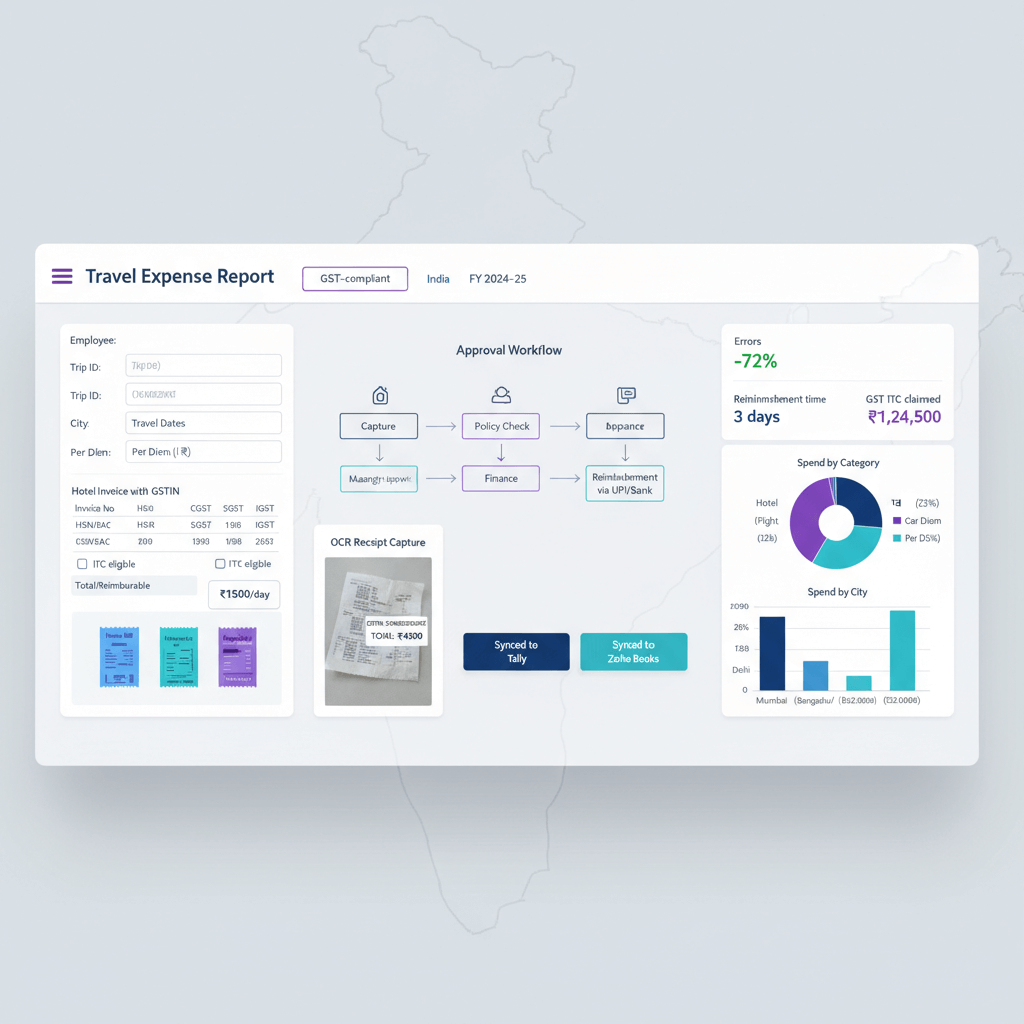
- Travel expense automation in India captures hotel bills, flight bookings, cab receipts, and per diem, then validates GST, classifies transactions, and syncs clean entries to Tally, cutting manual data entry by up to 80%.
- High accuracy OCR trained on Indian invoice formats extracts GSTIN, HSN/SAC codes, and place of supply, so ITC eligibility checks happen automatically instead of manually for every bill.
- Automated reconciliation links corporate card statements to underlying receipts, matches cab aggregator feeds to UPI and card entries, and posts consolidated entries without spreadsheet juggling.
- Per diem engines compute city slab allowances, handle half day rules, track advance settlements, and post forex gains or losses for international trips, all with audit ready documentation.
- Most Indian SMBs see positive ROI within 60 days: faster reimbursements, fewer GSTR mismatches, and hours saved each month on travel bookkeeping.
- Platforms like AI Accountant's bookkeeping automation handle India specific edge cases (mixed rate hotel invoices, IRCTC tickets, aggregator statements) that generic tools miss.
Travel Expense Automation in India: What's New in 2026
Until March 2025, GST e-invoicing applied only to businesses with turnover above ₹5 crore. From April 2025, the threshold dropped to ₹1 crore, pulling lakhs of additional SMEs into mandatory e-invoicing under CBIC's phased rollout plan. For travel expense workflows, this means every hotel chain and many mid sized service providers now issue e-invoices. Your automation must ingest and validate IRN (Invoice Reference Numbers) and QR codes on travel bills, not just extract line items.
The GSTN portal's improved GSTR-2B now reflects supplier filings faster, often within days instead of weeks. This tighter cycle means finance teams can run monthly GST reconciliation against travel expenses almost in real time, catching vendor mismatches before the filing deadline instead of during year end audits. Businesses still relying on manual matching risk missed ITC claims, penalties of up to 10% of tax due under Section 122, and interest at 18% per annum on delayed payments.
The 2026 shift hits CA firms managing multiple SME clients hardest. Each client may now have dozens of e-invoice enabled travel vendors, each needing IRN validation, place of supply checks, and ITC eligibility assessment. Firms still using spreadsheet based workflows face ballooning processing times.
What to do now:
- Confirm your expense system validates IRN and QR codes on hotel and service invoices.
- Run a GSTR-2B reconciliation against last quarter's travel expenses before the next filing deadline.
- Review vendor masters to flag suppliers who crossed the ₹1 crore threshold and should now issue e-invoices.
AI Accountant's extraction engine already parses e-invoice fields, including IRN and QR validation, alongside its existing GST and Tally sync workflows.
Understanding Travel Expenses in Indian Context
Travel expense automation India is not a luxury anymore. It is a necessity for Indian SMBs, CAs, CFOs, and founders who want clean books and faster reimbursements.
Hotel bills have accommodation, food, and services in one invoice, with multiple GST rates. Place of supply rules vary across states. Invoices from chains and independent hotels differ. ITC eligibility hinges on policy and the nature of services.
Flight invoices come from portals and airline desks. Base fare and convenience fees split differently. Cancellations and reschedules generate credit notes. International trips involve currency conversions.
Cab receipts are high volume. Invoices from aggregators arrive monthly. UPI and card entries need matching. Tips and tolls are separate. GST with TCS has to reflect correctly in your books.
Per diem depends on city slabs and timing. Half day rules apply. Advances must settle against claims. International allowances require forex accounting. Documentation must be audit ready.
Bottom line: Indian travel expense management is complex, but automation captures, validates, classifies, and syncs everything, reducing manual entry and cutting reimbursement delays.
Core Components of Travel Expense Automation India
Hotel Bill Processing Automation
Begin with digital capture of PDFs and images. Use OCR trained for Indian hotel formats to extract hotel name, GSTIN, room nights, food charges, HSN or SAC codes, and taxes. Automated validation checks GSTIN against the GST portal, confirms rate cards and line items, and flags ITC issues.
- Policy driven classification maps accommodation to a lodging ledger, food to meals, and services appropriately.
- Manager approvals happen digitally, then one click sync posts entries to Tally.
- Audit trails preserve the invoice, the approval, and the posting references.
Flight Booking Integration Systems
Capture invoices from portals, airline desks, and corporate feeds. Link PNRs to invoices for audit trails. Classify business versus economy based on policy. Handle credits, reschedules, and multi transaction splits automatically.
- Currency conversion applies for international fares. Documentation covers invoice, boarding pass, and payment record.
- Ledger mapping picks the right vendor, the right travel ledger, and the right tax treatment without manual intervention.
Cab Expense Tracking Solutions
Process aggregator statements in bulk. Ingest email receipts forwarded by employees. Match card or UPI transactions to actual rides.
Separate tips, tolls, and parking. Apply policy limits for airport trips versus local rides. Reflect GST or TCS correctly.
- Automated reconciliation (sometimes called transaction matching) reduces time from hours to minutes for cab heavy organizations.
- High volume rides remain compliant, properly documented, and accurately classified.
Per Diem Calculation Engines
Define city slabs for metro and tier two cities. Set half day rules by start or end time. Distinguish domestic and international rates. The engine computes allowances from itineraries, applies policy, and maintains documentation for audit.
- Track advances and settlements precisely. For example, an employee receives an advance, spends less, and the system posts the balance and any forex impact.
- Remember, per diem is an allowance, not a reimbursement. Tax implications vary, so keep approval and calculation logs intact.
Travel Spend Automation Tools and Platforms
Essential Travel Expense Software Features
When evaluating a platform, prioritize OCR accuracy on Indian documents, GST extraction, flexible policy mapping, robust reconciliation, and native Tally integration.
- AI Accountant — Purpose built for Indian SMBs, handles hotel bills, flight bookings, cab expenses, deep Tally sync, and India specific bank and GST formats.
- Zoho Expense — Strong receipt scanning and approvals, ideal for companies inside the Zoho ecosystem.
- SAP Concur — Enterprise grade, comprehensive travel booking integration, suitable for global operations.
- Happay — Corporate cards and expense management, prepaid cards and wallet flows.
- Fyle — Real time expense reporting, card feed integrations, effective email plugins for capture.
Look for Indian hotel chains and aggregator formats to parse correctly, IRCTC tickets to extract cleanly, and credit note workflows to reconcile automatically.
GST Compliant Travel Bookkeeping
Expense systems must understand ITC eligibility by category. Accommodation for business often allows ITC. Food may have restrictions. Place of supply rules matter for interstate stays. Flight tickets have distinct treatments for class and route.
As per GST Council recommendations, ITC on hotel accommodation is available when the stay is for business purposes and the invoice carries a valid GSTIN. However, food and beverages billed separately may face restrictions under Section 17(5) of the CGST Act.
- Automated GSTR reconciliation matches expenses to GSTR-2B, flags mismatches, and guides corrections.
- Compliance checks run continuously, improving audit readiness and reducing year end surprises.
Tally Travel Expense Sync
Sync should be bi-directional and near real time. Vendor masters flow from Tally. Discovered vendors flow back. Ledger mapping aligns with your chart of accounts. Cost centers or project tags move with expenses.
- Handle offline Tally sessions gracefully. Queue postings and resume without data loss.
- Map luxury versus budget hotels to separate ledgers if your analysis requires more granularity.
Implementation Roadmap for Indian SMBs
Week 1: Foundation and Setup
Document policy on day one. Define per diem slabs, approval matrices, and allowable categories. Set up ledgers in Tally for hotels, flights, local transport, and per diem. Then connect the expense system, import vendors, and create user profiles.
- Pilot with frequent travelers. Upload a batch of hotel bills across chains and cities. Review automated GST extraction and classification.
- Ingest one month of card and bank statements. Observe the reconciliation against receipts. Note exceptions for tuning.
Week 2: Refinement and Rollout
Tune category mapping, GST codes, and approval thresholds. Train approvers for mobile reviews. Set delegation rules. Run edge case tests such as cancellations, partial refunds, and international invoices.
- Reconcile aggregator statements against rides. Match card feeds against receipts. Confirm postings to the correct ledgers and cost centers.
- Go live next Monday with clear SLAs: employees submit within three days, managers approve within two days, finance pays within five days.
Compliance and Audit Considerations
GST Documentation Requirements
Validate GSTIN on every hotel invoice. Capture place of supply accurately. Separate food and room service with correct rates. Maintain clarity on ITC eligibility by category.
- Interstate hotel stays need careful treatment. The company GSTIN and hotel GSTIN may differ by state. Adjust filings accordingly per CBIC circulars on place of supply.
- Flight and cab taxes must be posted and reconciled so GSTR-2B and books remain aligned.
Audit Trail Maintenance
Preserve original receipts in a searchable repository. Log approvals with user and timestamp. Link travel requests to invoices, tickets, boarding passes, and payment records for end to end chains.
The Institute of Chartered Accountants of India (ICAI) emphasizes maintaining complete documentation trails for expense verification during statutory audits.
Complete documentation reduces audit queries, accelerates closing, and strengthens internal controls.
Advance Settlement Tracking
Monitor aging of travel advances. Post settlements within policy timelines. Handle forex differences between advance date and settlement date correctly.
- Set recovery rules for aged advances. Communicate transparently. Minimize manual reconciliations.
Measuring Success and ROI
Time Savings Metrics
Cut processing time per report from thirty minutes to under eight. Compress month end reconciliation from days to hours. Pay reimbursements within seven days.
Accuracy Improvements
Achieve over ninety percent first pass classification accuracy. Reduce GSTR mismatches toward zero. Keep documentation above ninety five percent completeness.
Visibility Enhancements
Provide real time dashboards by department, project, vendor, and category. Alert on budget variances above ten percent. Identify vendor savings opportunities.
Compliance Scores
Track audit queries year over year. Surface policy violations instantly. Optimize ITC claims while maintaining compliance and documentation quality.
Advanced Scenarios and Edge Cases
Multi Entity Organizations
Maintain entity level segregation for posting and compliance. Enable group level dashboards for consolidated visibility. Support intercompany cross charging when employees travel for sister entities.
International Travel Complexities
Convert foreign currency to INR using appropriate rates as per RBI reference rates. Accept international invoice formats. Classify visa fees, travel insurance, and forex charges separately for clarity.
Corporate Card Reconciliation
Match card statement merchants to invoices even when names differ. Support mixed usage of corporate and personal cards. Track disputes or chargebacks until resolution posts.
Group Bookings and Events
Split consolidated hotel or event invoices across employees. Tag shared cabs and group meals correctly. Break down travel management company statements to individual expenses for reimbursements.
Getting Started Today
Start with a pilot. Choose frequent travelers. Upload last month's expenses. Measure time saved. Tune policy mapping. Prioritize high volume transactions. Cab receipts are a great starting point, then extend to hotels and flights.
Do not wait for perfect policies. Begin with what you have, refine iteratively, and use analytics to find gaps. Pick your most painful workflows first. Hotel bill processing is a common quick win. Each automation step (receipt capture, approvals, accounting sync, and dashboards) delivers incremental value.
Most Indian SMBs reach positive ROI within sixty days, with fewer manual hours, consistent compliance, and faster reimbursements. For CAs, offer travel expense automation as a value added service. For CFOs, gain control and visibility. For founders, remove reimbursement anxiety and keep the team focused on growth.
For recurring reimbursement challenges, implement receipt capture and strict approval SLAs. To connect card statements to invoices, adopt corporate card ingestion and mapping. For handling pre trip funds, set policy around travel advances and settlement timelines.
The question is not whether to automate. The question is how quickly you can start. Begin with a one week set of hotel bills and a month's card statement. Experience the difference. Scale from there.
FAQ
How does travel expense automation work for Indian SMBs using Tally?
Travel expense automation captures hotel bills, flight invoices, and cab receipts via OCR, extracts GST details and line items, classifies them by policy, routes for digital approval, and syncs entries directly to Tally with correct ledger and cost center mapping. The entire cycle from receipt to ledger entry happens without manual data entry, and bi-directional Tally sync keeps vendor masters and chart of accounts aligned.
What is the recommended workflow to reconcile cab aggregator statements with card and UPI entries?
Ingest the monthly aggregator statement, auto link individual ride receipts from email, and match card entries (like OLA TRIP or UBER INDIA) and UPI transfers to rides by amount, date, and reference. Tips and tolls classify separately. Unmatched entries move to a reconciliation queue. This transaction matching approach reduces hours of spreadsheet work to minutes.
How do I treat flight cancellations and credit notes while maintaining an audit trail?
Record the original invoice, then post the credit note against the same vendor and PNR. Tie both to the travel request and payment record. Update the expense classification accordingly. For reschedules with fare differences, post adjustments with clear references. Maintaining PNR linking and document chains ensures auditors can trace every transaction end to end.
What are the GST implications for interstate hotel stays, and how should place of supply be verified?
When the company GSTIN and hotel GSTIN belong to different states, it is treated as interstate supply, and the place of supply is the hotel's location. ITC eligibility depends on whether the stay is for business purposes and whether the invoice is correctly issued. Validate GSTIN and address on every invoice, store evidence for audit, and reconcile with GSTR-2B. With the e-invoicing threshold now at ₹1 crore, most hotel chains issue IRN validated invoices (2026 update).
How do I manage travel advances, including forex differences for international trips?
Post advances to employee advance accounts, settle against actual expenses after the trip, and compute exchange rate differences between advance and settlement dates using RBI reference rates. Post forex gains or losses accordingly. Set reminders for aging and recovery after thirty days if unsettled. Clear logs of advance issuance, settlement, and any exchange impact keep the audit trail intact.
What metrics prove ROI on travel expense automation to management?
Track processing time per expense report, month end closing duration, reimbursement cycle in days, GSTR mismatch rate, first pass classification accuracy, and documentation completeness percentage. Department and project level dashboards, vendor savings insights, and year over year audit query reductions give management a clear picture of efficiency gains and compliance improvements.
Do I need to validate IRN and QR codes on travel invoices now?
Yes. From April 2025, businesses with turnover above ₹1 crore must issue e-invoices, which means most hotel chains and large service providers now include IRN and QR codes on their invoices (2026 update). Your expense system should validate these fields during ingestion to confirm authenticity, ensure ITC eligibility, and maintain compliance with CBIC requirements.

A results-driven finance and sales professional with hands-on experience through finance internships and a fast-paced sales role. With a strong interest in accounting and business finance, Harsh focuses on turning complex topics into clear, practical takeaways for founders and finance teams.