-01%201.svg)
Key takeaways
- Statutory compliance services keep GST, TDS, income tax, and ROC filings accurate and on time, protecting cash flow and credibility.
- A complete service includes reconciled books, a due date calendar, maker checker controls, storage of challans and acknowledgements, and clear dashboards.
- Most mistakes come from late book closure, scattered reminders, poor documentation, and skipped reconciliations, all fixable with a monthly workflow.
- For India, scope spans GST returns and e invoicing, TDS challans and returns, income tax and advance tax, payroll TDS, and ROC for eligible small companies.
- Non attest scope is standard, certification or statutory audits require a separate qualified engagement.
- A CA led managed model with a live dashboard, like AI Accountant’s Virtual Accounting, gives visibility, speed, and fewer notices.
- Track simple KPIs, on time filing rate, ITC variances, notices, and document turnaround for diligence.
Introduction to statutory compliance services
Statutory compliance services keep your business aligned with the law, with steady filings, timely payments, and tidy records across GST, TDS, income tax, and ROC. Done well, you avoid penalties, safeguard input tax credit, and build trust with banks and investors. This guide explains scope, process, tools, and how a CA led managed service with a dashboard brings it together.
For broad primers, see overviews on India compliance from SalaryBox and Commenda, both offer helpful context for due dates and obligations. SalaryBox guide, Commenda overview.
Statutory compliance definition and scope
Statutory compliance means you follow rules set by government statutes. In practice, it means correct filings, accurate payments, and proper records ready for checks and audits. In India, finance and tax requirements largely flow from GST, Income Tax, and the Ministry of Corporate Affairs.
- A reliable service sets a unified calendar, closes books monthly, performs reconciliations, files returns and challans, and stores proofs and acknowledgements.
- You get status visibility, what is due, what is filed, and what is pending.
Certification or attest work is separate, statutory audits need specific approvals and a different mandate, a managed service can prepare and support, but not issue attest reports unless separately engaged and qualified.
For further background, refer to India Briefing and Paysquare.
India specific scope for statutory compliance services
GST compliance
- Registration where applicable, e invoicing enablement when turnover or rules require it.
- GSTR 1, GSTR 3B, and annual returns GSTR 9 and 9C as applicable.
- Reconciliations with GSTR 2B, vendor data, and health checks on HSN, rates, place of supply, and reverse charge.
Deep dive on GST workflow and controls, GST compliance services.
TDS compliance
- Monthly TDS challan computations and payments.
- Quarterly returns like 24Q, 26Q, 27Q, plus forms 26QB, 26QC, 26QD.
- Form 16 and 16A issuance.
How end to end TDS is managed, TDS return filing services.
Income tax compliance
- Return filing for individuals, partnerships, and companies.
- Advance tax planning and payments, tax audit preparation support when applicable.
- International tax advisory for cross border income and Form 15CA for specified foreign remittances.
Payroll tax and salary structuring
- Monthly payroll TDS computations.
- Advice on employee friendly, compliant salary structures.
ROC and MCA compliance for small companies
- Annual MGT 7 and AOC 4, director KYC, DIN changes, and basic secretarial records.
- MSME filings for vendor dues where applicable, share allotments, board meetings and minutes, AGM support, and statutory registers.
Scope details, ROC and Secretarial Support. Note, scope here is limited to small companies as per MCA limits.
Out of scope
Attest and certification work like statutory audits require separate qualified engagements, the managed service can prepare schedules and support auditors, it does not issue attest opinions.
Helpful summaries, Commenda, SalaryBox, India Briefing.
Why statutory compliance services matter
Compliance is about cash and credibility, not just fines. Missed filings trigger late fees and interest, unreconciled purchases can forfeit input tax credit, improper TDS can lead to expense disallowance and notices. Refunds stall, leadership time is lost.
With steady compliance, banks process loans faster, investors find diligence smoother, and leadership trusts the numbers. Accurate, on time filings make the finance engine run cleaner so teams focus on customers, not paperwork. Good primers, SalaryBox, Commenda.
Common challenges in statutory compliance services
- Books not closed before returns, GSTR 2B, vendor ledgers, and books drift apart.
- TDS short payments or missed challans, leading to interest and strained vendor relations.
- Scattered reminders across email, chat, and sheets, something slips.
- Poor documentation, invoices and acknowledgements are hard to find when needed.
- Rushed e invoicing setup, place of supply and reverse charge errors creep in.
Fix the root causes, close books monthly, centralize the calendar, formalize maker checker, and keep documents in one searchable place.
Capabilities checklist for good statutory compliance services
- Unified due date calendar with proactive reminders by return and by entity.
- Monthly bookkeeping and ledger scrutiny, bank and payment gateway reconciliations.
- GST and TDS health checks with variance analysis and clear working papers.
- Accurate filings and challans with acknowledgment storage and audit trails.
- Central repository for returns, minutes, contracts, and registers.
- Dashboards that show filing status, risks, and insights for leadership.
- Advisory on HSN, rates, reverse charge, and place of supply, plus year end support.
- MIS for leadership and board reviews.
A dashboard first service like AI Accountant adds live views of revenue, expenses, cash flow, burn rate, and runway, plus AI insights and alerts.
See overviews from Commenda and SalaryBox.
Compliance calendar for statutory compliance services
Monthly and quarterly items
- GST, GSTR 1 and GSTR 3B as per scheme.
- TDS challans and payroll TDS.
- Vendor and GSTR 2B reconciliations.
Quarterly items
- TDS returns, 24Q, 26Q, 27Q.
Annual items
- GSTR 9 and 9C where applicable, income tax returns, tax audit preparation support, and ROC filings for eligible small companies.
Event based items
- GST registration, e invoicing enablement, Form 15CA, DIR 3 KYC, share allotments, and MSME disclosures.
Create one shared calendar, connect it to your dashboard, add maker checker steps, attach checklists, and store acknowledgements next to each task. Good references, Commenda, India Briefing.
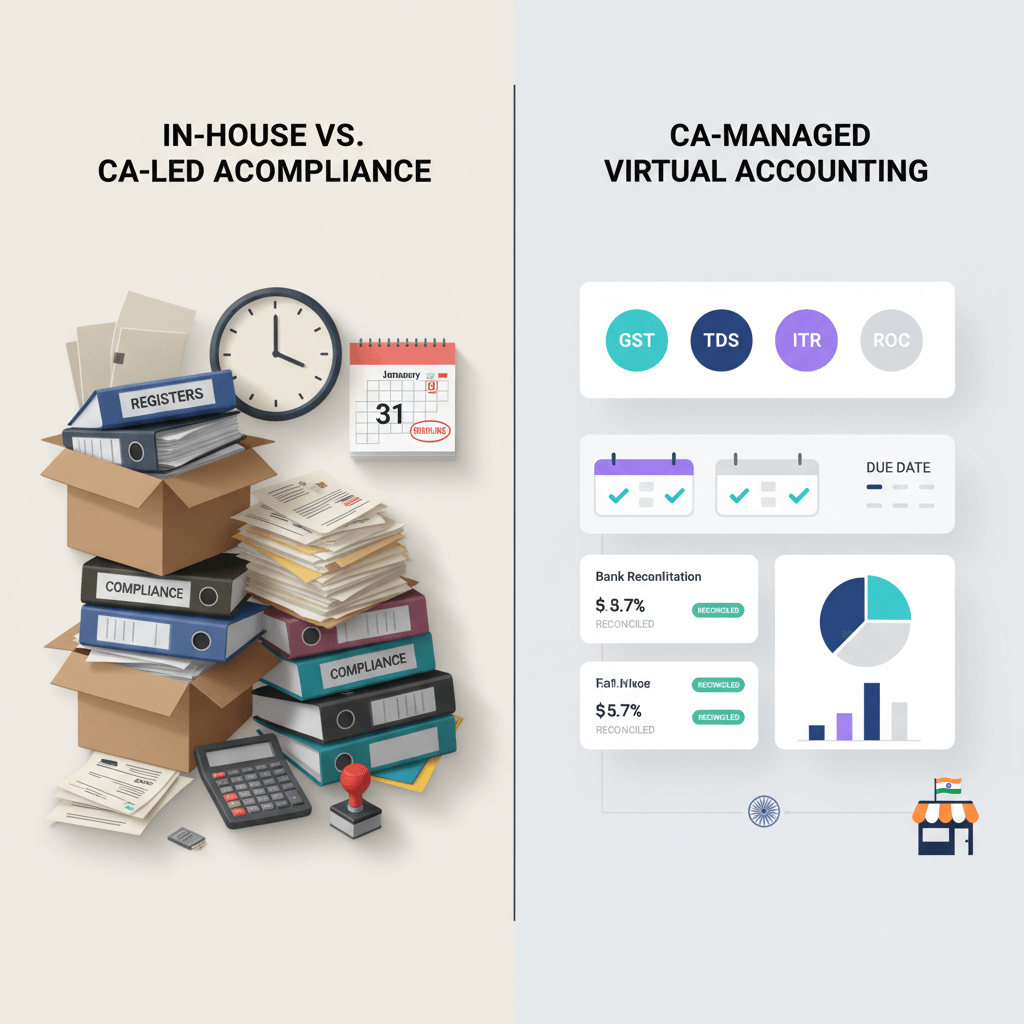
In house vs outsourced statutory compliance services
In house model
- Pros, full control and context, direct access to data and teams.
- Cons, expert staffing, tooling, reviews, and backups increase fixed costs.
- Best for, larger companies with complex operations and steady volumes.
Outsourced CA led model
- Pros, deep expertise, efficient processes, and easy scaling in peak seasons.
- Cons, daily visibility can feel lower without a strong dashboard.
- Best for, startups and SMEs that want strong compliance without a large team.
Hybrid model
- Pros, internal bookkeeping with external review and filing, combines context and oversight.
- Cons, more coordination and handoffs.
- Best for, growing teams with basic tools that want expert checks.
When evaluating partners, check scope, non attest limits, SLAs, dashboards, document control, and response times. See SalaryBox and Commenda.
Workflow setup for statutory compliance services
Step 1, foundation
- Clean chart of accounts, monthly close, reconciled bank and gateways, and AR or AP ageing reviews.
Step 2, integrations
- Bank feeds, payment gateway integration, e invoice integration, vendor GST validations.
Step 3, controls
- Maker checker approvals, exception handling ownership, variance thresholds and alerts.
Step 4, documentation
- Central storage for contracts, invoices, returns, challans, and minutes, with role based access and search.
Step 5, monitoring
- Dashboards for filings and payments, quarterly health checks for GST and TDS, and periodic ledger clean up.
Helpful summaries, Commenda, SalaryBox.
Monthly workflow example for statutory compliance services
Weeks 1 and 2
- Book sales, purchases, and expenses, reconcile bank and gateways, review AR and AP with ageing.
Weeks 2 and 3
- Prepare GST returns and TDS challans, variance checks with GSTR 2B and prior periods, run maker checker approvals.
By due date
- File returns and pay challans, store acknowledgements and confirmations.
Quarter end and year end
- File TDS returns, annual GST filings, income tax returns, and ROC submissions where applicable.
This cadence reduces rush, and makes audits and diligence easier. See Commenda for a concise view.
Tools for statutory compliance services and bookkeeping
- AI Accountant, a managed service with a live dashboard, aiaccountant.com.
- QuickBooks Online, Xero, TallyPrime, Zoho Books, and FreshBooks.
Choose tools that support clean books, reconciliations, and filings. A managed model adds a CA team on top for reviews and filings.
AI Accountant Virtual Accounting for statutory compliance services
AI Accountant’s Virtual Accounting pairs a dedicated CA team with a live dashboard. You see revenue, expenses, profit and loss, balances, and cash flow, plus burn rate and runway. You get alerts and AI insights, and can chat with the CA team. Compliance timelines and filing status are visible at a glance.
The team manages monthly bookkeeping, reconciliations, and year end close support. They handle GST registration, GSTR 1, GSTR 3B, GSTR 9 and 9C where applicable, e invoicing, and GST health checks. They manage TDS advisory and compliance, monthly challans, quarterly returns like 24Q, 26Q, and 27Q, and forms 26QB, 26QC, 26QD. They support income tax returns, advance tax, tax audit preparation support, international tax, expat tax, salary structuring, and Form 15CA preparation. For small companies, they support MGT 7, AOC 4, DIR 3 KYC, DIN changes, MSME filings, share changes, board meetings and minutes, AGM support, and statutory registers.
Scope is non attest, for statutory audits or certifications, use a separate qualified engagement, ROC support applies to small companies as per MCA limits.
Good background readings, SalaryBox, Commenda, India Briefing.
Case vignette and KPIs for statutory compliance services
A venture backed startup used separate vendors for GST, TDS, and payroll, due dates lived in spreadsheets, documents were scattered across email. Notices and late fees piled up, refunds were delayed. After moving to a CA led managed service with a dashboard, they standardized the chart of accounts, established weekly bank and gateway reconciliations, embedded due dates and checklists in the dashboard, ran maker checker approvals, and centralized documents with role based access. Within a quarter, filings were on time, variances reduced, and diligence for the next round was smooth. Zero penalties, one source of truth.
Track a few KPIs to keep this level.
- On time filing rate across GST, TDS, income tax, and ROC.
- Variances between books and GSTR 2B or vendor ledgers.
- Ageing in AR and AP.
- Number of notices received.
- Time to provide documents for diligence or audit.
See primers, SalaryBox, Commenda.
Practical checklist to start statutory compliance services this month
- Make or clean your chart of accounts, then close the last month and reconcile bank and gateways.
- Map vendors to GSTIN and confirm GSTR 2B capture, set a due date calendar for GST, TDS, ITR, and ROC.
- Define maker checker steps for every filing, centralize documents and assign access.
- Set a weekly review rhythm for AR, AP, and cash, choose your operating model, in house, outsourced, or hybrid.
- If outsourcing, align on SLAs, dashboard access, and scope limits, schedule quarterly health checks for GST and TDS.
- Document your process so new team members onboard quickly.
Reference guides, Commenda, SalaryBox.
Wrapping up statutory compliance services
Statutory compliance services are the backbone of clean operations. With a single calendar, clear roles, reconciled books, and a central repository, you reduce risk and save time. A CA led managed service with a strong dashboard, such as AI Accountant, combines expertise and visibility so you spend less time chasing filings and more time building the business.
If you pick only three actions this week, do these, close and reconcile last month, set your due date calendar in one place, centralize your documents. The stress drops immediately. See overviews at Commenda and SalaryBox.
Next steps for statutory compliance services
- Book a demo to see how the AI Accountant dashboard streamlines filings, payments, and documents.
- Request a free compliance health check to find gaps in GST, TDS, and ITR.
- Download the India Compliance Calendar and Checklist for your team.
Important notes, scope is non attest, ROC services apply to small companies as per MCA, for tailored advice, speak with a qualified CA.
FAQ
What exactly is covered in statutory compliance services versus bookkeeping, and why separate the two?
Bookkeeping records transactions, sales, purchases, expenses, and bank entries. Statutory compliance services convert those records into filings and payments, GST, TDS, income tax, and ROC. Separating the two improves control and accuracy, the books are the data source, compliance is the legal outcome. For a simple explainer, see SalaryBox and Qandle. AI Accountant combines both under a managed model, while keeping reviews distinct with maker checker.
Which filings are non negotiable for freelancers, early stage startups, and small companies in India?
Freelancers may need GST if above threshold or as per client requirements, plus income tax returns, and possible TDS when paying contractors. Startups usually need GST and income tax, and if they are companies, MCA or ROC duties. Small companies under MCA limits must file MGT 7 and AOC 4, along with director KYC. See Commenda for a concise scope map. AI Accountant’s dashboard shows due items by entity and status in one place.
How does a CA led, AI enabled managed service reduce GST notices and ITC loss?
Three things matter, monthly closure discipline, two way reconciliations with GSTR 2B and vendor ledgers, and clear documentation. AI Accountant’s Virtual Accounting enforces monthly close, runs reconciliations with variance alerts, and stores challans and acknowledgements alongside returns, which limits ITC leakage and reduces the chance of GST notices.
What controls should I insist on, especially if I outsource?
Insist on maker checker approvals for all filings, a single due date calendar, variance thresholds for reconciliations, and a central document repository. Ask for audit ready working papers and a dashboard that tracks what is due, what is filed, and what failed. AI Accountant implements these controls by default and shows evidence in the dashboard.
What are typical onboarding steps and timelines for a managed service, can we start mid year?
Onboarding usually takes one to two weeks, provide prior books, bank statements, GST and income tax credentials, and basic master data. The team sets up the calendar, integrations, and checklists. Mid year starts are fine, opening balances and historical reconciliations are scoped as a short project, followed by steady state. Sources like Commenda outline the essentials.
How do e invoicing thresholds and place of supply rules affect my setup?
When turnover or government notifications trigger e invoicing, you must enable and test it before go live. Place of supply, HSN, and reverse charge checks must align to your business model. AI Accountant performs a GST health check at onboarding, validating HSN codes, tax rates, and place of supply logic, and then monitors exceptions monthly. See a GST overview here, GST compliance services.
What TDS mistakes create the biggest downstream pain for vendors and for assessments?
Common issues are wrong sections, short deduction, missed challans, and late or incorrect Form 16A issuance. These lead to interest, vendor escalations, and reconciliation problems during assessments. AI Accountant automates monthly TDS computations and challans, and manages quarterly returns like 24Q and 26Q, reducing errors and notices. Learn more at TDS return filing services.
Can a managed service integrate with our Tally or cloud accounting, and still give us live dashboards?
Yes, most providers work with Tally, QuickBooks, Xero, Zoho Books, or FreshBooks. The key is clean mapping, consistent import or API flows, and monthly reconciliations. AI Accountant adds a live dashboard that reads from your ledger and reconciliations, showing filings and cash metrics in one view.
How is data security handled, especially for challans, returns, and board minutes?
Expect encrypted storage, role based access, and audit logs, with central repositories for documents and registers. Access and approvals should be tied to the maker checker process. AI Accountant maintains a segregated document library with traceable access history, improving readiness for diligence and audits. See broad context in Commenda.
What does non attest scope practically mean for audits and certifications?
Non attest means the managed service prepares books, schedules, and filings, but does not issue statutory audit or certification opinions. For that you appoint a separate, qualified auditor. AI Accountant works with your auditors, provides schedules and working papers, and supports queries, while the audit opinion remains independent. See India Briefing for audit context.
How should we budget for statutory compliance services, and what variables move the price?
Pricing depends on the number of entities, transaction volume, return types, international tax complexity, and advisory needs. Data clean up or migration is usually a one time project, steady state is a monthly fee. AI Accountant provides tiered plans with defined SLAs and dashboard access so finance heads can forecast expenses confidently.
What KPIs should founders and finance heads track monthly to confirm compliance health?
Track on time filing rate, GST ITC variances from GSTR 2B, TDS challan timeliness, number of notices, AR or AP ageing, and document turnaround time for diligence. AI Accountant’s dashboard highlights these KPIs, and triggers alerts when thresholds are breached, helping you course correct quickly.
How does AI Accountant compare to a traditional, hourly CA engagement for ongoing compliance?
A traditional model often relies on email and spreadsheets, which reduces visibility and response speed. AI Accountant’s Virtual Accounting offers a dedicated CA team plus a live dashboard that centralizes filings, approvals, and documents, giving leadership continuous clarity with fewer handoffs. This improves accuracy, saves time, and reduces risk month after month.
Can we get ROC and secretarial support as part of the same engagement, and what are the limits?
Yes, for small companies as per MCA limits, you can bundle ROC filings like MGT 7 and AOC 4, DIR 3 KYC, basic registers, and minutes. If you are outside small company limits, scope and pricing change, and some items may require specialized company secretary engagements. See details at ROC and Secretarial Support.
If we receive notices, who responds and how quickly can we close the loop?
Response depends on the notice type, data readiness, and whether the engagement includes representation. With well organized books, reconciliations, and document repositories, notices are easier to address. AI Accountant provides first level analysis, documentation collation, and coordinates with your CA or counsel for representation if required, timelines are tracked in the dashboard until closure.