-01%201.svg)
Key takeaways
- Scenario planning models multiple cash flow futures (best case, worst case, base case) instead of relying on a single forecast, helping you prepare for payment delays, GST refund holdups, and seasonal swings.
- Sensitivity analysis isolates high impact variables like collection periods or supplier terms, so finance teams know exactly where to focus attention.
- Monte Carlo simulations run thousands of probability based outcomes, giving you an 80/15/5 style confidence map rather than one fragile number.
- Indian SMBs face unique volatility from B2B payment delays, TDS deadlines, and Diwali demand spikes, making multi scenario modeling a practical necessity, not a luxury.
- CAs who offer scenario based advisory shift from compliance work to strategic counsel, commanding higher fees and stronger client retention.
- Automating transaction extraction and categorization eliminates the spreadsheet bottleneck. AI Accountant's bookkeeping automation handles the repetitive data work so teams can focus on building and updating scenarios.
Cash Flow Scenario Planning: What's New in 2026
Until early 2025, most Indian SMBs treated scenario planning as an annual budgeting exercise. That's shifted. Two regulatory changes in 2025–2026 have made multi scenario cash flow modeling a near daily concern for finance teams.
First, the GST e-invoicing threshold dropped from ₹5 crore to ₹1 crore (effective August 2023 per CBIC Notification No. 10/2023), and ongoing discussions in the GST Council point toward further threshold reductions in 2026. This pulls a larger pool of smaller businesses into real time compliance, meaning cash flow timing around ITC claims and refund cycles now demands scenario level attention, not just a single estimate.
Second, the RBI's tighter KYC and digital payment reporting norms (outlined in RBI's Master Direction on KYC) have increased reconciliation workloads for businesses processing high volumes of UPI and bank transfers. Finance teams that previously reconciled monthly now need weekly or even daily matching to avoid compliance flags.
Who it hits hardest: SMBs in the ₹1–10 crore turnover band and CA firms managing 20+ such clients. These businesses often lack dedicated treasury teams, yet they now face the same reconciliation expectations as larger firms.
Cost of inaction: Missed e-invoicing compliance triggers penalties of ₹10,000 per invoice (or 100% of tax due). Delayed ITC claims from poor reconciliation directly squeeze working capital, exactly the scenario where a worst case cash flow model would have flagged the risk months earlier.
What to do now:
- Audit your current e-invoicing threshold status and confirm your IRN generation workflow is active.
- Shift reconciliation from monthly to at least fortnightly. Platforms that automate GST reconciliation cut this cycle from days to minutes.
- Build or update your base, best, and worst case cash flow models to reflect the new refund and compliance timelines.
What Is Scenario Planning for Cash Flow?
Scenario planning for cash flow is a systematic process to model how different situations might affect your money coming in and going out. Instead of creating one forecast and crossing your fingers, you build multiple models that account for various possibilities.
Think of it like planning a wedding in India. You plan for 250 guests, 300 guests, and even 350 guests to cover all outcomes.
The process tests how changes in key variables affect your cash position. What happens if your biggest customer pays 60 days late instead of 30? How does a delayed GST refund impact your ability to pay suppliers? These questions get answered before they become emergencies.
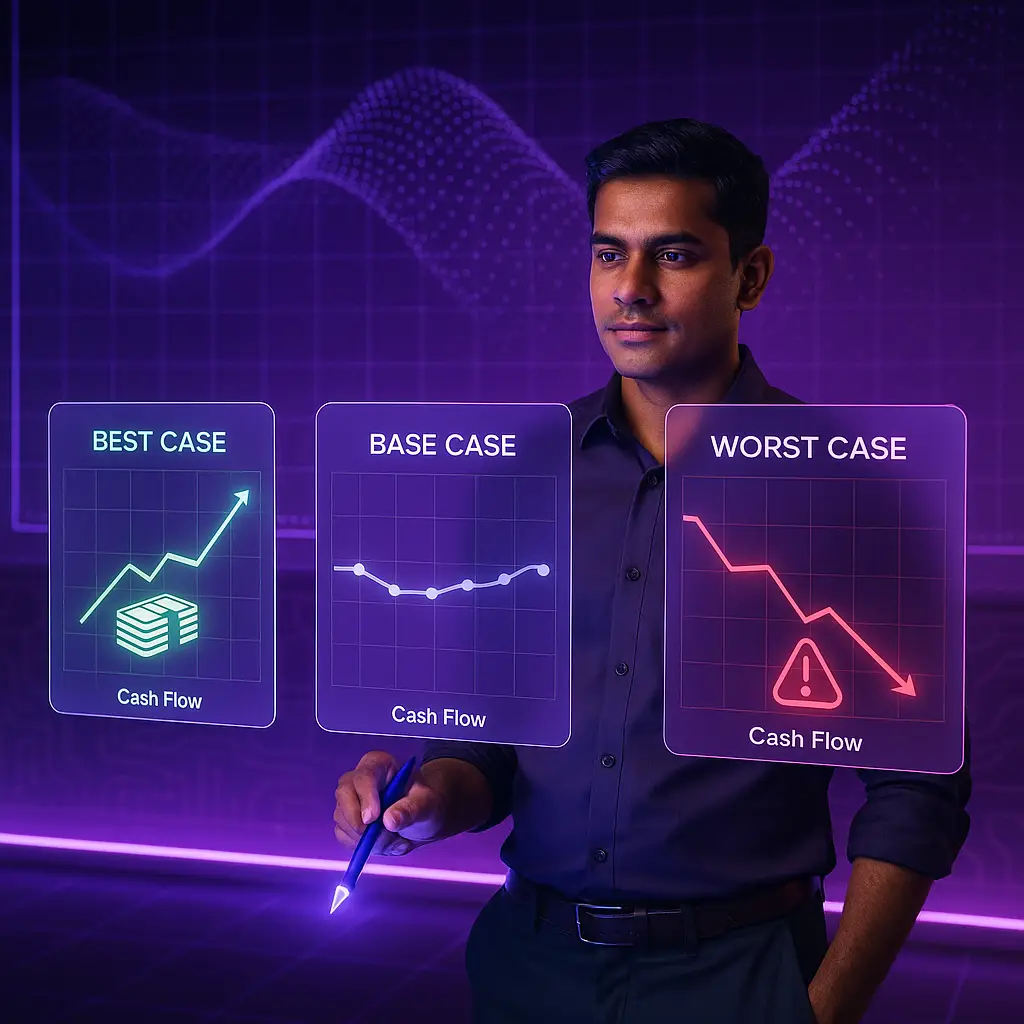
Common scenario types include best case, worst case, and base case. Each helps you understand different aspects of financial risk and opportunity.
Scenario Planning vs Traditional Forecasting
Traditional cash flow forecasting builds one probable outcome from historical trends. It works well in stable, short term settings (say, a quarter ahead) but assumes the future looks like the past. Scenario planning flips this by stress testing strategies across multiple plausible futures, including disruptions.
| Aspect | Traditional Forecasting | Scenario Planning |
|---|---|---|
| Focus | Single probable outcome based on past data | Multiple futures, including disruptions |
| Best use | Predictable settings, short term (under 1 year) | Uncertain, long term resilience (multi year) |
| Risk handling | Assumes trends continue; vulnerable to surprises | Stress tests for supply chain issues, policy changes, payment delays |
| Output | One estimate (e.g., 5% sales growth) | Narratives with contingencies (e.g., revenue under competitive pressure) |
The two approaches work best together. Use traditional forecasting for your operational budget and scenario planning to prepare for what the budget doesn't cover. As noted by Financial Models Lab's analysis on scenario planning advantages, this combined approach reveals strategy weaknesses, supports flexible resource allocation, and improves cross functional decision making.
Why Scenario Planning Matters for SMBs and CAs in India
Indian businesses face unique cash flow volatility that makes scenario planning essential. Customer payment delays are notorious, with many B2B companies struggling with high days sales outstanding. Meanwhile, government payments often take months to materialize.
The regulatory calendar adds complexity. TDS deadlines, GSTR filing dates, and payroll obligations don't wait for customer payments. Seasonality hits hard too: Diwali spikes and summer lulls challenge single point forecasts.
"For chartered accountants, scenario planning transforms your role from compliance focused to strategic advisory."
This advisory capacity commands premium fees and builds stronger client relationships. The benefits extend beyond risk management. Scenario planning uncovers opportunities like optimized equipment purchases or better supplier negotiations.
For SMBs in the ₹1–10 crore band, even a single delayed receivable can cascade into missed vendor payments. Modeling that delay as a worst case scenario, complete with the interest cost of emergency financing, turns a vague worry into a concrete contingency plan. According to ICAI, advisory services built on data driven insights are a key growth area for CA practices.
Best Case, Worst Case Cash Forecast Examples
Best case scenarios represent everything going right: early Diwali orders, receivables within 30 days, surprise GST refunds, stable raw material costs, and ahead of schedule production. The company can invest in inventory or expand into new markets.
Worst case flips this: export payment delays, largest customer extending terms from 30 to 90 days, cotton price spikes, and three month GST refund holdups. Cash flow turns negative, forcing deferred supplier payments or emergency financing.
Base case sits in the middle. It aligns with current trends but tests minor shifts, like your average collection period drifting from 45 days to 60 days. This is the scenario you'll use most often for operational planning.
These examples show why single forecasts fail. The gap between best and worst case can spell expansion or survival.
Sensitivity Analysis for Finance Teams
Sensitivity analysis tests how changes in single variables impact overall cash flow. For example, a Bangalore consulting firm with a 45 day average collection period can model what happens if this shifts to 30, 60, or 75 days. Each change gets isolated while other factors remain constant.
- Identify critical levers: customer payment timelines, supplier credit terms, GST refund delays, employee cost inflation.
- Set monitoring thresholds: alerts trigger when payments exceed tested parameters.
- Prioritize management attention: focus on variables with the greatest cash flow impact.
The key insight from sensitivity analysis is prioritization. Not every variable matters equally. A 15 day shift in receivables might swing your cash position by ₹12 lakh, while a 5% change in utility costs barely registers. Knowing this lets you allocate attention where it counts.
What If Analysis in Cash Budgeting Explained
What if analysis answers specific hypothetical questions. Unlike sensitivity analysis, which tests variables systematically, what if analysis explores particular events or opportunities.
Examples:
- "What if our largest customer defaults on a ₹50 lakh invoice?"
- "What if GST refunds get delayed by six months?"
- "What if we extend payment terms to 60 days and sales increase by 30%?"
- "What if we lose our second largest vendor and onboarding a replacement takes 45 days?"
This quantifies risk and opportunity in concrete terms, enabling informed decisions rather than vague concerns. The output is a clear number: "If refunds are delayed six months, we need ₹18 lakh in bridge financing by March." That's actionable.
Using Monte Carlo Cash Flow Models for Deeper Planning
Monte Carlo models simulate thousands of outcomes using probability distributions for variables like payment timing, cost fluctuations, and seasonal demand. The result is a probability map of cash positions rather than fixed scenarios.
"80% chance of positive cash flow, 15% chance of minor shortfalls, 5% risk of liquidity problems."
These models require quality historical data. Clean, categorized transaction histories are the foundation. Garbage in, garbage out applies with particular force here. If your ledger entries are inconsistent or your vendor invoice records are incomplete, the simulation outputs will be misleading.
For companies facing high uncertainty (exporters dealing with currency swings, manufacturers with volatile raw material costs), Monte Carlo simulations provide unmatched insight. They don't replace the simpler three scenario approach; they layer on top of it for teams ready to go deeper.
How Scenario Planning Works with AI Accountant
Manual scenario planning is time consuming and error prone. Spreadsheet models break when assumptions change. AI Accountant automates foundational work:
- Ingests bank statements (PDF, Excel, CSV, scanned images) via OCR and NLP.
- Automatically categorizes transactions with GST codes and vendor IDs.
- Integrates bidirectionally with Tally for live data sync.
- Updates visual dashboards instantly when scenario assumptions change.
This turns dedicated analyst tasks into click and play capabilities for finance teams of any size. Collaboration improves when management reviews dashboards rather than buried spreadsheets.
Final Takeaways
Scenario planning for cash flow is now an essential survival skill for Indian SMBs. Begin with simple best, worst, and base case models. As data quality and capabilities improve, advance to sensitivity, what if, and Monte Carlo analyses. Consistent application beats perfect models. Regular updates build resilience.
Chartered accountants who master these techniques shift from compliance roles to strategic advisory, commanding premium fees and stronger client relationships. The tools and techniques exist today: the real question is whether you can afford not to adopt them.
FAQ
How can a CA introduce scenario planning to a client using AI tools?
Start by uploading the client's bank statements into an automated platform that categorizes transactions and builds dashboards. With clean data in place, build best, worst, and base case models in a single sitting. Schedule monthly review sessions to keep assumptions current and demonstrate ongoing value.
What variables are most critical in an Indian SMB cash flow model?
Customer payment timelines and GST refund delays are typically the two highest impact variables. Supplier credit terms, payroll schedules, and seasonal revenue swings (like Diwali demand spikes) round out the top five. Sensitivity analysis helps you rank these for your specific business.
How does Monte Carlo differ from traditional scenario planning?
Monte Carlo runs thousands of simulations using probability distributions for each variable, producing a probability map of outcomes (e.g., 80% chance of positive cash flow). Traditional methods build a few fixed scenarios (best, worst, base). Monte Carlo layers on top of traditional planning for teams that need deeper risk quantification.
Is advanced scenario planning feasible for small finance teams?
Yes. Automated platforms handle data ingestion, classification, and dashboarding, making sophisticated modeling accessible without dedicated treasury staff. A two person finance team can run Monte Carlo simulations if their underlying data is clean and categorized.
How often should scenario forecasts be updated?
Monthly updates are a good starting point. Industries with high volatility (exports, manufacturing with commodity inputs) or periods of regulatory change should move to fortnightly or weekly reviews. (2026 update) With e-invoicing thresholds dropping and GST reconciliation cycles tightening, more frequent updates are becoming standard practice.
What examples show ROI from scenario planning?
A textile exporter avoided a ₹20 lakh emergency loan by preparing for delayed export payments through worst case modeling. A manufacturing client negotiated better supplier terms after demonstrating multiple cash flow outcomes to their bank. These are typical returns: avoided financing costs and improved negotiating leverage.
What is the difference between scenario planning and forecasting for cash flow?
Forecasting produces one probable outcome based on historical trends, ideal for short term budgeting in stable conditions. Scenario planning models multiple plausible futures, stress testing for disruptions like payment defaults or regulatory changes. The two work best together: forecasting for your operating budget, scenario planning for everything the budget doesn't cover.

A results-driven finance and sales professional with hands-on experience through finance internships and a fast-paced sales role. With a strong interest in accounting and business finance, Harsh focuses on turning complex topics into clear, practical takeaways for founders and finance teams.