-01%201.svg)
Key takeaways
- Profit and loss analysis turns numbers into action, it is a monthly habit that sharpens pricing, trims waste, and extends runway.
- Use accrual accounting and fair revenue recognition, this makes margins reliable and comparisons meaningful.
- Structure your P and L with clean buckets, keep direct delivery costs in COGS and normalize one time items.
- Combine vertical and horizontal analysis with unit economics, then link profit to cash, burn, and runway.
- A tight close checklist and reconciliations first, always, produce trustworthy insights and reduce audit risk.
- AI enabled Virtual Accounting, like AI Accountant, blends CA led execution with a live dashboard, so you get clean books and timely analysis in one place.
Introduction to profit and loss analysis
Profit and loss analysis is more than glancing at a P and L once a quarter, it is a simple, repeatable review of revenue, costs, and profit that guides better decisions. Whether you are a freelancer, a startup, or a growing SMB, an intentional monthly review helps you tune pricing, control spend, win investor trust, and extend runway. With clean books and rhythm, patterns surface early, leaks get fixed fast, and growth compounds with confidence. See primers and founder guides at MAccelerator, Chalifour Consulting, Oplin, and Founders CPA.
Think of your P and L as a map, not a mirror. It should show where to go next, not just where you have been.
What is profit and loss analysis
A profit and loss statement, the income statement, shows revenue minus expenses for a period. Profit and loss analysis reads the story behind those numbers, where profits arise, where costs creep, and which trends strengthen or fade, then turns raw figures into action.
- Revenue, total sales and other income.
- COGS, direct costs to deliver your product or service.
- Gross profit, revenue minus COGS, the fuel for operations.
- Operating expenses, rent, payroll, marketing, software, admin.
- Operating income or EBITDA, gross profit minus operating expenses.
- Depreciation and amortization, the spread of big asset costs across time.
- Interest and taxes, which lead to net profit, the bottom line.
Two ideas anchor good analysis:
Cash versus accrual, accrual books income when earned and costs when incurred, matching effort and outcome. Revenue recognition, record income when value is delivered, then match related costs in the same period so margins are fair. Helpful reads at MAccelerator, Oplin, Digits, and Founders CPA.
P and L structure for profit and loss analysis
A clear chart of accounts is the backbone. Separate revenue streams, discounts, refunds, COGS items, and each operating expense line. Keep shipping, payment gateway fees, and commissions in COGS when directly tied to sales. Keep software, rent, and salaries in operating expenses. Capital assets go to the balance sheet, then depreciate monthly. Stay consistent month to month so trends are real. See guidance at MAccelerator and Founders CPA.
Cash versus accrual in profit and loss analysis
If you sell on credit, cash accounting can mislead, sales look high when invoices go out, cash lags, and large annual prepayments distort costs. Accrual accounting fixes this by booking revenue when earned and costs when used. This stabilizes gross and net margin for smarter planning. Read more at AI Accountant and MAccelerator.
How to perform profit and loss analysis step by step
Use this monthly loop to turn your P and L into a working tool.
- Data hygiene first
- Update bookkeeping for the month, record all sales, purchases, and expenses.
- Reconcile banks, cards, wallets, and gateways, match statements to entries, see AI Accountant.
- Keep GST out of revenue and expenses, treat GST as collection and credit.
- TDS is a liability until adjusted against Form 26AS.
- Post discounts and refunds to the right lines.
- Pick clear time frames
- Review month to date and full month.
- Look at quarter to date and quarter.
- Build a trailing twelve months view to smooth noise.
- Normalize and adjust
- Remove one time items like a legal claim or a grant.
- Reclass capital items from expenses to assets.
- Normalize founder pay to a market rate.
- Do vertical analysis
- Convert each line into a percent of revenue.
- See how much each rupee of sales funds each cost.
- Compare months even as revenue grows.
- Do horizontal analysis
- Review month over month, quarter over quarter, and year over year change.
- Spot seasonality, step changes, and drift.
- Review margins and ratios
- Gross, operating, and net margins, trend them.
- Expense ratios, payroll percent of revenue, marketing percent of revenue.
- Revenue per employee and profit per customer where relevant.
- Check unit economics by model
- SaaS, ARPU, churn, LTV, CAC payback.
- E commerce, basket size, returns, shipping, and payment fees in COGS.
- Services, bill rates, utilization, pass through costs.
- Do variance analysis
- Compare actuals to budget or forecast.
- Explain the top three gaps with owners and dates.
- Run break even and sensitivity checks
- Find sales needed to cover fixed and variable costs.
- Test price, discount, and cost changes for margin impact.
- Link profit to cash
- Profit does not equal cash, watch AR, AP, and inventory.
- Compute burn rate and runway from cash flow, see AI Accountant.
Pro tip, focus on three actionable insights each month, price, mix, or spend, and assign owners with dates.
Industry specific nuances for profit and loss analysis
SaaS and software
- Capitalize eligible development costs where appropriate, then amortize.
- Use deferred revenue for upfront annual plans, recognize over the service period.
Primer, G Squared.
E commerce and D2C
- Keep shipping, packaging, payment gateway fees, and returns in COGS.
- Track discounts and promotions to show true net revenue.
Reference, Founders CPA.
Services and freelancers
- Track time by project with utilization.
- Treat subcontractors and other direct delivery costs as COGS.
Reference, Founders CPA.
Manufacturing
- Apply absorption costing properly.
- Allocate overhead and WIP to inventory until sold.
Reference, Founders CPA.
Common mistakes in profit and loss analysis
- Mixing GST or TDS into revenue or expenses
- Keep GST outside the P and L, treat TDS as a liability until offset.
- Reconcile GST returns and bank statements to avoid distortion.
- Recording capital spend as operating expense
- Move laptops, machines, and furniture to fixed assets, then depreciate.
- Ignoring one time items
- Adjust unusual items, keep a clear bridge of changes.
- Missing gateway and shipping fees
- Post them to COGS so gross margin is real.
- Reviewing without reconciliations
- Reconcile first, analyze second, messy data leads to bad calls.
- Chasing top line without unit economics
- Pair growth with margin targets and CAC payback.
Actionable monthly checklist for profit and loss analysis
- Close the month by day five.
- Reconcile all banks, wallets, and gateways.
- Check revenue recognition and discount treatment.
- Run vertical and horizontal analysis.
- Review gross, operating, and net margins against targets.
- Investigate the top three variances, record root cause and actions.
- Update the forecast and cash runway.
- Document insights and decisions for next month.
References, MAccelerator, Founders CPA.
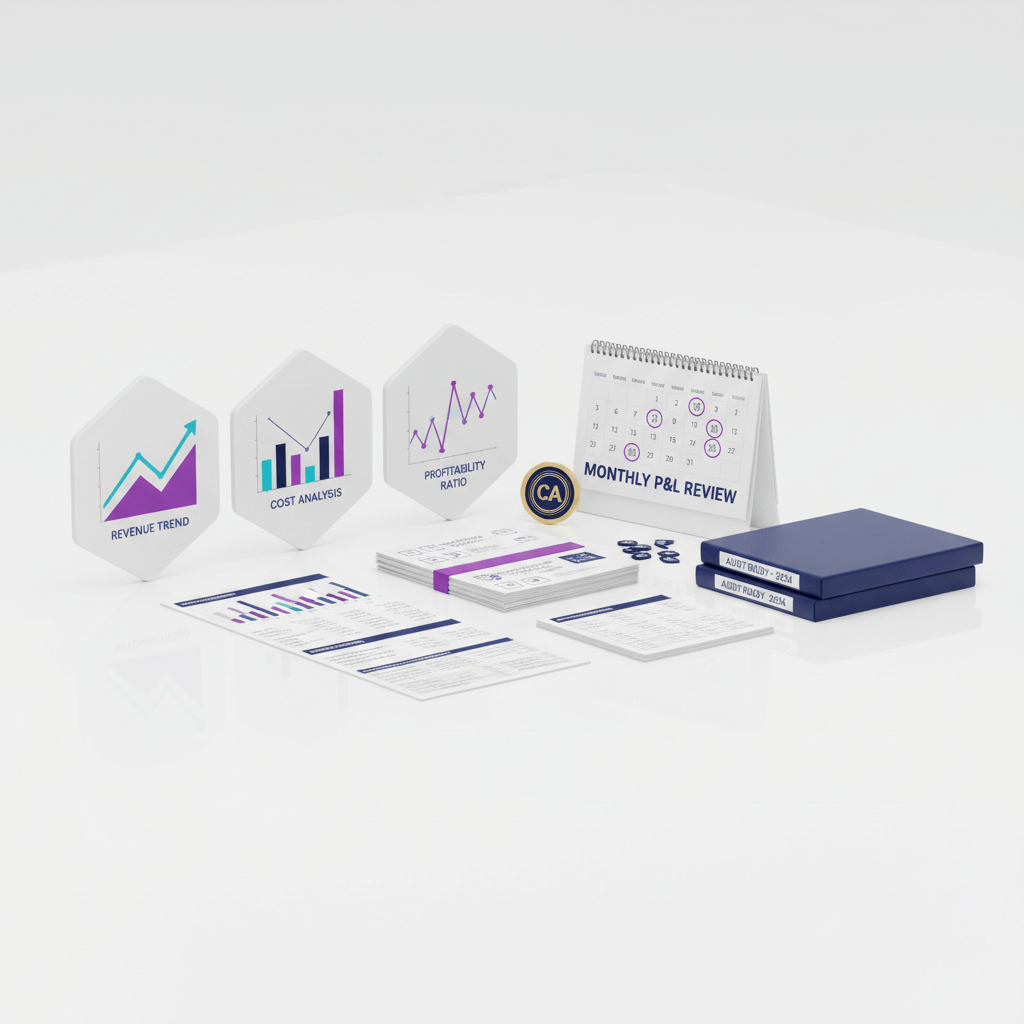
Visuals and reports for profit and loss analysis
- Common size P and L, each line as a percent of revenue.
- Trend lines for gross, operating, and net margin.
- Expense heat map to spot costs that outrun revenue.
- Break even chart, sales needed to cover fixed costs.
- Budget versus actual waterfall to explain the profit gap.
Helpful inspirations, MAccelerator, Oplin.
Mini case example profit and loss analysis
A D2C startup moved shipping and payment fees into COGS, then saw gross margin slide from 38 percent to 32 percent across three months. Root cause, carrier rate creep and overuse of free shipping. Fixes, pause blanket offers, add a price floor, renegotiate with two vendors, and lift average order value with bundles. Result, gross margin rose to 46 percent in two months, runway extended by three months. Source, Founders CPA.
How AI Accountant Virtual Accounting supports profit and loss analysis
Profit and loss analysis works only when data is clean and compliance is tight. AI Accountant blends CA led execution with an AI powered dashboard so you get accuracy, speed, and insight in one place.
What you get in the dashboard
- Financial overview with revenue, expenses, P and L, and balances.
- Category breakdowns to track trends.
- Cash flow trends with burn and runway.
- AI insights and alerts when margins drop or costs creep.
- Recent transactions with bank statement analysis.
- Document vault and live compliance calendar.
- Chat with your CA team to close loops fast.
What the CA team delivers
- Monthly bookkeeping with bank, wallet, and gateway reconciliations.
- Ledger review and cleanup.
- Year end closing, schedules, and fixed asset register.
- Inventory records and reconciliation where relevant.
- Accounts receivable and payable management.
- GST registration and filings, GSTR 1, GSTR 3B, GSTR 9, GSTR 9C.
- TDS advisory, challans, and return filings.
- Income tax returns with advance tax planning.
- Support for tax audits, international tax, and expat structures.
- Payroll TDS computations and salary structure advisory.
- ROC filings for small companies where applicable.
The outcome is simple, monthly reliable P and L analysis with clean GST and TDS treatment, faster decisions, and lower audit risk. Learn more at AI Accountant.
Practical tips and quick wins for profit and loss analysis
- Standardize the chart of accounts by business model, keep it simple.
- Separate discounts, refunds, shipping, and gateway fees to reveal true gross margin.
- Set soft caps for operating expenses, trigger alerts when a percent of revenue is breached.
- Build a rolling twelve month forecast, update after each close.
- Track AR aging and AP terms, protect cash even when profit looks fine.
More context, Founders Network.
Compliance notes on profit and loss analysis
Accurate GST and TDS treatment keeps your P and L clean and reduces audit risk. Regular reconciliations align filings with books, which builds lender and investor trust. See an overview at MAccelerator.
Founder friendly recap for profit and loss analysis
- Close fast, reconcile first.
- Use accrual with fair revenue recognition.
- Analyze margins and unit economics, not just sales.
- Compare to budget, act on the top three gaps.
- Watch cash, burn, and runway alongside profit.
- Use a dashboard and CA support to stay on track.
If you want help setting up this monthly rhythm, AI Accountant can plug in as your virtual accounting team and provide a clear dashboard view. Book a free P and L health check at AI Accountant.
FAQ
How often should a startup or SMB perform profit and loss analysis for effective control and board reporting
Monthly is ideal, it balances signal and workload, supports rolling forecasts, and enables timely board packs. For fast moving teams, a mid month flash with top line, COGS, and runway adds agility. See a primer at MAccelerator, and consider an AI enabled Virtual Accounting partner like AI Accountant to automate reconciliations and close on day five.
What is the best way to convert from cash to accrual accounting without disrupting filings or covenants
Run a parallel close for two cycles, map revenue recognition rules, defer prepaid expenses, accrue expenses for services consumed, and set opening AR, AP, and deferred revenue balances. Lock prior periods, then switch your official ledger. A CA led team from AI Accountant can execute the mapping, journals, and audit trail while keeping GST and TDS intact.
Which margin targets and cost ratios should founders and finance heads track by stage
Pre seed, focus on gross margin trajectory and CAC payback under 12 months. Seed to Series A, target gross margin above 60 to 70 percent for SaaS, above 40 percent for D2C after returns and gateway fees, and operating expense ratios that fall as revenue scales. Track payroll percent of revenue, marketing percent of revenue, and net margin trend.
How should GST and TDS be handled so that P and L margins remain clean and audit ready
Exclude GST from income and expenses, track input credits separately, and reconcile with returns. Treat TDS as a liability until matched with Form 26AS, never as an expense. AI Accountant’s CA managed workflows keep these outside the P and L, which preserves margin accuracy and reduces audit queries.
What reconciliations are non negotiable before I present the P and L to investors or the board
Bank, wallet, and payment gateway reconciliations, AR and AP subledger to GL tie outs, inventory to valuation report, payroll registers to GL, GST and TDS balances to statutory returns, and fixed asset register to depreciation schedule. AI Accountant automates bank and gateway matching, then a CA reviews exceptions.
Can an AI enabled Virtual Accounting service produce vertical and horizontal analysis plus unit economics each month
Yes, AI Accountant generates common size P and L, month over month and year over year trends, and model specific KPIs such as ARPU, churn, LTV to CAC, return rates, and utilization. Alerts flag margin drift or expense lines that outpace revenue.
How do variance analysis and accountability work when outsourcing bookkeeping to a CA managed service
AI Accountant closes the month, produces a budget versus actual view, then highlights the top three variances with root cause notes. Owners and due dates are assigned in the dashboard, for example pricing leakage in a channel, or vendor rate creep in logistics, and progress is tracked to next close.
What onboarding steps ensure a clean first month, especially when prior books are messy
Discovery of entities and tax registrations, chart of accounts redesign, prior period cleanup plan, bank and gateway connections, opening balance verification, and policy sign off for capitalization, revenue recognition, and expense classification. AI Accountant executes a time boxed cleanup, then moves to a stable monthly cadence.
Which tools integrate well with Virtual Accounting for faster P and L analysis
Core accounting and invoicing tools integrate with dashboards for automation. Examples include QuickBooks Online, Xero, FreshBooks, Zoho Books, Sage Accounting, and Wave. AI Accountant connects to banks and gateways and provides an analysis layer on top.
How does an AI enabled CA team handle revenue recognition for annual prepayments or milestone based projects
Policies define performance obligations and delivery patterns. For SaaS annual plans, cash is received upfront, revenue is deferred and recognized over the service period. For services, milestones or percentage of completion govern revenue. AI Accountant configures schedules and posts monthly journals with a full audit trail.
What SLAs should I expect for monthly close, MIS, and statutory filings from a Virtual Accounting partner
Typical SLAs include day five preliminary close, day seven final P and L and cash flow with commentary, GST returns as per statutory due dates, TDS challans and returns on schedule, and quarter end board packs with variance analysis. AI Accountant adheres to these SLAs and provides status in the dashboard.
How does Virtual Accounting improve cash visibility when profit looks healthy but runway is shrinking
By linking the P and L to AR, AP, and inventory movements, then projecting cash burn and runway. AI Accountant’s dashboard shows collections forecasts, payable calendars, and inventory turns, so you can pull cash levers quickly, for example earlier invoicing, tighter credit terms, or SKU rationalization.
What does pricing look like for CA managed Virtual Accounting, and how do I evaluate ROI
Pricing is usually a monthly retainer based on transaction volume and complexity. ROI shows up as faster close, fewer errors, reduced audit adjustments, better margin control, and improved cash runway. Many teams offset the fee by tightening discounts, reducing failed payments, and renegotiating high variance cost lines surfaced by analysis. AI Accountant structures plans by stage and complexity.
Can AI Accountant work with my in house finance team and auditors without creating a handoff gap
Yes, AI Accountant operates as an extension of your team, with shared task lists, month end checklists, and a clear audit pack, trial balance, reconciliations, schedules, and policy memos. This reduces back and forth with auditors and preserves continuity if you add in house hires later.