-01%201.svg)
Key takeaways
- Mileage tracking software India uses GPS, offline buffering, and auto-trip detection to build a tamper-proof digital logbook that replaces manual entries and keeps reimbursements audit-ready.
- Indian conditions demand multi-signal triangulation for accuracy in patchy networks, business versus personal trip splitting for mixed-use vehicles, and multilingual mobile apps for driver adoption.
- Clean accounting depends on distinct ledger mapping for fuel, tolls, repairs, and travel, plus robust reconciliation across fuel cards, cash, and FASTag to prevent month-end surprises.
- AI-powered reconciliation now auto-links bank and card transactions to trips at 80 to 90 percent automation rates, cutting manual matching and speeding up close cycles by up to 3x. Automated bookkeeping from AI Accountant handles this end-to-end for Tally users.
- Track ROI with concrete metrics: trip detection accuracy above 95 percent, auto-classification rate around 80 percent, reimbursement leakage down 20 to 30 percent, and 5 to 10 hours saved weekly on manual entry.
- Start small with a pilot on your weakest-coverage routes, publish a crisp reimbursement policy, train drivers in 20 minutes, and scale once controls and reports are proven.
Mileage Expense Tracking and Reimbursement Apps: What's New in 2026
Until mid-2025, most mileage expense tracking setups in India relied on rule-based matching: you uploaded a CSV, the system tried to pair fuel swipes to trips by date and amount, and an accountant cleaned up the mismatches. In 2026, agentic AI has changed this. Platforms now autonomously parse receipts, classify transactions by merchant category code, and auto-reconcile FASTag debits, fuel card charges, and bank feeds against trip logs with 80 to 90 percent straight-through accuracy (up from roughly 50 to 60 percent with rule-based logic).
This shift hits CA firms and SME finance teams hardest, especially those managing 10 or more vehicles. The operational change is tangible: instead of a weekly reconciliation ritual, the system flags only genuine exceptions (unauthorized purchases, route anomalies, missing receipts) in a review queue. Month-end close cycles that took five to seven days are now finishing in two.
On the compliance side, fuel remains GST-exempt per CBIC's current GST rate schedules, but fuel card service fees and convenience charges attract 18 percent GST. AI tools now auto-split these into the correct service ledger for input credit claims, a task that tripped up many teams in prior years.
What should you do right now?
- Audit your current reconciliation workflow. If you are still matching fuel and toll transactions manually, you are leaving 5 to 10 hours a week on the table.
- Test any mileage reimbursement app India shortlist against real low-network routes before committing.
- Ensure your Tally ledger structure separates fuel, tolls, card fees, and repairs. Platforms that offer automated vendor bill matching can map these splits without manual intervention.
The cost of inaction is not just wasted hours. Incorrectly claimed input credits on fuel (GST-exempt) can trigger reversal notices and interest during assessments. Clean automation prevents that quietly in the background.
What is Mileage Tracking Software in India?
Mileage tracking software India is a specialized system that uses GPS, mapping, and odometer data to automatically capture every kilometer your vehicles travel. It delivers a digital logbook that never forgets. It focuses on finance outcomes: reimbursements, allocations, and audit trails, not just fleet ops.
The India context matters. Offline buffering handles patchy networks. Business versus personal split works for mixed-use cars. Consistent receipt capture and reconciliation across cash, cards, and FASTag keep your books clean. The big win is compliance: GPS-verified, time-stamped evidence keeps reimbursements fair and audit-ready.
For teams evaluating expense tracking tools with mileage tracking, the key differentiator is whether the software connects cleanly to your accounting system (Tally, for example) or leaves you with export files to reconcile manually.
Think of it as your tamper-evident, GPS-verified vehicle diary, built for accountants, loved by auditors.
Core Features to Evaluate
GPS Mileage Tracking
GPS mileage tracking should auto-detect trips the moment a vehicle moves, maintain accuracy with multi-signal triangulation (GPS, cell towers, WiFi), and buffer data offline. Look for geofencing to auto-categorize visits to client sites or depots.
In 2026, the best tools maintain around 95 percent accuracy even in low-network zones by combining these signals. Always validate with a one to two week pilot on your actual routes before committing.
Vehicle Log Automation
Vehicle log automation removes manual entry entirely. Expect business versus personal classification, driver assignments for pooled cars, voice notes, purpose tags, and receipt capture. Over time, the system should learn your patterns and improve categorization automatically.
For field sales teams and delivery fleets, this is where a mileage reimbursement app India earns its keep: drivers submit clean logs without paperwork, and approvers see only verified data.
Fuel Expense Management
Fuel expense management matches pump bills to trips, tracks liters and rupees, and reconciles cash with card swipes and FASTag. A strong reconciliation layer is invaluable during audits, and it sharpens vehicle-level profitability.
For handling card feeds and clean matching, review corporate card reconciliation India. In 2026, AI-powered platforms auto-suggest matches by merchant category code and timestamp, achieving 80 to 90 percent straight-through processing.
Route Optimization Expense
Route optimization expense analysis compares toll versus free routes, time, and fuel consumption. It then recommends the most cost-effective path. This is especially powerful for delivery routes and recurring field circuits, where even small per-trip savings compound quickly across dozens of vehicles.
Integration Capabilities
Insist on clean CSV and Excel exports, and APIs that connect to Tally. Mobile apps should support Hindi and other regional languages for driver adoption. Bidirectional sync is ideal: pulling master data while pushing journal entries back to your books.
For mileage expense tracking to be truly useful, the data must flow into your ledgers without manual re-entry. Look for tools that post journal entries directly rather than just generating reports.
Privacy and Security Controls
Ensure driver consent, data minimization, trip redaction for personal time, role-based access, and encryption. These are not optional extras. For BYOD (bring your own device) setups especially, clear data policies and consent-based tracking prevent legal and trust issues.
India-Specific Compliance and Accounting Treatment
Fuel itself is outside GST, but related services (fuel card fees, convenience charges) attract 18 percent GST as per the GST portal's rate lookup. Configure ledgers carefully in Tally: separate Motor Car Expenses, Fuel Expense, Toll and FASTag, Repairs and Maintenance, Travel and Conveyance, and keep GST-applicable services distinct for input credit.
For audit readiness, maintain trip logs with start and end points, purpose tags, route proofs, receipt photos, and driver IDs. Build a clear reimbursement policy: rate slabs by vehicle type, approval hierarchies, monthly cut-offs, grade-wise limits, and complete audit trails.
Do not ignore vendor management. Track fuel stations and card providers as vendors, monitor ageing, and settle accounts frequently to avoid reconciliation pileups. The ICAI guidance on audit of expenses reinforces the importance of maintaining verifiable, time-stamped evidence for all travel and vehicle claims.
For ledger mapping rules and automation ideas, see ledger mapping automation in Tally and Zoho.
How AI Accountant Complements Mileage Tracking
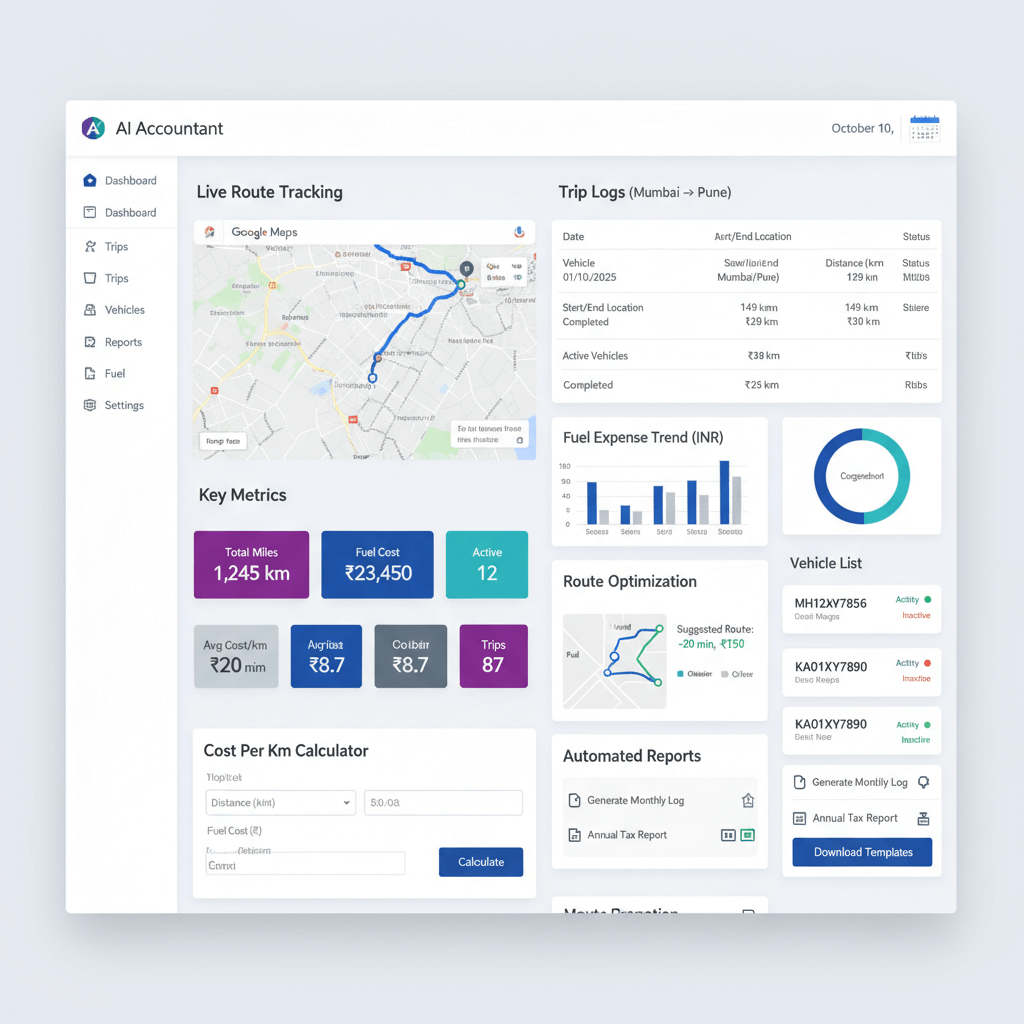
Mileage apps capture the movement. Your accounting still needs clean entries, reconciliations, and audit trails. AI Accountant ingests CSV or Excel logs, normalizes trips and fuel receipts, predicts ledger mappings, and posts entries to Tally.
The standout is bank and card reconciliation. The system auto-links fuel swipes and FASTag debits to the correct trip lines, cutting manual matching. In 2026, this happens with agentic automation: the platform classifies transactions by merchant category, learns from corrections, and improves match rates over time.
With one-click sync and anomaly dashboards, you spot unusual fuel consumption, route variances, and pending reimbursements quickly. Accounts payable workflows for fuel vendors and reimbursements run within robust security frameworks (ISO 27001 and SOC-2 Type II certified).
Result: fewer surprises at month-end, faster closes, confident audits.
Popular Mileage Tracking Tools for Indian Businesses
- AI Accountant, automates accounting for mileage, fuel, tolls, and reconciliation with Tally integration and anomaly dashboards
- MileIQ, automatic trip detection, simple classification, strong reports
- Everlance, mileage and expense tracking for freelancers and SMBs with OCR receipt capture
- TripLog, advanced GPS tracking, fleet options, compliance reporting
- Zoho Expense, integrated expense management with mileage capture
- Fyle, real-time expense reporting and card reconciliation
Evaluate fit based on accuracy, reconciliation depth, language support, and integration simplicity. For teams that need expense tracking tools with mileage tracking in one platform, prioritize tools that connect directly to your accounting stack rather than standalone trackers.
Implementation Playbook for SMBs and CA Firms
Step 1: Choose Your Software
Select a tool with robust GPS mileage tracking, offline sync, and clean exports. Pilot on routes with weak coverage to validate accuracy. Run the pilot for at least one to two weeks before deciding.
Step 2: Draft Your Reimbursement Policy
Define per-kilometer rates, evidence required, approval workflow, submission cut-offs, and dispute resolution. Keep it simple, publish it widely, and enforce consistently. A good mileage reimbursement app India setup is only as strong as the policy behind it.
Step 3: Configure Vehicle Log Automation
Assign drivers, set business hours and locations, create purpose tags, and rules for auto-classification. Require receipt photos before approval. For pooled cars, enable driver check-in and check-out per vehicle.
Step 4: Connect to Your Accounting System
Map ledgers for fuel expense management and route optimization expense. Schedule automatic exports. Set reconciliation workflows in your accounting system or with AI Accountant.
Phase this carefully: start with receipt ingestion in week one, add bank feed matching by week three, and enable full reconciliation by week four.
Step 5: Establish Weekly Routines
Drivers upload logs. Approvers review. Accountants reconcile with bank and card statements. Approved entries sync to Tally. A weekly cadence keeps month-end calm and prevents reconciliation backlogs.
Step 6: Train Your Team
Short sessions for drivers (20 minutes covers start/stop behavior, purpose tagging, receipt photos, and weekly submission). Crisp checklists for approvers. A flow diagram for the accounts team. Set SLAs for correcting mismatches, for example 48 hours. Provide a one-page quick guide and a helpline contact, then follow up after week one.
Metrics and ROI Tracking
Operational Metrics
- Cost per kilometer by vehicle, benchmarked over time
- Route variance: toll versus free roads, planned versus actual
- Driver adherence to approved routes and visit plans
- Missing receipt rate and time to resolution
Financial Outcomes
- Reimbursement leakage reduced by 20 to 30 percent
- Audit queries decline as documentation completeness rises
- Manual entry time saved: often 5 to 10 hours weekly
- Fuel cost savings from smarter routes: 10 to 15 percent
- Month-end close accelerated by up to 3x with AI-powered reconciliation (2026 update)
Leading Indicators
- Trip detection accuracy at or above 95 percent
- Auto-classification success around 80 percent or higher
- Approval turnaround under 48 hours
- Disputes below 5 percent of claims
Track these via dashboards and review monthly. For benchmarks, cross-check with fleet cost reduction strategies for Indian SMEs and GPS accuracy guidance from your vendor's pilot results.
Common Pitfalls and How to Avoid Them
GPS Drift Issues
Urban canyons and rural stretches can degrade accuracy. Demand offline buffering and multi-signal triangulation. Test on your actual routes before rollout, not just in demo mode.
Privacy and Trust Concerns
Secure written consent. Enable personal trip redaction. Restrict visibility with roles. Publish a clear data usage policy. Transparency builds trust, especially with BYOD setups.
Fake Trip Submissions
Mandate purpose tags. Cross-check with bank, card, and FASTag records. Run random audits. Use geofencing to verify client visits. In 2026, AI-based anomaly detection flags suspicious patterns (unusual fuel-to-distance ratios, trips outside business hours) automatically.
Missing Receipt Problems
Require photo capture at purchase. Use OCR to extract amounts and vendor names. Block approval without receipts. Escalate unresolved gaps within 48 hours.
Over-Engineering the Solution
Start with a pilot. Iterate on rules. Train users. Then scale. Keep workflows simple. The best system is the one people actually use. Clean data in the early weeks also trains AI models more effectively for later automation.
Real-World Indian Business Scenarios
Field Sales Teams
A pharma team rolled out GPS mileage tracking for reimbursements, achieving a 25 percent drop in inflated claims and full compliance with visit logs. The key was geofencing client locations and requiring purpose tags for every trip.
Intercity Delivery Operations
E-commerce routes optimized toll versus time, saving several lakhs monthly while properly accounting FASTag charges. Route optimization expense analysis paid for itself within the first quarter.
Mixed-Use Company Cars
Consulting teams using personal vehicles rely on vehicle log automation to split business versus personal trips. This eliminated disputes and cut processing time materially. The business-personal classification also ensures only eligible kilometers hit the reimbursement ledger.
Fuel Card Management
Linking fuel card statements and trip logs through AI Accountant flagged unauthorized purchases quickly and streamlined reconciliations. The system matched card swipes to specific trips by timestamp and merchant code, catching discrepancies that manual review missed.
Vendor Selection Checklist
| Criterion | Key Checks |
|---|---|
| GPS mileage tracking accuracy | Auto-detection, offline mode, battery optimization |
| Vehicle log automation | Multilingual UI, business and personal split, bulk categorization |
| Fuel expense management | Receipt capture, card integration, reconciliation tools |
| Route optimization expense | Cost comparisons, real-time suggestions, historical analysis |
| Integration capabilities | Tally exports, API availability, webhook support |
| Privacy and support | Security certifications (ISO 27001, SOC-2), India support hours, data residency |
| Pricing model | Per vehicle or user, transaction limits, hidden costs |
| Mobile experience | Android and iOS, offline capability, driver-first design |
| Reporting features | Custom reports, scheduled emails, audit trails |
| Scalability | Multi-location, bulk operations, growth-friendly limits |
Compare shortlists using pilot results, published technology reviews from Livemint, and user feedback from your CA network.
Taking the Next Steps
Start with a small pilot. Choose a tool strong in GPS mileage tracking and vehicle log automation. Publish a crisp policy for fuel expense management and route optimization expense. Train your team.
Pair the tracking app with AI Accountant for ledger mapping, reconciliation, and audit-ready reporting. Your drivers submit clean claims without paperwork. Your accountants post accurate entries without manual toil. Leadership gets transparent costs without guesswork.
The bottom line: mileage expense tracking is no longer a nice-to-have for Indian businesses managing vehicle fleets. It is the difference between confident audits and scrambled month-ends.
FAQ
How accurate is GPS mileage tracking in low-network areas for Indian routes?
Quality apps maintain around 95 percent accuracy even in patchy zones by buffering trips offline and triangulating with GPS, cell towers, and WiFi. Validate with a one to two week pilot on your actual routes and compare captured kilometers against odometer readings. Multi-signal triangulation has improved noticeably in 2026 tools (2026 update).
Can vehicle log automation handle pooled cars, driver swaps, and temporary allocations?
Yes. Enable driver check-in and check-out per vehicle, use geofences for depots, and require purpose tags. Downstream reconciliation can still match fuel spends and tolls to the right vehicle and driver window, even with frequent swaps.
How should a CA treat fuel purchases in books when fuel is outside GST but services are not?
Post fuel to Fuel Expense or Motor Vehicle Expenses (no GST input credit). Treat fuel card fees, convenience charges, and similar services in separate GST-applicable ledgers to claim input credit where applicable as per GST portal rate schedules. Reconcile monthly to FASTag and bank feeds for completeness. AI tools now auto-split these service charges into the correct ledger (2026 update).
What is a defensible way to set per-kilometer rates, and how often should we revise them?
Use rate slabs by vehicle category and city fuel prices, validated against your historical mileage and efficiency data. Review quarterly. Keep approval rules tiered by amount and frequency, with audit trails of every rate change.
What should I look for in expense tracking tools with mileage tracking for Indian businesses?
Prioritize tools that combine GPS trip detection with direct accounting integration (Tally export or API sync), offline buffering for Indian network conditions, and multilingual mobile apps. The tool should reconcile fuel cards, cash, and FASTag in one workflow rather than requiring separate manual matching. Auto-classification rates of 80 percent or higher and receipt OCR are now standard in leading platforms (2026 update).
How do I design the reconciliation flow for bank, card, and FASTag against mileage logs?
Import bank and card feeds daily. Map merchants and MCC codes. Auto-suggest matches to trips. Route exceptions to a review queue. In 2026, agentic AI handles 80 to 90 percent of matches autonomously, learning from your corrections over time (2026 update). Focus your team's time on the 10 to 20 percent of genuine exceptions.
What ROI benchmarks can a CA present to management for mileage software approval?
Expect 20 to 30 percent reduction in reimbursement leakage, 10 to 15 percent fuel savings from route optimization, and 5 to 10 hours per week saved on manual entry and reconciliation. Month-end close times typically shrink by 2 to 3x with automated matching. Fewer audit queries and cleaner documentation are additional wins that are harder to quantify but highly valued by auditors.

A results-driven finance and sales professional with hands-on experience through finance internships and a fast-paced sales role. With a strong interest in accounting and business finance, Harsh focuses on turning complex topics into clear, practical takeaways for founders and finance teams.