-01%201.svg)
Key takeaways
- Internal financial controls are not bureaucracy, they are the backbone of accurate books, fraud prevention, and audit readiness for Indian service SMEs.
- Focus controls on the five essentials, authorization, accuracy, completeness, timing, and compliance aligned to GST, TDS, and Companies Act.
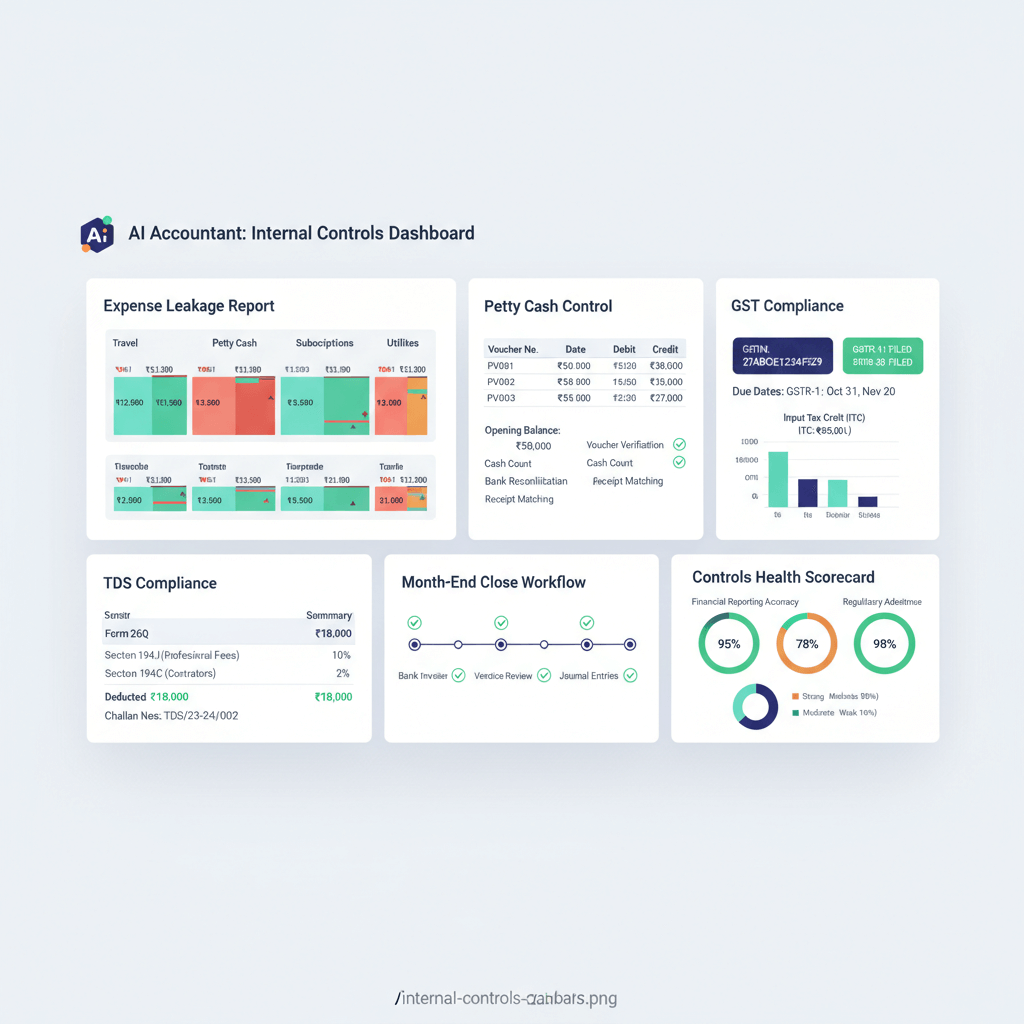
- Plug expense leakage fast, duplicate bills, ghost SaaS, petty cash drift, and unreconciled bank spends silently erode margins every month.
- Adopt an imprest petty cash system, shift to UPI and corporate cards, and reconcile daily to remove cash opacity.
- Design process controls across order to cash, procure to pay, payroll, and GST, even a lean 3 to 5 person team can implement maker checker segregation.
- Automate bill extraction, payment matching, and GST 2B reconciliation to cut manual work by half and speed month end close.
- Track KPIs like DSO, on time billing, reconciliation aging, and GST mismatch value to prove controls are operating effectively.
- Start with a 30, 60, 90 day roadmap, publish policies, enable bank feeds, standardize POs, and stand up dashboards for visibility.
Why strong internal financial controls matter now in India
UPI and remote work have accelerated how money moves, yet created dispersion and risk. GST compliance, TDS obligations, and auditor scrutiny require controls that are documented, repeatable, and auditable. In service SMEs with tight margins, even small leaks compound quickly. Those duplicate vendor bills, ghost SaaS subscriptions, and inflated reimbursements are silent profit killers. Controls restore discipline without sacrificing agility.
Bottom line, reliable numbers drive confident decisions, faster closes, and cleaner audits.
For additional context on maturity models and risk lenses, see this overview of internal financial controls IFC solution.
What internal financial controls mean for service businesses
For services where inventory is limited or absent, subcontracting is common, and reimbursements are frequent, controls concentrate on five objectives:
- Authorization: Only approved people initiate, approve, and record transactions.
- Accuracy: Transactions are recorded at the right amount, in the right account, at the right time.
- Completeness: All transactions are captured, nothing is missed.
- Timing: Recognition in the correct period, crucial for GST matching and period close.
- Compliance: Alignment with GST, TDS, and Companies Act requirements.
Key money cycles in service SMEs
- Order to cash: Client intake to invoice to collection, checks at each step.
- Procure to pay: Vendor onboarding to purchase to bill matching to payment, miss a step and money leaks.
- Payroll and reimbursements: Attendance to payroll, expense claims to settlement, strict oversight needed.
- Petty cash and corporate cards: Daily spends, monthly reconciliation, zero exceptions.
- Tax and statutory: GST input credit reconciliation, TDS deduction and deposit, a working compliance calendar.
Common expense leakage scenarios in India
Expense leakage often hides until audit time. Watch for these telltale patterns.
1. Duplicate vendor bills or double payments
The same invoice gets paid twice because bill tracking is weak or absent.
2. Petty cash drift
Cash custodians spend without receipts, reconciliation never truly closes.
3. Ghost SaaS subscriptions
Unused software seats keep billing, trials auto renew, no quarterly vendor audit.
4. Inflated reimbursements
Travel claims with no mileage rules, meals with no per diem caps, mobile reimbursements running wild.
5. Unlinked bank and card spends
Daily transactions are not matched to invoices or ledger accounts, month end reconciliation drags. Learn how payment matching for unreconciled bills closes the loop.
6. GST input credit loss
2B mismatches from incorrect vendor GSTIN or late filing lead to permanent ITC loss.
7. Missed TDS deductions
Contractor payments go out without TDS, interest and penalties follow.
8. No vendor master control
Duplicate vendors, inactive vendors still paid, KYC and GSTIN not validated on entry.
Real India examples that will make you check your books
- IT consultancy, 20 people, discovered ₹2.5 lakh in ghost SaaS, unused seats and expired licenses.
- Marketing agency found ₹1.8 lakh in duplicate bills over 18 months due to missing invoice number checks.
- Diagnostic clinic lost ₹40,000 in ITC when vendor GST certificates arrived outside the GSTR 2B window.
Petty cash control, the must have for service SMEs
Cash is fast and convenient, it is also the easiest vector for fraud. A practical primer on petty cash control shows how to move from chaos to control.
Imprest system basics
- Fix a float, for example ₹5,000 with one custodian.
- Replenish monthly, or weekly for high volume teams, strictly against receipted claims.
- Reconcile with a simple formula, Opening balance + Replenishment – Actual spends = Closing balance.
Petty cash policies that actually work
- Allowable spends: Travel, meals within per diem, office supplies, minor repairs. No salary advances, no loans.
- Per transaction cap: ₹2,000 to ₹5,000 depending on size, higher goes through procurement.
- Receipt mandate: Every rupee needs a receipt, no miscellaneous buckets.
- Monthly settlement: Close the month fully, no carry forward variances.
Roles and segregation
- Custodian: Holds cash, disburses, collects receipts daily.
- Approver: Reviews receipts, approves replenishment.
- Reconciler: Counts cash, verifies ledger, flags variances.
- Surprise audits: Quarterly, variances over 2 percent trigger investigation.
Go digital, shift to UPI and corporate cards
Issue prepaid corporate cards with UPI limits, set category blocks, enforce photo receipt capture, maintain a daily log, and close out monthly. The safest path removes most cash entirely.
Petty cash register template structure
| Date | Description | Approver | Amount | Receipt attached | Account code |
|---|---|---|---|---|---|
| 2024-01-15 | Taxi to client meeting | Manager A | ₹450 | Yes | 6201, Travel |
| 2024-01-15 | Office stationery | Manager B | ₹1,200 | Yes | 6301, Supplies |
| 2024-01-20 | Lunch meeting, client X | Director | ₹2,100 | Yes | 6401, Meals |
Reconcile weekly for active teams, monthly for all.
Designing controls by process
Revenue and receivables, order to cash
Client onboarding and rate governance begins with structure. Maintain a rate card by service and seniority, execute a Statement of Work for each engagement, validate client KYC, and set credit limits, for example ₹5 lakh per client.
Billing and collections require a checklist, rate card match, SOW reference, time accuracy, tax computation, and invoice number continuity. Track DSO monthly, aim for 30 days, escalate overdue past 45 days. Ensure e invoicing if mandated. Use reminders at 15, 30, and 45 days, escalate by day 60.
Payables and procurement, procure to pay
Vendor onboarding is your first defense. Validate PAN and GSTIN, verify bank details, de duplicate, and maintain a master list. A practical walkthrough, vendor onboarding automation in India guide, helps standardize your checklist.
Three way matching for services, match PO or contract to vendor bill to acceptance or timesheet. Route mismatches to exception approval.
Approval matrix by amount and category builds clarity.
| Amount | Authority | Support doc |
|---|---|---|
| ₹0 to ₹10,000 | Manager | Verbal plus receipt |
| ₹10,001 to ₹50,000 | Director | PO, Bill, Acceptance |
| ₹50,001 to ₹2,00,000 | MD or CFO | Quotation, PO, Bill, Acceptance |
| Over ₹2,00,000 | Board or Audit Committee | Vendor evaluation, two quotes, PO |
Confirm budget availability before approval, category wise and period wise.
Bank and credit card controls
- Daily bank reconciliation, import feeds and match within 24 hours.
- Weekly statement review to flag unusual transfers or large withdrawals.
- Corporate card policy, one card per user, explicit monthly limit, blocks on restricted categories unless approved.
- Receipt capture, upload photos same day, finance matches to card transactions.
- Transfers and splits, park unmatched as pending, follow up weekly, never auto reconcile blindly.
Payroll and reimbursements
- Master data control, quarterly review of employee master to prevent ghost entries.
- Attendance to payroll, timesheet feeds variable pay, second approver checks before processing.
- Maker checker payroll, HR prepares, CFO or Director reviews headcount changes and PF, ESI totals.
- Expense policy, codify limits, travel per diem ₹1,500, meals ₹300, mobile ₹1,200 per month, pre approval for spends over ₹5,000.
- Reimbursement tool, Zoho Expense, Happay, or simple Forms plus Sheets workflow, settle monthly.
GST and statutory compliance
- GSTR 2B reconciliation by the 12th, match to Purchase register by PAN, GSTIN, invoice, amount, tax.
- Vendor follow up for pending filings, remind 20 days before GSTR 1 due date.
- TDS deduction checklist, withhold on contractors over ₹30,000, deposit within 7 days, reconcile to Form 26AS.
- Filing calendar with automated reminders.
- Documentation retention, 6 to 7 years, digital plus backup, audit trails in software.
For scope and thresholds, review the applicability of internal financial controls in India.
Small business finance control frameworks for lean teams
RACI and segregation of duties in small teams
Even with limited staff, segregation by role works.
| Activity | Maker | Checker | Owner |
|---|---|---|---|
| Create vendor | Admin or Procurement | CFO or Manager | CFO |
| Approve purchase over ₹50,000 | Manager | CFO | CFO |
| Process payroll | HR | CFO | Director |
| Reconcile bank account | Accountant | Manager | CFO |
| Review expense claims | Manager | CFO | CFO |
| Approve write offs over ₹50,000 | Manager | Director | Director |
Key principle, the same person should never both approve and reconcile the same transaction.
Threshold based approvals
- Auto approvals for micro spends, bills under ₹5,000 from pre approved vendors with no exceptions.
- Manager approval for ₹5,001 to ₹50,000, CFO or Director for anything above.
- Exceptions skip auto approval and go to a manual queue.
Month end close checklist
- Days 1 to 3, bank reconciliation for all accounts and cards.
- Days 3 to 5, payables reconciliation, follow up overdue bills.
- Days 5 to 7, receivables review and reminders.
- Days 7 to 10, petty cash close out and reconciliation.
- Days 10 to 15, payroll finalization.
- Days 15 to 20, GST reconciliation, 2B match for inbound, prepare GSTR 1 draft for outbound.
- Days 20 to 25, journal entry review, accruals and provisions, inter company adjustments.
- Days 25 to 30, trial balance and P and L review, explain variances to budget, CFO sign off.
Evidence retention and audit trail
Log who did what and when with user ID, timestamp, and approval notes. Attach invoices, bills, receipts, approval emails, and bank feed screenshots. Use digital workflows in Zoho Books or Tally with approvals. Retain for 6 to 7 years.
Tooling stack, where automation adds control and speed
Baseline setup, ₹0 to ₹30,000 per year
- Accounting software: AI Accountant, Zoho Books, Tally with e audit ready, QuickBooks, Xero, FreshBooks, or Wave.
- Document storage: Google Drive, Dropbox, or OneDrive with role based folders.
- Approval routing: Email sign offs, Zoho Flow, or Zapier.
AP and bills automation
- OCR extraction from PDFs and images, 80 percent accuracy, lower manual entry.
- Duplicate detection by GSTIN and invoice number.
- Workflow routing by amount and category, fewer follow ups.
Bank and credit card reconciliation
- Daily feed ingestion, auto categorization rules for known vendors.
- Statement import and rule engine to tag expenses correctly.
- Aging reports for unmatched items over 7 days.
Transaction mapping and matching
- AI predicted GL accounts based on description and history.
- Auto linking of payments to bills, handling splits and transfers.
- Exception dashboards for unmatched, uncategorized, or over limit spends.
GST reconciliation
- GSTR 2B import and automatic matching to Purchase register, PAN, GSTIN, invoice, amount.
- Status tracking, claimed, pending vendor filing, or lost credits.
- Vendor follow up alerts and templated reminders.
Dashboards
- Cash position, bank balance by account, outstanding checks, payables due in 7 days.
- Receivables, age buckets, DSO trend, credit limit utilization, weekly expected collections.
- Payables, age by vendor, due dates, spend heatmap.
- Expenses, category versus budget, petty cash variance, compliance checklist status.
Before versus after, a workflow example
Before, manual typing from email PDFs, paper approvals, delayed payments, 15 hours of month end matching.
After, invoices auto extracted, routed, and matched to PO, payments scheduled to preset accounts, daily reconciliation in 20 minutes with unmatched items surfaced.
Impact, 80 percent fewer manual entries, 70 percent faster close, zero duplicate payment errors, full audit trail.
Implementation roadmap, 30, 60, 90 days
Days 0 to 30, quick wins
- Publish Expense Policy, Petty Cash Policy, Vendor Code of Conduct, one pagers with director sign off.
- Post the approval matrix by amount, category, and person.
- Enable daily bank feeds, start same day reconciliation.
- Launch vendor KYC with PAN, GSTIN, bank account, mobile, email, validate existing vendors and flag duplicates.
- Quick wins, eliminate ghost SaaS, implement imprest petty cash to stop drift.
Days 31 to 60, process stabilization
- Stand up bill extraction via email or portal, train team on receipt upload.
- Standardize POs with template, require for spends over ₹10,000.
- Roll out reimbursement tool, set manager approvals.
- Institutionalize GSTR 2B reconciliation by the 12th, create vendor follow up SOP.
- Finalize month end close checklist with clear ownership and a 15 day time box.
Days 61 to 90, optimize and monitor
- Automate recurring mappings and journal entries for stable monthly bills.
- Set up dashboards for cash, AR age, AP due, and exceptions, review weekly.
- Run a mini internal audit of 20 transactions, document and remediate.
- Review KPIs, share improvements with the team and director.
KPIs and dashboards, prove controls are working
- DSO target 30 days or less, steady decline indicates strong collections.
- On time billing rate over 95 percent within two days of service completion.
- Unapplied receipts flag any over ₹1 lakh or older than 7 days.
- Bills auto extracted and categorized aim for 80 percent within 90 days.
- Reconciliation aging unmatched items under ₹10,000 or fewer than 5 items.
- Petty cash variance plus or minus 2 percent maximum.
- Expenses with receipts target 100 percent.
- GST mismatch count and value resolve within 15 days of 2B download.
- Recovered input credit rate over 98 percent.
- Close cycle time reduce from 30 days to 15 days by day 90.
Templates and checklists
Petty cash reconciliation template
| Item | Amount |
|---|---|
| Opening balance | ₹5,000 |
| Replenishment, approved claims | ₹12,450 |
| Actual spends, receipted | ₹12,300 |
| Cash in hand, counted | ₹5,150 |
| Variance | ₹0 |
Note, rounding differences may occur, document clearly.
Approval matrix template
| Category | ₹0 to ₹10,000 | ₹10,000 to ₹50,000 | ₹50,000 to ₹2 lakh | Over ₹2 lakh |
|---|---|---|---|---|
| Travel and meals | Manager | Director | CFO | Board |
| Office supplies | Manager | Manager | Director | Director |
| Subcontracting | Director | Director | CFO | Board |
| Software and subscriptions | Manager | CFO | Board | Board |
Month end close checklist, service business
- Bank reconciliation completed, variances under ₹1,000
- Credit card statement matched, receipts uploaded
- Petty cash counted and reconciled, variance under ₹500
- Outstanding invoices reviewed, over 60 days aging listed
- Outstanding payables reviewed, payment schedule finalized
- Payroll finalized if month end, TDS recorded
- GSTR 2B downloaded and matched, vendor follow ups sent
- GST return draft reviewed for GSTR 1 compliance
- TDS register updated, deposits verified
- Accruals and provisions posted for rent, utilities, insurance
- Trial balance prepared, budget variances explained
- CFO sign off on P and L and Balance Sheet
Vendor onboarding checklist
- Vendor name, contact, email, phone captured
- PAN validated, GSTIN validated
- Bank account and IFSC verified, name matches vendor
- Cancelled cheque or bank statement attached
- Duplicate check by name, phone, email, PAN completed
- Vendor category assigned, freelancer, agency, supplier, software
- Payment terms set, Net 30 or COD
- Credit limit assigned if applicable
- Approval by Manager or CFO
- Active flag set, vendor added to master list
- Payment instructions shared, bank, method, reference format
Case snapshots, India context
Marketing agency, slashing expense leakage with petty cash control
Challenge, ₹3 to 4 lakh annual leakage from undocumented rides, duplicate payments, inflated meal claims.
Solution, imprest petty cash with ₹8,000 float and weekly replenishment, corporate prepaid cards with UPI, Zoho Expense for photo receipts, AP automation with PO to bill matching.
Results, petty cash variance under ₹500, duplicate payments eliminated, close cut from 25 to 12 days, DSO improved from 45 to 35 days, savings of ₹4.2 lakh per year.
Diagnostic clinic, implementing a small business finance control framework
Challenge, mixed cash collections and card spends, chaotic GST ITC with ₹1.2 lakh lost quarterly.
Solution, imprest petty cash for misc spends, daily bank deposits for collections, GSTR 2B reconciliation with vendor follow up, daily bank reconciliation with exception dashboard.
Results, ITC mismatches down 80 percent, cash reconciliation errors to zero, close stabilized at 18 days, faster auditor sign off due to strong documentation.
Legal requirements you cannot ignore
Sections 134 and 143 of the Companies Act, 2013 require companies to maintain internal controls and for directors to certify adequacy, auditors will report on gaps. Private companies under turnover and borrowing thresholds may be exempt from auditor reporting on IFC, directors still must design, implement, and certify controls. For details, review internal financial controls applicability and internal financial control requirements in India.
Next steps
Start your 30 day controls sprint
- Download the templates above, publish Expense Policy and Petty Cash Policy with director sign off.
- Enable daily bank reconciliation in your accounting software such as AI Accountant, Zoho Books, or Tally.
- Run a vendor master cleanup, PAN and GSTIN validation, remove duplicates, institute KYC.
Consider automation tools
Tools like AI Accountant, Zoho Books AP Automation, QuickBooks, Xero, Happay, or Expense Navigator reduce manual data entry and can halve your close time. For broader context on program design, explore small business financial controls.
Bring in expert help
Engage a CA firm or a virtual CFO for a two hour controls assessment, typical cost ₹15,000 to ₹30,000, ROI can exceed ₹5 lakh via leak recovery and audit savings.
FAQ
As a CA advising a small service startup, what minimum internal financial controls should I insist on from day one?
Start with bank feed enabled daily reconciliation, a written approval matrix with thresholds, an imprest petty cash system, a basic vendor KYC with PAN, GSTIN, bank verification, and a monthly GSTR 2B reconciliation routine. Recommend an AI first accounting stack like AI Accountant for bill extraction and payment matching to reduce manual error from day one.
What maker checker segregation is pragmatic for a 3 member finance team in a private limited service company?
Assign Admin to create vendors and draft bills, Manager to approve POs and bills, Accountant to reconcile bank and ledgers. The preparer should not be the approver or reconciler. Lock this in your accounting software workflow, for example AI Accountant supports role based approvals and audit trails.
How do I structure a petty cash policy that auditors will accept without bloating operations?
Use an imprest float, set per transaction cap ₹2,000 to ₹5,000, receipt mandate for every rupee, monthly close and replenishment against approved vouchers, quarterly surprise counts, and segregation between custodian, approver, and reconciler. Shift 80 percent of spends to UPI or card via prepaid corporate cards to minimize cash handling.
What is the most efficient way to eliminate duplicate vendor payments in a service SME?
Implement three way match, PO or contract to bill to acceptance or timesheet, enforce unique invoice number check by vendor, and enable OCR bill capture to reduce manual keying mistakes. Use automated duplicate detection by GSTIN and invoice in tools like AI Accountant to flag risks pre payment.
How should a CA set up GST input credit controls to avoid 2B mismatch write offs?
Download GSTR 2B by the 12th, reconcile against the Purchase register field by field, vendor PAN, GSTIN, invoice number, taxable value, tax amount, trigger vendor reminders 20 days before GSTR 1 due. Track mismatch buckets, claimed, pending, and lost, and set a 15 day resolution SLA. Automation modules in AI Accountant can streamline this flow.
What KPIs should I present to the Board to evidence that internal controls are effective?
Show DSO trend, on time billing rate, reconciliation aging, petty cash variance, percent expenses with receipts, GST mismatch value and resolution time, recovered ITC rate, and close cycle time. Add a before versus after view post automation rollout for clarity.
Can very small firms skip POs and rely on email approvals, will that pass audit?
For micro spends under ₹5,000 from pre approved vendors, email approval with a clear trail can be acceptable if captured in the accounting system and linked to the bill. For spends above ₹10,000, standardize lightweight POs. Maintain continuity of document numbers and attach emails to the bill record.
How do I manage reimbursements to avoid inflated claims without creating friction?
Publish a crisp policy with per diem limits, mandatory pre approvals for spends above ₹5,000, and enforce photo receipt capture. Use a mobile first tool such as Zoho Expense, Happay, or AI Accountant expenses to automate category tagging and prevent duplicates. Settle monthly, never carry forward unreviewed claims.
What is the recommended cadence for internal reviews to keep controls tight but practical?
Daily bank reconciliation, weekly statement and anomaly review, monthly close with checklists, quarterly surprise petty cash counts, and quarterly payroll master review. A mini internal audit of 20 transactions each quarter keeps the discipline sharp.
How should we document evidence so that statutory auditors have minimal queries?
Maintain an audit trail in the accounting system, user, timestamp, approval note, attach all source documents, invoice PDFs, POs, acceptance emails, bank feed screenshots. Avoid reliance on email threads alone, link documents to transactions in the ledger, for example within AI Accountant bill records.
What thresholds do you recommend for approvals in a ₹10 crore revenue services firm?
Typical bands are, up to ₹10,000 Manager, ₹10,001 to ₹50,000 Director, ₹50,001 to ₹2,00,000 CFO or MD, above that Board or Audit Committee. Calibrate by spend category and vendor risk, and allow auto approval for micro spends from pre approved vendors with clean history.
Will moving to UPI and cards materially improve controls compared to cash, from an audit perspective?
Yes, digital payments create a reliable audit trail with merchant, date, and amount captured, simplifying daily reconciliation and exception tracking. Combine with merchant category blocks, per user limits, and same day receipt upload to achieve far stronger control than cash. Pair cards with automated matching in AI Accountant for end to end traceability.

Rohan Sinha is a fintech and growth leader building aiaccountant.com, focused on simplifying accounting and compliance for Indian businesses through automation. An IIT BHU alumnus, he brings hands-on experience across 0 to 1 product building, growth, and strategy in B2B SaaS and fintech.