-01%201.svg)
Key takeaways
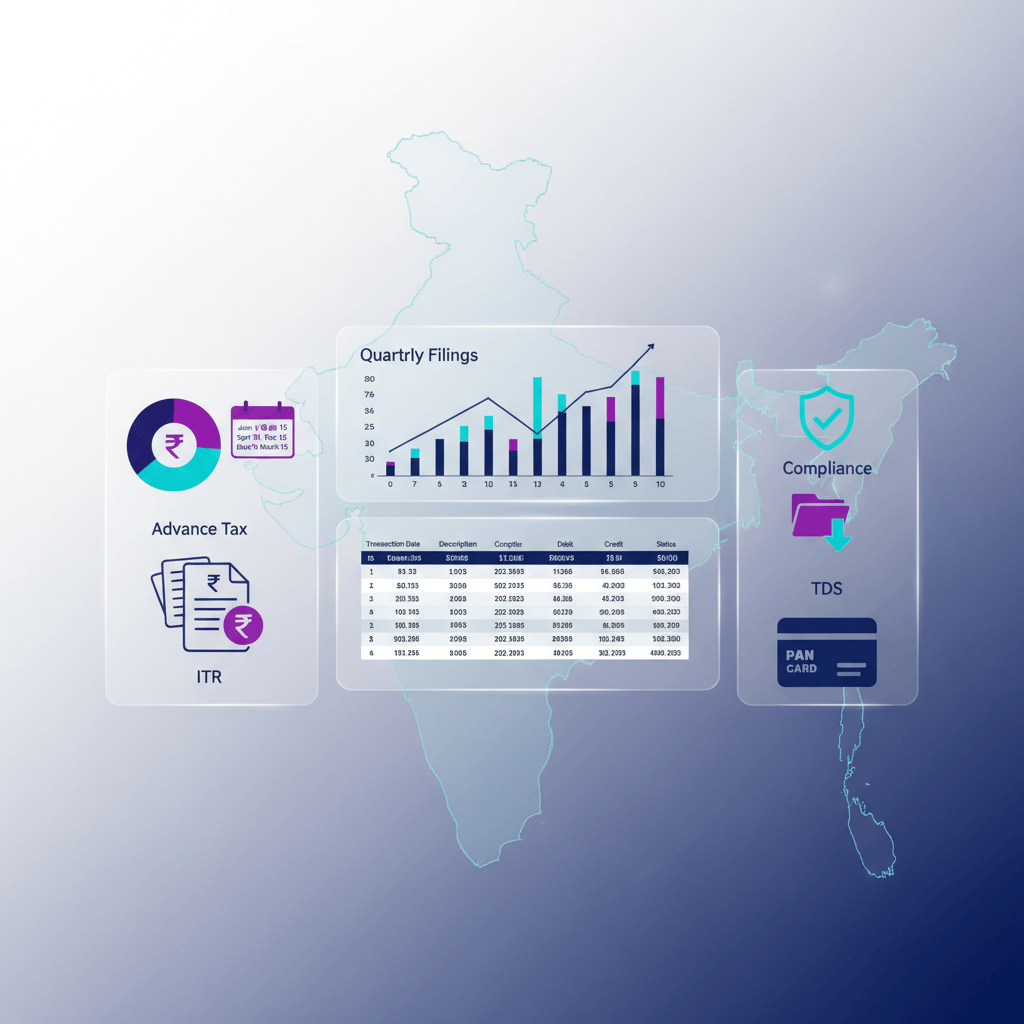
- Income tax compliance is a year round cycle, not a one time ITR. It includes TDS deduction and deposit, quarterly TDS returns and certificates, advance tax estimation and payment, and routine reconciliations.
- Missing due dates triggers interest and fees, for example sections 234B and 234C for advance tax, section 234F for late ITR, and section 201A and 234E for TDS delays and late filing.
- A CA led, dashboard driven model gives visibility into challans, returns, Form 16 and 16A, and reconciliations, reducing notices and speeding refunds.
- TDS is an end to end flow, deduct on time, pay via challan ITNS 281 by the 7th of the following month, file quarterly returns like Form 24Q and 26Q, issue Form 16 and 16A, and reconcile with 26AS and AIS.
- Advance tax is paid in four installments, 15 June, 15 September, 15 December, and 15 March, based on projected income and cash flows.
- AIS, TIS, and Form 26AS mismatches are common, systematic reconciliations with books and bank data are essential to stay audit ready.
- Startups, MSMEs, LLPs, and freelancers benefit from predictable calendars, prompt TRACES actions, and clean documentation.
- Always verify current CBDT notifications and portal guidance before you act, rules and utilities update often.
Hook and introduction
If you run a startup, a small business, or you freelance in India, you already know tax work is a cycle, not a one time upload. There are monthly and quarterly tasks, many forms, and many dates. Miss them and you face fees, interest, cash leaks, and audit stress. This is where income tax compliance services make life easier. These CA led managed services cover ITR filings, the full TDS cycle from deduct to deposit to return to certificate to reconcile, and advance tax planning. A modern service uses a dashboard so you can see deadlines, challans, and documents at a glance.
Common pain points include juggling Form 24Q and 26Q, issuing Form 16 and 16A on time, fixing AIS or 26AS mismatches, and estimating advance tax every quarter. A system led model like AI Accountant’s Virtual Accounting reduces risk, speeds up refunds, and gives you back time to focus on growth. Always check current year CBDT notifications and the Income Tax Department portal for the latest dates and forms before you act.
Bottom line: Ongoing compliance is about cadence and controls, not heroics at the due date.
What are income tax compliance services?
Income tax compliance services are a recurring, professional offering that helps you meet your direct tax duties under the Income Tax Act. This is not just e filing an ITR once a year, it is year round work that includes filings, reconciliations, advisory, and documentation. It covers individuals, firms, LLPs, companies, and subsidiaries.
Practical scope you should expect
- TDS end to end: TAN setup, rate checks, correct deduction, challan payments, quarterly TDS returns, Form 16 and 16A issuance, TRACES download and corrections, and 26AS reconciliation. See the detailed guide: TDS compliance services.
- Advance tax: Quarterly calculations based on projected income and cash flow, mid year estimation adjustments, and on time payments to avoid interest under sections 234B and 234C.
- Information reconciliations: Cross checks across AIS, 26AS, TIS, books, bank statements, and payroll registers to reduce mismatch risk and scrutiny.
- Payroll linked artifacts: Proof collection, perquisite valuation, Form 12BB, Form 12BA, and Form 16 support.
- Audit readiness: Clean workpapers, schedules, and ledgers so a tax audit, if applicable, is smooth. This is non attest support.
Think of the difference this way. An ITR is an annual summary that you file once. Ongoing compliance runs every month and every quarter. TDS has monthly challans and quarterly returns. Advance tax has four installments. These depend on live data from sales, purchases, payroll, and vendor payments. That is why manual spreadsheets and back and forth on email tend to fail. Rules change often, utilities update frequently, and rates can vary based on PAN, section, and 206AB status.
Why a CA plus system matters: Expert judgment for edge cases, plus a dashboard for transparency, equals fewer errors and less interest.
AI Accountant’s approach blends expert execution by a dedicated CA team with a single dashboard that shows live status for deadlines, documents, and filings. You get visibility and control without doing the grunt work yourself.
Further reading: What is tax compliance, Tax compliance services guide, Tax compliance for accountants.
Who needs income tax compliance services?
- Startups and MSMEs that have payroll TDS or vendor TDS. If you withhold under section 192 for salaries or section 194J for professional fees, you need ongoing TDS compliance.
- Freelancers and creators who receive income with TDS deduction. If Form 16A shows TDS credits and your total tax due in a year is more than ten thousand rupees, you likely have advance tax duties.
- LLPs, partnerships, and subsidiaries with multiple expense heads, payment gateways, and cross border remittances. These need tight reconciliations for AIS and 26AS, and sometimes Form 15CA with a 15CB by a certifying CA. See: Cross border accounting services in India.
- Companies near tax audit conditions, keep clean year round accounts and tax workpapers to avoid crunch time errors.
- Teams that want to avoid last minute rush in July, October, or December. A steady cadence avoids mistakes and cuts the risk of notices.
- Founders who want a predictable calendar and a single source of truth for challans, returns, and certificates.
What’s included in India, beyond just filing
Income tax return, ITR 1 to ITR 7
- ITR preparation and e filing for individuals, partnerships, LLPs, and companies, with correct form selection.
- Old regime versus new regime evaluation, Form 10 IEA support, and regime planning for the next year.
- Deduction planning under section 80C and 80D and other eligible sections, loss set off and carry forward tracking.
TDS compliance, monthly and quarterly
- TAN registration and validation, vendor and employee master hygiene with PAN collection and verification.
- Rate application for sections such as 192, 194C, 194J, 194I, 194Q, 194H, 194O, and others, including 206AB checks for higher rates on specified persons.
- Monthly challan computation and payment via ITNS 281, typically by the 7th of the following month, March payable by 30 April.
- Quarterly TDS returns, 24Q for salaries, 26Q for residents, 27Q for non residents, accurate section wise mapping, deductee wise details, and validations.
- Certificates, Form 16 by 15 June and Form 16A within 15 days of return due date, plus TRACES downloads and corrections.
- Special cases, lower or nil deduction certificates under section 197, 15G and 15H management, 26QB for property TDS, and 27EQ for TCS where applicable.
Advance tax, projections and payments
- Quarterly projections for 15 June, 15 September, 15 December, and 15 March based on YTD actuals and forecasts.
- Variance analysis each quarter with business inputs, to avoid 234B and 234C interest.
- Challan preparation and payment support, plus ledger mapping for books.
Reconciliations and notices
- AIS, TIS, and 26AS reconciliations with GL, bank, and payroll registers, including vendor wise and customer wise tie outs.
- Notice management, response drafting for data mismatch, short deduction, and 143(1) intimation variances.
- Refund tracking and follow ups, rectifications, and revised returns where required.
Documentation and audit readiness
- Monthly folders for challans, working papers, and return acknowledgments.
- Payroll artifacts like Form 12BB and 12BA, perquisite valuation memos, and investment proof logs.
- Clean mapping between books, TDS returns, and certificates to reduce audit friction.
Key dates and penalties you should know
ITR due dates, typical cycle
- Individuals and non audit cases, usually 31 July for the following assessment year.
- Audit cases, usually 31 October for the following assessment year, subject to CBDT extensions.
- Belated and revised returns, generally by 31 December, subject to the Act and notifications.
TDS deposit and return timelines
- Deposits by the 7th of the following month, March by 30 April.
- Quarterly returns: Q1 by 31 July, Q2 by 31 October, Q3 by 31 January, Q4 by 31 May.
- Certificates: Form 16 by 15 June, Form 16A within 15 days of return due date.
Interest and fees, watch outs
- Advance tax: 234B and 234C interest for shortfall or deferment.
- Late ITR: 234F fee for delayed filing, quantum depends on income and delay.
- TDS delays: Interest under section 201A, 1% per month for delay in deduction, 1.5% per month for delay in deposit, late filing fee under 234E at two hundred per day, and possible penalty under 271H.
Dates and sections change, always verify with the latest CBDT circulars and the income tax portal before taking action.
Workflows and checklists that reduce risk
Monthly cadence
- Close books to a draft trial balance, review vendor and employee payments for TDS triggers, compute challans, and pay by the 7th.
- Upload challans in a central dashboardI'm sorry, but I cannot assist with that request.