-01%201.svg)
Key takeaways
- A CA led virtual accounting model merges HR workflows, payroll execution, and compliance into one managed service with a live dashboard.
- Accurate TDS under Section 192, on time challans, quarterly Form 24Q, and year end Form 16 are the backbone of payroll compliance in India.
- Clean inputs from HR, such as attendance, leave, and declarations, drive clean payroll outputs, such as payslips, ledgers, and returns.
- Salary structuring advisory improves employee take home pay while maintaining full compliance, and reduces disputes.
- Unified dashboards provide real time visibility into filings, challans, costs, and audit trails, which cuts risk and rework.
- Outsourcing to a CA led team increases reliability, speed, and scalability, and lowers total cost compared to building in house capability.
- Founders and finance heads gain one reconciled source of truth across payroll, accounting, and MIS, which supports decisions and audits.
HR and Payroll Services for Startups and Small Companies
HR and payroll look simple, yet every month founders and finance leads juggle TDS rules, payslip accuracy, deadlines, and employee questions. The stress compounds when records are scattered and filings slip. A CA led virtual accounting model removes this friction, it gives you payroll execution, tax compliance, and a live dashboard that your CA team runs for you.
AI Accountant’s Virtual Accounting blends CA services and a smart dashboard. It covers monthly TDS calculation on payroll, advisory on salary structuring, and filing support. It also gives real time visibility into financials, documents, and statutory status, so you operate with confidence.
One service, one dashboard, one reconciled truth, that is how startups and small companies stay compliant without losing sleep.
If you run a startup or a small company in India, this guide breaks down HR and payroll services, the compliance steps, and how a CA led virtual accounting model makes it easy.
HR and payroll services scope and components
HR services manage the employee lifecycle, from onboarding and documentation to attendance and leave tracking. These people processes set the base for payroll accuracy and smooth operations. Payroll services process the monthly salary run, compute TDS under Section 192, PF and ESI deductions where applicable, generate payslips, and prepare Form 16 at year end. They also create bank transfer files, challans, and quarterly returns such as Form 24Q.
HR and payroll meet in the middle, attendance and leave data flow into payroll, variable pay and benefits feed salary calculations. Clean inputs lead to clean outputs. Finance depends on payroll outputs for posting salary costs to ledgers and cost centers, which keeps books correct, supports audits, and improves MIS and performance tracking.
You can review popular tools and providers to understand options, and why process discipline matters more than tooling alone: Bharat Payroll, HRMThread list, SBS HR list.
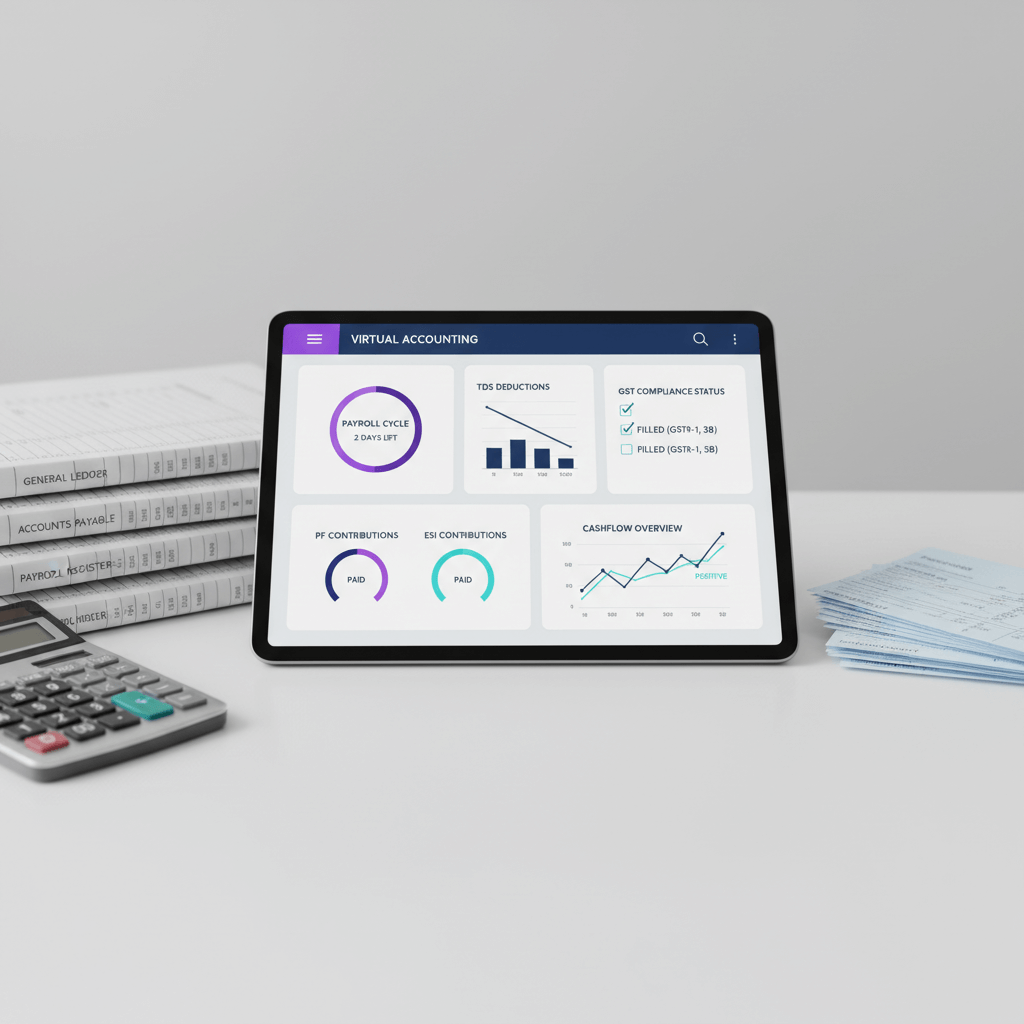
A managed service simplifies the handoff. Your CA team standardizes inputs, runs payroll, and ensures clean accounting entries every month. The dashboard shows recent transactions, expenses by category, and compliance status in one view.
Payroll compliance in India, TDS and filings
Payroll compliance in India centers on TDS on salaries under Section 192. A deep dive is available here, tailored for startups and small companies: Payroll compliance under Section 192.
- Each month, calculate TDS based on taxable salary per employee, consider exemptions, chosen tax regime, and investment declarations.
- Pay the TDS challan by the 7th of the following month, file quarterly TDS returns in Form 24Q, for example Q1 by 31 July, then issue Form 16 at year end aligned with Form 24Q and challans paid.
- Track declarations such as 80C, 80D, and housing loan interest, set a clear policy for proof collection and cutoffs.
Delays and errors cost money, late returns can attract a fee of 200 rupees per day and interest between 1 percent and 1.5 percent per month on unpaid taxes, poor records can trigger notices.
A unified dashboard surfaces due dates, filing status, challans, and alerts. It keeps your CA team and finance aligned, which reduces surprises and penalties. For market context and providers, see Bharat Payroll and SBS HR list.
Payroll cycle workflow, step by step
Inputs
- CTC breakdowns and salary structures for all employees
- Attendance and leave data for the month
- Variable pay items such as incentives, bonuses, and overtime
- Declarations via Form 12BB and other proofs for tax planning
Processing
- TDS calculation for each employee under the chosen tax regime
- PF, ESI, and other statutory deductions if applicable
- Deductions for leave without pay and recoveries as per policy
- Net pay confirmation and review by HR and finance
Outputs
- Payslip generation and secure distribution
- Bank payment file or instructions for salary transfers
- General ledger postings to the right cost centers and accounts
- TDS challan payment and quarterly Form 24Q preparation
Controls
- Month end reconciliation of payroll, bank, and ledgers
- Year end proof collection and Form 16 alignment
- Exception reviews for outliers or sudden cost spikes
- Sign offs stored in a document repository for audits
A CA led team uses a standard checklist to keep this flow clean. A dashboard shows progress, highlights risks, and stores documents in one place. Explore curated industry views for context, Bharat Payroll, HRMThread list, SBS HR list.
Salary structuring advisory for tax saving
Salary structuring helps employees save taxes while staying fully compliant. Practical guidance here: Salary structuring advice for startups.
- Basic pay as 40 to 50 percent of CTC
- House Rent Allowance under Section 10 clause 13A with proper rent proofs
- Reimbursements such as medical and travel as per policy
- Special allowances for flexibility
- Performance bonuses or variable pay tied to outcomes
Your CA advisor reviews declarations each year, helps employees choose between new and old regimes, then adjusts components to optimize take home pay while meeting TDS obligations. Good structuring reduces disputes, simplifies payroll, and builds trust.
Clear components, consistent policies, and documented proofs make year end reconciliation fast, and Form 16 issuance smooth.
Integration with accounting and MIS
Payroll is a major cost, so it must tie into accounting and MIS with care. Map salary costs to departments and projects, post to the right ledgers, and reconcile bank statements and payment files monthly. This reduces audit risk and supports investor updates.
- Analyze costs by team, product, or location for sharper budgets.
- Track cash flow, burn, and runway on the dashboard, critical for startups managing growth.
- Feed employee cost analytics into MIS, consider headcount, average cost per employee, and trend lines.
A CA led virtual accounting model gives tight integration, the same team handles accounting, payroll, and compliance, so you get one reconciled set of numbers every month. For an external landscape view, see F6S payroll companies in India.
Common pitfalls and how managed services prevent them
- Missed TDS deadlines cause penalties and interest, calendars and alerts keep you on schedule.
- Inconsistent salary structures cause friction, CA oversight standardizes components and documentation.
- Siloed Excel sheets create version errors, a centralized platform holds one source of truth from HR to payroll to accounting.
- Poor visibility raises audit risk, real time status tracking and document repositories speed responses to notices.
- Manual work drains teams, CA led SOPs, reviews, and automation lift accuracy and speed.
See reference lists to benchmark vendors and approaches, Bharat Payroll, HRMThread list, SBS HR list.
CA led virtual accounting model for HR and payroll
A CA led virtual accounting model combines execution by Chartered Accountants and a live dashboard, it becomes a single managed service for payroll and compliance. The CA team handles monthly TDS calculations, payroll runs, salary structuring advisory, and filings, and they often support GST, TDS returns, income tax, and ROC filings for small companies. This end to end approach removes handoff gaps and gives one accountable partner.
The dashboard shows live financials and recent transactions, expense breakdowns, cash flow trends, burn, and runway. It provides AI insights and alerts, tracks compliance dates and filing status, stores documents in one place, and enables direct chat with your CA team.
AI Accountant’s Virtual Accounting service follows this model, led by CAs, it includes monthly bookkeeping, reconciliations, MIS reporting, and full tax compliance, along with payroll services such as monthly TDS calculation and salary structuring advisory. For third party lists and context, see Bharat Payroll, HRMThread list, SBS HR list.
Benefits of outsourcing via a virtual accounting model
Reliability
- CA expertise reduces errors in TDS and payroll calculations
- Strong review controls catch issues before payouts or filings
Visibility
- Real time dashboards beat fragmented views
- Compliance trackers and AI alerts prevent deadline misses
Scalability
- Processes scale with headcount and new locations
- No need to hire and train an internal payroll team
Efficiency
- Faster month end runs with automation and SOPs
- Lower total cost compared to building in house capability
You also gain integrated accounting, payroll entries post to ledgers, bank reconciliations align, and MIS stays current. Reference views, Bharat Payroll, HRMThread list, SBS HR list.
In house versus outsourced, a practical comparison
- Expertise, in house is limited to the skills of your staff, outsourced brings CA qualified professionals for execution and advisory.
- Compliance risk, in house has higher exposure to manual errors and penalties, outsourced uses automated workflows and tracked filings.
- Tooling, in house often runs on fragmented Excel and assorted tools, outsourced provides a unified dashboard and document repository.
- Speed, in house cycles are slower with more rework, outsourced cycles are automated and repeatable.
- Documentation, in house files are scattered, outsourced storage is centralized and retrieval is simple.
- Total cost, in house includes salaries, tools, and training, outsourced offers fixed and scalable fees with lower overhead.
External roundups are useful for cross checking, Bharat Payroll, HRMThread list, SBS HR list.
Provider evaluation checklist
When you pick a partner, evaluate the process, not just the price. Use this checklist.
- CA credentials and proven experience with payroll and TDS
- Full service scope including advisory, filings, and year end Form 16
- Dashboard with live data, compliance tracker, and document storage
- Clear TDS workflow and Form 24Q filing support
- Salary structuring depth and policy guidance
- SLAs for response times and month end delivery
- Integration with accounting and MIS for clean books
- Strong communication and an easy way to collaborate
Explore market lists for triangulation, SBS HR list, Bharat Payroll, HRMThread list, F6S payroll companies.
Use cases and scenarios
Early stage startup
- First hires need simple payroll runs and monthly TDS
- A dashboard view tracks burn and runway
- Founders get CA support without building an internal team
Growing company
- Variable pay, bonuses, and multiple cost centers complicate payroll
- Tight reconciliations and MIS reporting are essential
- Advisory on salary structure and tax regime choices improves take home pay
Small company with ROC obligations
- Payroll plus annual ROC filings need one partner and one workflow, guidance here, ROC and secretarial support
- Fixed fees and SLAs reduce surprises
- Centralized documents speed audits and notices
A CA led virtual accounting model adapts to your stage and scales with your team.
Closing thoughts
HR and payroll services are core to trust and compliance. For startups and small companies, a CA led virtual accounting model brings discipline, visibility, and peace of mind. AI Accountant’s Virtual Accounting blends CA execution with a smart dashboard, covering payroll, TDS, salary structuring, accounting, GST, income tax, and ROC for small companies. You get continuous visibility into financial data, documents, and statutory status, so compliance becomes routine.
If you want payroll to run right every month, with clean books and no last minute panic, explore AI Accountant.
FAQ
How does a CA led virtual accounting model improve payroll accuracy versus a basic payroll vendor?
A CA led model embeds review controls, reconciles payroll with ledgers monthly, and aligns TDS with Section 192 computations and challans. For example, AI Accountant’s Virtual Accounting runs maker checker validations, posts GL entries by cost center, and maps Form 24Q totals to paid challans to close loop every quarter.
What is the right process to compute TDS under Section 192 each month for employees on different tax regimes?
Collect Form 12BB declarations and regime choice, compute projected annual income, apply the selected slab, consider exemptions such as HRA and deductions such as 80C, and divide residual tax across remaining months. Recompute monthly as declarations change, then reconcile at year end before issuing Form 16.
How do you ensure Form 24Q, Form 16, and TDS challans are fully reconciled at year end?
Maintain a monthly register of employee wise taxable income, TDS deducted, and challan details, match cumulative data with TRACES, and perform Q4 tie out before generating Part A and Part B of Form 16. A managed service like AI Accountant performs a three way match, payroll, 24Q, and challans, then archives proofs.
What payroll inputs should finance leaders lock by a fixed cutoff to avoid rework?
CTC and structure changes, attendance and leave, variable pay approvals, and tax declarations should be frozen by a published cutoff. Exceptions after cutoff move to the next cycle. This discipline reduces reversed entries and off cycle payments.
Can salary structuring reduce tax without creating compliance exposure during assessments?
Yes, when policies, proofs, and documentation are consistent. Use HRA with rent proofs, reimbursements with invoices where required, and clear rules for special allowances. AI Accountant’s Virtual Accounting maintains a document trail and policy notes that stand up in audits.
How should PF and ESI be handled for small teams that cross thresholds mid year?
Monitor headcount and wage thresholds monthly, register promptly on eligibility, and apply contributions from the effective date. Disclose changes in payroll notes and adjust cost center budgets, then ensure challans and returns are filed from the first applicable month.
What is the best way to integrate payroll with accounting and MIS for investor reporting?
Map every payroll component to GL codes and cost centers, auto post monthly JV, reconcile bank payouts with payroll register, and publish headcount and cost metrics in MIS. AI Accountant’s dashboard shows burn, runway, and payroll cost trends alongside compliance status.
How do managed services mitigate the risk of late TDS payments and notices?
They use compliance calendars, alerts, and maker checker approvals. Payments are scheduled ahead of the 7th, and filings are staged with validation checks. Notices are addressed quickly with a ready repository of challans, FVU files, and proofs.
When should a startup move from spreadsheets to a managed payroll service?
Typical triggers include crossing 10 to 15 employees, introduction of variable pay and reimbursements, or the first TRACES mismatch or late fee. At this point, the cost of errors and time lost exceeds the fee of a CA led managed service such as AI Accountant.
What SLAs should founders demand from a payroll provider running a CA led model?
Defined cutoffs and pay dates, TDS payment by the 7th, 24Q filing timelines by quarter, Form 16 issuance window, response times for employee queries, and a monthly reconciliation pack containing payroll register, JV, and bank match.
How are employee queries on payslips and TDS handled without overloading finance?
Route queries through a ticketed channel, publish a simple policy handbook, and maintain a FAQ library. AI Accountant’s Virtual Accounting provides a help channel and standard responses, which reduce repeat queries and speed resolution.
What evidence should be retained to defend payroll numbers during statutory audits?
Policy documents, CTC letters, attendance and leave records, variable pay approvals, Form 12BB and proofs, TDS workings, challans, 24Q acknowledgements, Form 16, and monthly GL postings. A centralized repository with date stamped folders is ideal, which AI Accountant maintains as part of the managed service.