-01%201.svg)
Key takeaways
- GSTR 2B reconciliation tools automate invoice matching, optimize Input Tax Credit claims, and compress month end timelines from days to hours.
- Accuracy, speed, coverage, and integrations are non negotiable, evaluate vendors with a clear capabilities checklist and a proof of value sprint.
- Exception buckets, smart matching, and automated vendor follow up reduce ITC leakage, improve cash flow, and cut compliance risk.
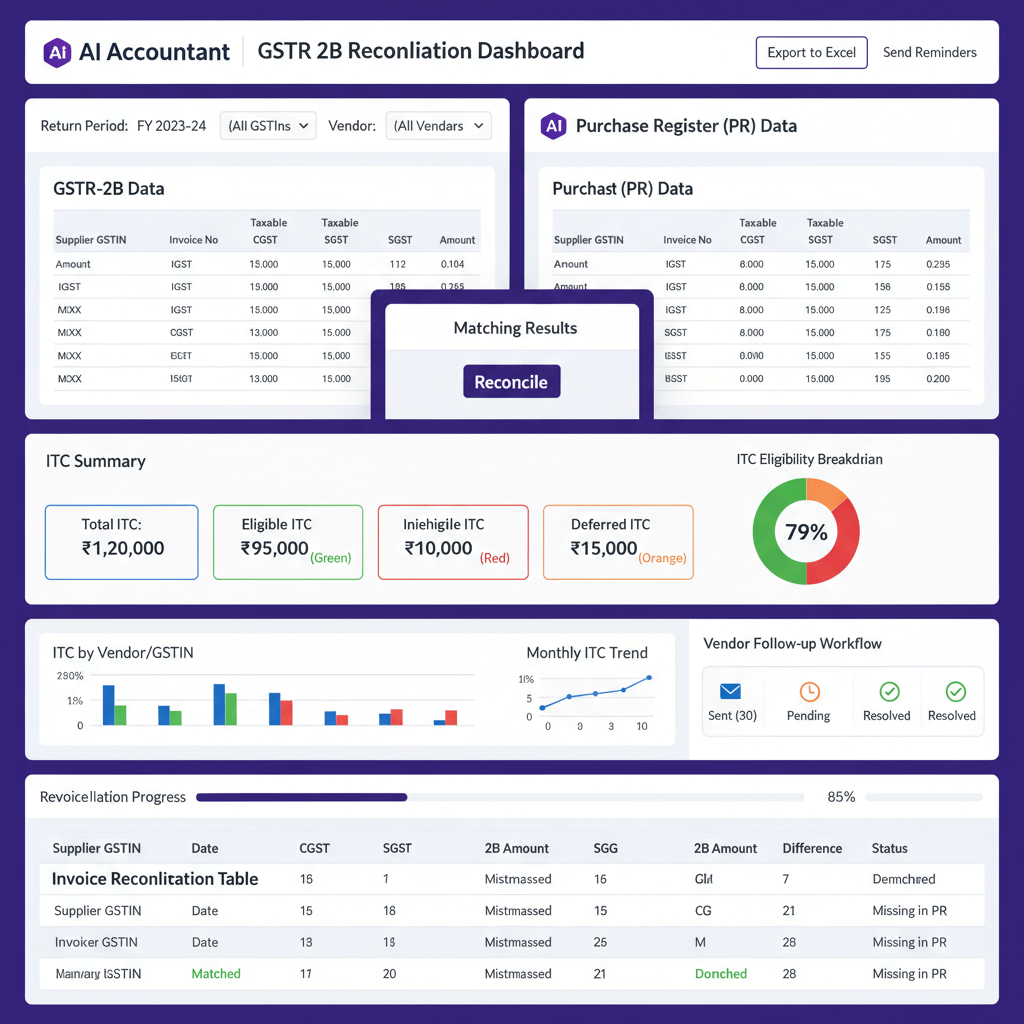
- A real time monthly dashboard gives CAs, CFOs, and founders instant visibility into ITC position, vendor compliance, and reconciliation progress.
- Well implemented tools deliver fast ROI, even a small lift in ITC utilization on a moderate base pays back subscriptions quickly.
- AI Accountant stands out for intelligent matching, configurable ITC policy automation, and practical workflows designed for CA firms and SME finance teams.
Why GSTR 2B reconciliation tools matter now
GSTR 2B reconciliation tools are transforming GST compliance by removing the grind of manual matching, eliminating VLOOKUP headaches, and surfacing discrepancies in seconds. For teams closing the month under pressure, this shift means fewer missed credits, cleaner books, and faster filings. As highlighted in sector explainers from RealBooks, Tally Solutions, and Binary Semantics, automation is no longer optional, it is essential.
No more VLOOKUP nightmares, no more missed credits weakening working capital, just clean, reconciled data ready to file.
Who needs GSTR 2B reconciliation tools and why
CA firms, SME finance teams, and leadership all benefit from automation, but their needs differ.
- CA firms handle multiple clients, every client adds new GSTR 2B downloads, fresh purchase registers, and more vendor follow ups. Without automation, effort scales linearly and quality suffers.
- SME finance teams prioritize speed, accuracy, and ITC protection. Every missed credit hurts cash flow, every delayed vendor nudge rolls problems into the next month.
- Founders and CFOs demand a monthly dashboard view of ITC, vendor compliance, and exceptions, so issues are addressed before they become penalties.
Benchmarks from practitioners, including GSTHero and Zintego, show that a typical SME matching 1,000 invoices spends a full work week each month on reconciliation when done manually.
What do GSTR 2B reconciliation tools do
These platforms centralize reconciliation into a single flow. The core engine matches your purchase register against vendor reported invoices in GSTR 2B using both exact and fuzzy logic on GSTIN, invoice number, date, and value. When matches fail, exceptions surface instantly.
- Identify missing invoices fast, with clear exception buckets for missing, value mismatch, GSTIN variance, and date variance.
- Separate logic for special cases such as RCM transactions, ISD credits, and imports.
- ITC claim optimisation via auto tagging, blocked credit identification under Section 17(5), and deferral for time sensitive claims.
- Vendor follow up automation to chase non filing or mismatch cases with templated messages and tracked SLAs.
- Monthly dashboard aggregating ITC position, vendor compliance, and reconciliation status across entities.
For deeper context, compare perspectives from RealBooks, Tally Solutions, Binary Semantics, and GSTHero.
Must have capabilities checklist
- Data ingestion: One click GSTR 2B import in JSON and Excel, flexible purchase register uploads, credit and debit notes without preprocessing.
- Matching engine: Exact and fuzzy matching to confidently match purchase register entries, configurable tolerances, amendment linking, duplicate detection.
- Exceptions and controls: Clear buckets to identify missing invoices, status tags, comments, attachments, and full audit trails.
- Policy engine for ITC claim optimisation: Auto tag eligible, ineligible, and hold categories, logic for RCM, ISD, and imports, vendor risk scoring, deferral rules.
- Communication layer for vendor follow up automation: Email and WhatsApp templates, automated reminders, SLA tracking, and escalations.
- Analytics via monthly dashboard: ITC availed versus potential, deferred and blocked breakdowns, vendor scorecards, entity level drill downs.
- Integrations and posting: Two way sync with popular ERPs and accounting systems, clean posting of reconciled bills and categorizations.
- Security and scale: Role based access, multi entity isolation, recognized certifications, high volume performance.
Useful buyer notes are compiled by GSTHero, Tally Solutions, Binary Semantics, Taxilla, Paytm, and Bicxo.
End to end reconciliation flow
- Import GSTR 2B and your purchase register, the tool should accept multiple formats without conversion.
- Run auto matching to quickly surface exceptions, then identify missing invoices and value or date mismatches.
- Apply ITC claim optimisation rules, auto post eligible entries, mark deferrals, and hold ineligible credits.
- Trigger vendor follow up automation for missing or mismatched items, track reminders and responses centrally.
- Post reconciled data back to books, lock the period, generate the filing pack with confidence.
- Review the monthly dashboard, export management and compliance reports, and monitor trends.
See practitioner walkthroughs from RealBooks, GSTHero, and Zintego.
Pro tip
Keep a short exception playbook, with standard actions and SLAs for each bucket. Consistency turns speed into reliability.
Evaluation criteria for buyers
- Accuracy: High match rates, low false positives, custom rules for your edge cases.
- Speed and usability: Bulk actions, inline edits, smart filters, quick onboarding.
- Coverage: Multi GSTIN, credit and debit notes, RCM, ISD, amendments.
- Integration: Reliable, resilient sync with your accounting stack, clear error handling.
- Collaboration: Roles, comments, and shared vendor follow up automation that teams can see and trust.
- Reporting: Actionable monthly dashboard, exportable analytics, audit ready documentation.
- Security: Recognized certifications, data residency options, comprehensive logs.
- Pricing and ROI: Transparent pricing, time saved, measurable ITC recovery gains.
Cross check requirements with buyer guides from Tally Solutions, GSTHero, Binary Semantics, Taxilla, Paytm, and Bicxo.
ROI model and benchmarks
Time savings are immediate, automated matching for 1,000 invoices takes minutes, not hours. Many teams report ten times faster processing versus spreadsheets.
ITC recovery improves with faster nudges and fewer errors. A two percent lift on a base of ₹25 lakhs returns ₹50,000 per cycle.
Cash flow benefits from timely claims, fewer penalties, and freed working capital. For example, processing 5,000 invoices monthly at twenty hours per team member, at ₹500 per hour, costs ₹10,000 in labor, add recovered ITC, and subscription payback often lands inside one month. CA firms multiply these gains across clients, compounding value.
For reference models, see GSTHero, Paytm, Binary Semantics, RealBooks, and Taxilla.
Top GSTR 2B reconciliation software options
- AI Accountant (https://www.aiaccountant.com) Comprehensive GST reconciliation with intelligent matching, automated vendor follow ups, and seamless Zoho Books and Tally sync, well suited for CA firms with many clients.
- ClearTax GST Popular platform covering reconciliation, e invoicing, and filings with deep portal features.
- Zoho GST Natural fit for companies already on Zoho Books.
- TaxiVaahan Cloud solution with multi GSTIN support and detailed reports.
- Gen GST Cost effective option for SMEs with straightforward needs.
- Masters India Enterprise grade features and analytics for complex environments.
Each tool excels in different scenarios, test against your volume, integration depth, and team workflow.
How AI Accountant handles the essentials
AI Accountant streamlines reconciliation with bulk ingestion, fuzzy and exact matching to catch typos or date slips, and clear exception buckets to identify missing invoices instantly. Configurable ITC claim optimisation auto tags eligible, ineligible, and deferred credits including RCM, ISD, and imports. Vendor follow up automation uses custom templates, reminders, and escalations, and the monthly dashboard tracks ITC, compliance, and progress across entities. Two way sync with Zoho Books and Tally posts clean entries back to your books. Teams report dramatic cycle time reductions and double digit lifts in ITC utilization, reflecting the value highlighted by RealBooks and GSTHero.
Implementation tips
- Clean vendor masters before go live, verify GSTINs for better matching quality.
- Set matching tolerances and approvals deliberately, balance strictness with practicality.
- Pilot for one month, then backfill history to establish reliable baselines.
- Train users on exception handling and vendor follow up automation, publish short playbooks.
- Document ITC policies inside the tool for consistent, auditable decisions.
For policy nuances and reconciliation scope, review Binary Semantics and Taxilla.
Compliance nuances and edge cases
- GSTR 2A versus GSTR 2B: 2A is dynamic, 2B is a monthly snapshot, handle late filings and amendments without false alarms.
- Blocked credits: Section 17(5) categories should be auto tagged ineligible.
- Time limits for claiming ITC: Track expiry risks, warn teams before deadlines pass.
- RCM and imports: Apply dedicated logic when you are both supplier and recipient, and for ISD allocations.
- Multi location entities: Support multi GSTIN purchases, inter branch transactions, and consolidated reporting.
- Quarterly filers: Accommodate vendor timing differences to avoid false exceptions.
Conceptual refreshers from Tally Solutions, Binary Semantics, and Zintego are helpful here.
Common pitfalls to avoid
- Skipping vendor master cleanup, poor GSTIN data ruins match quality.
- Over automating on day one, start simple, then refine rules.
- Under investing in training, user errors undo automation gains.
- Ignoring integration details, test end to end postings thoroughly.
- Mishandling amendments and credit notes, link them to originals.
- Treating all mismatches equally, prioritize by financial materiality.
Vendor management best practices
- Share your reconciliation schedule so vendors can plan filings.
- Publish vendor scorecards for timeliness and accuracy, reward improvement.
- Use tiered escalation for persistent issues, gentle to firm, with clear SLAs.
- Offer short training for vendors where recurring issues persist.
- Build buffer time for corrections, reality always includes late fixes.
Making your decision
Quantify current pain, hours spent and ITC leakage, shortlist tools against the checklist, and insist on a demo using your actual data. Consider total cost of ownership, not just subscription. Choose a platform that scales, integrates cleanly, and that your team enjoys using. The move from manual to automated reconciliation is not only about speed, it is about turning compliance into a controlled, proactive process. Explore AI Accountant for a guided walkthrough of ITC optimization and reconciliation workflows, then measure the before and after to confirm ROI.
FAQ
What is the practical difference between GSTR 2B reconciliation tools and generic accounting systems for a CA firm
Specialized reconciliation platforms are built for GST detail, they align your match purchase register workflow to vendor reported 2B data, apply ITC claim optimisation rules, and run vendor follow up automation with audit trails. Generic systems record transactions, but they rarely offer fuzzy matching, ITC policy engines, or exception buckets tuned for GST. For background, see the RealBooks guide and ClearTax reconciliation overview.
How should I treat invoices not appearing in GSTR 2B by my filing cutoff
Flag them as exceptions, initiate automated vendor follow up immediately, and if unresolved by filing day, defer the ITC claim to avoid interest or notices. Your tool should track the deferral and auto surface the invoice for the next eligible period once the vendor files. See Tally Solutions on GSTR 2B and GSTHero’s guidance.
What tolerance settings should a CA configure for value mismatches during matching
Start with a conservative percentage or absolute threshold aligned to your materiality policy, for example one percent or ₹50, then refine after a pilot. Ensure separate tolerances for tax value and invoice total. AI Accountant supports configurable tolerances per entity, helping firms tune accuracy while minimizing noise.
Can the software auto post deferred or held ITC entries back to Zoho Books or Tally without double counting
Yes, mature tools provide two way integrations that post cleaned bills, credit notes, and categorization updates, and prevent duplicates through unique document keys. Refer to Tally Solutions’ overview and confirm posting modes during vendor demos.
How secure is vendor and invoice data during automated follow ups and team collaboration
Look for role based access, encryption in transit and at rest, audit logs, and certifications like SOC 2 and ISO. Vendor communications should be templated, tracked, and access controlled. For an implementation perspective, review the RealBooks article and request a security pack from your shortlisted vendor.
What should I do when GSTR 2B contains invoices our books do not show
Treat them as potential missing purchases, verify legitimacy with the vendor and internal stakeholders, check period alignment, and rule out vendor duplicates. Good tools provide investigation fields, comments, and attachments so your team can resolve and document the decision trail.
How do CA firms handle quarterly supplier filings when clients file monthly
Use timing aware exception logic, park ITC from quarterly filers until their 2B catches up, and maintain a vendor calendar for nudges aligned to their filing cycle. AI Accountant’s buckets and vendor scorecards help teams avoid false exceptions and keep claims compliant.
How are partial payments, advances, and credit notes reflected in reconciliation
Reconciliation links documents, not just cash flows, so the tool should support partial matches, advance adjustment mapping, and credit note linkage to the original invoice. This preserves auditability and ensures ITC is claimed correctly against net liability.
Which reports are non negotiable for scrutiny readiness during departmental audits
Maintain the reconciliation summary by bucket, the matched and unmatched registers, vendor wise exception logs, ITC eligibility and deferral reports, and a period lock audit log. A buyer’s checklist from Paytm and Taxilla aligns well with these requirements.
How do I quantify ROI convincingly for partners or management before purchase
Run a two week pilot on one recent month, measure hours saved, match rate uplift, and recovered ITC. Even a two percent ITC lift on ₹25 lakhs yields ₹50,000, which often covers a monthly subscription immediately. AI Accountant includes a pilot playbook with benchmark templates so CAs can present a clean ROI case.
Can an AI powered tool like AI Accountant reduce vendor dependency for ITC realization
Yes, by sending timely, specific follow ups with invoice level details, tracking SLAs, and escalating intelligently, dependency becomes managed rather than ad hoc. The monthly dashboard highlights chronic defaulters, enabling structured interventions and contract level remedies.
What governance should a CA firm put in place to prevent accidental ITC overclaims
Define approval tiers by amount, enforce period locks after posting, require justification notes for overrides, and schedule exception reviews. Combine this with a policy engine that auto tags blocked credits and near expiry items, reducing manual oversight load while strengthening control.
How are amendments handled so that original and revised invoices reconcile correctly
Expect amendment linking that ties revised invoices to originals using GSTIN, invoice number, and date logic, with a clear timeline view. The system should reverse or adjust claims automatically and maintain an auditable chain for each change event.
What training plan ensures smooth adoption for client teams and article assistants
Deliver one short onboarding, one deep dive on exceptions, and a refresher after the first close. Provide a two page playbook with screenshots, SLA targets, and escalation routes. AI Accountant includes embedded walkthroughs and sample datasets to accelerate learning.

Rohan Sinha is a fintech and growth leader building aiaccountant.com, focused on simplifying accounting and compliance for Indian businesses through automation. An IIT BHU alumnus, he brings hands-on experience across 0 to 1 product building, growth, and strategy in B2B SaaS and fintech.