-01%201.svg)
Key takeaways
- Automated GSTR 2B reconciliation matches purchase registers quickly, flags missing invoices instantly, and helps you lock accurate ITC before the monthly freeze.
- Strong tools combine multi parameter, fuzzy, and tolerance based matching, with full audit trails and GSTR 3B alignment.
- Exception workflows, vendor chase lists, and bulk actions reduce manual follow ups, increase recovered ITC, and cut interest exposure.
- Dashboards, approval controls, and one click auditor packs bring transparency and control across entities and periods.
- CA firms and mid market finance teams see three to five times faster closes, with over ninety percent auto matches and measurable ITC leakage reduction.
- A short pilot, clean masters, and rule tuning are enough to move from spreadsheet firefighting to predictable month end routines.
Why GSTR 2B Reconciliation Matters Now
GSTR 2B is a monthly, static snapshot of supplier filed data that drives your eligible Input Tax Credit. Once it freezes on the fourteenth, your claim window for that period effectively closes. Miss invoices and you lose ITC, claim without matching and you invite interest, penalties, and audit friction.
The spreadsheet approach strains under volume, time pressure, and human error. Typos, format mismatches, and late vendor filings turn simple checks into late night marathons. Modern tools compress this cycle into hours, they surface discrepancies, and they structure vendor follow ups so nothing slips.
Every mismatch represents either unrealized cash or compliance risk, the best teams turn reconciliation into a repeatable, auditable routine.
For deeper context, see the SAG Infotech guide to reconciling GSTR 2B and GSTR 3B, the Taxilla overview of GSTR 2B and 2A reconciliation software, and the ICAI AI use case on automated GST reconciliation.
What Good Looks Like: Feature Checklist for GSTR 2B Reconciliation Tools
Data Ingestion Breadth
Your tool should import GSTR 2B in JSON and Excel, consolidate months in bulk, and ingest purchase registers, JVs, and credit or debit notes with smart column mapping. Direct sync with Zoho Books or Tally removes manual exports, while bidirectional updates keep both systems aligned. Helpful references, the ICAI AI use case, and this SoftwareSuggest roundup of GST reconciliation software.
Core Matching Logic
Accuracy hinges on multi parameter checks, not just invoice numbers. Professional tools match GSTIN, invoice date, taxable value, tax breakup, and RCM status. Exact, partial, and fuzzy matching handle real world inconsistencies. Tolerance controls help you ignore small rounding differences while flagging material gaps. See the ICAI AI use case and the BUSY GSTR reconciliation overview.
Exceptions and Insights
Find, categorize, and act. The tool should separate missing in 2B, in 2B but missing in books, value and GSTIN mismatches, duplicates, blocked credits, related party cases, and RCM applicability. Great systems guide ITC treatment, auto tagging invoices as eligible, deferred, or reversed, backed by ITC reversal automation. Month wise deferrals and match GSTR 1 with GSTR 3B totals keep filings consistent. Helpful references include the SAG Infotech reconciliation guide and the SoftwareSuggest review page.
Actioning and Collaboration
Automation reduces chasing. Generate vendor wise chase lists, assign owners and due dates, and use standard email or WhatsApp templates for common cases. Bulk accept, defer, or reverse with notes for audit. Close the loop by syncing cleaned data back to accounting. See the SAG Infotech guide, the ICAI AI use case, and the SoftwareSuggest software directory.
Reporting and Controls
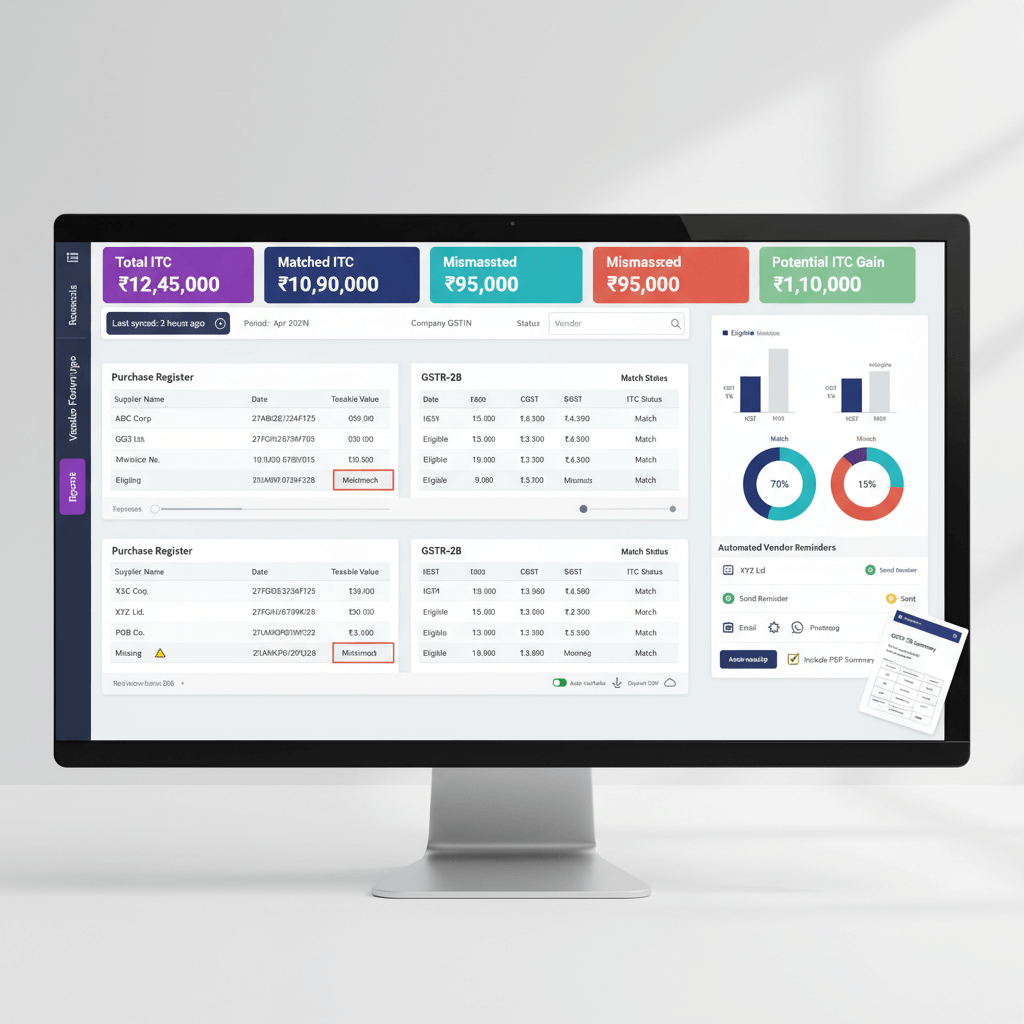
Dashboards should show eligible, deferred, and ineligible ITC, top defaulting vendors, and reconciliation percentages. Approval workflows separate preparers and approvers, with audit logs for every action. One click auditor packs reduce scramble during reviews. Explore the ICAI AI use case and the BUSY reconciliation feature set.
Non Functional Requirements
Expect over ninety percent auto match rates at scale, multi organization support for CA firms, and documented security such as ISO or SOC. Understand SLAs, data residency, and retention. For evaluation pointers, see the ICAI AI use case and the SoftwareSuggest buyer guide.
Comparison Guide: Shortlist with Pros and Cons
Manual Excel remains free, yet error prone and time consuming, with no fuzzy matching and limited auditability.
Custom macros add low cost automation, yet become opaque over time, and require technical maintenance.
Accounting software add ons in Zoho Books, BUSY, or Gen GST bring integration and tolerance controls, but limited vendor automation. See BUSY GSTR reconciliation and this Gen GST focused walkthrough by SAG Infotech.
Dedicated platforms such as ICAI backed tools offer fuzzy matching, deep dashboards, and automated vendor follow up, delivering three to five times faster cycles. Explore the ICAI AI use case, browse the SoftwareSuggest directory, and watch this YouTube walkthrough for context.
Evaluation Questions for Vendors
- Matching capabilities: How do you handle partial and fuzzy matches, can I tune tolerance levels by field, how are amendments tracked across periods.
- ITC optimization: Can the system auto tag eligibility, create deferral and reversal JVs, and align with GSTR 3B totals consistently.
- Vendor follow up: Do you generate chase lists with owners and due dates, what exports are supported, do you integrate with email and WhatsApp.
- Integration depth: Is there native, bidirectional sync with Zoho Books or Tally, how do you handle conflicts safely.
- Reporting and controls: Do dashboards show ITC buckets and vendor trends, are approvals and audit trails comprehensive.
- Audit evidence: Can I generate one click reconciliation packs with logic, exceptions, and resolutions.
- Security: What certifications exist, where is data stored, what are uptime and response SLAs.
Useful frameworks appear in the ICAI AI use case, this SAG Infotech checklist, and the SoftwareSuggest buyer guide.
Recommended GSTR 2B Reconciliation Tools
- AI Accountant offers comprehensive GSTR 2B reconciliation with Zoho Books and Tally sync, fuzzy matching, and automated vendor follow up, with over ninety percent auto matches.
- ClearTax GST provides bulk reconciliation, detailed mismatch reports, and ITC optimization for enterprise scale complexity.
- Zoho Books GST Module suits existing Zoho users, with native filings and straightforward reconciliation.
- BUSY Accounting Software brings strong reconciliation, tolerance controls, and reporting trusted by traditional firms.
- Gen GST Software focuses on GST compliance, reconciliation, and e invoicing with practical workflows.
- Tally Prime with GST keeps reconciliation inside Tally, familiar for current users, with basic matching.
Sample Workflow: How This Works in Practice
Using AI Accountant as an example, you begin with a sync from Zoho Books or Tally, masters and open documents flow in, then you upload the monthly GSTR 2B. The system auto matches across GSTIN, invoice number, dates, values, and tax breakups, then assigns statuses such as Matched, Missing in 2B, In 2B not in books, GSTIN or value mismatch, or RCM applicable.
Next, you filter by exception, perform bulk accepts, deferrals, or reversals, and add notes. Vendor automation creates chase lists with owners and due dates.
Finally, ITC buckets are confirmed, deferrals scheduled, and clean data pushes back to accounting. One click packs archive the period for audit.
For comparable reference models, see the ICAI AI use case, the SAG Infotech Gen GST walkthrough, and this SoftwareSuggest software list.
ROI and Time Saved Model
Consider one thousand monthly purchase invoices. A manual process might consume twenty hours. With automated reconciliation, three to five times faster cycles cut this to four to six hours. With over ninety percent auto matches, only the last ten percent require review. ITC leakage reduces as missing in 2B invoices surface earlier, while interest exposure drops as you align books and returns consistently. See evidence patterns in the ICAI AI use case and the BUSY reconciliation overview.
Implementation Playbook
- Prepare data, standardize vendor GSTINs, export clean purchase registers, and download recent GSTR 2B JSON files.
- Run a two month pilot, aim for eighty five percent or higher auto matches, and under seven days for unresolved items.
- Measure success, track ITC accuracy, missing invoice recovery, and close time reduction.
- Train your team on exception handling and vendor outreach, not on manual matching.
- Establish routines, reconcile as soon as 2B is out, set vendor follow up cadences, and review dashboards weekly.
Compliance Best Practices
Close reconciliation before the fourteenth so you can nudge vendors, defer wisely, and claim accurately. Create vendor scorecards to inform negotiations. Maintain a period wise reconciliation pack with matches, exceptions, resolutions, and final ITC claimed. Review patterns quarterly to address recurring mismatches and process gaps. For structured checklists, use this SAG Infotech checklist and the Taxilla comparison.
Getting Started with GSTR 2B Reconciliation Automation
Start with your most problematic vendors or highest value categories, run a pilot month, and compare time and leakage. A short walkthrough using your own files is often enough to validate fit and ROI. For structured evaluation, refer to the ICAI AI use case and the SoftwareSuggest directory.
FAQ
How should a CA tune matching tolerances to reduce noise without missing material ITC issues
Begin with strict checks on GSTIN, invoice number, and date, then set small currency tolerances on taxable value and tax amounts, for example Rs 10 to Rs 50 for rounding. Review the first pass exception list, tighten thresholds if too many false positives emerge, or expand slightly if true mismatches are already rare. Tools like AI Accountant allow separate tolerances by field, which helps isolate rounding versus value errors.
What is the best practice to reconcile amended invoices spanning multiple periods
Use a tool that tracks original and amended entries with cross period linkage, then show the net impact on the current period’s ITC. Maintain an amendment register that maps amendment references to prior filings, and reflect adjustments in the current 3B. AI Accountant maintains amendment history and shows status transitions so audit evidence stays intact.
How do I treat invoices missing in GSTR 2B but present in the purchase register at month end
Classify them for vendor follow up, verify supplier GSTR 1 status, and defer ITC until the invoice appears in 2B unless backed by robust documentation and policy. Generate vendor chase lists with owners and due dates, and roll unresolved cases forward. AI Accountant automates chase lists and deferral tagging to keep control tight.
Can I reconcile historical periods efficiently for a new GST client onboarding
Yes, bulk upload purchase registers and 2B files for multiple months in one go, run automated matching, then sweep exceptions by category. Start with the latest quarter for quick wins, then work backwards as needed. AI Accountant supports multi month bulk processing with period wise segregation and audit trails.
What approach should I use to align 2B reconciliation with GSTR 3B reporting totals
Close reconciliation first, lock eligible, deferred, and reversed buckets, then map these to the relevant 3B tables. Validate totals using a reconciliation report that compares current period 2B credits with proposed 3B claims. Tools that implement match GSTR 1 with GSTR 3B totals logic reduce interest risk and rework.
How do I handle RCM transactions during reconciliation without double counting
Ensure the tool detects RCM applicability and separates such invoices from regular credits. The purchase side records tax liability under RCM, while 2B may reflect supplier reporting differently. A clear Reverse Charge Mechanism accounting rule set in AI Accountant prevents duplicate credit and aligns liability and ITC timing.
What controls should a CA firm implement when juniors prepare and partners approve ITC
Adopt maker checker workflows with role based access, restrict tolerance changes to seniors, and require notes on manual overrides. Maintain versioned reconciliation packs and exportable logs of every action. AI Accountant provides approval queues, action notes, and immutable logs that simplify peer review and audit.
How can I quantify ROI from a reconciliation tool for a multi entity client portfolio
Track three metrics, hours per period, auto match percentage, and recovered ITC from resolved exceptions. Compare two to three pilot cycles against the baseline. Typical outcomes include three to five times time reduction, over ninety percent auto matches, and a measurable drop in interest due to better 3B alignment. AI Accountant dashboards surface these metrics across entities.
What is the recommended way to manage vendor communication at scale for missing invoices
Centralize a chase list with status, owner, due date, and last contact, use standardized templates, and send weekly reminders until closure. Export lists for campaigns or use built in WhatsApp and email connectors. AI Accountant auto builds chase queues, captures responses, and rolls unresolved items forward with traceability.
How should credit notes and debit notes be reconciled against the purchase register and 2B
Match CN and DN using reference numbers and values, then net them against the base invoice or treat separately depending on policy. Confirm that vendor reported notes are reflected in 2B, and that your books carry consistent adjustments. AI Accountant links notes to base documents and shows net ITC effect period wise.
What data preparation checklist should I follow before first run to avoid poor match rates
Standardize GSTIN formats, normalize invoice numbers, ensure date formats are consistent, deduplicate purchase register lines, and split tax components cleanly. Start with two recent months for calibration. AI Accountant’s smart column mapping and validation catches common format issues upfront.
How do I evidence reconciliation during audits without spending days compiling files
Generate a single pack containing matching logic, exception categories, resolutions with timestamps, and final ITC claimed. Include vendor follow up logs and deferral or reversal JVs. AI Accountant produces one click auditor packs that align with standard working paper expectations.
Can a single login manage multiple GSTINs or client entities with different rules
Yes, choose a platform that supports multi organization workspaces, entity specific rules, and separate data domains. AI Accountant allows entity level configurations, tolerance profiles, and reporting, enabling CA firms to switch contexts quickly while keeping controls tight.

Rohan Sinha is a fintech and growth leader building aiaccountant.com, focused on simplifying accounting and compliance for Indian businesses through automation. An IIT BHU alumnus, he brings hands-on experience across 0 to 1 product building, growth, and strategy in B2B SaaS and fintech.