-01%201.svg)
Key takeaways
- Automated GSTR 2B reconciliation reduces manual effort, increases ITC accuracy, and cuts notice risk for CAs and SMEs.
- Look for robust data ingestion, a strong matching engine, clear exception workflows, and end to end automation.
- Capabilities like ITC claim optimization, monthly dashboard visibility, and vendor follow up automation are non negotiable.
- Expect 40 percent time savings, 1.8 to 5 percent ITC uplift, and faster month end closes when implemented well.
- Integrations with Zoho Books and Tally are critical for scale, accuracy, and audit readiness.
- Security, audit trails, maker checker, and multi GSTIN support separate enterprise ready tools from basic options.
- Evaluate tools against a clear checklist, run a pilot, clean masters, and track success metrics from day one.
Quick refresher: GSTR 2B and reconciliation basics
GSTR 2B is a static, month wise statement of eligible ITC derived from suppliers’ GSTR 1 filings. Each month, you download the statement and reconcile it with your purchase register to validate ITC claims.
Common mismatches include timing differences when suppliers file late, GSTIN typos, wrong tax rates, prior period amendments, credit and debit notes, plus complexity from Reverse Charge Mechanism entries.
Risk reality: Over claiming ITC can invite notices, under claiming locks cash, and manual Excel reconciliation magnifies both risks.
For a policy depth refresher, see the ClearTax GST guide, this Refrens GST reconciliation playbook, and a perspective on software value from The Munim.
What great GSTR 2B reconciliation tools should do
Data ingestion that just works
Direct pulls of GSTR 2B from the GST portal, import of purchase registers, JVs, credit and debit notes, and smooth Excel, Zoho Books, and Tally flows.
A matching engine built for accuracy
Invoice level, line level, and fuzzy logic driven matching, with GSTIN, invoice number, date, taxable value, and tax breakup checks, plus many to many scenarios.
Exception workflows that save hours
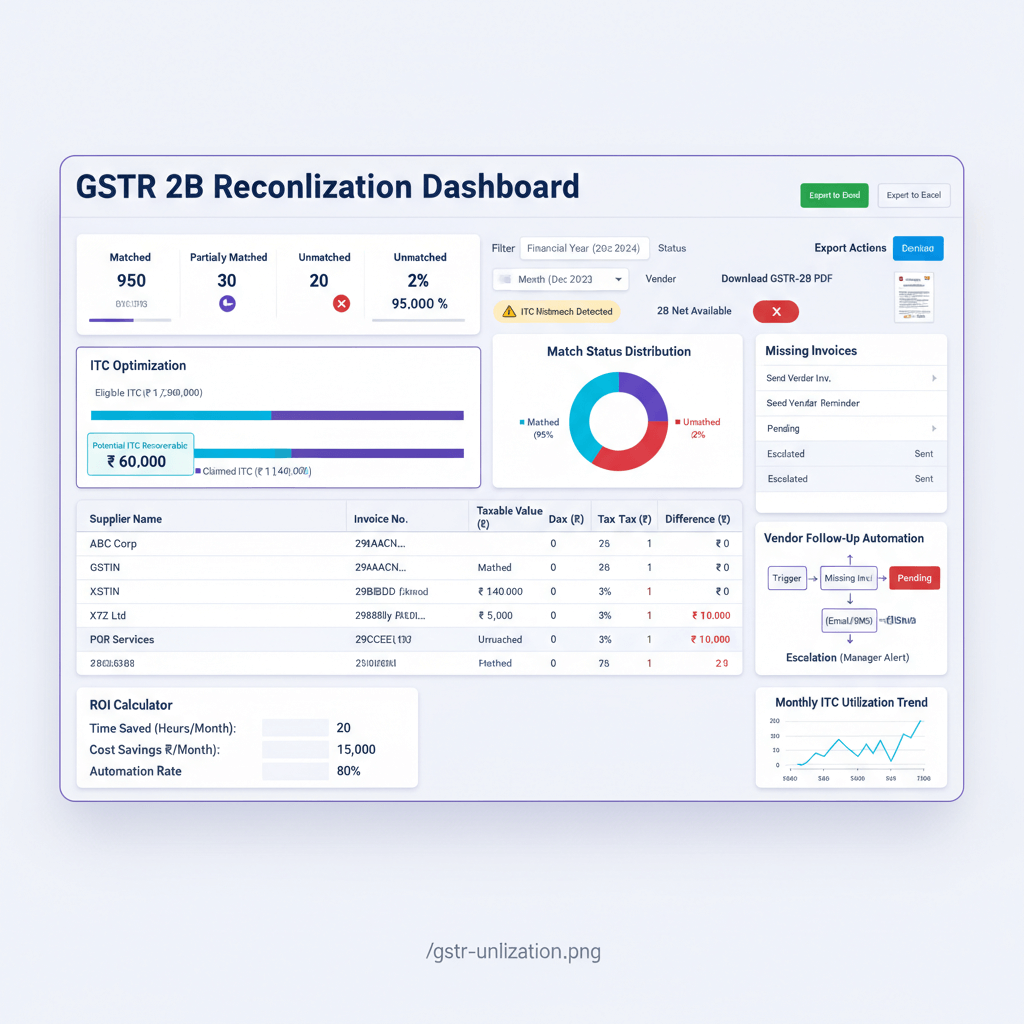
Instant identification of missing invoices, duplicate flags, tax mismatches, and clear reason codes like Not in 2B, GSTIN mismatch, or Tax rate variance.
ITC claim optimization beyond basics
Rule driven tagging of eligible, ineligible, and deferred ITC, with automated reversals and re claims, and scenario simulation before filing.
Vendor follow up automation
One click discrepancy lists, templated outreach by email or WhatsApp, status tracking, and automated reminders, so coordination does not live in Excel.
Monthly dashboard visibility
Real time ITC eligible versus claimed, vendor variances, aging, error categories with drill downs, and export ready MIS.
Integrations and data integrity
Two way sync with Zoho Books and Tally, APIs and webhooks for custom flows, and reliable pushback that keeps ledgers aligned.
Controls and compliance
Maker checker, role based access, complete audit trails, multi org support, and period locking for disciplined closes.
Scale, performance, and security
Fast processing across ten thousand to five lakh lines, with ISO 27001 and SOC 2 level safeguards, encryption in transit and at rest, and data residency alignment.
Support and onboarding
Clear SLAs, hands on training, and documentation that accelerates adoption.
For market scans and comparisons, explore the enComply versus LogiTax comparison, the ClearTax GST guide, the Pice overview of reconciliation tools, this Refrens explainer, the SaaSCounter listings, and TCS iON BizHub’s roundup.
Pro tip: Ask vendors to show live, messy data, not cherry picked demos. Real world noise is where great engines shine.
Workflow walkthrough, end to end
- Import and sync, connect masters from Zoho Books or Tally, upload GSTR 2B, import purchase registers, and auto validate formats.
- Match purchase register, run fuzzy rules with confidence scores, auto approve high confidence matches, queue low confidence for review.
- Identify missing invoices, bucket exceptions by vendor mismatch, amendments, rate variance, and more for targeted resolution.
- Trigger vendor follow up automation, send discrepancy lists with specifics and due dates, track and escalate non responses.
- Run ITC claim optimization, tag eligibility, simulate scenarios, and finalize the filing plan.
- Approve and post, push adjustments back to your books, lock the period, and generate audit packs.
- Review the monthly dashboard, sign off, export MIS, and archive.
For step by step context and guardrails, see ClearTax GST, these notes from The Munim, a Pice tools overview, the Refrens guide, this side by side comparison, and the SaaSCounter catalog.
Top GSTR 2B reconciliation software options
- AI Accountant, comprehensive reconciliation with deep Zoho Books and Tally integration, enterprise security, and scale.
- ClearGST, a market leader with AI driven matching and automation depth.
- enComply, strong for complex multi GSTIN scenarios with advanced matching logic.
- LogiTax, budget friendly with essential reconciliation coverage.
- Pice, known for a user friendly experience and vendor communications.
- FreshBooks, integrated accounting with basic GST reconciliation capability.
Evaluation checklist, printable
Coverage requirements
- Purchase registers, JVs, credit and debit notes
- RCM and import handling
- Multi GSTIN management
- Carry forward reconciliation
Matching capabilities
- Exact and fuzzy options
- Amendment handling
- Split invoice support
- Partial credit matching
Control features
- Maker checker workflows
- Comprehensive audit logs
- GSTR 2B version tracking
- Period locking
Automation depth
- Vendor follow up automation workflows
- Bulk update capabilities
- Rule based tagging
- Exception routing
Analytics quality
- Monthly dashboard completeness
- Drill down analysis
- Export flexibility
- Custom reports
Integration strength
- Zoho Books and Tally sync reliability
- Retry logic
- Ledger pushback accuracy
- Master data alignment
Security standards
- ISO 27001 and SOC 2
- Access control granularity
- Encryption in transit and at rest
- Data residency controls
Usability factors
- Bulk actions and inline edits
- Mobile access
- Short learning curve
Cost structure
- Per org or per invoice pricing
- Hidden fee transparency
- Onboarding costs
- Scaling economics
Use the checklist live during demos, mark gaps, and request workarounds before you sign.
For deeper research, consult ClearTax GST, Cashflo’s reconciliation overview, the Pice tools list, this enComply versus LogiTax review, SaaSCounter software listings, TCS iON BizHub, and pricing notes from OreateAI.
ROI and time savings model, India context
Hours saved: many teams report a forty percent reduction in closing time. One thousand invoices that once took three days can be completed within hours.
ITC uplift: one point eight to five percent of total claims recovered, frequently unlocking three to five percent of working capital stuck in taxes.
Notices drop: complete audit packs and faster reconciliation cycles leave room to correct before filing.
Vendor response: automated outreach raises response rates to seventy percent, expediting corrections.
Example, five hundred monthly purchase invoices, twenty four hours manually, six hours with automation, eighteen hours saved. At one thousand rupees per hour, that is eighteen thousand rupees per month, excluding ITC recovery and notice avoidance. See ClearTax GST, SaaSCounter benchmarks, and the Refrens guide for context.
Approaches compared
Manual Excel reconciliation
Low entry cost, high risk and limited scalability beyond a few hundred invoices, little to no audit trail, and error prone formulas.
In house scripts
Custom fit but fragile, frequent maintenance due to rule changes, and knowledge loss risk when developers leave.
Dedicated reconciliation tools
Balanced speed, scale, and compliance with predictable subscription costs and continuous regulatory updates. Match the tool’s sophistication to your complexity.
Comparative reads include the Refrens playbook, this Munim article, the SaaSkart comparison, and ClearTax GST.
Implementation guidance
Prerequisites
Clean vendor masters, validate GSTINs, standardize purchase registers, and align tax codes to prevent matching failures.
Phased rollout
Pilot with one or two entities, test two to three months of history, validate match accuracy, and expand gradually.
Change management
Define maker checker ownership, review cadences, vendor communication templates, and document the new process.
Success metrics
Target ninety percent auto match, keep exception aging under thirty days, drive toward zero ITC variance post reconciliation, and track vendor response times.
Training investment
Two to three days for the core team, quick reference guides, and short videos for onboarding new staff.
Integration planning
Stress test Zoho Books or Tally sync, verify mappings, plan for API limits, and set fallbacks.
Helpful primers include The Munim’s checklist, the SaaSkart comparison, SaaSCounter’s directory, and ClearTax GST.
Risk and compliance considerations
Evidence generation
Produce detailed match listings, reason coded exceptions, category summaries, and immutable audit logs with timestamps.
Amendment handling
Re reconcile prior period changes, adjust ITC correctly, and maintain version control of reconciliations and filings.
Data privacy and security
Protect GSTINs and invoice data with encryption, strict access controls, regular backups, and certifications.
Staying current with rules
Choose vendors who ship timely regulatory updates and communicate changes proactively.
Audit readiness
Generate reconciliation certificates, export in tax office friendly formats, and retain multi year data.
For more on diligence, see this comparison note, the Pice guide, and SaaSCounter’s overview.
Short case snapshots, illustrative
CA firm with twenty SME clients: Excel reconciliation took five days per client, automation cut this to three days in total, closings were forty percent faster, ITC recovery averaged one point eight percent, and vendor follow ups achieved seventy percent response rates.
Manufacturing SME, fifteen thousand monthly invoices: backlogs cleared within two cycles, the CFO now reviews monthly dashboards, and audit notices dropped by sixty percent.
Trading company with multiple GSTINs: unified reconciliation across entities, centralized exceptions, and working capital improved by forty five lakh rupees through optimized ITC.
Contextual reads, ClearTax GST and the Pice tools list.
How AI Accountant maps to your checklist
AI Accountant integrates deeply with Zoho Books and Tally, ingests purchase registers, JVs, and credit notes in bulk, and uses intelligent rules to match purchase register entries with GSTR 2B data while flagging exceptions with clear reason codes.
ITC claim optimization applies configurable eligibility rules, manages reversals and re claims, and simulates impact before filing. Vendor follow up automation tracks communications and responses to raise closure rates.
The monthly dashboard consolidates reconciliation status, ITC positions, and vendor level discrepancies. Multi org and role based access support complex entity structures. With ISO 27001 and SOC 2 Type II compliance and more than three hundred million transactions processed, the platform is built for scale and trust.
Pricing and TCO notes
Pricing models: per organization, per invoice, or tiered plans, often with annual discounts.
Hidden costs: data preparation for non standard formats, custom reports, API overages, premium support, and feature training.
Total cost of ownership: include onboarding services, ongoing support, integration maintenance, training refreshers, version upgrades, and storage for retention.
ROI calculus: combine hours saved, ITC uplift, and penalty avoidance with soft gains from faster closes and better vendor relationships.
Plan for a fifteen to twenty percent buffer above subscription to cover change management and light customization. For pricing context, see the SaaSkart comparison and this OreateAI pricing analysis.
Vendor demo questions, to shortlist
Matching logic
- How are amended invoices handled across periods, and can we configure matching rules and weights
- Show fuzzy logic examples, partial matches, and many to many handling
Exception handling
- How do you identify missing invoices and categorize with reason codes
- Can we customize exception categories, resolve in bulk, and track exception aging
ITC optimization
- Can we simulate ITC claim optimization pre posting
- How are section wise eligibilities, reversals, and re claims automated
Automation
- Walk through vendor follow up automation, templates, reminders, and response tracking
- Show configurable automation rules and alerts
Dashboards and reporting
- What does the monthly dashboard include, and can we drill to line level
- Export options and custom report builders
Controls
- Maker checker, audit trail depth, period locks, and role granularity
- Data retention and archival policies
Integrations
- Show Zoho Books or Tally sync live, what happens on failure, and how retries or rollbacks are handled
- Field mapping control and validation
Moving forward with confidence
Choosing the right GSTR 2B reconciliation tool transforms compliance from a monthly scramble to a steady, auditable process. Start by documenting volumes, complexities, integrations, and team bandwidth, then evaluate against the checklist above.
Request demos with your own data, verify exception handling, and test Zoho Books or Tally sync. Clean master data, train the team, run in parallel, and measure match rates, exception aging, and ITC variance month over month.
The goal is bigger than compliance, free your finance team from repetitive matching and reinvest those hours into analysis, planning, and vendor performance management.
FAQ
As a CA managing multiple GSTINs, what auto match rate is realistic and how do I push it higher
Target ninety percent auto match within two cycles for clean data. To improve, standardize vendor masters, validate GSTINs, normalize invoice formats, and tune fuzzy rules. Tools like AI Accountant let you adjust rule weights and create vendor specific heuristics for better first pass yield.
How should I treat suppliers who file GSTR 1 late and impact my 2B and ITC claim window
Quarantine such invoices as deferred ITC, claim when they appear in 2B, and document vendor wise exceptions. Use vendor follow up automation to escalate consistent late filers. AI Accountant tags deferred credits automatically and notifies when they become eligible.
What is the best practice to reconcile RCM and imports, including ICEGATE references
Map RCM self invoices to corresponding expense lines and taxes, then reconcile imports with bill of entry details and duty payments. Advanced tools support RCM buckets and import registers, AI Accountant maintains separate reason codes and supports BOE level reconciliation.
Which audit trail documents should I keep ready for scrutiny
Maintain the reconciliation report, exception summary by category, invoice level match logs with timestamps, user action logs, vendor communications, and final ITC computation notes. AI Accountant can generate audit packs with immutable logs for each period.
How do I map credit notes and prior period amendments without skewing ITC
Anchor credit notes to original invoices using GSTIN, taxable value, and date logic, and apply month of impact rules consistently. For amendments, re reconcile affected periods and update ITC in the current month per guidance. AI Accountant auto links amendments and prevents double counting.
What should I sync with Tally or Zoho Books to avoid data drift
Sync vendor masters, tax masters, purchase registers, and reconciliation adjustments. Use two way sync for posted adjustments and lock periods once filed. AI Accountant supports master sync, pushback to ledgers, and rollback if errors occur.
How do I handle one to many matches at PAN level when a supplier uses multiple GSTINs
Enable PAN level grouping with configurable thresholds, then use invoice date, value, and HSN to disambiguate. Keep a vendor GSTIN map to guide matching. AI Accountant supports PAN hierarchy rules and confidence scoring to resolve such cases.
What implementation timeline should I plan for a ten GSTIN environment and what are common pitfalls
Plan two to four weeks. Week one for setup, integrations, and data cleansing, week two for pilot and parallel run, weeks three and four for scale up. Pitfalls include poor master hygiene, inconsistent invoice formats, and lack of exception ownership. A maker checker plan mitigates delays.
How do I present ROI to my client or CFO credibly
Track baseline hours for reconciliation, time to close, auto match rate, exception aging, ITC variance, and notices. After go live, measure the same metrics monthly. Add recovered ITC amounts and reduced penalties. AI Accountant provides dashboards that quantify hours saved and ITC uplift.
What security assurances should I demand from a reconciliation vendor
Look for ISO 27001 and SOC 2, encryption in transit and at rest, role based access, data residency choices, and documented incident response. AI Accountant is ISO 27001 and SOC 2 Type II compliant with strict access controls.
Can I automate GSTR 3B working papers from the reconciliation output
Yes, map eligible, ineligible, and deferred ITC to your 3B working template and push entries to your accounting system. AI Accountant exports section wise ITC and can push adjustments to Tally or Zoho Books for 3B preparation.
Does the tool support a CA firm workflow with maker checker and client wise segregation
Choose software with role based access, org wise segregation, and period locks. AI Accountant supports multi org structures, client wise separation, and maker checker approvals for clean, auditable controls.

Rohan Sinha is a fintech and growth leader building aiaccountant.com, focused on simplifying accounting and compliance for Indian businesses through automation. An IIT BHU alumnus, he brings hands-on experience across 0 to 1 product building, growth, and strategy in B2B SaaS and fintech.