-01%201.svg)

Key takeaways
- Stop wrestling with VLOOKUPs. Modern reconciliation turns month end into minutes, not days, with audit-ready accuracy.
- Recover 5-15% more ITC through smart matching, intelligent exception buckets, and proactive vendor follow ups.
- Prioritise tools that ingest JSON, Excel, and purchase registers from Zoho Books or Tally, then auto-normalise data without manual work.
- Look for a blended matching engine, exact plus fuzzy logic, with tolerance controls, duplicate detection, and learning from corrections.
- ITC claim optimisation is non-negotiable, including rules for Section 17(5), credit notes, amendments, and RCM.
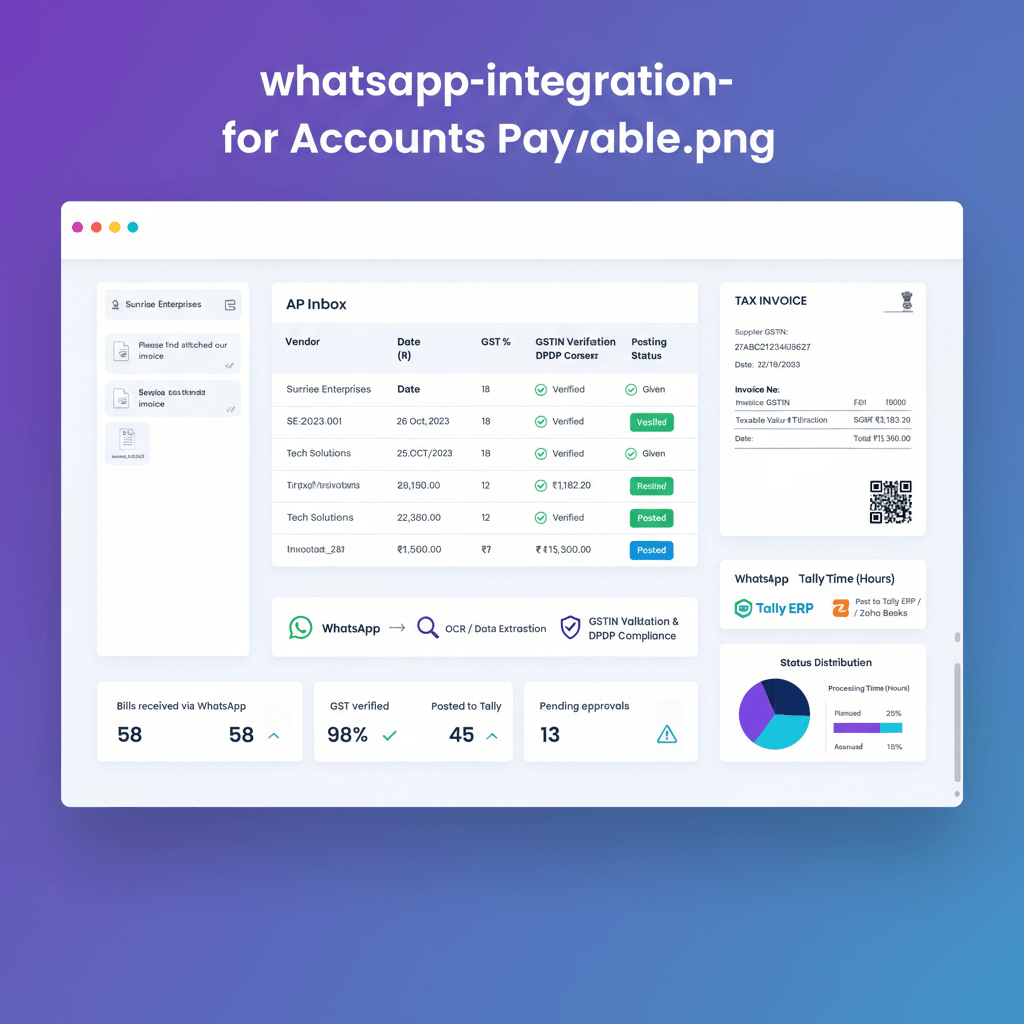
- Automation that reminds vendors via email and WhatsApp, with escalation and tracking, protects cash flow and ITC eligibility.
- Dashboards, collaboration, and secure sync-back to accounting systems make reconciliation continuous, visible, and controlled.
- Security matters, ISO 27001 and SOC 2 Type II should be table stakes for handling sensitive financial data.
Why GSTR 2B Reconciliation Tools Matter More Than Ever
Picture this, it is month end, your Excel file has 50,000 invoice rows, and a single typo torpedoes your ITC claim. GSTR 2B reconciliation tools turn that grind into a predictable, fast, and accurate workflow. They consistently cut reconciliation time from 20-30 hours to minutes, while surfacing credits you might otherwise miss.
Manual reconciliation invites errors, suppliers file late, amendments slip through, and ITC gets blocked. For CA firms managing multiple clients, the compounding risk is real. Automated reconciliation delivers audit-ready claims, faster compliance, and peace of mind, all in a single flow.
Automation is not just speed, it is control, accuracy, and recoverable cash sitting in your GSTR-2B.
Understanding GSTR-2B and Why Reconciliation Is Critical
GSTR-2B is a static monthly statement of available ITC, pulled from suppliers’ filings, then frozen for that period. Because suppliers, dates, values, and invoice formats vary, reconciliation against your purchase register is essential to avoid over-claiming, or leaving money on the table.
Mismatches happen often, invoice numbers differ, dates vary, GSTINs have errors, and credit notes, RCM, and amendments add complexity. Without disciplined reconciliation, legitimate ITC gets delayed or lost, and ineligible credits trigger notices later.
Essential Features Every GSTR 2B Reconciliation Tool Must Have
Data Ingestion Capabilities
Import GSTR-2B in JSON or Excel, load purchase registers, debit or credit notes, and journal vouchers, then auto-map vendor masters. Direct pulls from Zoho Books or Tally reduce manual steps.
Smart Matching Engine to Match Purchase Register
Combine exact and fuzzy logic, match on GSTIN, invoice number, date, value, and tax, apply tolerance for rounding, and detect duplicates. Learning from corrections improves results over time.
Exception Handling to Identify Missing Invoices
Bucket exceptions clearly, in GSTR-2B not in purchase register, in purchase register not in GSTR-2B, partial matches, GSTIN mismatches, and duplicates. Recommended actions accelerate closure.
ITC Claim Optimisation Features
Auto-tag eligibility, flag Section 17(5) restrictions, handle credit notes and RCM transactions properly, manage timing differences, and lock decisions with audit trails.
Vendor Follow Up Automation
One-click reminders via email and WhatsApp, escalation workflows, and status tracking drive on-time supplier filing and protect your ITC.
Monthly Dashboard for Quick Insights
Get matched versus mismatched counts, ITC at risk, vendor compliance trends, and aging to prioritise actions immediately.
Bulk Operations and Team Collaboration
Use bulk edits, tags, and assignments across exception buckets, with role-based access for clean team operations.
Seamless Sync-Back to Accounting Systems
Push reconciled data back to Zoho Books or Tally, export filing-ready reports, and close the loop.
Security and Compliance Standards
Expect ISO 27001, SOC 2 Type II, encryption, audit trails, and multi-org support for CA firms.
How Top GSTR 2B Reconciliation Tools Actually Work
- The tool auto-ingests GSTR-2B and purchase register data from your accounting system.
- It normalises formats, maps to vendor masters, and prepares for matching.
- The engine runs exact matches first, then applies fuzzy logic with tolerance, while flagging duplicates.
- Exception buckets surface missing or mismatched invoices with clear reasons and next steps.
- ITC claim optimisation algorithms recommend the best eligible claim per invoice, and lock decisions for audit.
- Automated vendor follow ups nudge late filers with tracked reminders.
- Dashboards summarise matched items and ITC at risk, then you export or sync back to your accounting system.
The entire loop that once took days now runs in minutes, with clear accountability.
Deep Dive into Critical Capabilities
Advanced Matching to Match Purchase Register
Blend exact and fuzzy rules, handle GSTIN variations and invoice formats, apply paise-level tolerance, and respect amendments. Side-by-side variance views help reviewers decide quickly, while the engine learns from decisions to reduce future review loads.
Smart Bucketing to Identify Missing Invoices
Systematic buckets, in PR not in 2B, in 2B not in PR, partial matches, GSTIN mismatches, and duplicates, come with recommended actions. Multi-period views handle amendments without noise.
Intelligence-Driven ITC Claim Optimisation
Rules classify eligibility, detect Section 17(5) blocks, manage deferred claims, and handle RCM cleanly. Smart optimisation boosts cash flow by maximising eligible ITC, while preparing carry-forwards where appropriate.
Automated Vendor Follow Up Automation
Cadenced communication works, email on day 1, WhatsApp on day 7, with invoice lists embedded. SLA tracking and scorecards identify chronic late filers, while escalation ensures the right people act.
Actionable Monthly Dashboard Insights
Answer the essentials instantly, how much ITC is blocked, which vendors are late consistently, what is the trend month over month. Drill downs meet audit and management needs.
Dashboards convert noise into action, they tell you what to fix, who to chase, and how much cash is at stake.
Comparing Different Tool Categories
- Manual Excel plus GST portal: Free, but slow and error prone, suitable only for tiny volumes.
- Generic reconciliation tools: Decent matching, but weaker purchase register sync and vendor follow up, fine for basics.
- Full stack platforms: End to end automation, matching, ITC logic, dashboards, and ERP sync, they turn reconciliation into a strategic advantage.
Top GSTR 2B Reconciliation Tools in the Market
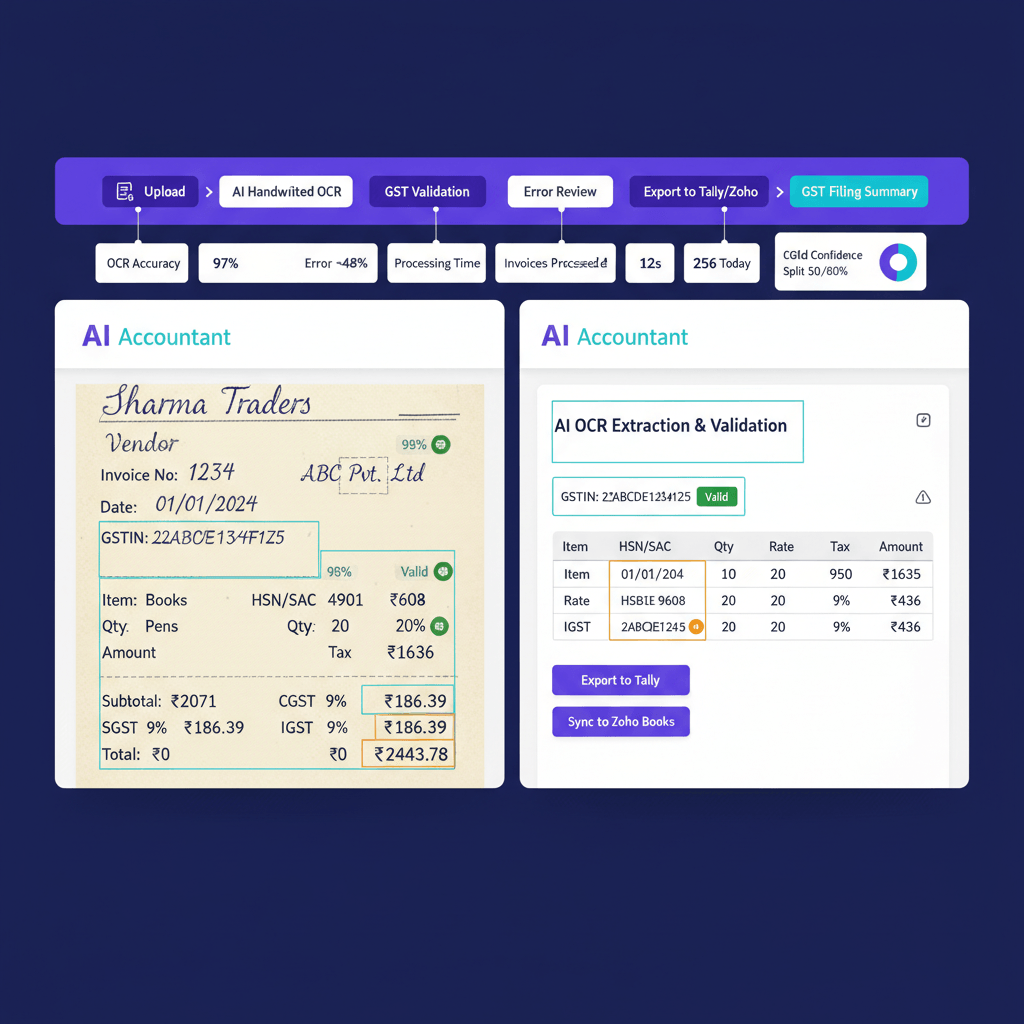
- AI Accountant — Multi-org management for CA firms, deep Zoho Books and Tally integration, 300M+ transactions for 450+ customers including 100+ CA firms, ISO 27001 and SOC 2 Type II.
- Octa GST — Strong supplier communication and detailed exception handling.
- ClearTax — Free basic matching, suitable for small businesses testing automation.
- Vyapar TaxOne — GST compliance suite with reconciliation, good for SMEs on Vyapar.
- RealBooks — Tight integration for users of the RealBooks accounting platform.
- Zoho GST — Native for Zoho Books users, simple interface, fewer advanced controls.
Where AI Accountant Stands Out
AI Accountant syncs directly with Zoho Books and Tally, then matches purchase register entries with high precision. It identifies missing invoices via intelligent buckets, recommends compliant claims through ITC optimisation, automates vendor follow ups, and summarises risk and progress on a monthly dashboard. Beyond GST, it offers AP automation, transaction categorisation, and multi-org support, ideal for CA firms. Security credentials include ISO 27001 and SOC 2 Type II.
Real Results and ROI Impact
Firms processing 50,000 invoices monthly report 80-90% time savings, translating into 20-30 hours saved every month. ITC leakage drops, cash flow improves, and vendor discipline rises. One Mumbai CA firm recovered ₹15 lakhs of missed ITC within three months, while reducing monthly reconciliation from 25 hours to about 3 hours.
Implementation and Change Management
Data Preparation
Gather GSTR-2B JSONs and purchase registers, clean vendor masters, and verify GSTIN mappings.
Setup and Configuration
Define roles and permissions, set tolerance levels, load templates for vendor communications, and configure audit logs.
Training and Testing
Run short training sessions, test on a sample month, validate match rates, and dry-run vendor reminders.
First Month Checklist
Run parallel reconciliation, review buckets, monitor dashboards, and incorporate team feedback for tuning.
Making Your Decision
Choose a platform that scales, secures your data, and supports your workflow, not just a feature checklist. Validate matching accuracy on your real data, assess exception handling clarity, and confirm vendor follow up reliability. The goal is control, accuracy, and faster cash recovery. With the right tool, time saved plus ITC protected pays for the subscription within months.
FAQ
How should a CA firm reconcile GSTR-2B with a large purchase register across multiple GSTINs without rebuilding our Excel models?
Adopt a tool that ingests GSTR-2B JSON and purchase registers for all GSTINs, then runs exact plus fuzzy matching with tolerance controls. AI Accountant, for example, lets you centralise multi-org data, bucket exceptions by GSTIN, and close items in bulk, so you retain control without managing complex spreadsheets.
What is the most reliable approach to handle Section 17(5) ineligible ITC during automated reconciliation?
Use a rules engine that auto-tags ineligible categories, then locks decisions with an audit trail. In AI Accountant, you can configure Section 17(5) mappings, mark items as blocked or deferred, and generate period-wise ITC eligibility reports to support filings and audits.
How do I ensure accurate matching when suppliers change invoice formats, or values differ slightly due to rounding?
Rely on a blended matching engine, exact match first, then fuzzy logic with value and tax tolerances. Enable duplicate detection and side-by-side variance views. AI Accountant applies tolerance bands and learns from reviewer decisions, improving accuracy in subsequent months.
What is the best way to handle credit notes, amendments, and period shifts between GSTR-1 and GSTR-2B?
Choose a tool that maintains multi-period visibility, buckets amendments separately, and recomputes net ITC impact. AI Accountant tracks amendments across periods, nets credit notes against original invoices, and defers timing differences to the correct period automatically.
Can vendor follow ups be automated with audit-friendly proof of communication?
Yes, use templated email and WhatsApp reminders with tracked delivery, escalation, and acknowledgement logs. AI Accountant records every reminder, provides vendor scorecards, and preserves an audit trail that supports your reconciliation stance.
How do I reconcile RCM transactions while keeping eligibility and accounting entries aligned?
Pick a system that recognises RCM line items, applies correct ITC rules, and reconciles against your purchase register and liability recognition. AI Accountant classifies RCM cleanly, ensures visibility in buckets, and preserves audit-ready documentation.
What KPIs should I track monthly to prove reconciliation efficiency to clients and management?
Monitor match rate, ITC at risk, unresolved exceptions aging, top late-filing vendors, and time-to-close. AI Accountant’s dashboard highlights these KPIs, enabling faster prioritisation and measurable improvement month over month.
How secure is client data during reconciliation, and what certifications should I mandate?
Insist on ISO 27001 and SOC 2 Type II, encryption at rest and in transit, role-based access, and complete audit logs. AI Accountant meets these standards, with multi-org segregation for CA firms managing many clients.
Will this integrate with Zoho Books or Tally without manual CSV juggling?
Look for native connectors that pull GSTR-2B and purchase registers automatically, then sync reconciled outcomes back. AI Accountant offers direct integrations with Zoho Books and Tally, plus exports for other ERPs when needed.
What pricing model suits a CA firm managing dozens of SMEs with fluctuating invoice volumes?
Tiered plans based on organisations and transaction volumes work best, with the option to add users as teams scale. AI Accountant provides flexible pricing for CA firms, aligning costs with active clients and monthly throughput.
How quickly can a mid-size CA firm go live without disrupting month-end timelines?
With prepared GSTR-2B files and purchase registers, go live within days. AI Accountant typically completes setup, role mapping, training, and a pilot month in under a week, then moves to business-as-usual for the next cycle.
What proof does the tool provide to defend ITC positions during audits or departmental queries?
Exportable audit trails, decision logs for eligibility, communication records with suppliers, and exception closure notes. AI Accountant consolidates this evidence, so you can substantiate every claim, deferment, or block with confidence.

Rohan Sinha is a fintech and growth leader building aiaccountant.com, focused on simplifying accounting and compliance for Indian businesses through automation. An IIT BHU alumnus, he brings hands-on experience across 0 to 1 product building, growth, and strategy in B2B SaaS and fintech.